A manual cart misses a replenishment run. A line operator waits for parts. A supervisor pulls someone from another station to recover the schedule. By noon, output is behind, quality checks are rushed, and everyone blames labor when the underlying problem is flow.
That's the moment most plants are in when they start looking at material handling automation solutions. Not because automation is trendy, but because manual movement is usually the hidden constraint. Parts arrive late, the wrong container reaches the wrong station, forklift traffic creates delays, and simple transport tasks consume skilled labor that should be doing higher-value work.
Manufacturers can optimize production and services without blowing up the whole facility. The right move usually isn't a giant lights-out project. It's a practical system that fixes the exact transfer, staging, replenishment, or picking problem slowing the plant down right now.
Table of Contents
- Your Manufacturing Bottleneck Is An Automation Opportunity
- What Are Material Handling Automation Solutions
- Key Automation Technologies You Can Implement Now
- Finding Your Fit The Semi-Automated vs Fully Automated Path
- Your Implementation Roadmap From Assessment to Scale
- Maximizing Uptime With Smart Maintenance And Support
- How To Choose Your Ideal Automation Partner
Your Manufacturing Bottleneck Is An Automation Opportunity
The bottleneck you're fighting is probably not where your team says it is. Most plants focus on machine cycle time, operator speed, or staffing. In reality, the recurring pain often sits between processes. Material waits. People walk. Forklifts queue. Work-in-process piles up where no one wants it.
That's why material handling automation solutions matter. They don't just move boxes, totes, pallets, and assemblies. They control timing, sequence, visibility, and consistency across the floor. When movement gets reliable, production gets predictable.
The market shift makes that clear. The global material handling equipment market is projected to reach US$ 424.6 billion by 2033, and the installed forklift base is over 15 million units globally, which points to a massive upgrade cycle from manual handling to semi-automatic and fully automated systems according to this market outlook on material handling equipment.
The signal your floor is already sending
If any of these sound familiar, you've got an automation opening:
- Operators are waiting for parts: The machine isn't the issue. Replenishment is.
- Forklifts are doing precision work: They're strong tools, but they're poor tools for repeatable line-feeding.
- Supervisors are expediting all day: That means your system depends on heroics.
- Quality swings by shift: Inconsistent handling creates inconsistent presentation, sequencing, and damage risk.
Practical rule: Automate the repeatable movement that causes delay first. Don't start with the most glamorous machine in the catalog.
A lot of plants also discover that handling problems and balancing problems are the same problem wearing different clothes. If work arrives unevenly, staffing and cycle time studies won't fix the root cause. That's why line flow and transport design have to be looked at together, especially if you're already reviewing production line balancing strategies.
Stop treating workarounds as normal
Plant managers get used to patching flow issues with extra labor, extra forklifts, and extra inventory near the line. That keeps shipments moving, but it also locks in waste. The better approach is to identify the transfer points where manual handling adds delay, risk, or confusion, then fix those points with the smallest level of automation that gets control back.
That's how you optimize production and services in practice. One bottleneck at a time. With equipment that fits the process instead of forcing the process to fit the equipment.
What Are Material Handling Automation Solutions
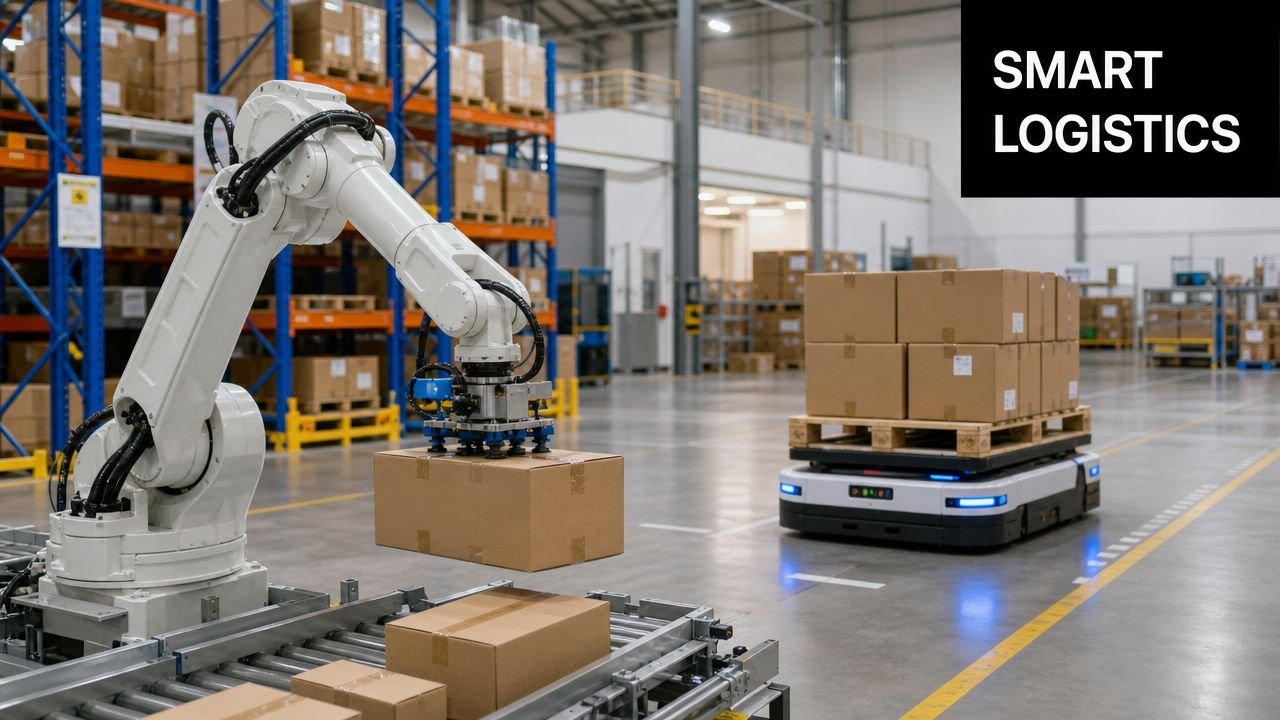
Material handling automation solutions are the systems that move the right material to the right place at the right time with less manual effort and more control. That includes transport, storage, staging, presentation, sorting, and handoff between people and machines.
Think of them as the factory's circulatory system. Machines may do the cutting, welding, assembly, filling, or packaging, but handling systems deliver what those machines need to keep running. If that flow is weak, the whole plant feels it.
What they actually change on the floor
Good handling automation does four things well.
- Reduces walking and lifting: People stop spending time pushing carts, hunting for material, and repositioning loads.
- Standardizes presentation: Parts arrive in the same orientation, container, and sequence every time.
- Improves timing: Stations receive material based on demand instead of guesswork.
- Creates traceable flow: Supervisors can see where material is, where it's waiting, and where it's getting stuck.
That matters in both general manufacturing and regulated production. If you build medical devices or any product with strict process discipline, handling isn't just a labor topic. It affects cleanliness, traceability, segregation, and repeatability.
This isn't only about replacing labor
A lot of bad automation decisions happen because teams define the goal too narrowly. They chase labor reduction and ignore everything else. That's a mistake.
You should care just as much about these outcomes:
| Focus area | What automation improves |
|---|---|
| Safety | Less manual lifting, fewer repetitive transport tasks, reduced forklift exposure in tight areas |
| Quality | Fewer handling mistakes, better part presentation, less damage during movement |
| Flow | More predictable replenishment, cleaner station changeovers, less waiting between processes |
| Management | Easier scheduling, clearer bottleneck visibility, more stable daily output |
The best systems remove friction your operators have learned to tolerate.
That's why the definition shouldn't be limited to AGVs, conveyors, or robots. A semi-automatic lift assist, a guided work cell with smart fixtures, a powered transfer, or a custom station that controls how material enters and exits a process can all be the right answer. If it reduces strain, cuts handling error, and makes output more consistent, it belongs in the conversation.
The smartest plants don't ask, “How automated can we be?” They ask, “Where does manual movement hurt us most, and what's the cleanest fix?”
Key Automation Technologies You Can Implement Now
Most plants don't need a complete rebuild. They need the right toolkit. Start with technologies that match your product, payload, floor space, and process variability.
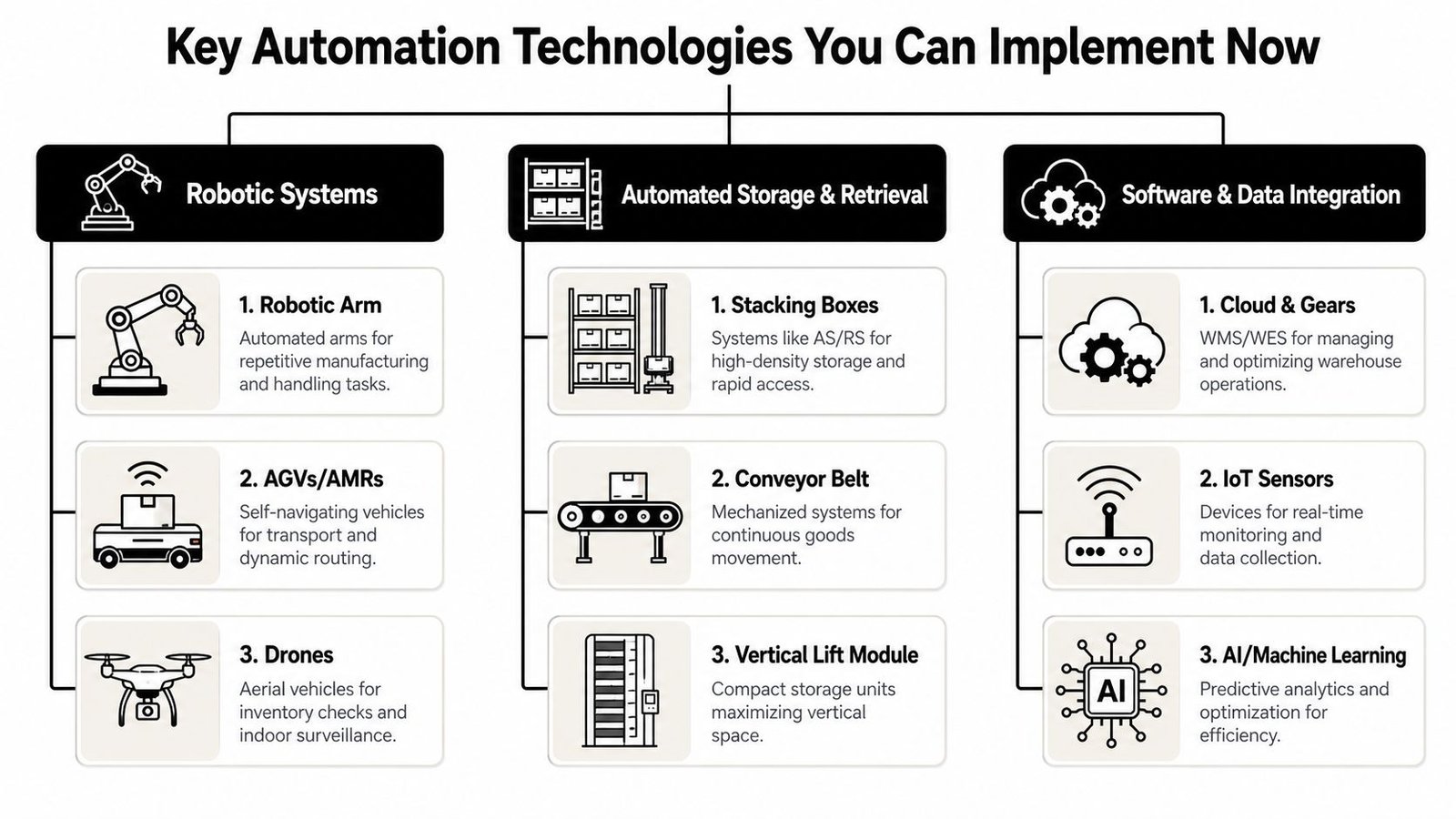
A useful way to think about material handling automation solutions is by function. Some systems move material. Some store it efficiently. Some connect decisions to motion.
Start with the transport layer
Conveyor systems are still the simplest answer for repeatable, fixed-path movement. Use them when products move between known points at steady volume. They're best for packaging lines, inspection transfer, carton movement, and predictable part flow between stations.
AGVs and AMRs are better when routes change, traffic changes, or production mix changes. They act like mobile couriers inside the plant. AGVs usually rely on more fixed guidance logic. AMRs adjust their paths more dynamically, which makes them useful in plants where layouts evolve or aisles serve multiple functions.
Robotic arms handle transfer, loading, unloading, palletizing, and repetitive handoff tasks. They fit best where position and cycle are consistent. If operators spend all day picking, placing, or rotating the same part presentation, a robot may be the cleanest answer.
Custom semi-automatic stations deserve more attention than they get. These are often the highest-value projects because they solve a specific bottleneck without requiring a full-system rewrite. Examples include lift-and-present stations, guided assembly feeds, powered indexing tables, ergonomic loading fixtures, and controlled handoff cells between manual and automatic processes.
If one station causes most of the delay, automate that station first. Don't automate the whole building to avoid fixing one bad interface.
A short walkthrough helps frame the options:
Use storage automation where travel is the waste
If your operators or pickers burn time covering distance, storage automation usually beats adding labor.
AS/RS systems are particularly strong in dense environments with frequent retrieval. Advanced AS/RS can reduce manual travel time by up to 75%, improve picking accuracy to 99.9%, and drive a 30–40% increase in order fulfillment throughput in high-density environments according to this analysis of material handling automation and AS/RS performance.
That makes AS/RS a strong fit for:
- High-SKU operations: When parts are numerous and retrieval discipline matters.
- Space-constrained facilities: When vertical storage is more realistic than expanding footprint.
- Controlled replenishment zones: When line-side inventory needs tighter control.
Tie equipment together with software and controls
Physical hardware is only half the system. A conveyor without logic is just motion. A robot without signals is just a machine waiting for permission.
The coordination layer usually includes:
- WMS or WES tools: For task release, prioritization, and execution flow.
- IoT sensors: For position checks, jam detection, load presence, and system status.
- Integrated controls: For handshakes between stations, safety devices, scanners, and operator interfaces.
Crucial to many projects' success or failure is the following: You don't need the most advanced hardware. You need hardware, controls, and operator workflow that work together on your floor.
Finding Your Fit The Semi-Automated vs Fully Automated Path
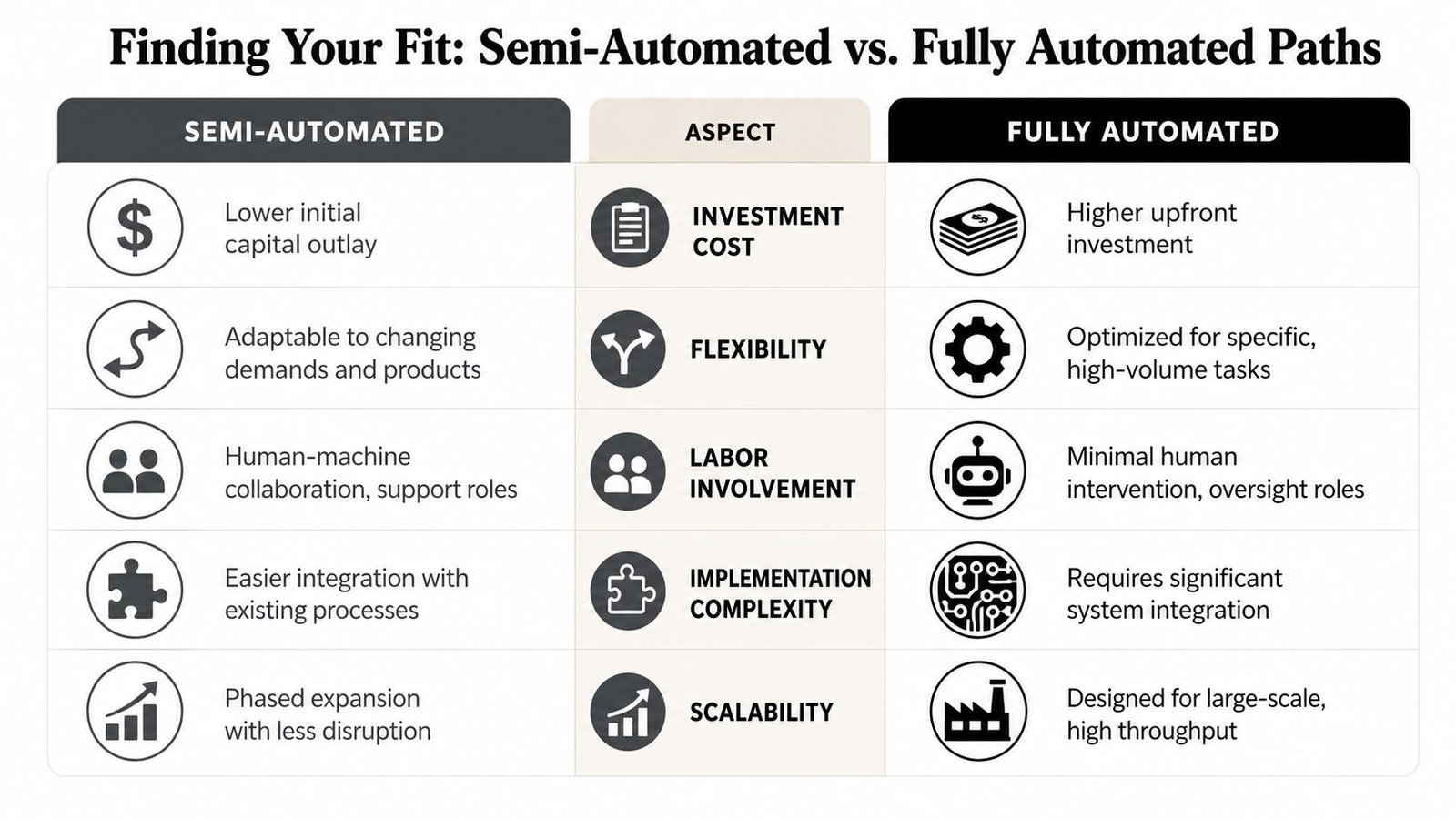
The hype says full automation is the goal. I disagree. For most manufacturers, especially small to mid-sized operations, the better first move is a semi-automated or point solution aimed at the nastiest bottleneck in the plant.
That isn't a compromise. It's usually the financially smarter path.
Why point solutions win more often than people admit
The best evidence is straightforward. 45% of manufacturers achieve optimal ROI by starting with semi-automated point solutions for their most labor-intensive functions, and over-customization can be 35% more expensive with 2x longer payback periods, based on this discussion of right-sized material handling equipment decisions.
That tracks with what experienced plant teams already know. The more custom and all-encompassing the project becomes, the more assumptions it bakes in. If your product mix changes, your staffing model changes, or your schedule changes, a rigid system can turn into an expensive constraint.
For many operations, a semi-automated path is stronger because it lets you:
- Target the pain directly: Fix dock-to-line replenishment, kitting, staging, or repetitive transfer without disturbing stable areas.
- Move faster: Smaller projects are easier to engineer, install, validate, and train around.
- Keep flexibility: Operators can still absorb variation where automation would be too rigid.
- Scale in phases: Once one cell or route proves itself, you can expand with better data.
If you're evaluating options, this overview of semi-automated systems that fit budget and goals is the right mindset. Start with fit, not fantasy.
A practical comparison
| Decision factor | Semi-automated path | Fully automated path |
|---|---|---|
| Capital exposure | Lower initial commitment | Higher upfront spend |
| Speed to value | Faster to deploy in focused areas | Slower because integration scope is larger |
| Flexibility | Better for changing mix and evolving layouts | Better for stable, high-volume, repeatable flows |
| Operational risk | Easier to isolate and correct issues | Broader disruption if assumptions are wrong |
| Expansion | Add modules in phases | Usually requires more front-loaded planning |
Buy the level of automation your process can support today. Leave room to earn the next level.
Full automation absolutely has a place. If your volume is high, routing is stable, product variation is limited, and every manual touch is a recurring liability, a broader system may be justified. But many plants jump there too soon. They automate complexity they haven't even stabilized yet.
A semi-automated solution forces discipline. It makes you define the actual problem, clean up the process around it, and prove value before scaling. That's why it so often produces the best return.
Your Implementation Roadmap From Assessment to Scale
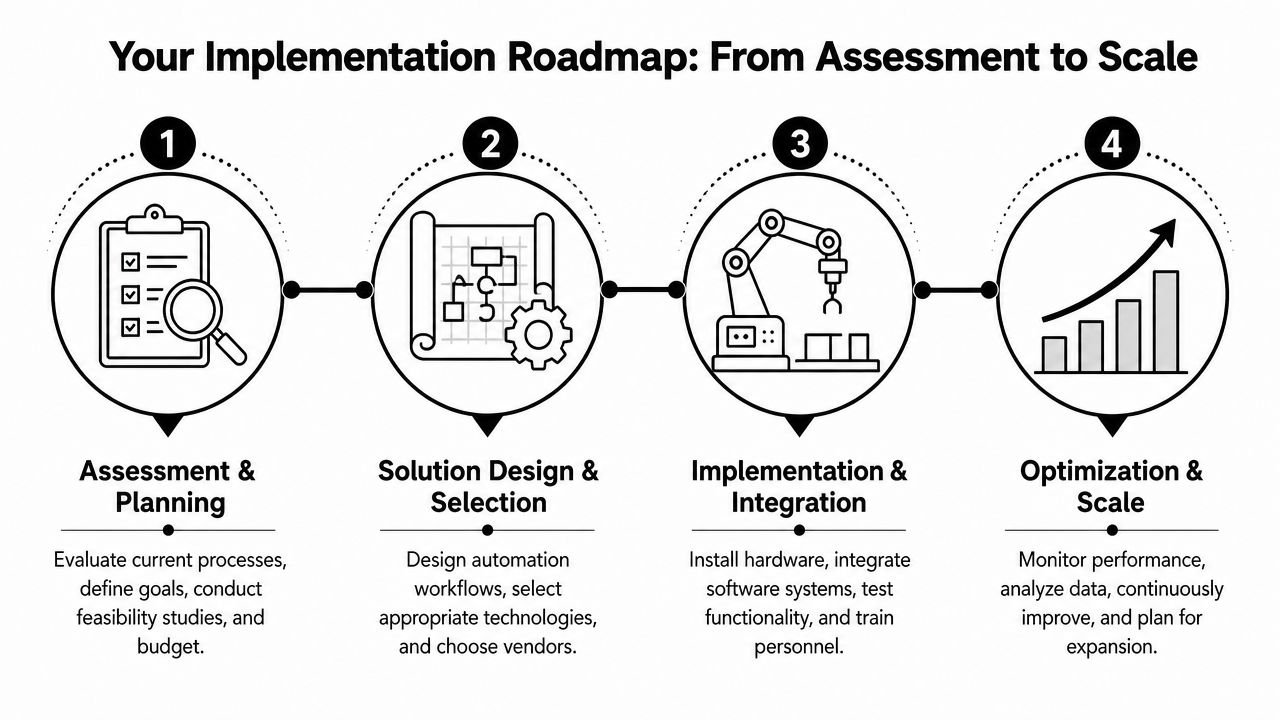
Most automation projects fail before equipment arrives. They fail during definition. The team buys around symptoms, not root causes. The way around that is a phased roadmap with a hard pilot in the middle.
Stage one and two
Assessment and planning starts on the floor, not in a conference room. Watch where material waits, where operators leave stations, where forklifts interrupt flow, and where errors happen during handoff. Define success in operational terms. Less waiting, cleaner replenishment, fewer handling mistakes, better presentation, smoother changeovers.
Then move into solution design and selection. Match technology to payload, path, takt, and variability. If you build in a GMP-aware or medical device environment, design for validation, traceability, cleanability, and controlled process behavior from the start. Retrofitting compliance logic later costs time and creates avoidable headaches.
A quick checklist helps here:
- Map the exact move: What material moves, how often, in what container, and under what constraints?
- Define the handshakes: Which machine, operator, scanner, gate, or sensor must confirm the move?
- Set the pilot boundary: Keep the first implementation narrow enough to evaluate clearly.
- Choose what must remain manual: Not every touch should be automated.
Stage three and four
The pilot is where smart teams separate theory from fact. Deploying AMRs in a pilot phase, often with a minimum fleet of three units, can yield a 15% improvement in overall throughput and demonstrate a 35% gain in labor efficiency before full-scale investment, according to this review of automated material handling system types and AMR pilot performance.
That pilot approach matters because it forces the team to test traffic, routing, operator interaction, charging, exception handling, and integration under real conditions.
- Implementation and integration: Install the hardware, connect controls, test handshakes, and train the people who'll run it.
- Optimization and scale: Review jams, delays, route conflicts, refill timing, and operator workarounds. Then expand only what proves itself.
Start narrow enough to learn quickly, but not so narrow that you avoid real operating conditions.
Plants often rush the pilot because they want the big win faster. Don't. The pilot is the cheap place to find bad assumptions. Once the workflow is stable, scaling gets easier because you're replicating a working model instead of defending a slide deck.
Maximizing Uptime With Smart Maintenance And Support
Buying the system is the easy part. Keeping it productive is where the return gets protected.
That matters even more as these systems become more common. The automated material handling equipment market is projected to grow from USD 52.7 billion in 2026 to USD 101.0 billion by 2036, which makes maintenance and support strategy a core part of operational continuity according to this automated material handling equipment market forecast.
Protect the asset after launch
Reactive maintenance is expensive because it turns a small issue into schedule loss. A worn roller, drifting sensor, weak battery, misaligned stop, or ignored alarm doesn't stay small for long in an automated flow.
You need three things in place from day one:
- Preventive maintenance routines: Scheduled checks on wear points, sensors, safety devices, mobile robot health, and control components.
- Operator ownership: Train crews to recognize misuse, recovery steps, and early warning signs instead of waiting for engineering.
- Responsive support access: When controls fault, routes fail, or transfer timing breaks, someone has to respond fast and competently.
A lot of managers under-budget support because they treat it as optional overhead. It isn't. It's insurance on uptime. If you're planning equipment life beyond installation, build in maintenance and support services as part of the original decision, not as an afterthought.
The plants that get the most from automation don't just install equipment. They maintain standards around it.
How To Choose Your Ideal Automation Partner
Your automation partner should challenge your assumptions, not just quote your wish list. If a vendor agrees with every idea you have in the first meeting, be careful. Good partners ask where the bottleneck starts, what variability exists, what must stay manual, and how the solution will be maintained after launch.
The right partner also understands that material handling automation solutions aren't all-or-nothing decisions. They should be able to recommend a custom fixture, a semi-automatic station, an AMR route, or a larger integrated system based on fit. Not on whatever product they most want to sell.
Questions that expose weak vendors fast
Ask these before you sign anything:
- How do you identify the true bottleneck? If they can't explain their assessment method, they're guessing.
- What level of automation would you avoid in our plant right now? A serious engineer will tell you where not to overbuild.
- How do you handle GMP-aware or regulated requirements? If validation and controlled design come up late, expect pain later.
- What stays flexible if our mix changes? Rigid systems break first when operations evolve.
- What does post-installation support look like? You need a real service model, not vague reassurance.
- Can the system scale in phases? Expansion should come from proven wins, not one giant bet.
Choose the team that solves your current flow problem cleanly and leaves you room to improve again later. That's what right-sized automation looks like.
If you're ready to improve flow without overcommitting to a massive automation project, System Engineering & Automation is worth talking to. SEA builds practical manufacturing solutions that optimize production and services with semi-automatic systems, custom tooling, fixtures, integrated controls, and full engineering support. If your plant needs a smarter first step instead of an oversized promise, SEA can help you define the right level of automation and turn it into a system that delivers real operational value.