A line can look productive all shift and still lose output in places nobody measures closely. A die change takes forty minutes. Small stops interrupt the cycle repeatedly. A batch reaches packing before someone finds rejected parts. By the time the team reviews the day, the lost capacity has blended into overtime, missed schedules, and unexplained variation.
Each loss has a different response. Lean methods remove unnecessary work, fixtures prevent repeatable loading errors, maintenance protects critical assets, and semi-automation makes sense when a task is stable enough to mechanize without sacrificing flexibility. In regulated production, cleaning, validation, traceability, and documented change control must remain part of the design.
This practical list of performance improvement methods connects ten approaches to the decision a small or mid-sized manufacturer needs to make: which loss to remove first, which task to error-proof, and when to invest in equipment. The same logic applies whether you're upgrading one workstation, improving a packaging operation, or developing a GMP-aware medical-device production system.
Table of Contents
- 1. Lean Manufacturing
- 2. Six Sigma DMAIC
- 3. Total Productive Maintenance
- 4. Overall Equipment Effectiveness
- 5. Single-Minute Exchange of Die
- 6. Poka-Yoke Error-Proofing
- 7. 5S Workplace Organization
- 8. Kaizen Continuous Improvement
- 9. Jidoka Autonomation and Automatic Stop
- 10. Theory of Constraints
- Top 10 Performance Improvement Methods Comparison
- Match Each Method to the Loss You Can Measure
1. Lean Manufacturing
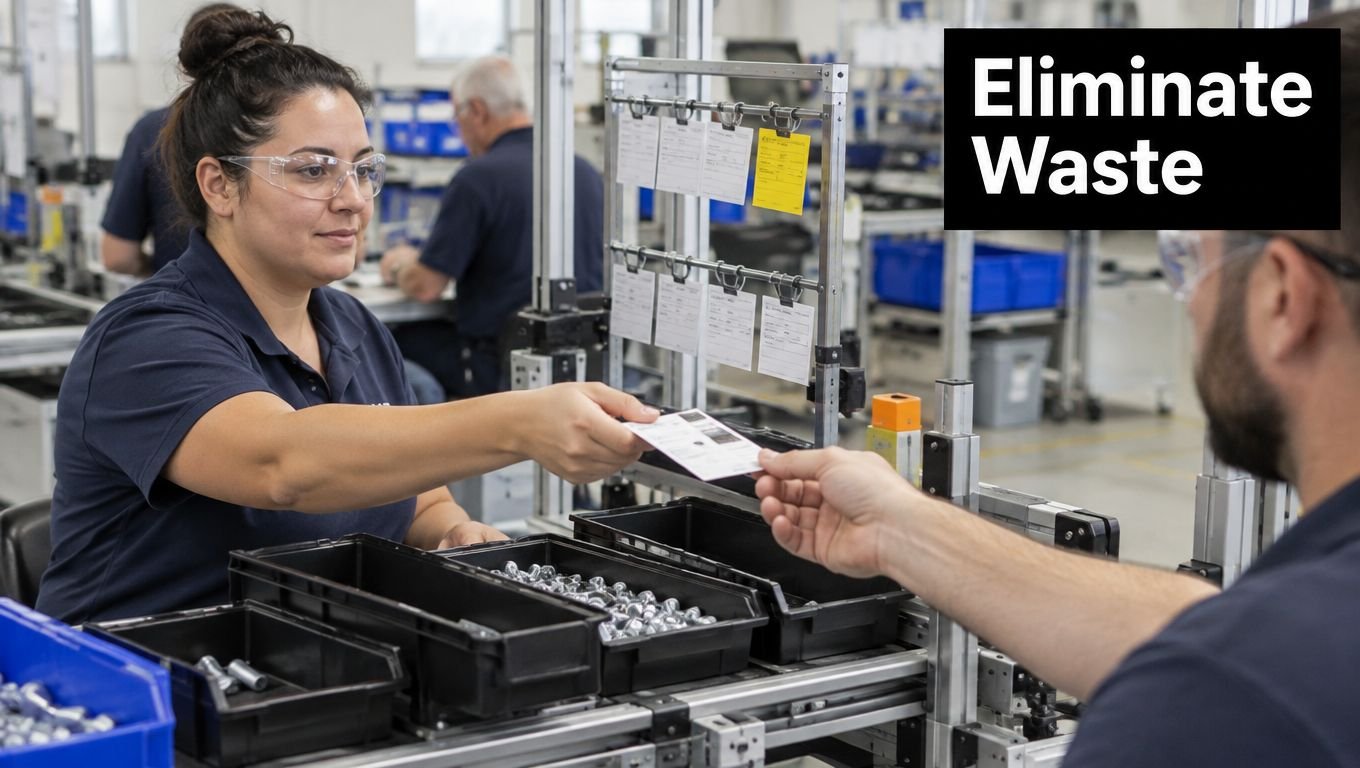
Lean manufacturing answers a basic question: which work consumes resources without increasing customer value? The method focuses on waste such as waiting, excess movement, unnecessary transport, overproduction, excess inventory, defects, and processing steps that the customer doesn't need.
Start with one product family and map the current flow from incoming material to shipment. Don't begin by buying equipment. A value stream map often exposes a queue, duplicated inspection, long material travel, or a workstation that releases work faster than the next process can accept it.
Lean became globally influential through the Toyota Production System and its emphasis on flow, pull scheduling, standardized work, quick changeover, visual management, preventive maintenance, and kaizen. MIT's International Motor Vehicle Program compared production systems internationally from 1985 to 1990 and reported that Japanese manufacturers achieved stronger productivity, shorter product-development time, fewer faulty products, and lower inventories than typical U.S. and European producers. The study and later benchmarking helped establish why disciplined process design must accompany technology investment. The longitudinal manufacturing comparison provides the historical evidence behind that lesson.
Remove waste before automating
Pilot the revised flow in one cell. Track lead time, inventory, first-pass yield, and the time operators spend walking or searching. In a GMP-aware operation, include cleaning access, material segregation, line clearance, and document handling in the flow map.
Practical rule: Don't automate a queue, an unnecessary inspection, or a badly arranged workstation. Stabilize the flow first, then automate the loss that remains.
For a small manufacturer, lean is often the lowest-cost starting point. It gives engineers a clearer specification for tooling, conveyors, controls, or a semi-automatic station, and it reduces the risk of embedding waste in a new system.
2. Six Sigma DMAIC
Six Sigma answers a different question: what source of variation is creating defects, rework, or customer complaints? Its DMAIC structure, Define, Measure, Analyze, Improve, and Control, keeps teams from jumping to a solution before they understand the process.
A project should start with a specific defect or cost-of-poor-quality problem. Before analyzing the process, validate the measurement system. If inspectors, gauges, sensors, or test fixtures produce inconsistent results, the team may optimize measurement noise rather than improve production.
Statistical process control provides the foundation for this type of work. Walter A. Shewhart developed SPC concepts in the 1920s, and W. Edwards Deming later promoted them internationally. The method measures defects, analyzes variation, applies corrective action, and reassesses the process to distinguish normal variation from assignable problems. Deming's work connected lower variation with reduced scrap, rework, inspection effort, and customer complaints. This history of Deming and SPC explains why measurement-driven improvement remains relevant to automated and semi-automated production.
Use DMAIC on equipment decisions
Six Sigma is useful when choosing between fixture concepts, sensor arrangements, tooling materials, or control logic. Compare repeatability, defect modes, operator inputs, and maintenance requirements rather than selecting the fastest concept in isolation.
- Define the failure: State the defect, affected product, process step, and business consequence.
- Measure the baseline: Record first-pass yield, defect categories, cycle conditions, and measurement variation.
- Control the gain: Use a control plan and SPC chart after implementation, including checks for fixture wear and sensor drift.
For a medical-device process, design verification, traceability, and approved change control should be included in the project from the beginning. A technically effective improvement that cannot be documented or validated won't be easy to release.
For practical tools, see this guide to Six Sigma tools and techniques.
3. Total Productive Maintenance
Total Productive Maintenance answers: how do we keep the asset capable of producing good parts when the schedule needs it? TPM moves maintenance away from a repair department that reacts to failures and toward shared equipment ownership. Operators perform basic care, maintenance teams address technical failure modes, and engineering builds maintainability into new equipment.
Begin with one critical machine. Define what operators can inspect, clean, lubricate, tighten, or identify, then make those activities visible through a short checklist. The checklist should support the production process, not become a form that people complete without looking at the equipment.
Track failure modes and mean time between failures to decide where planned maintenance has the greatest value. A recurring pneumatic leak, misaligned guide, worn locating pin, or contaminated sensor may create more disruption than a dramatic breakdown because it causes repeated micro-stops and quality variation.
Design maintenance into the cell
New equipment should provide access to service points, safe isolation, clear fault information, replaceable wear components, and straightforward cleaning. For medical-device or hygienic production, coordinate maintenance with cleaning and validation schedules. Lubricants, materials, tool access, and post-maintenance inspection can affect product risk and release decisions.
Predictive maintenance is most useful where unplanned failure creates substantial throughput, quality, or safety cost. Industry analyses citing U.S. Department of Energy benchmarks report that suitable predictive-maintenance programs can cost less than preventive or reactive approaches, with benchmark reductions in breakdowns, downtime, and maintenance cost. These are not guarantees. Sensor quality, failure-mode coverage, alert accuracy, and the maintenance team's response determine whether the program creates value. The predictive-maintenance benchmark discussion sets out those conditions.
Use condition data only when someone can act on it. A dashboard that identifies degradation without a work-order process is another form of waiting.
4. Overall Equipment Effectiveness
Overall Equipment Effectiveness answers: is the asset losing capacity through downtime, slow running, or defective output? OEE combines availability, performance, and quality. Its value isn't the score alone. Its value is the loss breakdown behind the score.
Define the categories before collecting data. One operator may call a short sensor stop downtime, while another records it as a speed loss. Without common definitions, the report becomes an argument about labels instead of a useful production signal.
Start with manual logging on one shift or one workstation. Record planned production time, stops, actual cycle time, rejected units, changeovers, and recurring fault codes. Once the categories are stable, automated data capture can reduce reporting effort and improve event resolution.
Let the loss choose the investment
A low availability result points toward maintenance, reliability, or changeover work. A performance loss may require material presentation, fixture improvement, controls, or removal of micro-stops. A quality loss may justify poka-yoke, better sensing, or a controlled process change.
McKinsey describes digitally enabled manufacturing methods such as predictive maintenance, remote monitoring, performance-management systems, advanced robotics, and automated guided vehicles as capable of producing efficiency improvements in the range of approximately 15 to 20 percent. Mature deployments of predictive maintenance or remote monitoring have been associated with 30 to 50 percent reductions in total machine downtime, while combined digital performance management, robotics, and automated material movement can improve labor productivity by a further 40 to 50 percent. These figures are deployment benchmarks, not promises. McKinsey's Industry 4.0 analysis stresses the need for staged implementation and baseline measurement.
Review the loss tree weekly with operators present. Management needs the trend, but operators often know which fault code, part variation, or setup decision caused the event.
5. Single-Minute Exchange of Die
SMED answers: which changeover work can happen before the machine stops? The method separates internal work, which requires the machine to be stopped, from external work, which can happen while production continues. The improvement comes from converting internal tasks to external tasks and simplifying what remains.
Film a complete changeover before redesigning it. Time each activity, including searching for tools, waiting for material, removing guards, adjusting stops, verifying settings, and completing production records. The slowest step isn't always the main opportunity. Repeated adjustment and searching often create more total loss than the physical die removal.
For injection molding, stamping, and other high-mix operations, quick-release clamps, locating pins, preset tooling, and staged materials can make setup repeatable. A fixture that loads into one known position is more valuable than a faster clamp if operators still need to measure and adjust the tooling.
Standardize the handoff
Create a changeover checklist with the operators who perform the work. Include the correct die or mold identification, tooling condition, material status, approved settings, first-piece inspection, and line-clearance requirements. In a regulated process, the checklist must align with approved documentation and traceability requirements rather than creating an unofficial production record.
Shorter changeovers can support smaller batches and greater flexibility, but only if the new sequence remains safe and controlled. A rushed setup that increases startup rejects has moved the loss from downtime to quality.
See this practical resource on changeover time reduction before specifying quick-change tooling or controls.
The physical sequence matters, so show it to the team rather than describing it only in a meeting.
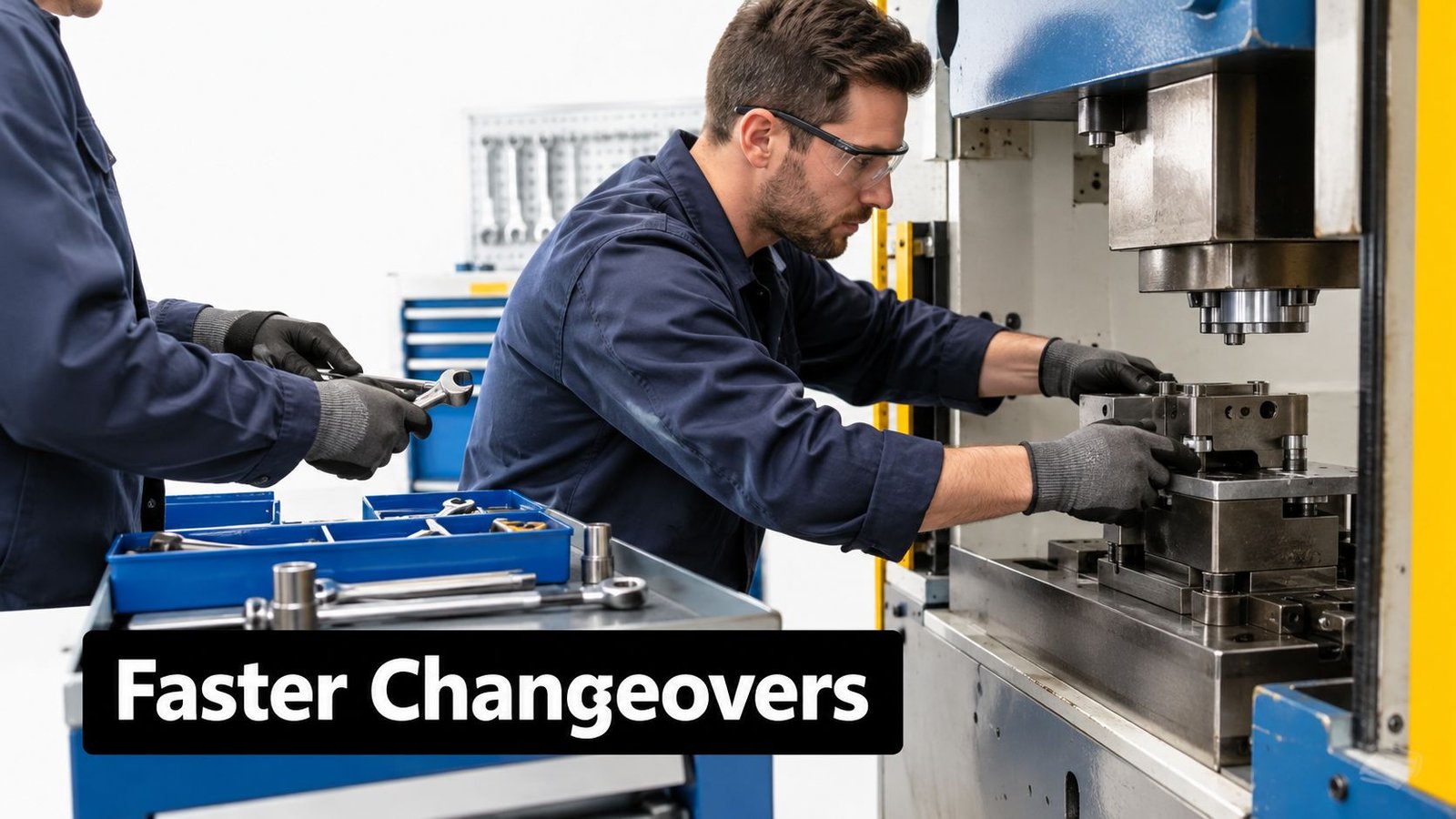
A short demonstration can expose unnecessary motion, unsafe access, and steps that need better visual controls.
6. Poka-Yoke Error-Proofing
Poka-yoke answers: which operator error can we prevent at the source? Instead of relying on final inspection, the process makes an incorrect action impossible or detects it before the part moves downstream.
Start with a known failure mode. If operators load a part backwards, use an asymmetric nest or keyed fixture. If a component can be omitted, use presence sensing and a clear fault message. If two similar materials can be mixed, separate the presentation method and require an identification check before the cycle starts.
The best error-proofing is simple, specific, and difficult to bypass. A sensor that stops production for every minor variation will be defeated or ignored. A sensor that checks the one feature associated with a serious defect can protect quality without creating nuisance interruptions.
Build the control into the fixture
Fixtures should locate the part consistently, expose the inspection feature, and make the correct loading position obvious. For medical-device manufacturing, connector geometry, labeling, packaging, and material identification deserve particular attention. FDA guidance describes controls for incoming packaging and labeling materials, proofreading, separation to prevent mix-ups, checks against the device master record, and formal control of labeling changes. Those requirements make identification checks and controlled material flow practical targets for error-proofing. FDA's labeling requirements guidance provides the relevant framework.
Validate every poka-yoke device during commissioning. Document what it detects, how it fails, how it is challenged, and what happens when it produces a fault. Include the device in the control plan and verify that cleaning, inspection, and maintenance won't defeat its function.
For a focused overview, see poka-yoke manufacturing methods.
7. 5S Workplace Organization
5S answers: can people see the normal condition and find what they need without searching? Sort, set in order, shine, standardize, and sustain are not a housekeeping contest. They create visual control around tools, materials, fixtures, documents, and abnormalities.
Start with one cell. Red-tag items that aren't needed, define locations for the remaining tools, and photograph the arrangement. Shadow boards, floor markings, labeled bins, and standard locations reduce searching and make missing equipment visible at the start of a shift.
A well-organized workstation also supports automation. When tooling, sensors, carts, and documentation have defined locations, engineers can design a cell with clearer material presentation and fewer uncontrolled operator movements. That matters during changeovers and maintenance, when an unmarked item can be mistaken for approved equipment.
Make 5S part of the process
Use a short audit with observable conditions. Check that the correct fixture is present, obsolete materials are removed, cleaning tools are available, documents are current, and walkways or access points remain clear. In a GMP-aware area, include segregation, cleaning status, line clearance, and protection of product-contact surfaces.
5S fails when the team treats it as a one-time cleanup. It also fails when auditors score appearance but ignore whether the arrangement helps the operator perform the work correctly.
A clean station isn't automatically a controlled station. The layout must make the right action easier and the wrong action visible.
Design storage into new workstations instead of adding cabinets after installation. That approach protects access, preserves ergonomic reach, and reduces the temptation to place materials on equipment or beside the process.
8. Kaizen Continuous Improvement
Kaizen answers: what small change can the people doing the work test now? Frontline operators see awkward reaches, unreliable stops, difficult loading, and confusing paperwork long before those issues appear in a monthly report.
A useful kaizen event starts with a defined problem and a measurable target. The team may redesign a locating aid, reposition a material rack, simplify a verification step, or remove a recurring adjustment. Operators should help design the change because they understand the actual work sequence and the exceptions that a drawing may miss.
Use PDCA, plan, do, check, and act, to test the idea before making it permanent. A temporary fixture or revised work instruction can show whether the change improves cycle consistency without introducing new defects or cleaning problems.
Close the feedback loop
Track suggestions, decisions, implementation, and results. If people submit ideas and never see action, participation declines. If every suggestion is approved without measurement, the plant accumulates local improvements that may complicate the overall flow.
Kaizen is especially effective for small and mid-sized manufacturers because it doesn't require a large capital project for every improvement. It can also prepare a process for automation by stabilizing the work sequence, clarifying operator decisions, and identifying which steps are repetitive.
For regulated production, document the point at which a trial becomes a controlled process change. A low-cost improvement still needs appropriate review if it affects product characteristics, validated parameters, cleaning, inspection, or traceability.
9. Jidoka Autonomation and Automatic Stop
Jidoka answers: when should the process stop instead of passing a defect forward? The principle combines automatic abnormality detection with human judgment. A machine can perform a repeatable operation, detect a fault, and stop while an operator or technician investigates.
This is a strong fit for semi-automated cells. The machine handles the precise, repetitive step. The operator loads components, responds to meaningful faults, performs judgment-based checks, and manages variation the equipment shouldn't be forced to solve.
An automatic stop is worthwhile when the downstream cost of a defect is high, when the defect could create a safety concern, or when continuing the cycle would damage equipment. It isn't worthwhile when every harmless fluctuation creates an alarm and stops the line.
Make alarms actionable
Each fault should identify the condition, the likely cause, and the permitted response. An alarm that says “cycle fault” forces the operator to search. A message that identifies a missing part, failed presence check, or pressure condition gives the operator a controlled next action.
Use andon lights, stop buttons, interlocks, torque verification, presence sensors, or vision checks where they match the failure mode. Review stop logs weekly. Repeated stops indicate a root cause that may require better part presentation, fixture design, maintenance, or supplier control.
FDA requirements make this principle particularly relevant to medical-device automation. The QMSR became effective on February 2, 2026, amended 21 CFR Part 820, and incorporated ISO 13485:2016 by reference. It covers methods, facilities, and controls used in design, manufacturing, packaging, labeling, storage, installation, and servicing. The FDA overview of device regulation explains why a faster cycle must also support documented and controlled quality processes.
10. Theory of Constraints
The Theory of Constraints answers: which process step limits total output right now? A busy machine isn't automatically the constraint. The constraint is the step that prevents the rest of the system from producing more.
Map cycle times, queue sizes, downtime, changeovers, and material starvation across the line. Then identify the station that consistently controls throughput. A sterilization step, inspection operation, slow manual assembly, or constrained test asset may be the limit even when another machine appears to run constantly.
The five focusing steps are straightforward: identify the constraint, exploit it, subordinate other work to it, raise its capacity, and repeat. Exploiting means getting more from existing capacity before buying equipment. That may involve reducing changeover loss, protecting the station from starvation, scheduling maintenance outside the critical window, or removing unnecessary work from the operator.
Automate the constraint first
A semi-automated fixture, quick-change tool, material feeder, or controlled workstation can deliver more value at the constraint than a faster machine elsewhere. Protect the investment with a buffer that prevents starvation, but avoid creating uncontrolled work-in-progress that hides quality problems.
After each improvement, repeat the analysis. The bottleneck will move. A project that improves the former constraint but leaves the next limiting step unmanaged won't deliver the expected system result.
For medical-device production, include validation, traceability, cleaning, inspection, and release capacity in the constraint map. FDA's QMSR and ISO 13485 alignment emphasize consistent production of safe, effective, and compliant devices, so the fastest station cannot be evaluated separately from the controls that authorize product release. The FDA's QMSR frequently asked questions explains the relationship between the framework and consistent device production.
Top 10 Performance Improvement Methods Comparison
| Method | Complexity 🔄 | Resource requirements ⚡ | Expected outcomes ⭐📊 | Ideal use cases | Quick tips 💡 |
|---|---|---|---|---|---|
| Lean Manufacturing | Moderate 🔄🔄, process mapping & culture change | Low–Medium ⚡⚡, mainly staff time | ⭐⭐⭐⭐, lower cost, shorter lead times, quality gains | Operations/plant managers cutting waste and lead time | Start with value-stream map; pilot a product family; track lead time & inventory turns |
| Six Sigma (DMAIC) | High 🔄🔄🔄, structured DMAIC & statistical tools | High ⚡⚡⚡, training, data systems, belt experts | ⭐⭐⭐⭐, measurable defect and variation reduction | Quality leaders in regulated or high‑reliability environments | Validate measurement systems (Gage R&R); tie projects to cost of poor quality |
| Total Productive Maintenance (TPM) | Moderate 🔄🔄, cross‑functional routines & training | Medium ⚡⚡, operator involvement and maintenance planning | ⭐⭐⭐, reduced downtime, longer equipment life, safety improvements | Plant managers focused on uptime and asset protection | Begin autonomous maintenance on a critical machine; document MTBF and failure modes |
| Overall Equipment Effectiveness (OEE) | Low–Moderate 🔄🔄, metric definitions and data capture | Low–Medium ⚡⚡, manual logs or basic automation | ⭐⭐⭐, diagnostic visibility; prioritizes loss categories | Ops managers needing objective equipment performance data | Define loss categories clearly; start manual logging before automating |
| SMED (Single‑Minute Exchange of Die) | Moderate 🔄🔄, setup analysis and fixture design | Low–Medium ⚡⚡, quick‑change tooling, staging materials | ⭐⭐⭐, drastically reduced changeover times; more flexibility | High‑mix manufacturers with frequent changeovers | Video changeovers; design quick‑release fixtures; pre‑stage tools and checklists |
| Poka‑Yoke (Error‑Proofing) | Low 🔄, fixture/sensor design and validation | Low ⚡, simple fixtures or sensors | ⭐⭐⭐, immediate error prevention; less rework | Assembly and medical device operations where human error drives defects | Fix most frequent errors first; use keyed fixtures and presence sensors; validate devices |
| 5S Workplace Organization | Low 🔄, discipline and visual standards | Low ⚡, time for audits and minimal materials | ⭐⭐, cleaner, safer, and faster search times; visible abnormalities | Teams starting continuous improvement; small manufacturers | Use red‑tag sorts, shadow boards, floor markings; schedule weekly audits |
| Kaizen (Continuous Improvement) | Low–Moderate 🔄🔄, frequent PDCA cycles and events | Low ⚡, staff time and small budgets | ⭐⭐⭐, cumulative gains; improved engagement and problem‑solving | Organizations building continuous improvement culture on limited budget | Set measurable targets for events; involve frontline staff; track suggestions completion |
| Jidoka (Autonomation) | Moderate 🔄🔄, sensors, controls, and stop procedures | Medium ⚡⚡, control logic, alarms, operator authority | ⭐⭐⭐, prevents defects downstream; improves safety and oversight | Semi‑automated lines needing defect containment and quick response | Auto‑stop where defects are costly/unsafe; keep alarms specific and actionable |
| Theory of Constraints (TOC) | Moderate 🔄🔄, bottleneck analysis and scheduling | Low–Medium ⚡⚡, analysis effort and buffer management | ⭐⭐⭐, increased throughput by addressing the true constraint | Ops deciding where to invest for maximum throughput gain | Map cycle times and WIP to find the constraint; protect it with a buffer; re‑evaluate after improvements |
Match Each Method to the Loss You Can Measure
Performance improvement methods work best when each one has a defined loss to attack. Lean is appropriate when the process contains waiting, excess movement, duplicated work, or poor flow. 5S fits a workstation where people search for tools, materials, or documents. SMED fits a machine that loses capacity during repeated changeovers.
Use Six Sigma when the process produces variation and the team needs evidence about root cause. Use poka-yoke when a known human error can be blocked through fixture geometry, sensing, or controlled sequencing. Use TPM when equipment condition, recurring failures, or weak maintenance ownership limits output. Use Jidoka when the process must stop before an abnormal condition becomes a defect or safety issue.
OEE helps separate these losses, but it shouldn't become a target that operators chase without understanding. Start with one line and log availability, performance, quality, stops, changeovers, and rejected units for a week. The purpose is to identify the largest measurable loss, not to create a polished dashboard.
Choose the smallest effective intervention
If the largest loss is unnecessary motion, rearrange the cell before installing robotics. If a task is stable but repetitive, consider a fixture, sensor, or semi-automatic mechanism. If the task changes frequently, preserves operator judgment, or involves variable product presentation, semi-automation may outperform full automation by retaining flexibility and knowledge transfer.
Manufacturers also need to consider workforce and adoption constraints. Deloitte reports that 46% of large manufacturers ranked process automation among their top two investment priorities, while 48% reported moderate-to-significant difficulty filling production and operations-management roles and 46% reported similar difficulty filling planning and scheduling roles. The same research reported automation use at 37% in 2025 and active implementation at 22%, showing that adoption is incomplete rather than universal. Deloitte's 2025 smart manufacturing survey supports a staged approach instead of assuming full automation is always the answer.
For medical-device operations, the equipment concept must also support design controls, verification, documented responsibility, traceability, cleaning, and validation. FDA guidance describes design and development controls that require controlled specifications, documented plans and responsibilities, and verification that outputs meet inputs. FDA's discussion of design controls is a useful reference when tooling or equipment changes could affect product characteristics.
Start by logging one line's OEE and changeover time for a week, then select the single method aimed at the largest measured loss. Fix the process with lean, 5S, or SMED first. Apply poka-yoke or semi-automation where the data shows repeatable errors, unstable manual work, or avoidable labor dependency. When a fixtured or semi-automated solution is appropriate, System Engineering & Automation can assess the right level of equipment against your budget, production goals, and GMP requirements.
System Engineering & Automation provides custom tooling, fixtures, semi-automatic systems, integrated controls, and broader automation solutions for manufacturers improving quality, throughput, and consistency. Visit System Engineering & Automation to discuss a measured production loss and identify a practical equipment concept that preserves flexibility while supporting GMP-aware implementation.