Systems engineering is an interdisciplinary, lifecycle-wide approach that aligns stakeholder needs, design, technical management, operations, and retirement. Its value for manufacturers is practical: it connects manual or semi-automated production steps before mismatched equipment, unclear requirements, and quality problems become expensive rework.
A plant manager usually feels the problem before anyone calls it systems engineering. A new inspection station is ready, but its data format doesn't match the existing production system. Operators still record a critical step on paper because the controls engineer never received the quality team's acceptance criteria. A conveyor moves parts efficiently, yet a fixture introduces variation that appears only during final inspection. Each department has completed its task, but the production system still doesn't work as one system.
That gap is where systems engineering earns its place. It gives manufacturing teams a disciplined way to connect people, equipment, software, processes, requirements, risks, and lifecycle decisions. The approach doesn't require a small or mid-sized manufacturer to copy the full process stack used on an aerospace program. It does require the team to define what success means, understand how components interact, and verify that the finished line performs in actual operating conditions.
Table of Contents
- Why Disconnected Processes Cost Manufacturers Real Money
- The Core Definition and Lifecycle of Systems Engineering
- How Systems Engineering Differs from Project Management and Integration
- Measurable Benefits for Manufacturing and Medical Device Production
- Practical Tools and Deliverables You Will Actually Use
- Real-World Use Cases in Semi-Automated Production Lines
- A Pragmatic Roadmap for Adoption and ROI
- How System Engineering & Automation Supports Your Implementation
Why Disconnected Processes Cost Manufacturers Real Money
A mid-sized manufacturer may begin with a reasonable improvement request: reduce manual handling at an assembly station, add automated inspection, or connect a new feeder to an existing press. The mechanical team selects a workable layout. Controls engineers configure sensors and motion. Production adjusts staffing. Quality writes a final inspection procedure. Procurement sources components from different vendors.
The trouble starts at the handoffs. The feeder presents parts at a height the operator can't comfortably reach. The vision system detects defects but doesn't preserve the image or result needed for quality review. The new controller communicates with the machine, but not with the plant's reporting system. Operators create workarounds, maintenance adds bypasses, and supervisors accept small delays because stopping the line feels worse than tolerating them.
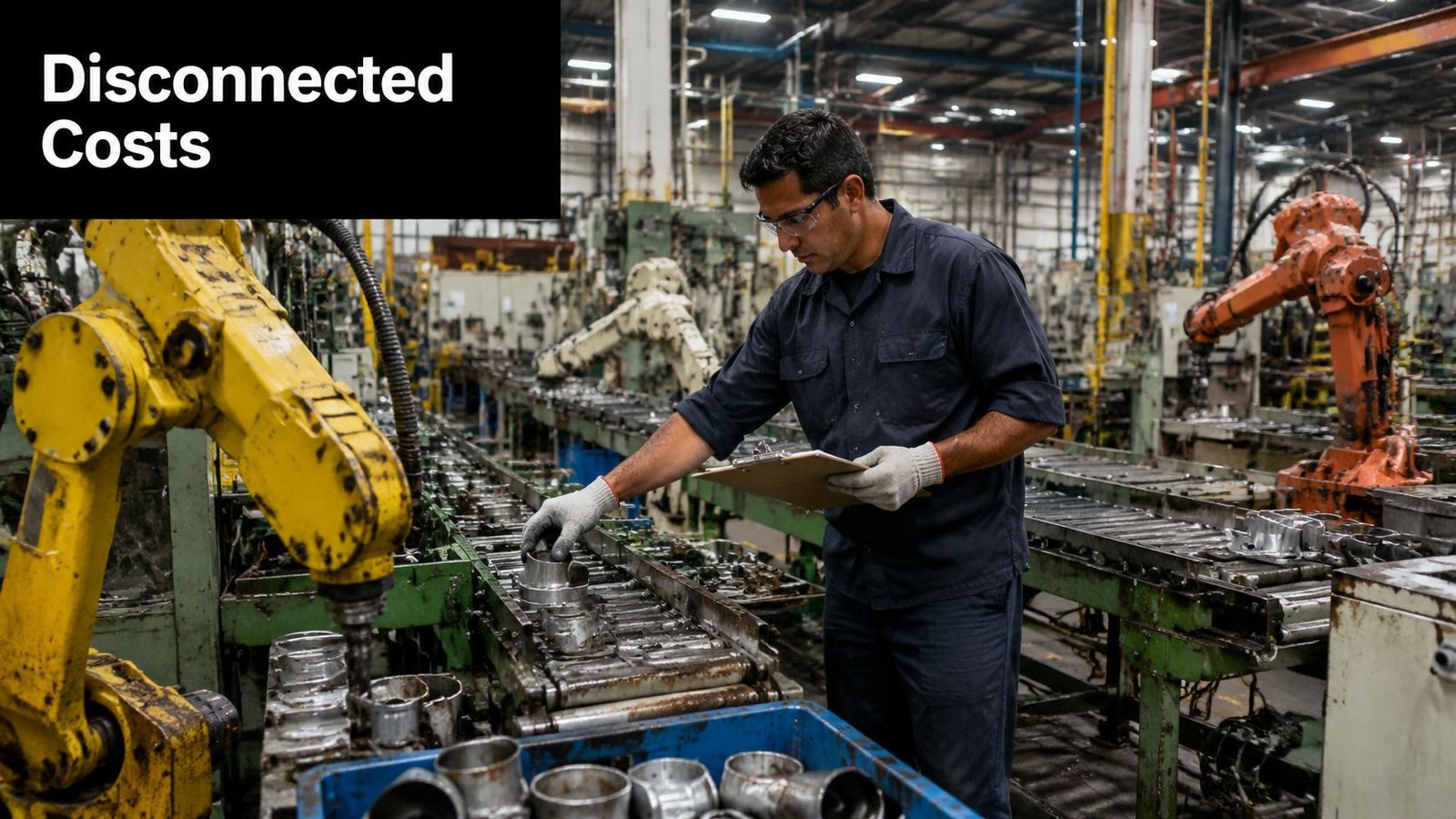
The cost hides in the interfaces
Disconnected processes create several forms of loss at once:
- Lost labor capacity: Operators wait for parts, repeat checks, enter the same information in multiple places, or compensate for unreliable tooling.
- Material waste: A process may discover an error only after additional assembly, packaging, or testing has already occurred.
- Rework and troubleshooting: Engineers spend time diagnosing interactions between equipment that each appeared to work correctly in isolation.
- Quality exposure: Incomplete records, unclear acceptance criteria, and uncontrolled software changes make investigations harder, particularly in regulated production.
- Missed throughput targets: A fast machine doesn't improve the line if upstream feeding, downstream inspection, changeover, or operator interaction becomes the constraint.
Systems engineering addresses the complete arrangement rather than optimizing one workstation in isolation. The practitioner asks what the operator must accomplish, what the product requires, how the equipment exchanges information, what happens when a sensor fails, and how technicians will maintain the line after commissioning.
Practical rule: A production upgrade isn't complete when the machine runs. It's complete when the people, interfaces, controls, quality records, maintenance routines, and operating conditions work together predictably.
This is why the discipline matters beyond design. It prevents a manufacturer from approving a local improvement that creates a downstream bottleneck. It also creates a shared technical basis for production, engineering, quality, and suppliers, so disagreements surface while changes are still affordable.
The Core Definition and Lifecycle of Systems Engineering
Systems engineering is an interdisciplinary approach for realizing successful systems by identifying stakeholder needs, documenting requirements, creating an architecture, synthesizing a design, validating the result, and managing performance throughout the life cycle. The International Council on Systems Engineering history of the discipline traces the field's roots to Bell Telephone Laboratories in the early 1940s, with the first attempt to teach systems engineering as understood today at MIT in 1950.
NASA describes systems engineering as a methodical, disciplined approach covering design, realization, technical management, operations, and retirement. That definition is useful on a factory floor because it includes the work that happens after the equipment is designed. Installation, operator training, verification, maintenance, upgrades, decommissioning, and lessons learned all belong to the system's lifecycle.
Use the V-model as a working mental model
The V-model helps teams connect decisions made early with evidence collected later:
- Define stakeholder needs: Capture what production, quality, maintenance, safety, management, and end users need from the system.
- Develop system requirements: Convert those needs into testable statements about functions, performance, interfaces, safety, records, and operating conditions.
- Create the architecture: Decide how mechanical equipment, electrical controls, software, tooling, sensors, operators, and information systems fit together.
- Develop and integrate components: Build or procure the parts, then combine them in controlled increments.
- Verify and validate: Verify that each requirement has been met, then validate that the complete system solves the production problem in its intended environment.
- Manage the lifecycle: Monitor performance, control changes, maintain the equipment, and plan retirement.
The model isn't a one-way staircase. NASA's systems engineering handbook describes repeated application of systems engineering processes through development, verification, validation, operation, maintenance, and closeout. A production line may return to requirements after a pilot reveals an operator burden, then revise the architecture and repeat integration testing.
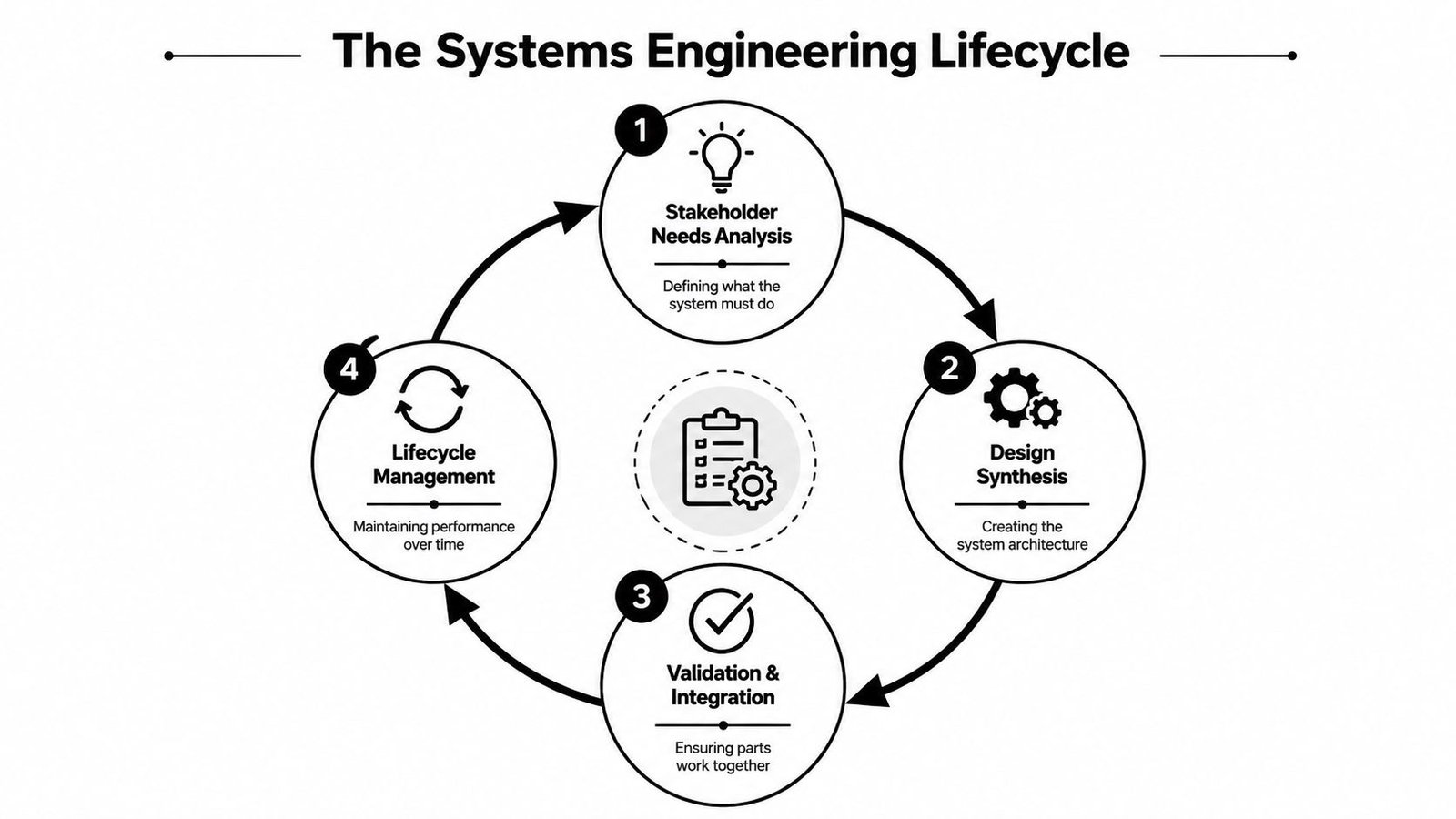
That recursive quality prevents scope creep from becoming invisible. A requirement has an owner, a design response, and a verification method. If the team can't explain how it will prove a requirement, the requirement may be too vague, or the design may be incomplete. For manufacturers exploring digital methods, model-based systems engineering can connect requirements, architecture, interfaces, and analysis in a more usable model rather than leaving every relationship in disconnected documents.
How Systems Engineering Differs from Project Management and Integration
Manufacturers often assign a project manager and an automation integrator, then assume the technical problem is covered. Those roles are important, but they answer different questions. Project management controls delivery, while systems engineering controls the technical coherence of the system. Systems integration connects components, while systems engineering defines what those components must accomplish and how the complete lifecycle will be governed.
| Discipline | Primary Focus | Key Deliverables | Lifecycle Scope |
|---|---|---|---|
| Systems engineering | Stakeholder needs, requirements, architecture, interfaces, risk, verification, and lifecycle performance | Requirements baseline, architecture, interface definitions, verification plan, risk controls, change records | Concept through operation, maintenance, and retirement |
| Project management | Scope, resources, schedule, cost, communication, and delivery coordination | Project plan, schedule, budget tracking, action log, status reporting | Project execution and closeout |
| Product engineering | Designing a product or equipment component to meet defined technical needs | Component design, drawings, calculations, specifications, prototypes | Product development and sustaining engineering |
| Systems integration | Connecting and commissioning hardware, software, controls, and subsystems | Integration procedures, configuration, commissioning records, issue resolution | Build, integration, and startup |
Choose the discipline based on the problem
If the line has a clear design and needs a qualified team to connect a robot, conveyor, and controller, integration may be the immediate need. If the project is late because suppliers, operators, and engineers disagree about what the system must do, project management may restore coordination. If the team can't agree on requirements, interfaces, acceptance tests, or ownership of technical risks, systems engineering is the missing function.
A project manager can report that a machine is on schedule. That doesn't prove the machine will achieve the required takt, produce reliable quality records, or remain maintainable. An integrator can make two devices communicate. That doesn't prove the selected interface supports future product variants or controlled change.
The useful question isn't “Who owns automation?” It's “Who is accountable for the complete technical outcome over the equipment's working life?”
For a small manufacturer, one experienced engineer may perform several of these roles. The labels matter less than the responsibilities. Someone must own the requirements, preserve traceability, challenge local optimization, coordinate technical decisions, and make sure verification reflects real production use.
Measurable Benefits for Manufacturing and Medical Device Production
Systems engineering doesn't create productivity by itself. It creates the decision structure that lets automation, tooling, controls, and quality practices produce their intended result. Evidence on automation shows why that structure deserves attention. An OECD review of robot adoption found positive productivity impacts, while a 30-country study reported that, in most countries, robots' average contribution to productivity growth from 1975 through 2019 didn't exceed 0.2 percentage points per year.
That finding is a useful warning for plant managers. Buying a robot isn't the same as improving a production system. The gain depends on feeding, fixturing, programming, changeover, operator interaction, maintenance, quality controls, and how the work is reorganized around the equipment.
What the firm-level evidence means
A firm-level study of Thai manufacturing found that automation adopters had, on average, 23% higher total factor productivity than non-adopters, with 81% higher labor productivity, as reported in the Bank of Thailand PIER discussion paper. Those figures don't promise the same result for every plant. They do show why manufacturers should evaluate automation as a system-level change rather than as an isolated equipment purchase.
The practical measurement set should include:
- Throughput: Finished good output under normal operating conditions.
- Quality: Defects, rework, inspection escapes, and the evidence available for investigations.
- Labor use: Manual touches, walking, handling, and dependency on scarce specialized operators.
- Availability: Downtime causes, recovery time, and maintenance access.
- Flexibility: Product variants, tooling changes, and the effort required to adapt the process.
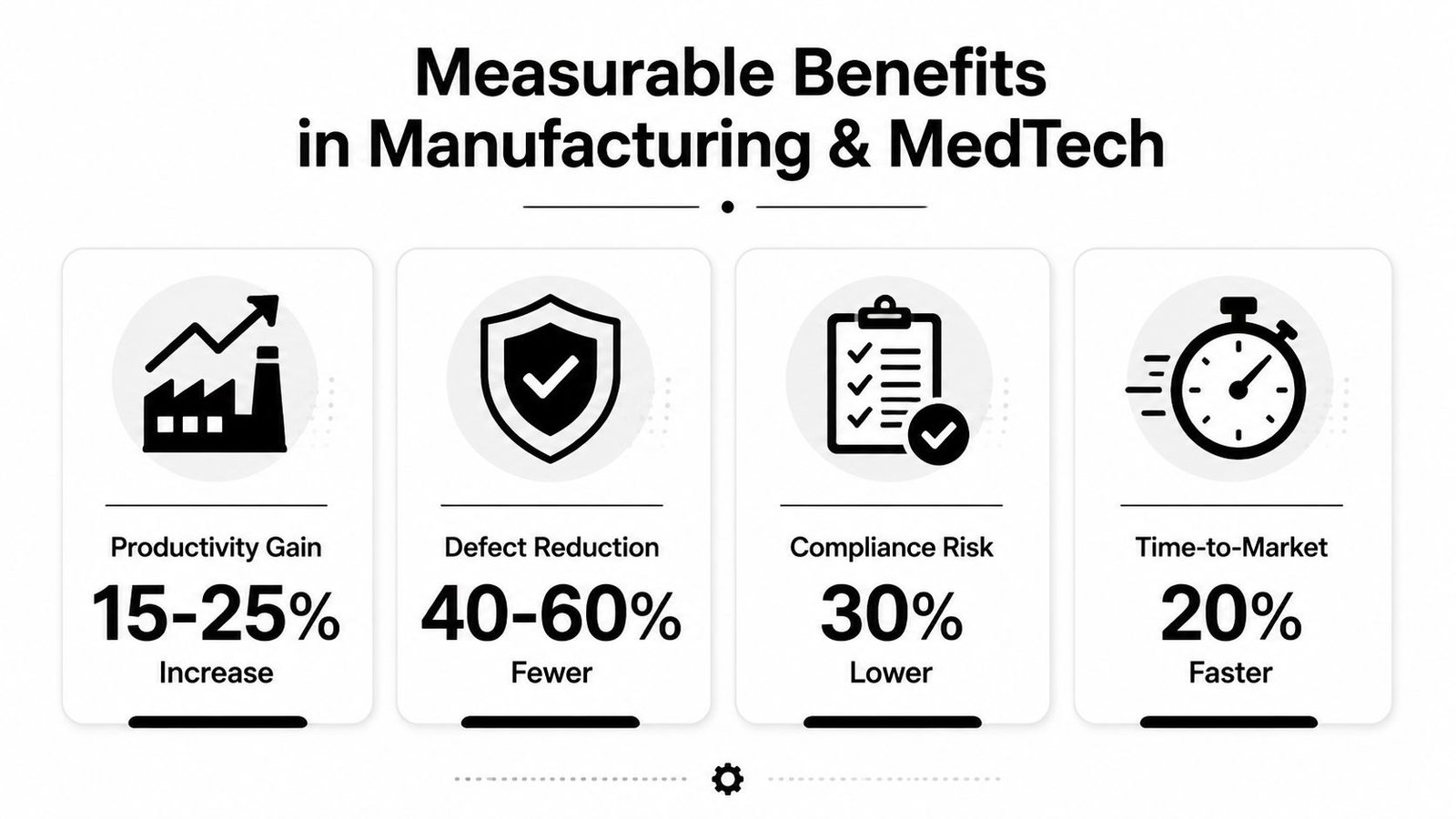
Medical device manufacturers face an added control obligation. The FDA guidance on computer software assurance says automated data processing systems used in production or a quality management system should be controlled using a risk-based approach. That makes requirements, intended use, data integrity, access, change control, and verification part of the automation design conversation, not paperwork added at the end.
Manufacturers can use an automation ROI calculator to structure the financial discussion, but the calculation should include quality, maintenance, flexibility, and implementation risk. A workforce survey cited in the Manpower discussion of engineering skills reported that 40% of respondents identified systems knowledge as the leading engineering workforce challenge, and 40% said academia doesn't cultivate these skills adequately. The shortage reinforces the value of a partner that can translate production needs into a controlled technical plan.
Practical Tools and Deliverables You Will Actually Use
A small or mid-sized manufacturer doesn't need a library of documents that nobody consults. It needs a compact set of artifacts that answer practical questions: What must the system do? How do the subsystems connect? What could fail? How will the team prove the line works?
Start with traceability, not paperwork volume
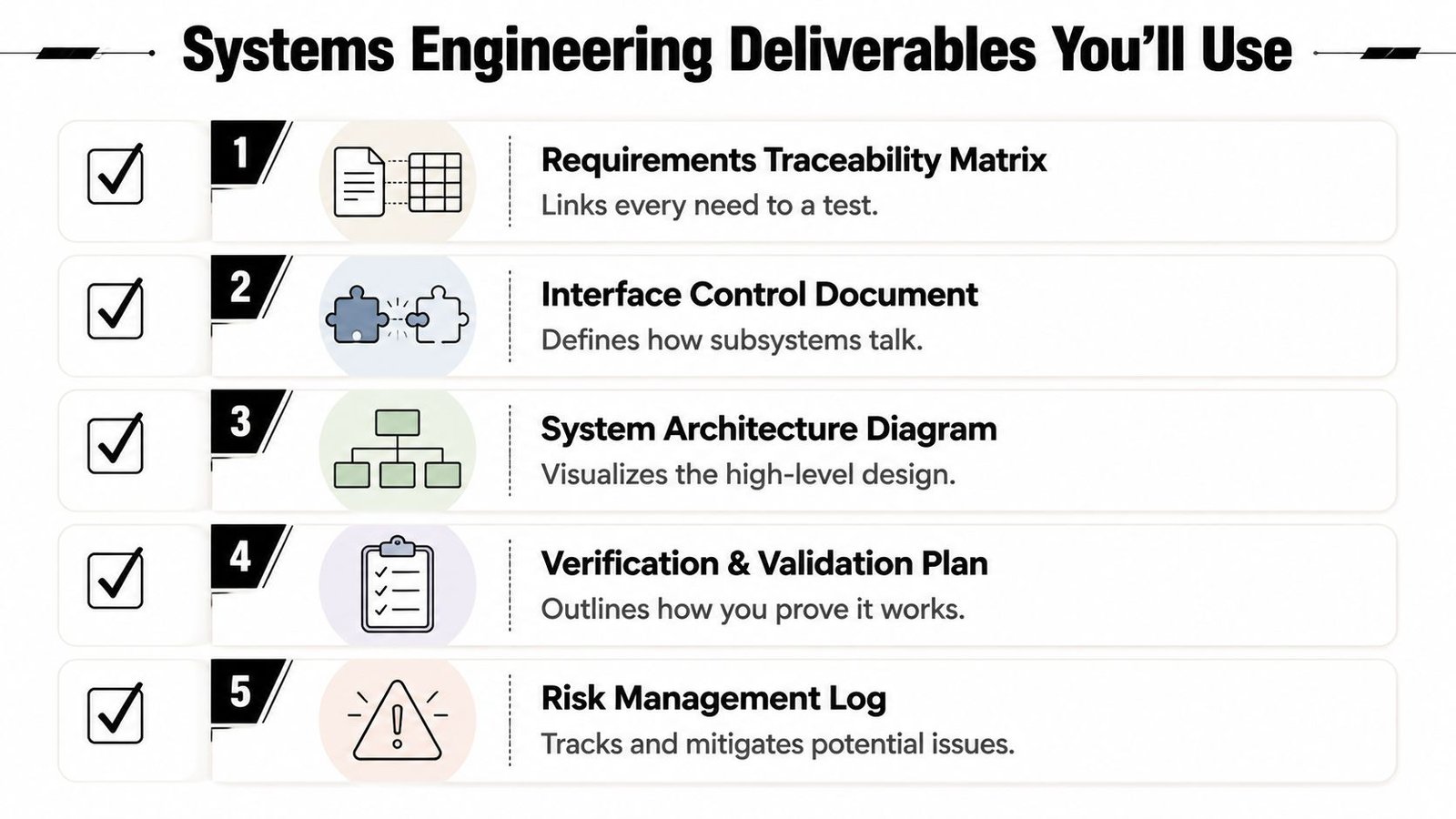
A requirements traceability matrix links each stakeholder need to a system requirement, design element, test, and result. For a semi-automated assembly station, one row might connect a required part orientation to a fixture feature, a sensor condition, a control response, and an inspection step. The matrix exposes gaps early. A requirement without a test is difficult to defend, while a test with no requirement may be unnecessary work.
An interface control document defines the boundaries between subsystems. It can cover mechanical mounting, electrical signals, network communication, data fields, timing, safety states, and responsibilities between suppliers. A focused interface control documentation approach is particularly useful when a plant combines existing equipment with new tooling or controls.
The remaining deliverables should stay proportionate to the risk:
- System architecture diagram: Show operators, fixtures, sensors, controllers, robots, conveyors, inspection devices, databases, and external systems in one view.
- Verification and validation plan: State how the team will test requirements, integrate subsystems, and confirm the process works for its intended production use.
- Risk management log: Record hazards, failure modes, detection methods, owners, mitigations, and residual risk.
- Configuration record: Identify approved software, recipes, drawings, electrical files, tooling revisions, and critical component versions.
Match the method to the consequence
A low-risk fixture upgrade may need a short requirements list, an interface sketch, a risk review, and an acceptance checklist. A medical device production system may need a more formal, risk-based package that supports quality-system procedures and audit questions. The mistake is treating every project identically, either by skipping controls on a consequential change or by burying a modest improvement under heavyweight documentation.
Good artifacts remain live during design, build, commissioning, and maintenance. If a sensor changes, the responsible engineer should be able to identify affected requirements, tests, wiring, software behavior, training, and service documentation without reconstructing the project from email threads.
Real-World Use Cases in Semi-Automated Production Lines
Consider a manual assembly station where an operator positions a component, tightens a fastener, performs a visual check, and moves the product to the next operation. The first automation proposal might replace the operator with a robot. A systems engineering approach starts with a different question: which parts of the task cause variation, injury risk, delay, or poor traceability?
A practical solution may retain the operator while adding a guided fixture, smart tooling, torque feedback, part-presence sensing, and a simple pass or fail sequence. The operator still handles product variation and replenishment, while the tooling controls the critical assembly conditions. The design team verifies the tool, sensor, controller, operator interface, and quality record as one workflow.
Three patterns that work on real lines
Smart tooling for repeatable manual work is effective when the work is variable but certain steps must be controlled. A fixture can prevent incorrect orientation, while integrated controls prevent the next cycle until the required condition is met. This often preserves flexibility better than a fully automated cell designed around a narrow product configuration.
Inline sensing for early quality feedback makes sense when a defect can be detected close to its source. Sensors, vision systems, force measurement, or dimensional checks can feed a local decision and a production record. The systems engineer must define what happens when the sensor is unavailable, uncertain, or out of calibration. Otherwise, the plant may create a faster way to generate unreliable data.
Scalable semi-automation suits manufacturers that expect product changes, constrained capital, or uncertain volume. A table-top station, stand-alone tester, custom fixture, or pick-and-place module can solve the immediate bottleneck while preserving a path toward additional automation. The architecture should reserve the right interfaces and physical space without paying for unused complexity.
For medical device production, the system also needs a clear relationship between automated decisions and the quality process. The FDA's risk-based software assurance guidance is relevant when software supports production or quality management workflows, so the team should define intended use, data handling, access, change control, and verification before commissioning.
SEA's role in this kind of work is to combine mechanical, electrical, and controls engineering with custom automation, integrated controls, robotics, pick-and-place units, bowl feeders, conveyors, tooling, and fixtures. The outcome isn't automatically a fully autonomous line. It may be a safer workstation, fewer manual handoffs, clearer quality evidence, or a modular platform that reduces labor dependency while retaining operator judgment.
A Pragmatic Roadmap for Adoption and ROI
Small and mid-sized manufacturers should resist two bad starting points. The first is buying equipment before defining the production problem. The second is building an aerospace-style governance system for a modest fixture or workstation change. A better approach applies the control that the risk and complexity require.
Begin with the constraint
Walk the process with operators, maintenance, quality, and production supervisors. Record where parts wait, where people repeat work, where defects are first detected, which tasks require unusual skill, and which failure stops the line. Don't rely only on an average shift view. Observe changeovers, material replenishment, startup, recovery, cleaning, and abnormal conditions.
Select a pilot with a visible constraint and a bounded technical scope. Establish a baseline for throughput, labor touches, defects, downtime, changeover effort, and maintenance burden before modifying the process. Without a baseline, the team can argue about benefits but can't distinguish an actual improvement from a favorable production week.
Design the pilot for learning
The pilot should test more than whether equipment cycles. It should answer whether operators can use it, whether maintenance can recover it, whether quality can review the evidence, and whether the interface works with surrounding equipment. Build a verification plan around requirements and a risk review around credible failure modes.
Use these checkpoints:
- Problem checkpoint: Confirm that the selected bottleneck is important enough to justify intervention.
- Technical checkpoint: Demonstrate subsystem behavior, interfaces, safety functions, and representative materials.
- Production checkpoint: Run the process with normal operators, product variation, replenishment, and planned interruptions.
- Financial checkpoint: Compare the measured result with the agreed business case, including implementation, training, service, tooling, and future change costs.
- Scale checkpoint: Decide whether to replicate, modify, pause, or retire the concept before expanding it.
Keep the architecture open enough to evolve
Over-automation can lock a plant into expensive maintenance and narrow product assumptions. Under-engineering can leave operators with unreliable equipment and no useful records. The right level depends on product variation, risk, volume, workforce capability, regulatory obligations, and the cost of downtime.
A phased plan also addresses the skills gap. Train internal staff on requirements, change control, troubleshooting, and basic data interpretation, while using an experienced engineering partner for architecture, integration, and commissioning. That combination builds capability without pretending that every plant needs to develop every specialist function internally.
How System Engineering & Automation Supports Your Implementation
A small manufacturer may need a reliable fixture, better operator guidance, or controls that connect existing equipment. It may not need the full aerospace-style systems engineering process stack. Systems engineering still provides a practical structure for defining requirements, controlling interfaces, testing the result, and managing changes.
System Engineering & Automation applies that approach to semi-automated systems, custom tooling, fixtures, integrated controls, and fully automated or manual equipment. The work can cover consultation and preliminary concepts, design, manufacturing drawings, material sourcing, installation, and commissioning.
The company brings 30+ years of engineering experience, GMP-aware practices for appropriate production environments, a one-year guarantee, and ongoing maintenance support. Keeping design, build, startup, operator use, and service connected helps expose problems before they become production interruptions.
For a plant manager, the decision is practical: select automation that matches the production goal, budget, product variation, and available skills. A capable partner should control risky interfaces and verify safety, quality, flexibility, and labor impact under actual operating conditions.
System Engineering & Automation provides consultation, custom tooling, semi-automated and automated equipment, integrated controls, installation, commissioning, and maintenance support. Manufacturers facing manual bottlenecks, inconsistent quality, or a difficult equipment upgrade can discuss a practical systems engineering path.