A production line can run smoothly while the plant's information remains badly disconnected. Machines complete cycles, operators record batch details on paper, quality staff re-enter results into another system, and planners compare an ERP schedule with output that may already have changed. The equipment works, but the operation still depends on manual reconciliation.
That's the practical starting point for understanding what systems integration is in manufacturing. It's not a matter of connecting machines to software. It's a governed way to connect equipment, controls, manufacturing applications, and business systems so people can act on reliable information at the right time. For small and mid-sized manufacturers, the most effective approach often isn't full digital transformation. A phased, semi-automated integration can target the bottleneck that is costing the plant time, quality, traceability, or labor without forcing every system to change at once.
Table of Contents
- The Real Cost of Disconnected Manufacturing Systems
- Understanding the Layers of Systems Integration
- Measurable Benefits of Integrated Manufacturing Operations
- A Practical Integration Process for Manufacturers
- Common Integration Challenges and How to Mitigate Them
- Real-World Integration Scenarios for Manufacturers
- How SEA Delivers Tailored Systems Integration Solutions
The Real Cost of Disconnected Manufacturing Systems
A common shop-floor pattern looks harmless at first. A filling machine records its own operating information, the operator writes production details into a batch record, quality personnel transfer test results into a separate system, and the planner later updates the ERP based on what production says happened. None of those tasks is difficult by itself. Together, they create delays, duplicate work, and opportunities for conflicting records.
The plant may not notice the problem during a routine run. It becomes visible when a batch needs review, a material lot must be traced, or a schedule changes during the shift. Quality staff search through paper records, spreadsheets, machine screens, and laboratory results. Production supervisors wait for a complete picture before adjusting labor or priorities. The line keeps moving, but decision-making slows down.
Where the hidden losses appear
Disconnected systems create operational costs that don't always appear as a line item:
- Duplicate data entry: Operators and quality staff record the same information more than once.
- Delayed release decisions: Reviewers spend time reconciling records instead of evaluating the process.
- Reactive quality checks: Teams discover abnormal conditions after production has moved on.
- Schedule disconnects: ERP plans don't reflect actual cycle times, scrap, downtime, or labor use.
- Weak accountability: When data changes between systems, it becomes difficult to identify where an error occurred.
These problems also affect the plant's broader technology economics. A useful way to examine them is through total cost of ownership for manufacturing systems, including implementation effort, support, training, downtime, rework, and the cost of keeping workarounds alive.
Practical rule: If a supervisor needs three screens, a paper log, and a conversation with quality to understand the current state of a job, the plant has a data-flow problem, not just a reporting problem.
Integration changes how the plant operates
Systems integration connects the operational workflow, not merely the applications. A sensor value can support a quality decision. A PLC can provide verified cycle information to an MES. An MES can return actual output and quality status to ERP. A LIMS result can become part of a controlled release process rather than a separate record that someone must manually interpret.
ISA-95 and IEC 62264 formalize the interface between enterprise business systems and control systems around Levels 3 and 4 of the Purdue hierarchy. The standards establish common terminology, information models, and electronic exchange definitions for data moving between MES or MOM and ERP, which helps reduce ambiguity and integration risk when production information must support business planning. The ISA-95 standard provides the formal reference point for that structure.
The important question isn't, “Can these systems exchange data?” It's, “Who owns the data, which decisions depend on it, and what controls keep it trustworthy?” A plant that connects every available endpoint without governance can create more duplicate records and more fragile interfaces. A plant that integrates one critical workflow with clear ownership can improve daily execution without undertaking an oversized technology program.
Understanding the Layers of Systems Integration
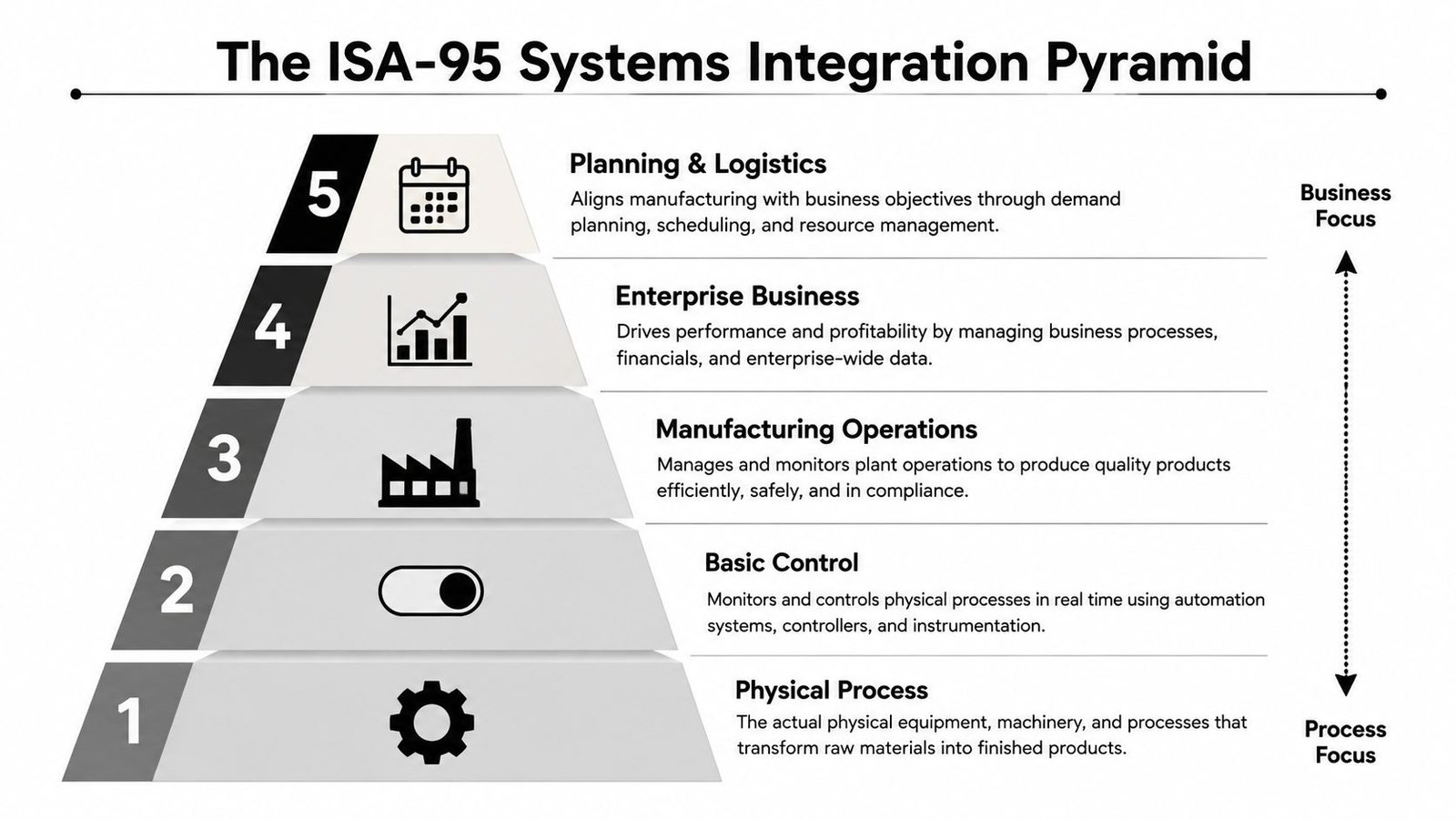
A useful mental model starts with the Purdue hierarchy and the ISA-95 relationship between production operations and enterprise planning. Each layer has a different job. Integration works when the plant preserves those responsibilities while defining the information exchanged between them.
Physical process and basic control
At the equipment level, integration begins with sensors, actuators, drives, tooling, and machines. A temperature probe, presence sensor, pressure switch, or torque transducer produces information about the physical process. An actuator, valve, motor, or robotic device responds to control logic.
The next layer is basic control. PLCs, safety systems, HMIs, and industrial networks coordinate machine behavior. For example, a PLC may capture the cycle-complete signal from an assembly station, monitor a tool's torque result, and stop the process when a required condition isn't met. An HMI gives operators access to status, alarms, recipes, and controlled adjustments.
This layer should remain dependable even if a higher-level business application is unavailable. A production machine still needs safe, predictable local control. Sending every control decision to an ERP system is a poor architecture because business systems aren't designed to provide deterministic machine control.
Manufacturing operations and enterprise business
Manufacturing operations sit above direct control. MES or MOM applications can manage work instructions, electronic records, production dispatching, genealogy, quality checks, and performance information. A PLC sending verified cycle times and machine states to MES is a practical example. The MES can associate those events with a work order, product, operator, equipment asset, or material lot.
LIMS serves a different purpose. It manages laboratory samples, test methods, results, review, and approval workflows. Connecting LIMS with MES can link laboratory evidence to a specific production event or batch. Connecting MES and ERP can align operational execution with orders, materials, routing, and inventory.
At the enterprise layer, ERP supports planning, purchasing, inventory, costing, customer orders, and broader resource coordination. ERP may send a work order, bill of materials, routing instructions, or scheduling window to MES. MES then returns actual quantities, cycle times, scrap counts, labor actuals, and quality outcomes. This is an enterprise-to-operations loop, not a one-way data dump.
Planning and logistics
The top layer connects manufacturing information to demand, supply, and logistics decisions. Planners need production status that reflects reality, not just the last manually entered update. Inventory teams need trustworthy material consumption. Management needs to understand whether a schedule is achievable based on current constraints.
The architecture should also define what doesn't cross a boundary. Raw high-frequency machine data may belong in an industrial data platform, while a summarized event belongs in MES. A detailed laboratory result may remain in LIMS, while its approved status is shared with MES and ERP.
For plants assessing their current maturity, hardware and software integration is best viewed as a layered design exercise. Start by identifying the decision each layer supports, then define the minimum reliable information needed by the next layer.
Measurable Benefits of Integrated Manufacturing Operations
The strongest business case for integration comes from a specific operational chain. A work order enters the execution system, production performs the work, equipment and operators provide actual results, quality records the evidence, and the enterprise system receives a trustworthy completion status. Each handoff removes a question that someone would otherwise answer manually.
Integrating MES, LIMS, and ERP is associated with end-to-end traceability, real-time data exchange, resource optimization, improved throughput, fewer quality-related deviations, faster batch release, and stronger regulatory compliance, as described in the analysis of MES, LIMS, and ERP integration. The value depends on implementation quality. A badly governed interface can move bad data faster.
Follow the bidirectional loop
ERP and MES integration works as a two-way exchange:
| Direction | Typical information | Operational purpose |
|---|---|---|
| ERP to MES | Work orders, BOMs, routing instructions, scheduling windows | Give production a controlled execution context |
| MES to ERP | Actual quantities, cycle times, scrap counts, labor actuals, quality outcomes | Keep planning, inventory, costing, and supply coordination aligned |
This loop improves visibility because planners can compare the intended job with what occurred. It also gives production a clearer basis for managing materials and priorities. Scrap information can support corrective action, while labor actuals can expose a workstation that needs better tooling or a different automation strategy.
Traceability and compliance
For GMP-aware manufacturing, the benefit isn't merely faster access to information. It's the ability to show which material, process, equipment state, instruction, test result, and approval contributed to a released product. Integrated records can reduce manual transcription and create a more consistent audit trail, provided the plant controls user access, change management, review, and electronic records appropriately.
Integration also supports earlier intervention. A machine event or quality result can trigger an alert before the issue becomes a completed batch problem. That doesn't replace operator judgment or quality oversight. It gives both groups better evidence while the process is still active.
A business case should therefore measure more than labor hours. Track the time spent reconciling records, waiting for status, investigating discrepancies, reviewing batch documentation, correcting inventory, and responding to unplanned equipment conditions. The automation ROI calculator can help structure that assessment around the specific process being considered.
A Practical Integration Process for Manufacturers
A workable integration project begins with the operation, not the software catalogue. Plants often know that information is missing, but they haven't separated a genuine bottleneck from a general desire for modernization. The first task is to identify where unreliable or delayed information changes a production decision.
Assess the process before selecting an interface
Walk the value stream with operators, maintenance, quality, engineering, planning, and IT. Document the physical steps, the records created, the systems used, and the points where people re-enter or reinterpret data.
Look for a narrow first target, such as:
- A recurring reconciliation task: The same production status is maintained in paper, a spreadsheet, and ERP.
- A release bottleneck: Quality cannot complete review until equipment or laboratory information is collected.
- A visibility gap: Supervisors learn about downtime or scrap only after the shift ends.
- A legacy connection problem: An older machine has useful signals but no modern application interface.
Define the decision that integration should improve. “Connect the line” is too vague. “Give quality an approved batch status tied to the correct production event” is testable.
Design the information model
The design phase should establish ownership, naming, units, timestamps, states, and exception handling. Decide which system is authoritative for each object. A work order may originate in ERP, execution status may belong to MES, and test results may remain controlled in LIMS.
Standardized object models and exchange profiles are preferable to a collection of point-to-point custom mappings. IEC 62264-2:2026 specifies interrelated information models for content exchanged between manufacturing control functions and enterprise functions, while related ISA and IEC guidance recognizes common operations-management events and integration profiles. The IEC publication on manufacturing and enterprise information models is a useful technical reference for this approach.
Implement in a controlled slice
A phased project might connect one workstation, one product family, or one quality event before expanding. Semi-automation can be the right answer when a process needs reliable data capture but still requires operator judgment, flexible handling, or manual inspection.
Build the interface, configure equipment signals, map the required objects, and test failure states. A system that works only when every network, device, and application is available isn't ready for the floor. Define what operators do during a communication outage and how the system reconciles records afterward.
Validate and commission
GMP-aware environments need documented requirements, risk assessment, traceability, testing, approval, training, and change control. Validation should focus on the intended use and critical data flows, not on producing paperwork disconnected from risk.
Commissioning also includes the practical work that determines adoption. Confirm that screens make sense to operators, that alarms are actionable, that maintenance can diagnose faults, and that quality can review records without building a parallel spreadsheet.
Commissioning test: Disconnect the upstream system, interrupt a sensor, create an out-of-sequence operation, and test a rejected result. Integration is credible only when its failure behavior is understood.
Common Integration Challenges and How to Mitigate Them
The assumption that integration means end-to-end automation causes unnecessary risk. Small and mid-sized plants often have mixed equipment, limited internal IT resources, tight capital budgets, and processes that still depend on experienced operators. A practical architecture must respect those constraints.
Legacy equipment is a design condition
Older machines may not expose modern interfaces, but they often provide usable signals through PLC tags, discrete I/O, serial communications, or an added sensor package. Retrofitting a controlled gateway or smart tooling can be more sensible than replacing a productive asset.
The trade-off is data richness. A retrofit may provide cycle complete, fault state, count, and selected process values, but not every internal machine variable. That can still be enough to improve production visibility or traceability if the plant defines the intended use carefully.
Cybersecurity and uptime need equal attention
Connecting OT to IT expands the set of systems that must be protected and maintained. Segment networks appropriately, control access, manage accounts, patch where practical, and document who can change recipes, logic, mappings, and interfaces. Cybersecurity isn't a final checklist item to add after commissioning.
Cloud and hybrid architectures can offer useful flexibility, but they don't remove the need for local resilience. Critical control should continue safely when a remote service is unavailable. Store and reconcile data deliberately rather than assuming a platform will recover every event automatically.
Governance matters more than the number of connections
A plant can integrate many systems and still lack a single source of truth. The failure usually starts with unclear ownership, inconsistent naming, or custom mappings that only one person understands.
Use a governance register that identifies:
- Data owner: The role accountable for correctness.
- System of record: The application authorized to create or approve the information.
- Event owner: The process responsible for generating a status or transaction.
- Exception path: The person and procedure used when an exchange fails.
- Change authority: The approval route for modifying logic, mappings, or records.
Recent manufacturing guidance describes integration as governed data flow across PLM, MES or MOM, ERP, and IIoT or OT, rather than simple point-to-point linking. It also emphasizes that integration changes daily decision-making, a perspective outlined in this manufacturing systems integration guide.
For regulated plants, incremental validation can reduce the burden of changing everything at once. Validate the critical workflow, monitor it in production, and expand only after the records, alarms, and recovery procedures behave as intended.
Real-World Integration Scenarios for Manufacturers
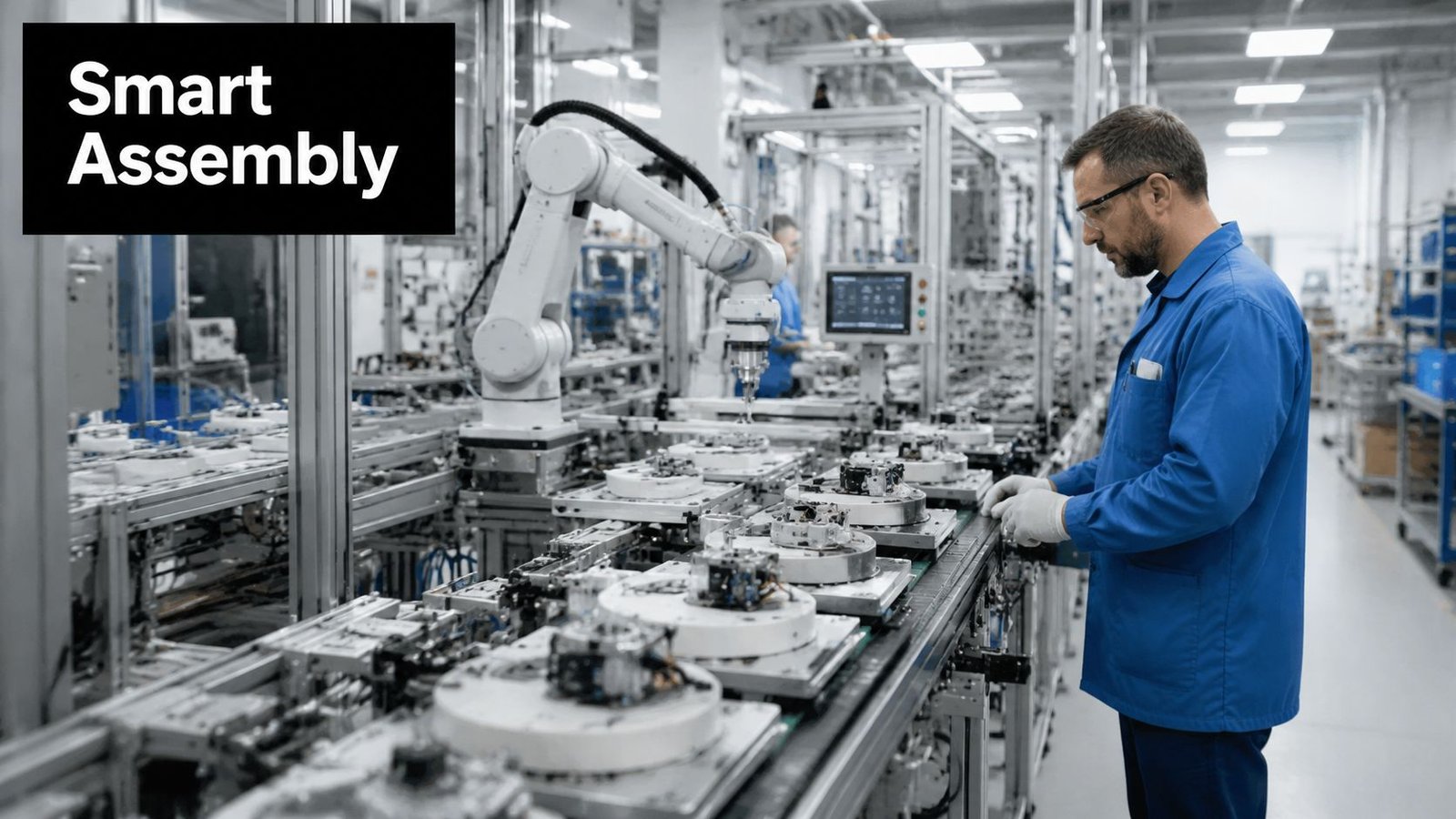
A medical device manufacturer doesn't always need a fully automated line to improve traceability. Consider a semi-automated assembly cell where an operator loads components, smart tooling confirms the correct fixture and sequence, integrated controls capture critical process values, and MES associates the events with the work order and lot. The operator still handles exceptions, but the system creates a more reliable production record and gives quality a clearer review path.
The challenge in that setting is balancing traceability with usability. If the interface forces operators through unnecessary screens, they'll create workarounds. If the system captures only a pass or fail result without the underlying process context, quality may still need a separate investigation. The design should capture the information that supports the risk controls, while leaving flexible handling to trained personnel where automation adds little value.
A small manufacturer may face a different constraint at a manual workstation. Instead of purchasing a complete line, the plant can add a controlled fixture, torque tooling, presence sensing, and a simple operator interface. The controls can prevent an obvious sequence error, record the critical result, and send a concise event to the plant's production system. This approach reduces dependence on memory without trying to remove the operator from a process that still changes between products.
A mid-sized plant with legacy equipment may prioritize planning visibility. A gateway can collect available machine states and production counts, normalize them into a shared model, and provide ERP with dependable completion information. The plant won't obtain every possible machine parameter, but it can improve the information needed for scheduling, inventory coordination, and demand forecasting.
The integration method should match the constraint:
| Plant condition | Suitable starting point |
|---|---|
| Manual records create traceability gaps | Smart tooling and controlled data capture |
| Legacy equipment limits connectivity | Signal retrofit and an edge gateway |
| Quality review waits for multiple records | MES and LIMS workflow integration |
| ERP schedules diverge from production | Bidirectional ERP and MES exchange |
The following video provides another visual reference for how integrated automation can connect equipment, controls, and operator activity. It should supplement, not replace, a site-specific assessment.
How SEA Delivers Tailored Systems Integration Solutions
System Engineering & Automation supports manufacturers from early consultation and preliminary concepts through design, manufacturing drawings, material sourcing, installation, commissioning, maintenance, and ongoing support. Its work includes semi-automatic and fully automated equipment, custom tooling, fixtures, integrated controls, robotics, pick-and-place units, bowl feeders, and conveyors. With 30+ years of engineering experience and GMP-aware practices, SEA helps small to mid-sized plants choose the level of automation that fits their production goals, budget, flexibility requirements, and validation needs, with a one-year guarantee on all builds.
If your plant is losing time to manual records, disconnected equipment, delayed quality information, or unreliable production status, System Engineering & Automation can assess the workflow and define a practical integration path. Contact SEA to discuss a phased or semi-automated solution that improves production visibility while respecting your uptime, compliance, and budget constraints.