The line is running well until it reaches the end of the process. Parts are made on time, operators are doing what they can, and then output starts to stack up because palletizing, transfer, staging, or storage still depends on manual handling. That's where a lot of plants lose capacity without noticing it at first. The machine cycle looks fine, but the overall flow doesn't.
In most facilities, an automatic pallet system isn't a single purchase. It's a way to remove the handoff points that slow production, create ergonomic strain, and introduce inconsistency into shipping or downstream operations. The important decision isn't whether to automate everything. It's whether you're choosing the right level of automation for your mix, labor reality, floor space, and budget.
Table of Contents
- The Bottleneck on Your Production Floor
- Anatomy of an Automatic Pallet System
- Semi-Automatic vs Fully Automated Systems
- Core Benefits for Modern Manufacturers
- How to Choose the Right System for Your Facility
- Your Integration and Installation Roadmap
- Real-World Applications and FAQs
The Bottleneck on Your Production Floor
A common scene on the plant floor looks like this. The upstream process is steady, but the last few steps depend on people lifting, rotating, stacking, wrapping, and moving loads by hand or by forklift. Production doesn't stop completely. It pulses. Operators rush to catch up, pallets wait in the aisle, and forklifts start competing with people for the same space.
That bottleneck costs more than labor. Manual pallet handling usually creates four problems at once:
- Lost throughput: Machines keep producing, but finished goods can't leave the area fast enough.
- Ergonomic exposure: Reaching, twisting, lifting, and rework all add strain.
- Inconsistent pallet builds: Loads vary by operator, shift, or fatigue level.
- More product risk: Impacts, leaning loads, and rushed transfers raise the chance of damage.
In practice, this is why many plants start looking at an automatic pallet system. Not because automation sounds modern, but because manual handling becomes the constraint after other process improvements are already in place.
Practical rule: If your best operator can keep up but your average shift can't, the process is too dependent on individual effort.
The right answer isn't always a fully automated warehouse or a robotic cell with every option. Sometimes the best move is a pallet dispenser, a powered conveyor, a lift-and-rotate fixture, or a semi-automatic palletizing station that removes the worst manual steps while keeping human flexibility where it still matters. That approach often gets a plant most of the operational benefit without the complexity of automating every exception.
Plant managers usually get the best return when they treat pallet automation as a flow problem, not a packaging accessory. If pallets are arriving late, leaving unstable, or blocking WIP movement, you're not dealing with an end-of-line nuisance. You're looking at a production control issue that happens to show up at the pallet.
Anatomy of an Automatic Pallet System
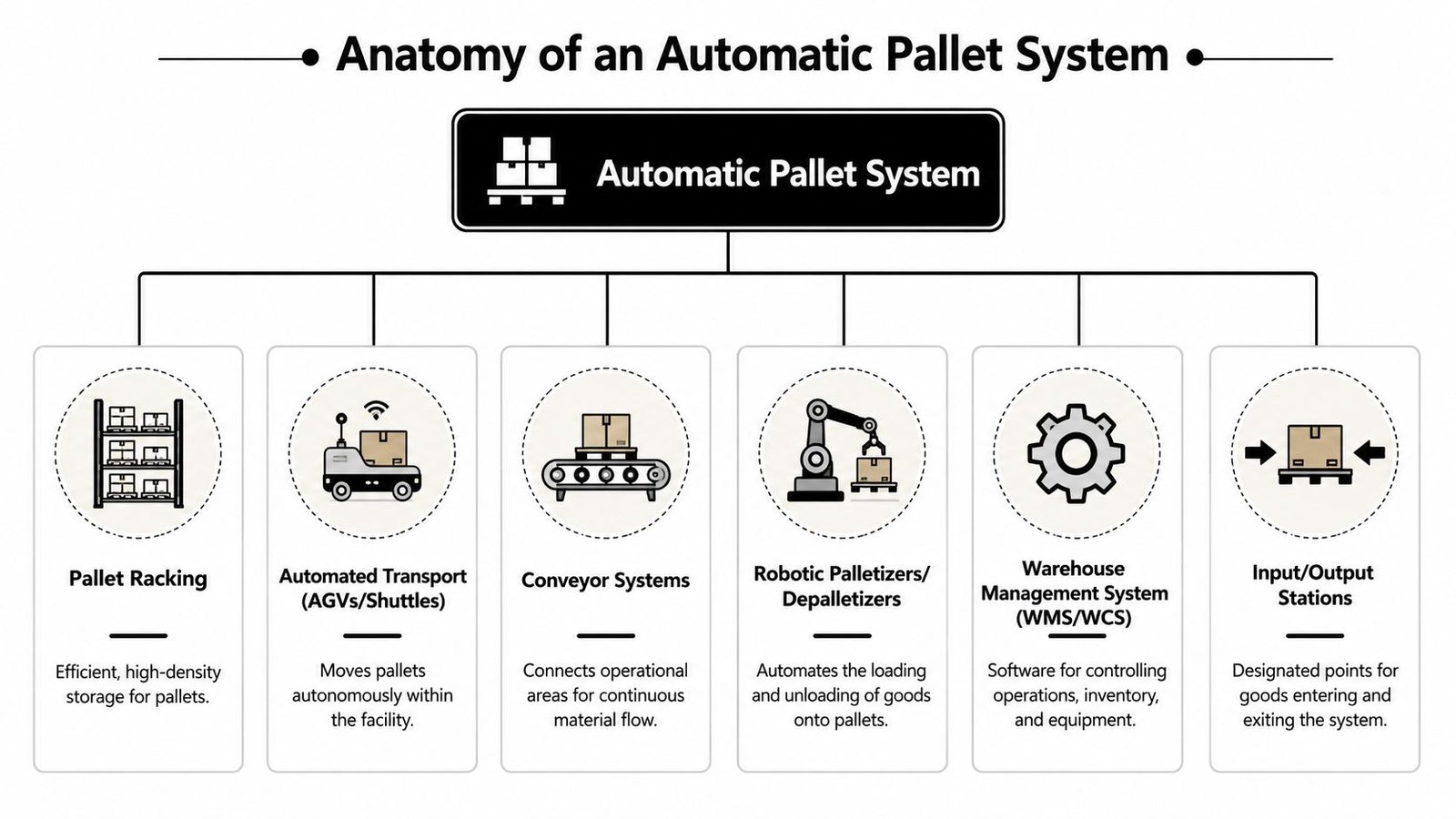
An automatic pallet system works best when you think of it as a factory circulatory system. Pallets are the blood cells. Transport equipment acts as the vessels. Palletizing and handling devices provide the muscle. Controls and software act as the brain, deciding where each load goes and when.
The system only works well if each part is matched to the others. A fast robot feeding a poorly planned conveyor loop won't fix the line. Neither will dense storage if operators still have to chase inventory manually.
Where the system starts
The foundation is the pallet itself. The modern pallet patent was filed in 1925, and pallet design accelerated during World War II with the introduction of the four-way pallet. That standardization mattered because machine handling depends on predictable geometry and repeatable fork access, as outlined in this history of the modern pallet and four-way pallet development.
That point still matters today. If your pallet quality varies too much, automation performance drops fast. Broken deck boards, poor dimensional consistency, and incompatible entry points create jams, bad picks, and awkward transfers.
For manufacturers evaluating broader line upgrades, this is the same systems thinking used in an automation machine system approach. The pallet is not an afterthought. It's the interface every other automated component has to trust.
The moving parts that matter
Most systems combine a few core building blocks:
- Conveyors and transfer modules: These move pallets through zones such as load, inspect, wrap, stage, or store.
- Lifts and transfer cars: These connect elevations or move pallets across longer distances where a simple conveyor run isn't practical.
- Pallet dispensers and stackers: These present empty pallets consistently and reduce manual setup.
- Robotic palletizers or depalletizers: These handle repetitive load building or unloading where consistency matters.
- Racking and buffer zones: These hold work between process steps so one machine's pause doesn't stop the whole line.
- PLC, WCS, or WMS controls: These decide routing, priorities, interlocks, and inventory status.
A lot of underperforming systems fail for a simple reason. The team bought equipment, not a workflow. Good system design defines how pallets enter, how they're identified, where exceptions go, and how operators recover the line without creating new delays.
A strong pallet system isn't the one with the most hardware. It's the one with the fewest uncontrolled handoffs.
Semi-Automatic vs Fully Automated Systems
This is the decision point that matters most for small and mid-sized manufacturers. Many teams assume they need to choose between staying manual or jumping straight to a fully automated setup. That's usually the wrong frame.
There's a wide middle ground, and it's often where the strongest ROI lives.
Where semi-automatic systems win
A semi-automatic pallet system uses automation where repetition is high and manual effort adds little value. People still handle exceptions, product changes, mixed patterns, quality checks, or lineovers. The machine takes over the tiring, slow, or inconsistent parts.
That can include:
- Pallet dispensers with manual load build
- Powered pallet conveyors between stations
- Lift tables, rotating fixtures, and ergonomic positioning tools
- Robot-assisted palletizing with operator supervision
- Machine tending cells where pallets are loaded automatically but jobs are staged by people
This approach works well when your plant has product variation, frequent changeovers, or limited capital. It also lets you keep experienced operators focused on value-added decisions instead of repetitive motion. A useful reference on this middle-ground approach is the role of semi-automated systems in bridging manual and full automation.
In many plants, semi-automatic systems outperform full automation on real-world flexibility. They're easier to commission, easier to modify, and less sensitive to one-off packaging changes. If your SKU mix moves around or your production schedule changes week to week, that matters more than having the most advanced brochure.
Where full automation makes sense
A fully automated pallet system is the right choice when throughput is high, product flow is stable, and the facility can support the software, controls, guarding, and maintenance discipline that comes with it. In warehouse environments, Swisslog describes software-controlled automated pallet warehouses that handle loads up to 3,500 kg using the goods-to-person principle in a compact footprint, and high-density shuttle systems can handle pallets up to 48 x 48 inches and 3,300 lbs in compact storage applications, as described in this overview of an automated pallet warehouse and pallet shuttle capability.
If your operation has stable pallet formats, predictable demand, and a clear need for dense storage or unattended transfer, full automation can be a strong fit. If not, it can become an expensive way to automate edge cases badly.
| Factor | Semi-Automatic System | Fully Automated System |
|---|---|---|
| Capital intensity | Lower entry cost and easier phased rollout | Higher upfront investment |
| Flexibility | Better for varied products and frequent changeovers | Best for stable flows and repeatable loads |
| Labor model | Keeps people on exceptions and higher-value tasks | Removes more routine handling |
| Implementation | Faster and simpler in many brownfield plants | More demanding on controls, layout, and integration |
| Scalability | Good for modular growth by station or line | Strong when long-term volume justifies full architecture |
| Risk profile | Lower operational shock during adoption | Higher payoff when assumptions stay true |
The practical takeaway is simple. Don't buy for the ideal week. Buy for the messy average week your plant lives through.
Core Benefits for Modern Manufacturers
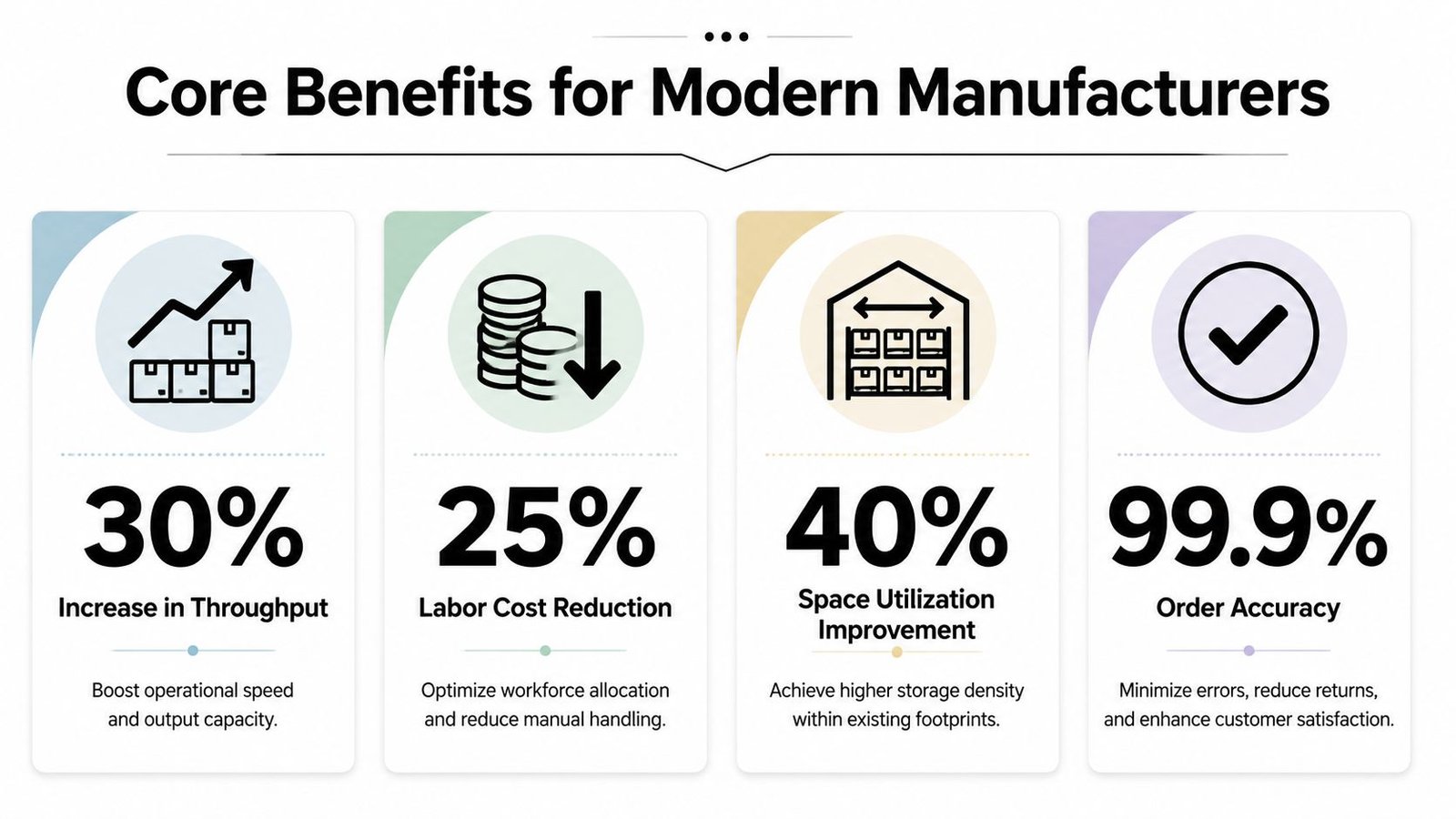
The value of an automatic pallet system isn't just speed. Its true value emerges when production becomes easier to schedule, safer to run, and more consistent to ship. Pallet automation is also a mature category. Swisslog notes it has offered pallet automation solutions for over 40 years, and DMG MORI states that automated pallet handling reduces machine downtime and frees operators to prepare new orders, including for small batches and individual parts, as discussed in this review of how pallet automation is changing warehouse and machine operations.
Throughput without adding chaos
When pallet movement is controlled, production stops waiting on whoever is available with a pallet jack or forklift. Machines keep running, buffers are intentional, and downstream areas receive material in a predictable sequence.
For machine shops and automated cells, this matters even with smaller runs. If pallets move between storage and the machine without manual interruption, operators can spend more time on setup, inspection, and job preparation.
Safety quality and control
The strongest gains often come from boring improvements. Fewer awkward lifts. Less twisting. Fewer rushed forklift pickups around pedestrians. Better load presentation. Cleaner transfer points.
A good system also improves shipping consistency:
- More repeatable pallet builds: Loads are squared, positioned, and supported the same way each cycle.
- Less avoidable damage: Standardized pallet size and quality support automation and help reduce product damage while improving warehouse space use, as noted earlier in the article's discussion of pallet automation maturity.
- Cleaner traceability path: Software-controlled movement makes it easier to know what moved, where it went, and what status it holds.
- Better compliance discipline: In GMP-aware environments, controlled handling reduces unnecessary touches and supports repeatable documented process flow.
If the pallet leaves your line in a different condition depending on who built it, you don't have a people problem. You have a process problem.
This is why the best projects don't start with a robot model. They start with the KPI that hurts most: downtime, safety exposure, product damage, floor congestion, or shipping inconsistency.
How to Choose the Right System for Your Facility
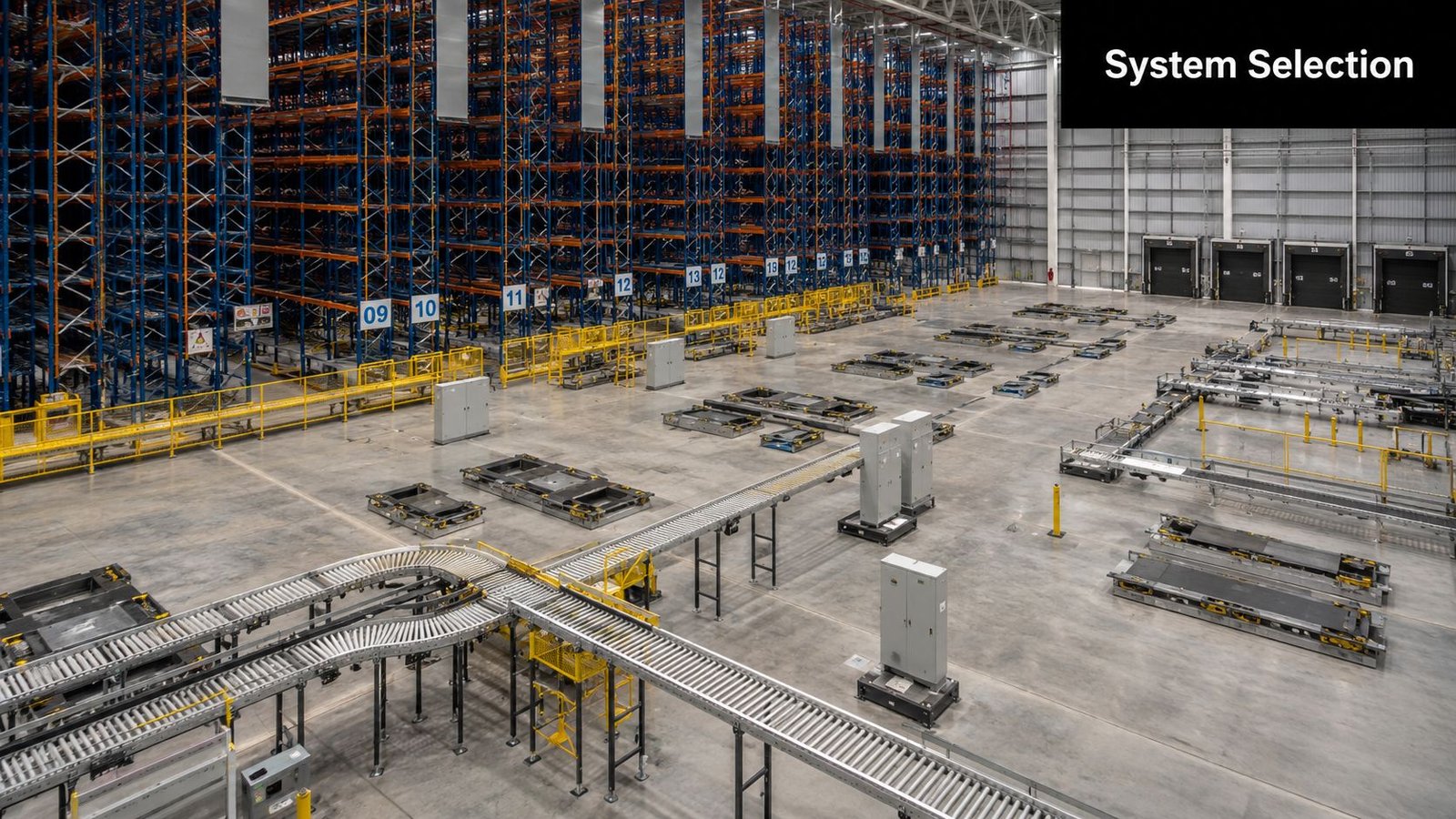
Selection starts with honesty. Not vendor demos, not wish lists, and not the most advanced system you saw at a trade show. You need a clear view of how pallets move through your plant today, including where they stop, where they wait, and where people are compensating for process weakness.
Start with the process not the machine
Begin with a floor-level audit. Walk the line and document what happens at each handoff. Look at empty pallet supply, load presentation, operator travel, forklift crossings, buffer accumulation, and rework caused by unstable stacks or damaged pallets.
Then sort the issues into three buckets:
- Manual tasks that should stay manual because judgment or variability is high.
- Manual tasks that need better fixtures because the problem is ergonomics or positioning.
- Manual tasks that should be automated because they're repetitive, predictable, and expensive to keep doing by hand.
That exercise usually reveals that some problems need controls and tooling, not full automation. A smart fixture, indexing table, or powered transfer can remove a major bottleneck without turning the project into a full line rebuild.
Questions that prevent expensive mistakes
Ask these before selecting any automatic pallet system:
- What pallet conditions do you really have? New pallets behave differently than damaged return pallets.
- How much product variation is normal? Mixed dimensions, weights, and stack patterns can change the entire design.
- What happens during exceptions? A line is only as resilient as its jam recovery and manual bypass plan.
- How much software discipline can your team support? A system that depends on perfect data will struggle in a plant with weak transaction habits.
- How constrained is the building? Column spacing, mezzanines, floor flatness, aisle width, and fire protection all matter.
One issue that gets ignored too often is sensing. In controlled demos, pallet detection looks easy. On a real floor, it isn't. Recent research on pallet localization in cluttered environments highlights that accurate identification may require fusing multiple sensor types such as vision and 3D point clouds, especially when pallets are obscured, stacked, or viewed under difficult conditions, as detailed in this paper on robust pallet localization under real-world sensing conditions.
That has a direct design implication. If your operation uses mixed pallets, partial loads, or cluttered staging, don't assume the perception layer is trivial. It often drives the difference between a system that looks good in commissioning and one that survives daily production.
Your Integration and Installation Roadmap
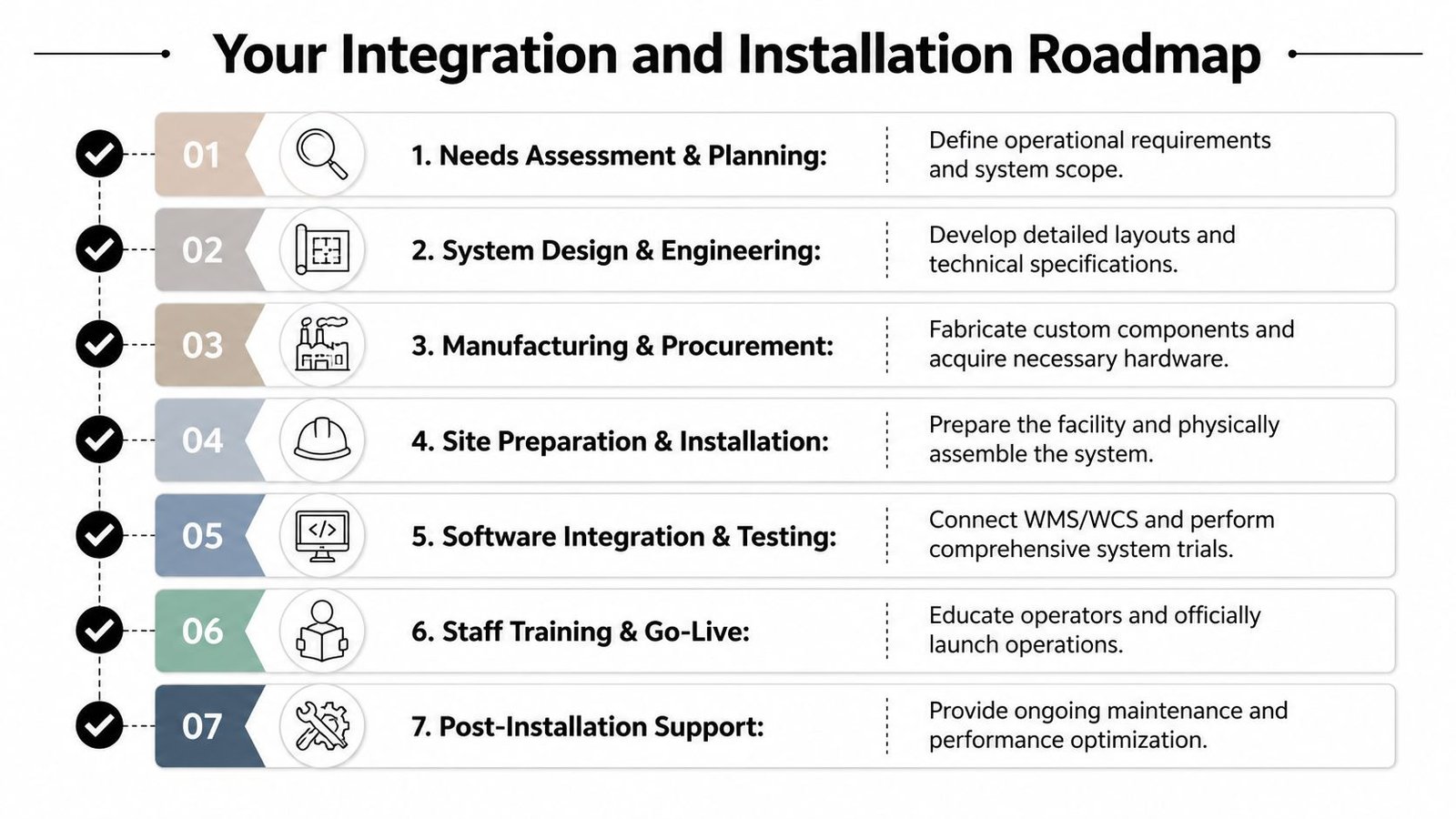
Most pallet automation projects go wrong before startup. The root cause is usually incomplete definition early on, followed by rushed installation and software surprises. A disciplined rollout avoids most of that.
What a disciplined project looks like
A solid project path usually follows this sequence:
Needs assessment and concept development
Define pallet types, load conditions, cycle expectations, operator roles, exceptions, and layout constraints.Design and simulation
Build the flow on paper before cutting steel. Confirm clearances, guarding, sequencing, and recovery strategy.Procurement and fabrication
Order standard components early and fabricate custom tooling, frames, or stations around the agreed process.Site preparation
Prepare floor space, utilities, data drops, and any structural changes before equipment lands.Mechanical and electrical installation
Install the hardware, connect controls, and verify every interface point.Software integration and testing
Connect PLC logic, HMI screens, barcode or sensor inputs, and any MES or ERP signals that matter.Commissioning and operator training
Validate performance under production conditions, then train both operators and maintenance staff.
For larger or more custom systems, an early validation stage matters a lot. A structured Factory Acceptance Test process can expose sequencing errors, guarding issues, and software gaps before equipment reaches your floor.
What separates a smooth launch from a painful one
The strongest installations share a few traits:
- They define success clearly: Everyone agrees on what the system must do, and equally, what it will not do.
- They plan for manual mode: Operators need a safe, workable path for maintenance, recovery, and temporary bypass.
- They train maintenance early: If only the integrator understands the controls, uptime will suffer after handoff.
- They test bad conditions on purpose: Skewed pallets, delayed sensors, and awkward loads reveal the truth fast.
The best commissioning days are usually uneventful because the hard questions were answered weeks earlier.
Real-World Applications and FAQs
Where these systems pay off
A medical device manufacturer may not need a large automated warehouse at all. In many cases, the right answer is a semi-automatic palletizing and transfer setup that reduces manual touches, supports cleaner process flow, and gives the team better control over traceability and standardized handling.
A machine shop often sees a different pattern. The useful upgrade might be pallet storage and automatic transfer tied to CNC operations so machines can keep running while operators prepare the next job, inspect completed work, or support setup.
A packaging line with frequent pallet build variation may benefit most from smart fixtures, powered conveyors, and a robot-assisted station rather than a fully closed system. That keeps the flexible decisions with people while removing the repetitive lifting and transport burden.
Common questions from plant teams
Do we need to replace all existing pallets?
Not always. But pallet quality and consistency matter much more once automation is involved. Many projects succeed after narrowing the approved pallet types and tightening pallet condition standards.
How much maintenance do these systems require?
That depends on complexity. Conveyors, lifts, sensors, dispensers, and robots all need preventive maintenance. The practical question is whether your team can support the chosen system without relying on outside help for routine issues.
Can the software integrate with current systems?
Usually yes, but only if the data handoffs are defined well. The integration scope should be specific from the beginning, including what status signals, inventory transactions, and exception messages need to move between systems.
Is full automation always the best ROI?
No. In many plants, a semi-automatic approach with better tooling, controlled transfer, and focused automation produces the better business case because it solves the main bottleneck without overbuilding the solution.
If you're evaluating the right level of pallet automation for your plant, System Engineering & Automation helps manufacturers choose practical solutions that fit real budgets, real floor constraints, and real production goals. From smart fixtures and semi-automatic systems to fully integrated automation, SEA supports the full path from concept and design through installation, commissioning, and ongoing service.