A plant manager usually feels the pressure long before an automation project gets approved. Orders keep shifting, quality complaints don't get any easier to absorb, and every hour of downtime feels more expensive than the last. In that environment, industrial automation & robotics stops being a future idea and becomes a practical question about throughput, labor, and whether the line can stay flexible enough to handle the next product change.
The hard part is that the wrong answer can be expensive. Full automation can lock a plant into a rigid process, while staying fully manual can leave too much labor and variation on the table. The useful question isn't whether to automate in the abstract, it's how far to automate, where to keep human judgment, and how to build a system that fits the actual production mix, floor space, and budget.
Table of Contents
- The Automation Decision Facing Modern Manufacturers
- Understanding Industrial Automation and Robotics Systems
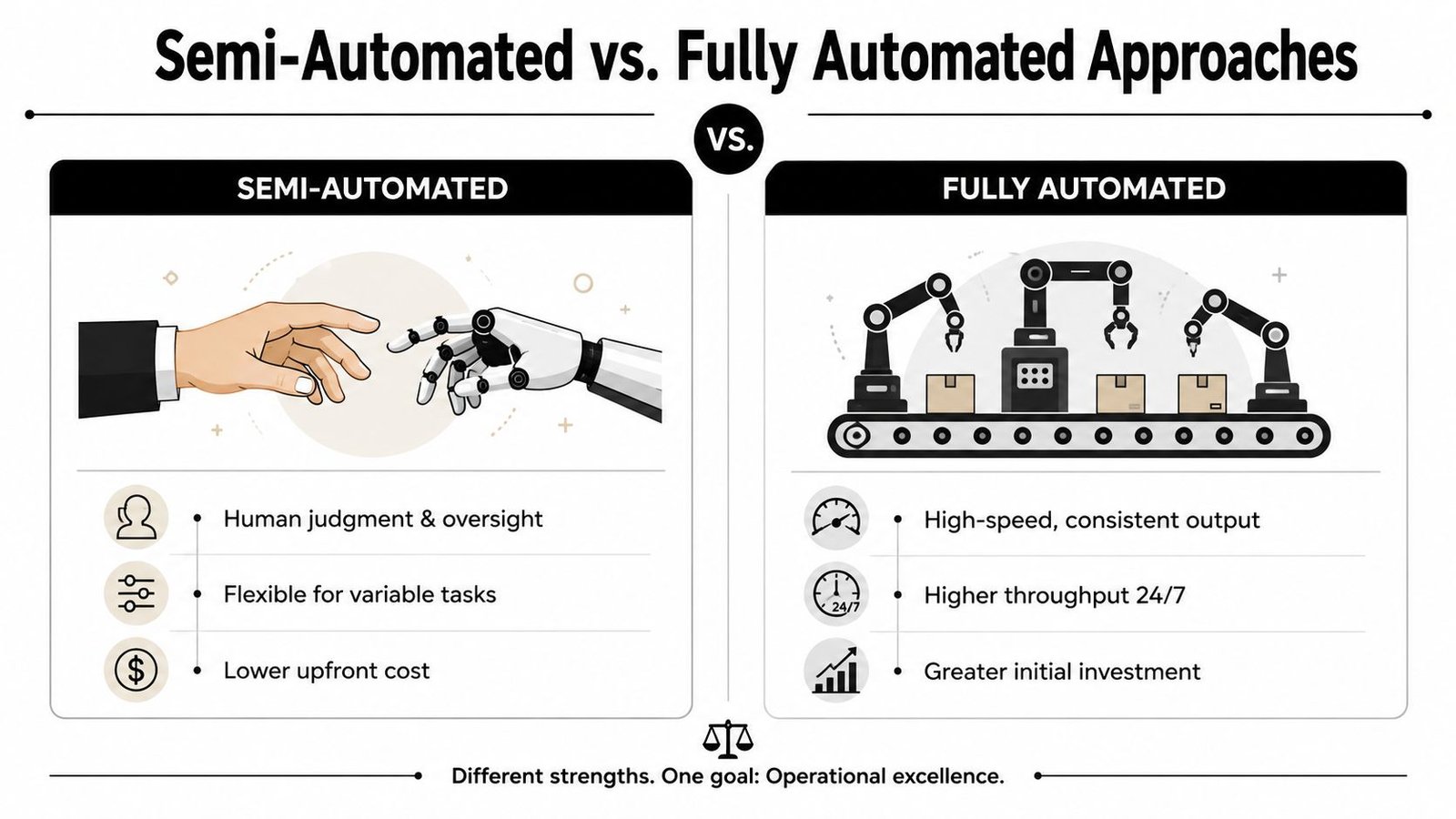
- Semi-Automated vs Fully Automated Approaches
- Calculating ROI and Meeting Regulatory Requirements
- Your Implementation Roadmap and Evaluation Checklist
- Real-World Examples from Small-to-Mid Manufacturers
- Making Your Automation Decision with Confidence
The Automation Decision Facing Modern Manufacturers
A common scene in a small-to-mid plant looks like this. Production is busy, the best operators are stretched thin, and one late shipment forces the team to decide whether to add another shift, hire again, or invest in equipment that can take pressure off the line. That's where automation enters the conversation, not as a novelty, but as a response to rising demand, tighter quality expectations, and labor that's harder to schedule reliably.
The market around you is already scaled. McKinsey estimates the core industrial automation product categories will reach about $115 billion globally in 2025, up from $92.6 billion in 2019 (McKinsey). The point isn't that every plant needs the same equipment. The point is that automation has become a mature manufacturing decision, not a fringe experiment.
A practical way to start is by comparing the current line against the cost of doing nothing. If the current setup depends on repeat manual handling, constant inspection, or a single skilled operator who can't be replaced quickly, then the risk is already visible. A good first pass on economics can come from a structured tool like SEA's automation ROI calculator, but the value is in using it to define the bottleneck, not to justify a preselected solution.
Practical rule: automate the bottleneck first, not the most visible workstation.
For many manufacturers, the strongest case is not “replace labor,” it's “remove unstable labor dependency.” That shift matters because automation projects usually succeed when they solve a specific production constraint, such as inconsistent cycle times, hard-to-recruit shifts, or a quality step that should not depend on operator fatigue. The right project narrows the problem before it broadens the technology.
Understanding Industrial Automation and Robotics Systems
Industrial automation uses controls, sensors, software, and machinery to run a process with less manual intervention. Robotics is one part of that larger system, usually the part that moves, handles, welds, assembles, or inspects. A robot arm without the right controls, fixtures, and logic is just a machine in motion. A useful system is a coordinated production cell.
Core control and sensing elements
A programmable logic controller, or PLC, acts as the line's decision-maker. It reads inputs such as sensors, switches, and machine states, then sends the right commands to outputs. A human-machine interface, or HMI, gives operators a dashboard where alarms, cycle status, recipes, and manual overrides are visible.
Sensors matter because automation cannot react to what it cannot detect. Vision systems, proximity sensors, torque monitoring, and part-present checks all help the process make decisions at the right moment. Robotic arms add motion and repeatability, but performance comes from the combination of controls, sensing, tooling, and fixtures.
How the pieces fit together
There are three broad automation patterns. Fixed automation is built for one repetitive task and usually performs well when volume is stable. Programmable automation allows recipe or changeover updates, which makes it useful when product families change but still follow predictable patterns. Flexible automation is the most adaptable, because it can handle variation without fully rebuilding the line.
A shop that runs multiple SKUs, frequent changeovers, or short production campaigns often gets better results from smart tooling and semi-automated cells than from a rigid fully automated line. That is especially true when the process depends on operator judgment, part positioning, or quick re-tasking. The smartest cell is often the one that keeps humans where judgment matters and machines where repetition dominates.
For small-to-mid manufacturers, the decision usually comes down to precision, speed, and flexibility. If a part needs tight positioning at one station but human inspection at the next, the line should reflect that split. Custom tooling, part nests, and modular controls earn their keep because they let the process be precise where it must be and adaptable where it can be.
For plants trying to bridge manual work and higher automation, semi-automated systems often provide the most practical middle ground. They keep operators in the loop for judgment calls, while robots handle the repetitive steps that slow throughput or create inconsistency.
Semi-Automated vs Fully Automated Approaches
A line that looks fully automatic on paper can become a maintenance headache on the floor. In many plants, the better move is a semi-automated setup that keeps operators in the process, shortens changeovers, and avoids tying up capital in a line that is still changing.
The decision should follow the production reality. A fully automated line makes sense when output is steady, parts are consistent, and the work repeats with little variation. Semi-automation fits better when the plant runs mixed SKUs, changes over often, has limited floor space, or needs room to adjust as demand shifts. In those environments, the practical goal is not to remove people from the process. It is to place them where judgment, inspection, and exception handling still matter.
McKinsey reported that in its 2022 Global Industrial Robotics Survey, many industrial companies expected automated systems to account for 25% of capital spending over the following five years, while logistics and fulfillment players expected 30% or more (McKinsey). The point is not that every line should be fully automated. Capital is still moving toward automation, so the question is where that money reduces friction instead of adding it.
For smaller plants, the main barriers are usually operational. The same survey identified capital cost (71%) and lack of experience with automation (61%) as the biggest adoption barriers (McKinsey). That is why operator-assisted fixtures, modular controls, and semi-automated cells often beat a full line rebuild. They let a plant improve throughput without forcing every step of the process into a rigid format.
The strongest programs are built around both the machine and the operator. A useful way to evaluate the system is by asking what must be precise, what must be fast, and what must stay flexible. In the broader automation field, that usually leads to intuitive interfaces, quick re-tasking, interoperability, and safe human-robot interaction. Those traits matter because they let a system work in a real plant, not only in a demo cell.
| Factor | Semi-Automated Systems | Fully Automated Systems |
|---|---|---|
| Product mix | Better for mixed SKUs and frequent changeovers | Better for stable, repeatable products |
| Capital exposure | Lower upfront commitment | Higher initial investment |
| Labor role | Operator oversight stays central | Operator role is reduced |
| Flexibility | Easier to adapt as product families change | Harder to reconfigure once installed |
| Throughput | Good where bottlenecks are targeted | Strong where the process is consistent |
| Downtime risk | Lower if the human can intervene quickly | Higher if one failure stops the cell |
| Typical fit | SMEs, regulated environments, evolving lines | High-volume, stable production |
Bottom line: full automation is a process choice, not a badge of maturity.
For plants that want a practical middle ground, the article on the power of semi-automated systems bridging the gap between manual and full automation is a useful match for cases where flexibility matters more than unattended operation.
Calculating ROI and Meeting Regulatory Requirements
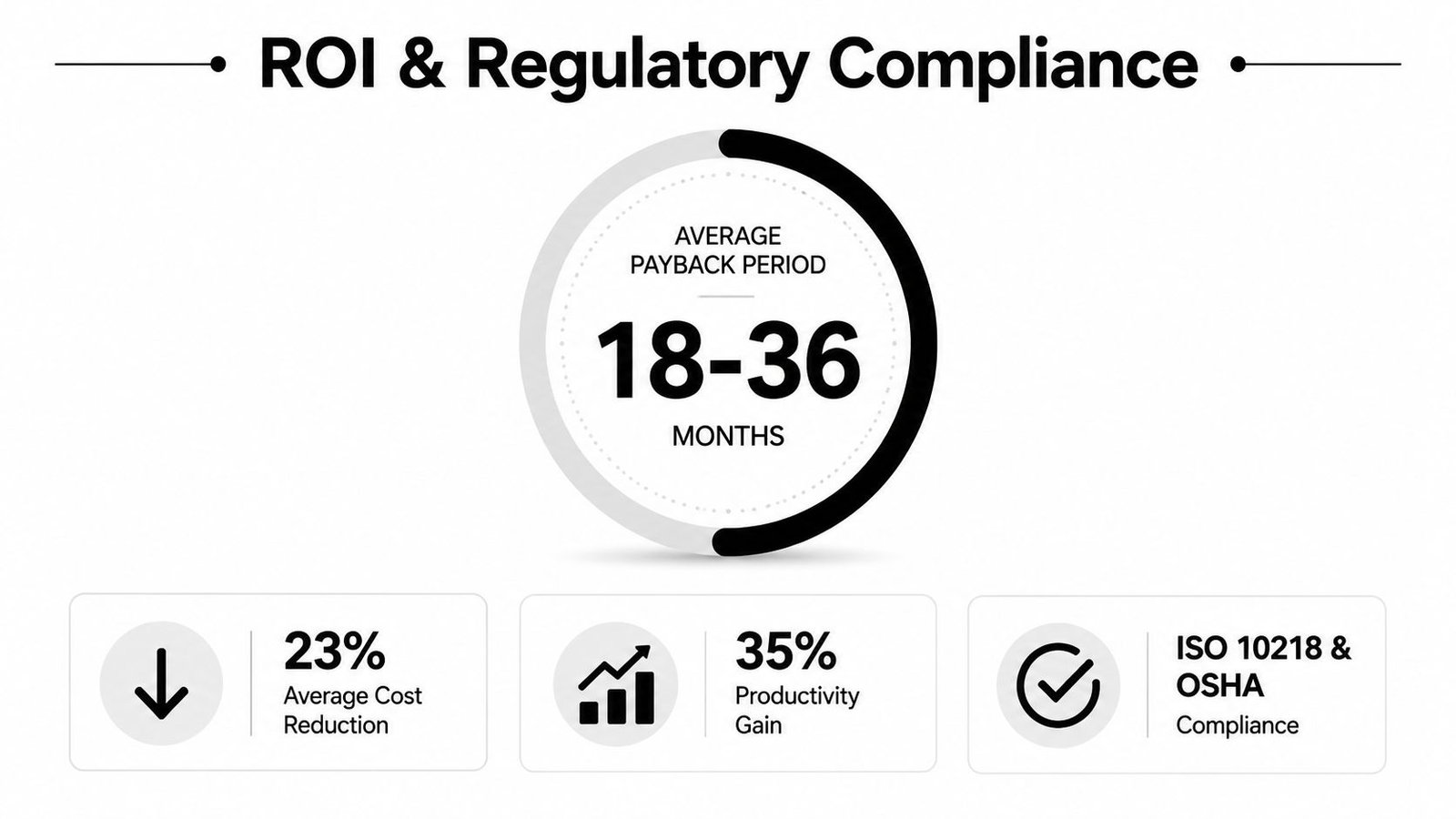
ROI gets messy when teams only count labor replacement. The better approach is to stack the value drivers: less rework, more consistent quality, better uptime, fewer ergonomic risks, and reduced dependence on hard-to-fill roles. Those are the factors leadership feels in production reviews, quality meetings, and scheduling decisions.
The U.S. Commerce Department found that a 1% increase in industrial robot density was associated with a 0.8% increase in productivity overall, and 5.1% in slower-adopting industries. It also found that the same 1% increase was associated with a 1% decrease in hours worked (U.S. Commerce Department). That supports a practical truth, automation can raise output per worker while reducing labor dependency, but only if the process is well designed.
What should go into the business case
A credible case usually includes these elements:
- Capital cost: equipment, integration, fixtures, safety systems, and commissioning.
- Quality impact: fewer defects, less rework, and more repeatable process control.
- Uptime impact: less line stoppage from fatigue, variation, or manual handling delays.
- Labor impact: reduced dependency on scarce or difficult-to-train roles.
- Changeover impact: less time lost when the product mix changes.
For regulated environments, especially medical devices, automation often helps more than it complicates, provided the process is designed for traceability and change control. GMP-aware practices favor repeatability, documented settings, and controlled handoffs, which is exactly where well-specified automation can reduce human variation. A useful reference for the compliance side is what GMP means in manufacturing.
Practical rule: if a process step is hard to document manually, it's often a strong candidate for automation.
The compliance benefit isn't just about paperwork. Consistent machine behavior helps make lot-to-lot performance easier to defend, and that matters when auditors ask how the process is controlled. The key is to avoid buying complexity just because it looks advanced. Simpler systems with clear traceability often beat elaborate systems that operators can't maintain.
If leadership is cautious, phase the project. Start with one cell, one operation, or one repeatable bottleneck. That approach spreads cost, proves value, and lowers the risk that the plant gets locked into a design that doesn't match future product changes.
Your Implementation Roadmap and Evaluation Checklist
Good automation projects usually fail for ordinary reasons. The team rushes requirements, leaves operators out of the design review, underestimates changeover complexity, or buys a system that cannot handle a new SKU six months later. The fix is disciplined planning before hardware shows up.
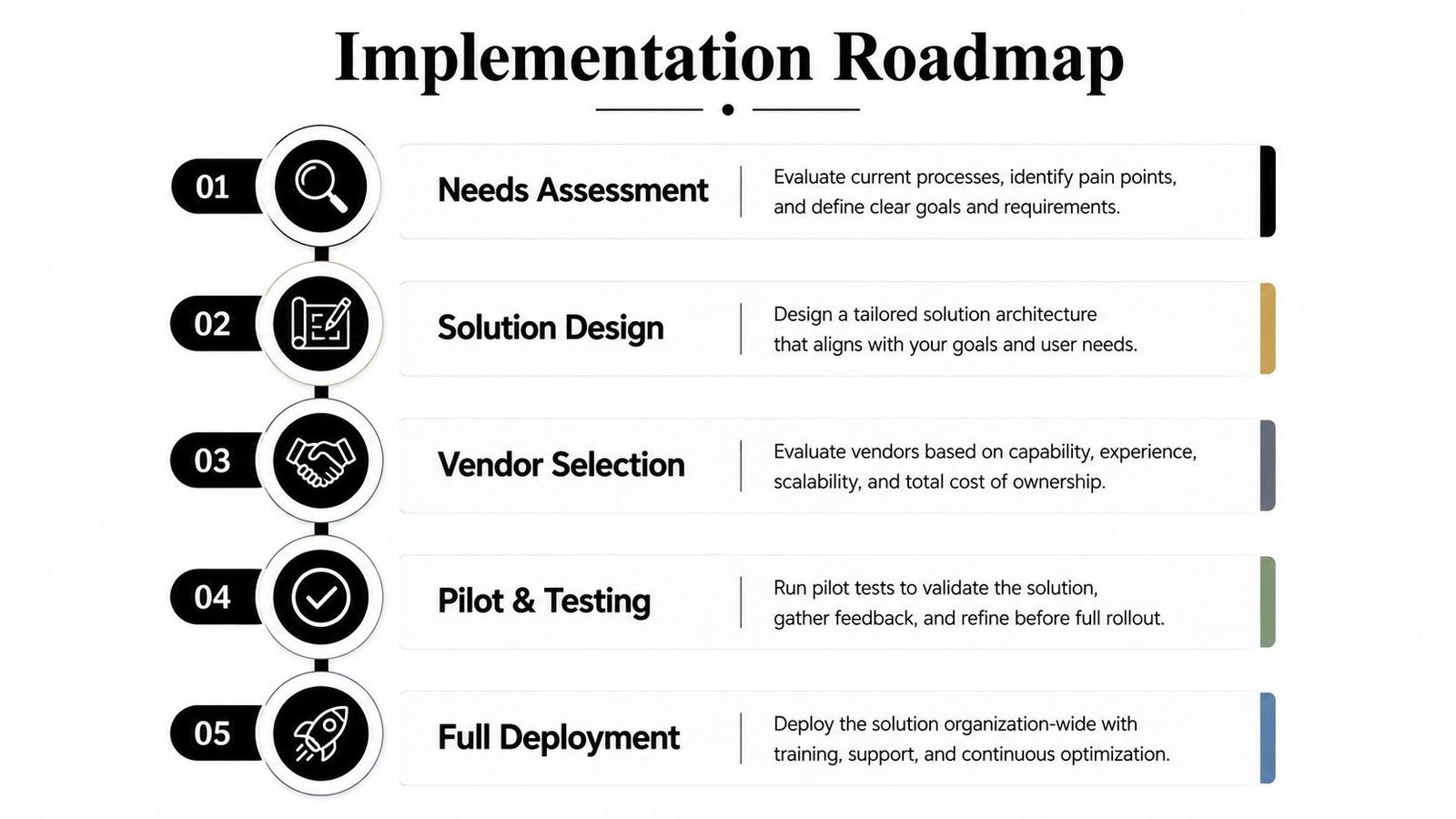
Start by defining the process in production terms. Identify where quality slips, where labor is least stable, where the bottleneck sits, and what happens if the line grows or the product changes. Then separate the steps that must be automated from the ones that are convenient to automate. That keeps scope from drifting and protects the budget when the first proposal comes back with more hardware than the plant needs.
Evaluation checklist for a real plant
Use these questions before signing off on a design:
- What problem are we solving? Throughput, quality, safety, labor scarcity, or all four.
- How variable is the product mix? Stable parts favor deeper automation, mixed parts favor flexibility.
- How often do changeovers happen? Frequent changeovers make quick re-tasking necessary.
- What space is available? Floor plans matter more than vendor drawings.
- Who will maintain the system? Internal capability is part of the purchase, whether it is planned or not.
- What happens during downtime? A good system needs a recovery path, not just a fast cycle.
- What does compliance require? Traceability, documentation, validation, and controlled access may shape the design more than speed.
A capable integrator should be able to discuss payload, reach, safety, motion control, vision, and serviceability in practical terms. That is where System Engineering & Automation fits naturally as one option among others, especially when a plant needs semi-automatic systems, custom tooling, fixtures, PLCs, HMIs, motion control, or robotic cells designed around real manufacturing constraints.
The rollout should be staged. A pilot cell proves the process, operators learn the new rhythm, and the team collects failure modes before wider deployment. That is cheaper than finding out late that a fixture is hard to load or that a robot path breaks when a product variation appears.
Real-World Examples from Small-to-Mid Manufacturers
A mid-sized medical device plant had a familiar problem. Operators were doing a repetitive assembly step by hand, but the process also needed careful alignment and traceable handling. Full-line automation would have been too rigid for the product mix, so the team used a semi-automated cell with custom fixtures, guided loading, and controlled motion at the critical step.
The result wasn't just faster work. The plant got a more stable process because the operator handled setup and judgment while the machine handled the repetitive movement. That combination is often the right answer in regulated environments, where variation hurts more than raw speed helps.
A second example comes from a manufacturer with mixed SKUs and short runs. Instead of automating the whole line, the team upgraded a manual workstation with smart tooling, better part presentation, and a robot-assisted pick-and-place task. That reduced strain on the operator and kept the line flexible enough to absorb product changes without a major rebuild.
Another plant chose to automate a single inspection or handling step rather than the entire process flow. That decision mattered because the biggest pain point wasn't the whole line, it was one repeatable step that created delays and quality drift. By targeting only the unstable operation, the team preserved cash and avoided buying more rigidity than the plant could use.
These examples share the same pattern. The winning projects didn't chase maximum automation. They matched automation level to product mix, operator skill, and changeover reality. That's why semi-automated cells often outperform grander plans on real shop floors.
Making Your Automation Decision with Confidence
The decision gets easier when you stop treating automation as a binary choice. The key variables are production volume, mix variability, capital constraint, regulatory pressure, and internal capability. If the line changes often, keep more human flexibility. If the process is stable and repetitive, push further toward automation.
A simple decision filter helps. If the process step is repetitive, hard to staff, quality-sensitive, and easy to fixture, it belongs on the short list. If it changes frequently, depends on judgment, or would be painful to maintain, keep it semi-automated until the process stabilizes.
The most reliable path is usually a pilot, a measured rollout, and a partner who can support commissioning and maintenance after the install. That keeps the project tied to production reality instead of to a sales demo. Automation works best when it improves the process you already have, not when it tries to replace plant knowledge.
If you're weighing semi-automated versus fully automated options, System Engineering & Automation can help you evaluate the process, define the right level of control, and build around the realities of your line. Visit System Engineering & Automation to discuss custom tooling, robotic cells, fixtures, and integrated controls that fit your production goals and budget.