Complete automation in Michigan isn't a single purchase. It's a phased engineering program, and for most plants the right answer is a semi-automated line with a few fully automated stations, not a fully automated greenfield build.
If you're staring at a vendor quote and wondering whether the scope matches your production reality, you're probably already in the right mindset. Michigan plants have to deal with legacy equipment, mixed product runs, GMP pressure in some sectors, and limited engineering bandwidth, so the smartest automation program is the one you can integrate, validate, and support.
Table of Contents
- The Michigan Plant Manager's Automation Dilemma
- What Complete Automation Actually Means
- The Five Phases of an Automation Project
- GMP and Regulatory Considerations for Medical Device Manufacturers
- Building a Realistic Cost and ROI Model
- The Real Limits of Automation in Michigan Plants
- Questions to Ask Before Signing an Automation Contract
- How SEA Approaches Complete Automation in Michigan
The Michigan Plant Manager's Automation Dilemma
A plant manager in Grand Rapids or Warren looks at a full-line automation quote and sees two things at once, a cleaner process and a bigger headache. The quote promises consistency, but the current line still runs on mixed work, older controls, and a crew that already knows how to keep production moving when the parts vary.
That's the problem with complete automation Michigan searches. The phrase sounds like a single project, but the work is usually a series of decisions about where machines should take over and where people still need to stay in the loop.
The quote that looks better than it is
The vendor deck always looks tidy. Every station is automated, every transfer is synchronized, and every handoff is supposed to be smooth. In the plant, though, the line rarely starts as a clean sheet of paper.
Michigan manufacturing is full of legacy systems and uneven product mixes, and those details matter more than the glossy renderings. Brookings found that Detroit-Warren-Dearborn had an average automation potential of 45.4%, with 39.9% low-risk, 35.4% medium-risk, and 24.7% high-risk jobs, which is a blunt reminder that automation pressure is broad, not isolated to one corner of the floor (Brookings automation analysis).
Practical rule: If a vendor can't explain where the line will still need human judgment, the scope is probably too aggressive.
What good managers ask instead
The better question isn't whether you can automate everything. It's which stations deserve automation first, which ones need fixtures or smart tooling, and which ones are already stable enough to leave alone. That's how you protect throughput without turning your plant into a months-long integration project.
Michigan's automation story has always been tied to the auto industry, especially welding, painting, material handling, and packaging. That history matters because it taught local manufacturers a hard lesson, full automation is only a win when the process is standardized enough to support it, otherwise you just automate the chaos.
A good plant manager doesn't chase the biggest quote. A good plant manager chooses the level of automation that can be commissioned, validated, and maintained without draining the team that still has to run the business every day.
What Complete Automation Actually Means
Complete automation is a spectrum, not a binary switch. On one end you have manual workstations, on the other you have fully automated lines, and in the middle sit semi-automated cells where people and machines split the work by design.
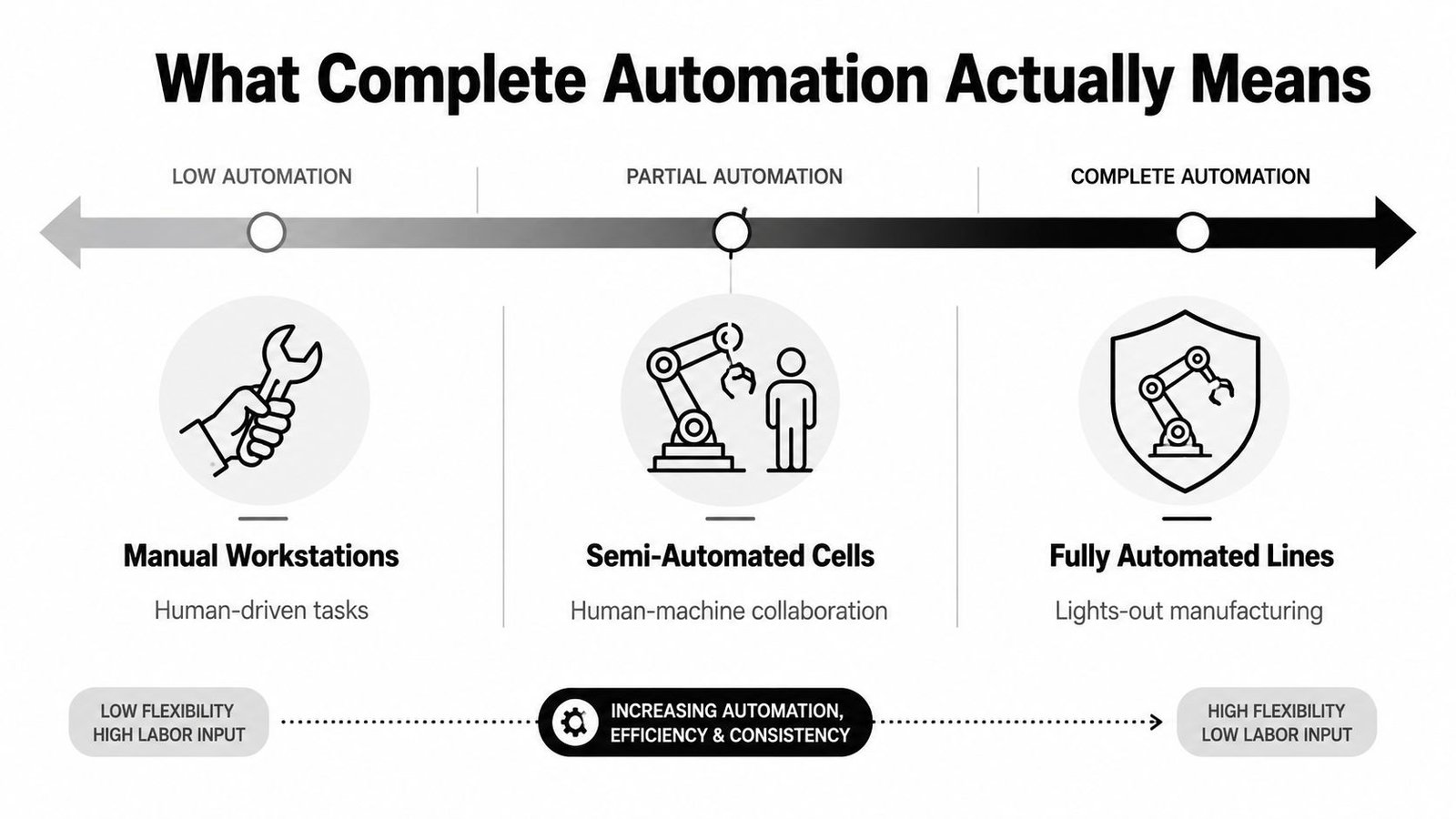
Michigan already sits deep on that spectrum. Brookings reported that the state had more than 28,000 industrial robots in use, about 12% of all robots nationwide, and that the Detroit metro area alone used more than 15,000 robots, equal to 8.5 robots per 1,000 workers and roughly three times the rate of similar-sized U.S. metros (Brookings automation analysis). That doesn't mean every plant should chase lights-out manufacturing. It means Michigan has a mature base of automation experience, but that experience still has to fit the process in front of you.
Think in stations, not slogans
A useful way to think about automation is as a set of muscles, not one giant machine. A plant can automate material handling, then inspection, then a repetitive assembly or welding step, while leaving changeover, exception handling, and final verification to operators. That's usually what “complete automation” looks like in practice for a mid-sized Michigan plant.
The right automation type depends on variability. Fixed automation works when the part and the sequence stay stable. Flexible automation makes more sense when the product mix changes, fixtures need to adapt, or the plant runs multiple variants on the same cell.
The spectrum that actually fits Michigan
If your parts are repetitive and the changeover burden is low, a more rigid architecture can pay off. If you run mixed geometry, legacy equipment, or frequent engineering changes, a modular semi-automated layout is usually the safer bet. That's the point many vendors skip because it doesn't sound as dramatic as a fully automated line.
Complete automation in Michigan usually means a phased program where the highest-priority stations are automated first and the rest stay semi-automated. That approach gives you control over risk, commissioning time, and operator adoption, which matters more than the brochure language ever will.
The Five Phases of an Automation Project
A real automation project starts with a blunt assessment of what is broken, what repeats too often, and what should be standardized before anyone draws a single panel layout. In a Michigan plant, that usually means confronting legacy equipment, messy handoffs, and the fact that the best solution is often a phased one, not a full rip-and-replace.
Phase 1 through phase 3 set the project shape
Assessment and goal setting should identify the bottleneck, the quality pain points, and the stations that can be standardized without hurting flexibility. If the team cannot define the target state in plain production terms, the rest of the project turns into guesswork and wishful thinking.
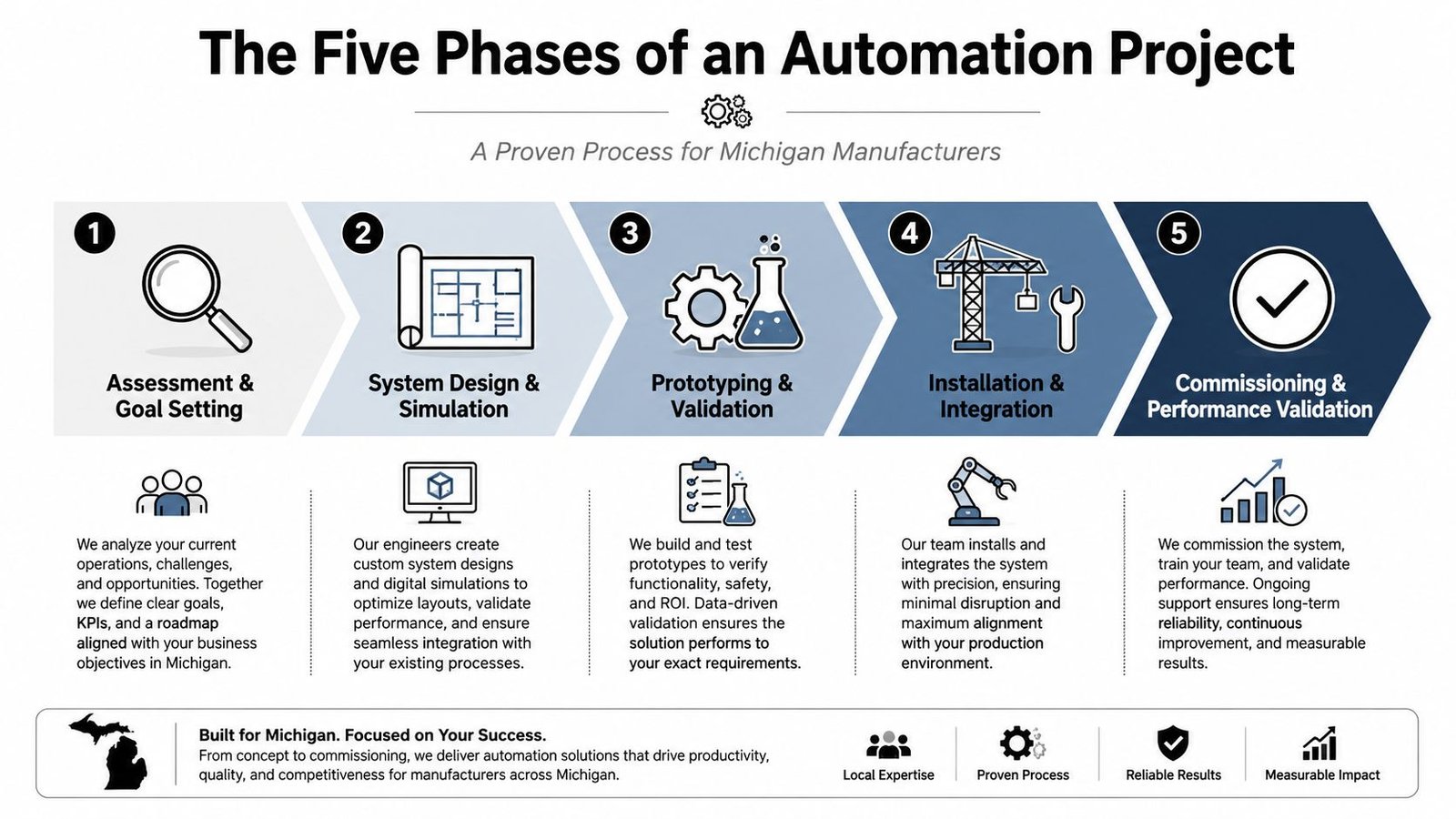
System design and simulation defines controls, fixtures, guarding, and material flow together. Michigan projects often stall here because old machines rarely talk cleanly to new ones, and the control architecture has to prove that PLCs, MES, and inspection data can share a reliable model. The World Economic Forum report points to the problem, noting that manufacturing still carries “massive legacy systems and infrastructure in place” that must be integrated with emerging technologies to reach a digital factory floor (World Economic Forum report).
Prototyping and validation is the phase that tells the truth. A cell that looks perfect on paper can still choke on part variation, fixture wear, or upstream inconsistency. A small prototype often saves more time than a grand launch ever could.
A solid prototype answers one question, can this cell survive production reality without constant operator rescue?
Phase 4 and phase 5 decide whether the project sticks
Installation and integration is where the schedule slips if the plant underestimates commissioning. The World Economic Forum notes that automation implementation faces barriers including lack of 3D models, compatibility and interoperability issues, missing specifications and inspection procedures, and insufficient training (World Economic Forum report). Those are not abstract technical problems, they are the things that force teams to open cabinets, rewrite logic, and rework interfaces.
Commissioning and performance validation should not be treated as a victory lap. It is the point where the cell proves it can run at the required pace, produce the required quality, and hand off to the operators who will live with it. If the team skips discipline here, the plant pays for it later in downtime and workarounds.
For a practical design reference, a well-scoped systems plan can help anchor expectations, and this automation systems design resource is a useful benchmark for how the sequence should be thought through.
GMP and Regulatory Considerations for Medical Device Manufacturers
Medical device automation in Michigan lives under a stricter standard than general industrial work. If the cell touches product quality, traceability, or release decisions, then documentation, validation, and change control aren't extras, they're part of the design.
That's why a cheap quote often becomes an expensive audit problem later. A fixture that only helps an operator with ergonomics may need a lighter level of documentation than a fixture tied to product-critical assembly, but the vendor has to know the difference before metal is cut.
Build the validation into the design
The best medical device programs treat IQ, OQ, and PQ as part of the project plan, not as paperwork to finish after install. If the automation partner can't describe how traceability works for each station, what gets verified, and how changes are controlled, the design isn't ready for GMP production.
For GMP-aware work, this manufacturing GMP reference is worth using as a baseline for the level of discipline a plant should expect from the start.
Michigan law also matters for automated systems
Michigan's automated-vehicle framework shows how specific the state can be about machine authority. Under Michigan law, when an automated driving system is engaged and can operate without a human operator, it is treated as the vehicle's “driver or operator” for traffic-law compliance and is deemed to satisfy physically required driver actions electronically (Michigan legal analysis of automated-driving rules). The state also requires proof of insurance before highway or street testing begins, and the vehicle must be monitored by an authorized person who can take control if needed, or achieve a minimal risk condition if that's not possible (Michigan testing statute).
Those rules are about road testing, but the lesson for manufacturing is simple. Michigan likes operational clarity. If the system can't show who is responsible, what gets monitored, and how exceptions are handled, it's not ready for serious deployment.
A second legal note is worth keeping in mind. Michigan's 2016 autonomous-vehicle legislation allowed on-demand automated motor vehicle networks for certain non-traditional manufacturers only after they had operated autonomous vehicles on public roads for more than 1 million miles (Michigan autonomous-vehicle legislation summary). That kind of threshold tells you exactly how cautious the state can be when public safety and automation meet.
Building a Realistic Cost and ROI Model
Most automation quotes understate the cost of making the machine part of the plant. The hardware is visible. The hidden work is controls, integration, installation, commissioning, and validation, and that's usually where a project gets expensive.
A useful ROI model starts with the cost buckets, then asks what the automation removes or stabilizes. If a project doesn't reduce labor dependence, improve throughput consistency, lower defect risk, or reduce ergonomic strain, the business case is weak.
Use the right cost categories
| Cost Category | What It Covers | Typical Risk Area |
|---|---|---|
| Equipment | Robots, fixtures, conveyors, sensors, guards | Choosing hardware that is overbuilt for the process |
| Controls | PLCs, HMIs, safety circuits, networked devices | Poor interoperability with existing equipment |
| Integration | Mechanical tie-ins, electrical work, data handoffs | Legacy systems, unclear interfaces, rework |
| Installation | Set-in-place work, utility connections, startup labor | Downtime during plant disruption |
| Commissioning | Debugging, tuning, operator training, acceptance testing | Schedule drift and missed performance targets |
| Validation | Documentation, traceability, GMP evidence where needed | Audit gaps and change-control failures |
A simple payback view is enough for most decision meetings. Take the total project cost, then compare it against the annual savings from fewer manual touches, fewer defects, less rework, and more consistent output. If the plant can't defend those savings with actual operating data, the project is still in the idea stage.
Don't ignore the costs the quote leaves out
The quotes that look cheapest usually leave out production downtime during installation, retraining for operators and maintenance staff, and the long-term burden of supporting more PLCs, sensors, and networked devices. If your facility already has limited industrial IT support, that maintenance load can become a real operating constraint.
For a practical way to pressure-test assumptions, this automation ROI calculator is a useful starting point for structuring the business case.
Decision rule: If the financial model only works when everything goes perfectly, the project is too fragile.
The Real Limits of Automation in Michigan Plants
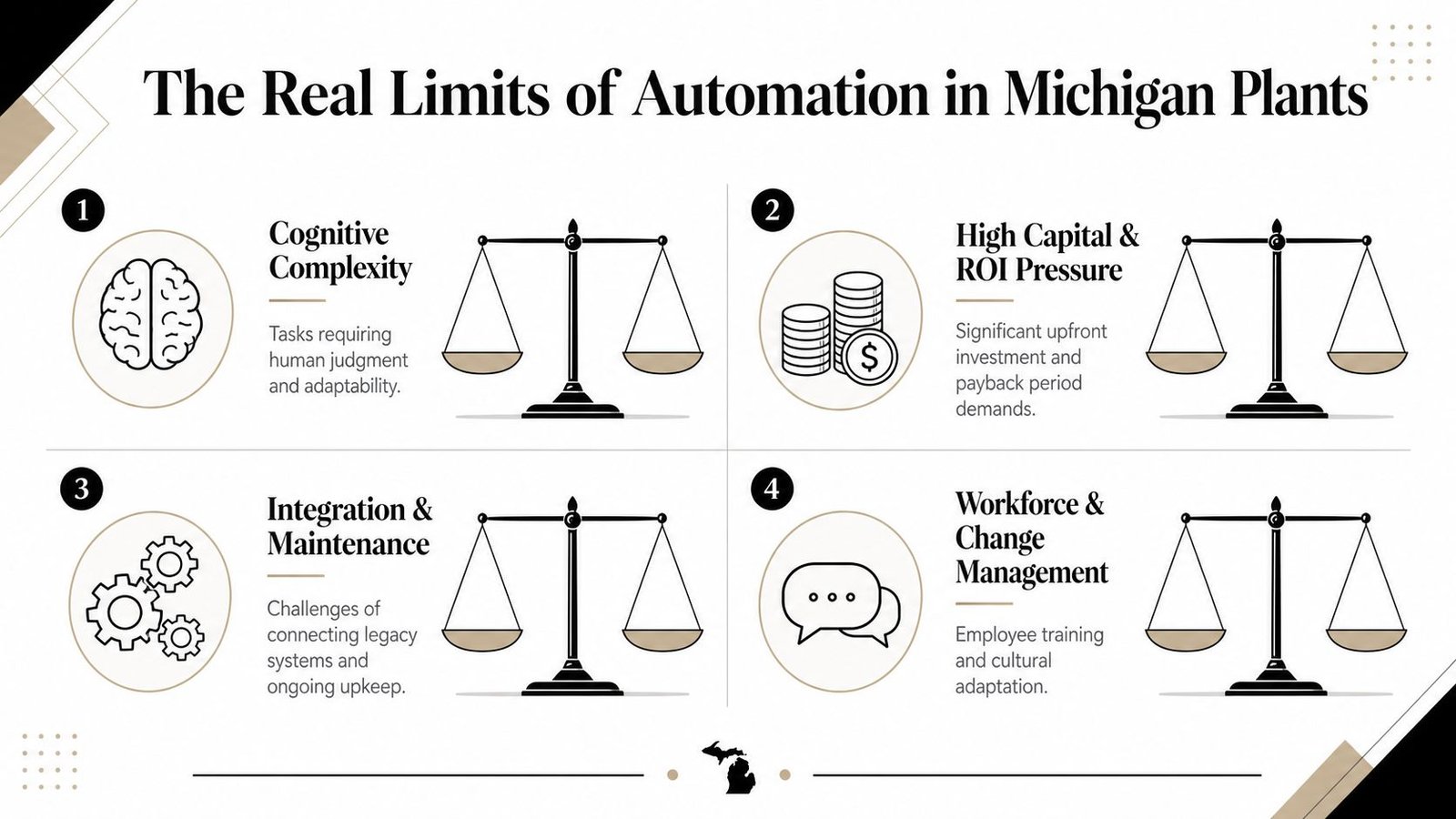
More automation is not always better. In Michigan plants, the projects that underperform usually run into the same four constraints, process variation, connectivity gaps, limited internal engineering capacity, and legacy interoperability.
The hardest part isn't buying the robot. It's making the robot survive the production line, with product variation, in a facility that may not have the digital or staffing backbone to support it.
Variation breaks elegant designs
Industry guidance on automation implementation points to existing equipment, inconsistent inputs, and process variation as common reasons automation underperforms, and it recommends phased deployment at individual stations rather than full-line replacement when the product mix is variable (Keyence automation challenge guidance). That advice matters in Michigan because mixed part geometry and upstream variability are normal, not edge cases.
Connectivity still limits remote-ready automation
Michigan still has nearly 500,000 homes and businesses that are unserved or underserved by high-speed internet infrastructure, according to state and federal broadband materials (Michigan broadband reference material). That's not just a rural broadband story. It affects whether plants can support remote monitoring, connected equipment, and reliable industrial IT integration outside major metro corridors.
Smaller plants need a simpler answer
Automation Alley has framed the workforce problem around underserved and underrepresented talent, which is another way of saying many plants don't have enough internal engineering depth to absorb a complex build without strain (Automation Alley workforce discussion). That's exactly why a semi-automated cell often beats a fully automated line in a mid-sized plant. It asks less of the maintenance team and gives operators more room to handle exceptions.
The plants that win don't ask for the most advanced system on the market. They ask for the one they can support after the integrator leaves.
Questions to Ask Before Signing an Automation Contract
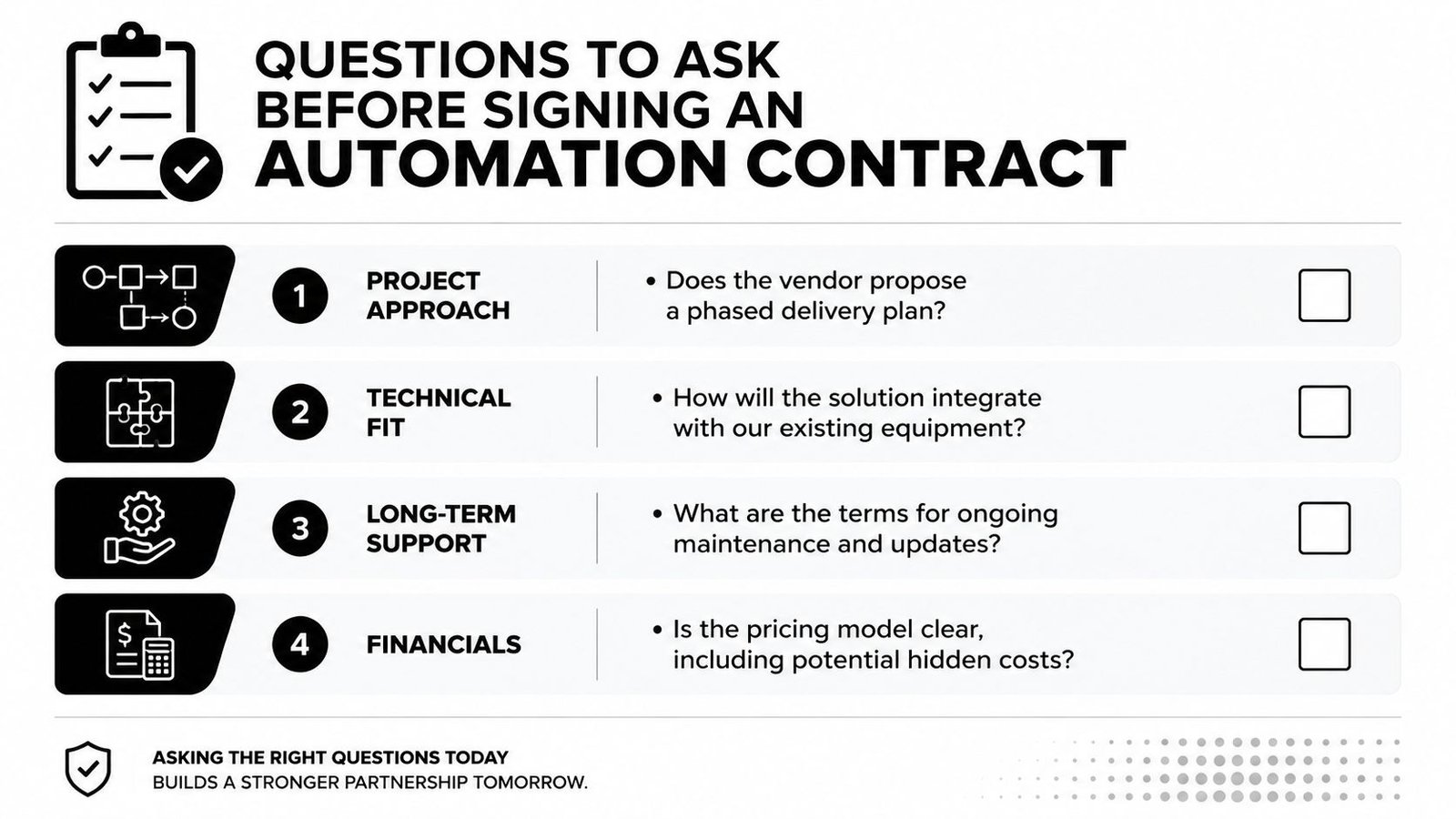
A good automation contract is usually obvious when the vendor is honest about what the plant can support. A bad one is easy to spot too. It's the quote that promises full automation before it proves the process deserves it.
Ask the questions that expose overscoping
- Project Approach: Does the vendor propose a phased delivery plan, or are they pushing a full-line replacement from day one?
- Technical Fit: How will the solution integrate with your existing controls, fixtures, and inspection process?
- Long-Term Support: What happens after startup, who handles troubleshooting, updates, and maintenance?
- Financials: Is the pricing clear about integration, commissioning, and validation, or are those costs buried?
Those four questions cut through a lot of sales language. If the vendor can't answer them directly, they probably don't understand your plant well enough to build for it.
Look for evidence, not enthusiasm
Ask for a reference project that looks like your scope, not a glossy flagship install in a different industry. If you're in medical devices, ask to see validation deliverables from a previous GMP-sensitive job. If your line still has older equipment, press them on how they handle legacy controls and whether they've had to recommend a semi-automated solution before.
If the answer is always “yes, we can automate that,” you're not hearing engineering judgment. You're hearing a sales script.
A serious partner will also tell you where the commissioning risk is highest. That matters more than the promise of a clean demo.
How SEA Approaches Complete Automation in Michigan
The right automation partner doesn't start with the fanciest line concept. It starts with the production goal, the budget, the available internal support, and the level of risk the plant can carry.
SEA's model fits that reality. It covers early consultation, preliminary concepts, full design, manufacturing drawings, material sourcing, installation, and commissioning, with a one-year guarantee and ongoing maintenance support built into the relationship. That matters because the install isn't the finish line. It's the point where the equipment has to prove it can live in your plant without constant babysitting.
SEA also takes the position that semi-automatic systems are often the best answer, with carefully selected fully automated stations where they create the most value. That approach is the opposite of overscoping. It lets a plant automate the repetitive, error-prone, or ergonomically ugly work first, then expand only where the process has earned it.
The practical takeaway is simple. Complete automation Michigan projects work best when they're treated as engineering programs, not shopping trips. You get better results when the design respects legacy equipment, documentation needs, operator skill, and the maintenance reality after startup.
If you want a partner that will tell you when semi-automation is the smarter call, and build around your real production goals instead of a one-size-fits-all line, visit System Engineering & Automation.