The advice most plants hear is simple. If a station is slow and scrap is climbing, buy the fullest robot cell you can finance. That advice treats peak cycle time as the only grown-up metric, and it is the reason good lines get an expensive machine they cannot staff, change over, or keep running.
Automation machine design is a production decision before it is a hardware decision. The economical machine is often the least automated design that removes one real constraint, while capital, legacy equipment, maintainability, and validation stay inside what the plant can support this year. A full cell can be the right answer later. It is a poor default when the line still has to ship.
Table of Contents
- What Automation Machine Design Actually Decides
- Choose the First Bottleneck to Automate
- Pick the Automation Level Before the Hardware
- Benchmark Gains You Can Defend to Finance
- Design Stages from Process Study to Commissioning
- Design for Maintenance Validation and People
- Start with a Staged Production Review
What Automation Machine Design Actually Decides
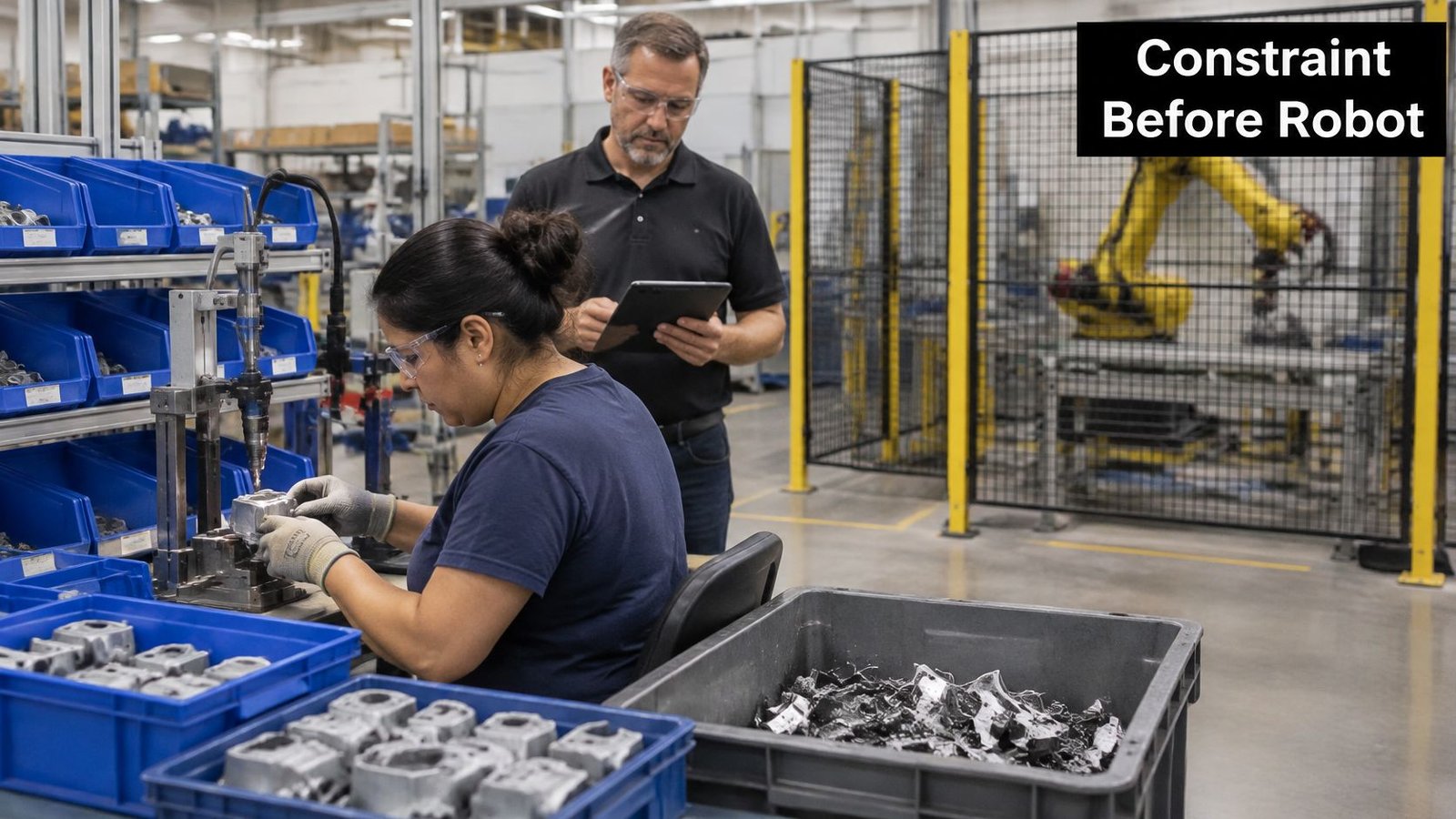
Say the press bench on second shift is the bottleneck. Operators wait on a torque check, scrap from uneven dispense is climbing, and someone has already priced a fenced robot cell. The grown-up move is not to buy the biggest machine. It is to decide which repeatable task the machine should own, which judgments a person should keep, and how much capital the process can absorb without stopping shipments.
Treat the machine as a reliable coworker for the same motion every cycle, not as a replacement for the whole crew. It can press, dispense, torque, test, label, or load the same way on part one and part one thousand. It cannot see a bent lead, a missing kit, or a fixture that was set up for yesterday's revision. Those calls stay with people.
McKinsey's analysis of global manufacturing activities, using technology demonstrated as of 2015, found that 478 billion of 749 billion manufacturing-related working hours, 64%, were technically automatable. That labor equaled 236 million full-time employees out of 372 million, and about $2.7 trillion of $5.1 trillion in manufacturing labor costs. Those hours are activities that could be automated if the technology is adapted to the use case and adopted. They are not a headcount target.
The cut that pays on a small or mid-sized floor
For a plant that is not an automotive mega-line, the useful cut is narrow. Automate the repetitive, predictable motion. Keep people on setup, exceptions, quality calls, and maintenance. Payroll is only one outcome. The others that finance and quality will defend are throughput, less variation, safer tasks, and data a quality tech can trace to a cycle.
Practical rule: If you cannot name the motion the machine repeats and the judgment the operator keeps, you do not have a machine concept. You have a catalog page.
The disciplines that have to move together
A working station is not a demo with a robot dropped on a bench. Hold these together before layout freezes.
- Mechanical design: Fixtures, nests, and only the motion the task needs. A nest and a cylinder beat a six-axis arm when the part only has to be pressed once.
- Controls: A PLC, or simpler stored logic, with sequencing and interlocks. Don't specify a control architecture the night-shift electrician cannot reset.
- Sensing: Presence, position, torque, and a vision check only where a sensor would otherwise miss a defect.
- Safety: Risk review and guarding before the footprint is painted on the floor. Pinch points and stored energy are design inputs, not a sticker added at install.
- Tooling: Quick-change nests and mistake-proofing so the wrong part cannot seat.
- Process validation: Evidence that a good part comes out every cycle, stored as torque, force, or pass-fail, not as someone's memory.
Pick the automation level next, run the design stages against one bottleneck, specify upkeep and validation as performance specs, then test any published gain against this plant's mix. A coordinated set of those disciplines is what separates a station that ships from a cell that looks finished in a video.
Choose the First Bottleneck to Automate
Robot stock is large, and that scale tempts people to start with a cell. In 2023, factories worldwide operated 4,281,585 industrial robots, a 9.7% increase from the prior year, while global manufacturing robot density rose from 151 to 162 robots per 10,000 manufacturing employees, according to the International Federation of Robotics executive summary. The same installations split across automotive at 25%, electronics at 23%, and metal and machinery at 14%. That mix is assembly, handling, inspection, and process tooling, not one universal cell. Your first machine should match one of those jobs on your floor.
Four stations that earn a machine
Assembly with a repeated press, torque, or dispense. Scrap and warranty cost usually live in the parameter, not in the walking. A semi-automatic nest locks the part and applies the same force or torque every cycle. Say a medical-device bench still kits by hand because lot sizes move. You add a torque-and-test station for the screw that fails incoming inspection, and you leave full conveyance alone until weekly volume is stable. Kitting stays manual. The parameter does not.
Packaging and labeling. Automate the apply-and-check step. A person still handles odd counts, short lots, and the changeover between two labels. A labeler that needs an engineer for every SKU swap will lose the time it saved.
Inspection and test. A fixture plus sensors, or a simple vision check, records pass-fail and a serial. When a complaint arrives, quality traces it to a cycle instead of asking who was on the bench. If the only record is a stamp in a logbook, the station is still manual no matter how fast the gage is.
Machine tending. A loader earns its cost only when waiting for a person is the main constraint, and someone on site can recover a mispick before the spindle sits idle. If recovery means calling the integrator, the loader is a new bottleneck with a higher hourly rate.
Three tests before you spend
Run the candidate through three tests. A station that passes all three is a candidate for the first machine. One that fails any of them stays manual, or gets better tooling, until the facts change.
- The task repeats every cycle. If the motion changes with every work order, you are automating variety, and variety is what operators are for.
- The defect or delay is measurable this month. Cycle time, scrap count, or waiting minutes. A feeling that the area is "slow" is not a spec.
- The line can keep shipping while the station is installed. Build and debug off the line. If installation requires a week of lost shipments, the project fails before it cycles once.
Bottleneck identification is the filter, not a tour of available robots. Name the station, write the defect, and confirm the line can live without that square of floor during install. Everything else can wait.
Pick the Automation Level Before the Hardware
The most economical automation machine is often not the most automated one. Choose the level around the process, available capital, legacy equipment, and the support your team can maintain. Hardware comes after that decision.
| Level | Best when | Operator role | Cost and risk | First win |
|---|---|---|---|---|
| Manual tooling and fixtures | Low volume, frequent changeover, or tight capital with a stable manual process | Performs the full cycle using guided nests and mistake-proofing | Lowest integration risk; no cell programming | Fewer handling errors and faster training |
| Semi-automatic workstation | One repetitive step such as pressing, dispensing, torque control, testing, labeling, or packaging, while product mix still changes | Loads parts, starts the cycle, and unloads finished products | Lower development and integration costs than automating an entire line | Shorter cycles and consistent process parameters |
| Fully automated cell | High, stable volume, a labor or safety constraint, and the skills to support the cell | Provides minimal intervention while tending and material flow run automatically | Highest cost due to extra design work, specialized components, manufacturing, wiring, and complex programming | Continuous operation with less labor dependency |
Which row a constrained plant should fund
A full cell carries the highest cost because it requires more design, specialized components, wiring, and programming. A table-top semi-automatic station focuses on a specific task, so development and integration costs are significantly lower. For a mostly manual operation, tooling and fixtures may be the more practical first investment.
Manual tooling suits low volume, frequent changeovers, or tight capital when the process itself is stable. Guided nests and mistake-proofing can reduce handling errors without adding a control system to maintain. A staged path can start with tooling, move to semi-automation as production demands increase, and reach full automation when the process and support capacity justify it.
A semi-automatic workstation suits a repetitive task within a changing production mix. The operator loads parts, starts the cycle, and removes finished products while automated components handle pressing, dispensing, testing, labeling, or assembly. The operator retains control of the process, and the system repeats the relevant parameters for each part.
A fully automated cell suits stable production where continuous operation, safety, or labor dependency justifies the added capital and support requirements. Robotic tending, conveyors, vision systems, PLCs, and sensors can be integrated as the process requires. If the plant cannot maintain and recover the cell, automation may shift the bottleneck from manual work to downtime.
The 2025 Smart Manufacturing Adoption Study found the leading barriers were high cost at 21%, capital requirements at 16%, lack of a convincing business case at 14%, and workforce skill gaps at 14%. Capital and skills can constrain adoption, so a staged investment can be more practical than funding a complete cell at the outset.
The cheapest design that removes the bottleneck usually beats the most automated design you can draw.
Payback that finance will not throw out
Do not calculate payback on labor hours alone. Account for changeover time, fault recovery, and whether quality problems can be traced. A station that saves labor but adds delays or untraceable defects may not deliver the expected return.
- Quality: Repeatable process parameters can reduce variation and rework.
- Safety: Fixtures or automated handling can keep operators away from hazardous tasks.
- Uptime: Clear fault recovery helps avoid unnecessary delays.
- Changeover: If short runs require frequent changes, account for the time needed to switch nests or settings.
- Training: Operators need clear instructions for loading, starting, and recovering the process.
Design the interfaces so a later vision check, fixture, or connection to production systems can be added without replacing the machine base. Levels of automation provide options to match the process and investment, not a ranking of which plant is most modern. Fund the level the team can support now, while leaving a practical path to the next one.
Benchmark Gains You Can Defend to Finance
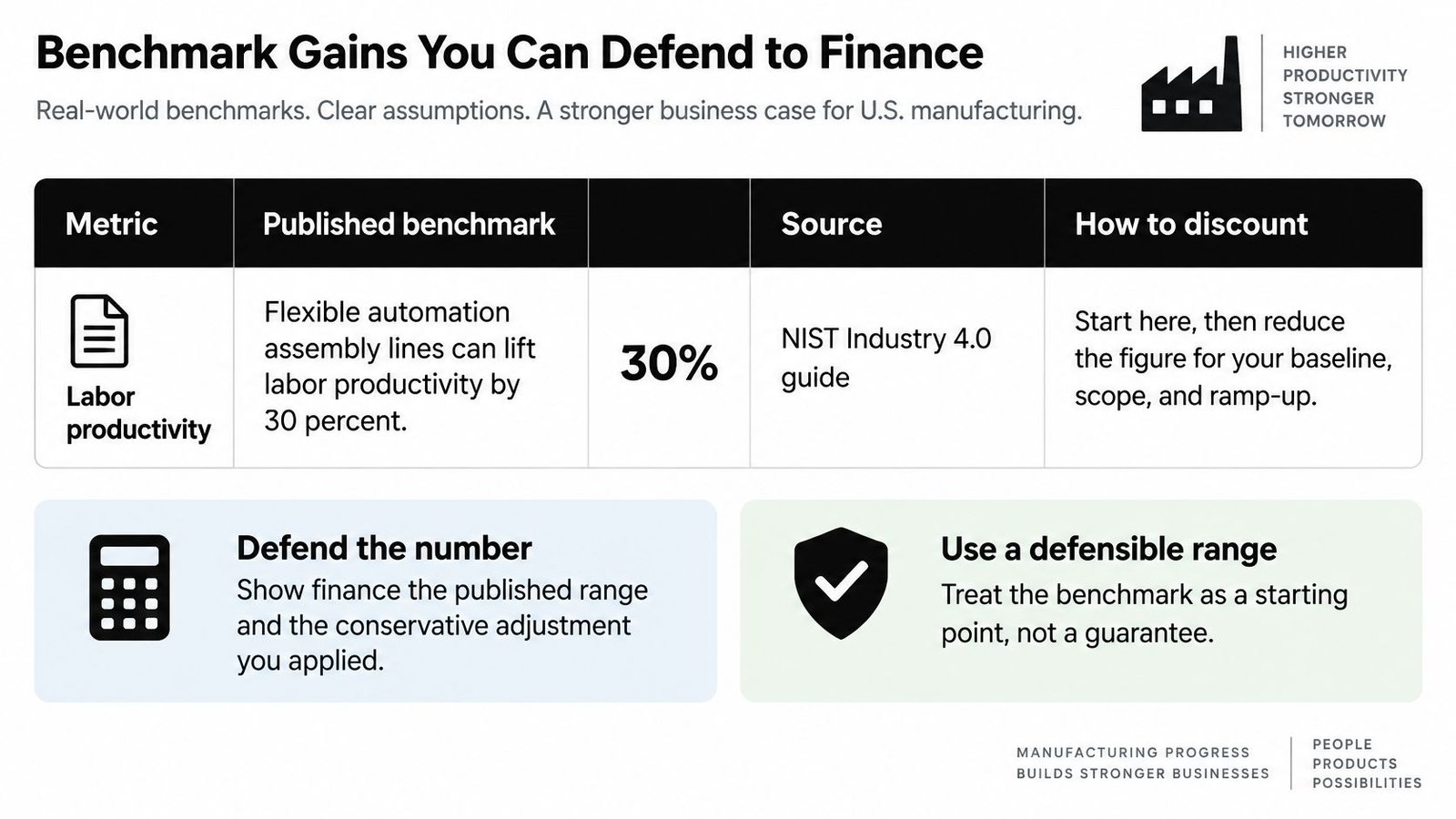
Published ranges are ceilings, not a promise your line will hit them. Put your baseline next to the range, then cut the number for scope, mix, and the months it takes people to run the station well.
| Benchmark | Reported result | Applies when | Do not assume |
|---|---|---|---|
| Flexible automation assembly | 30% higher labor productivity | A constrained assembly or handling step | The whole factory improves by 30% |
| Collaborative robotics | 25% better labor efficiency | A person still loads, judges, or changes over | A cobot replaces the station crew |
| Advanced analytics | 80% fewer process deviations | Sensors and usable process data already exist | Dashboards alone cut defects |
| AI quality management | 60% fewer customer complaints | Quality data is acted on before shipment | Every plant sees a 60% drop |
| Digital manufacturing, engineering labor | 45–55% higher productivity | Design, drawings, and controls are one project | Hiring software creates the gain by itself |
| Digital manufacturing, quality cost | 10–20% lower quality cost | Process control cuts scrap and rework | Inspection headcount is the only saving |
| Resource and process productivity | 3–5% higher | High volume where small gains compound | A modest line will transform overnight |
Read the figure at the station, not the factory
The NIST Manufacturers' Guide to Industry 4.0 Technologies reports that flexible automation assembly lines can increase labor productivity by 30%, and that collaborative robotics can improve labor efficiency by 25%. The same guide identifies an 80% reduction in process deviations through advanced analytics and a 60% reduction in customer complaints through artificial-intelligence quality-management systems. These are technology-specific examples. They are not a factory-wide entitlement.
A 30% labor-productivity figure supports automating one bottleneck in assembly, loading, inspection, or handling. It does not support blanketing every bench. A 25% collaborative-robot figure supports keeping a person in the loop for load, judgment, and changeover. The 80% and 60% quality figures hold only if the plant already collects clean data and someone acts on it before the part ships. A screen in the office does not cut a field complaint.
NIST's survey material on artificial intelligence in U.S. manufacturing reports that 72% of respondents associate AI adoption with reducing costs and improving operational efficiency, 54% with process improvement, 54% with preventative or predictive maintenance, and 50% with productivity and cost reduction alongside 49% with quality improvement. That is a motive for sensors, diagnostics, and a maintained control program. It is not another hardware tier to buy before the station can record a torque.
A one-page case finance can audit
Build the case on one sheet.
- Baseline: Cycle time, first-pass yield, scrap, unplanned downtime, and training hours on that station only.
- Ceiling: One relevant published range, applied to that station, not to the plant.
- Subtractions: Integration with the legacy machine, the skill gap on the crew who will own it, and the weeks of ramp before the new cycle is the normal cycle.
None of these percentages transfer automatically. Fund a pilot station, measure the same five baselines, then scale where the return is real.
Automation ROI metrics should be the ones you already collect, not a slide of industry averages. If you cannot fill the baseline row this month, you are not ready to defend a machine to finance.
Design Stages from Process Study to Commissioning
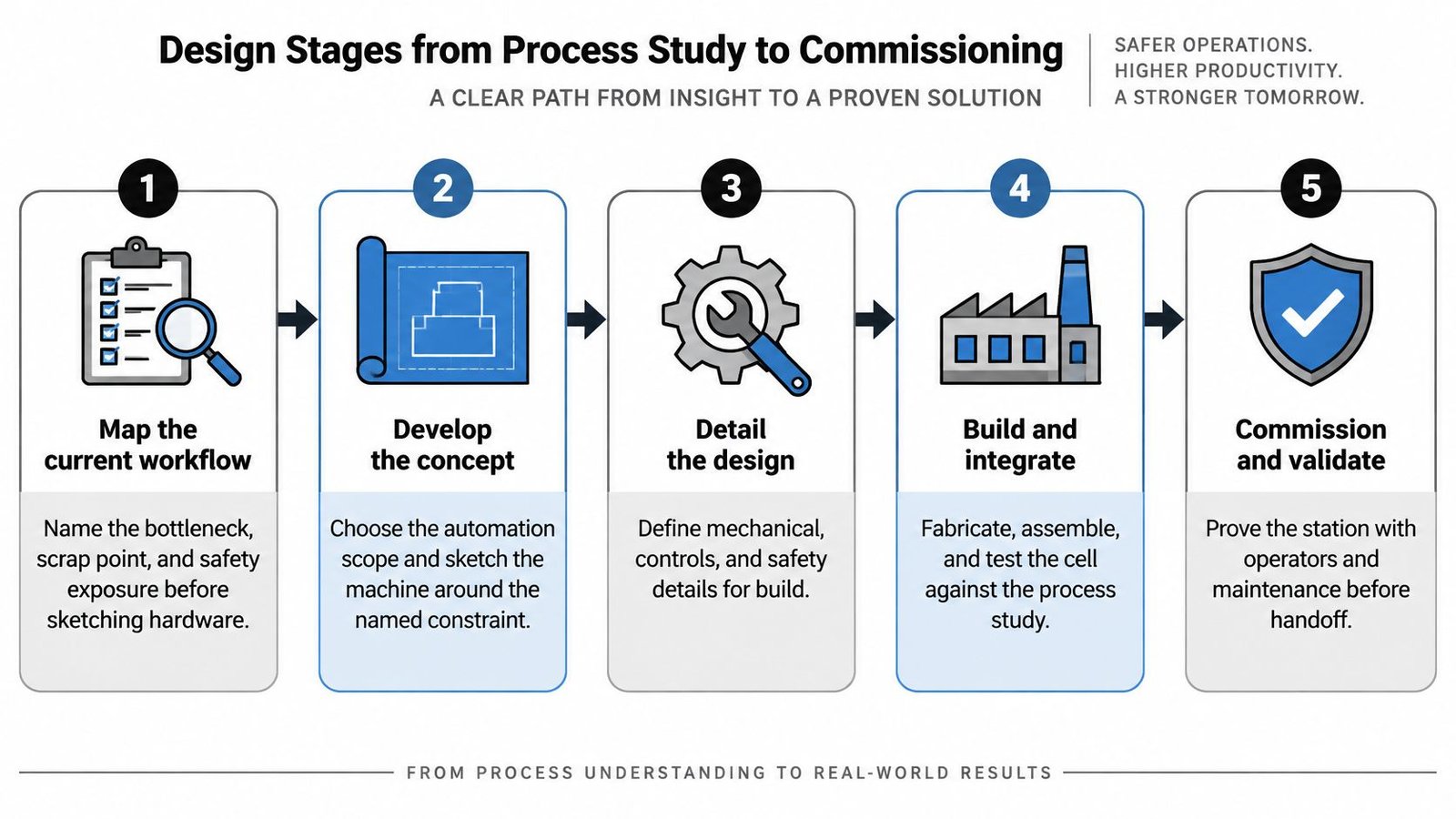
The lowest-cost machine is rarely the one with the most automation. Build the design around the production constraint, existing equipment, and available capital. A staged project can improve a process without forcing a full line replacement, while leaving room to add automation if production needs change.
NIST's digital manufacturing research reports a 3–5% increase in resource and process productivity, a 45–55% increase in engineering labor productivity, and a 10–20% reduction in quality costs. These ranges are targets, not promises. Results depend on the baseline, data quality, process stability, and whether operators follow the redesigned process. A few percent of resource productivity can matter on a high-volume route, but the same gain may not justify a major investment on a short-run bench.
System Engineering & Automation designs new equipment and improves existing manufacturing processes and equipment. The project sequence turns a production need into a machine that can be built, installed, and used.
Six stages and the paper each one leaves behind
- Map the current workflow. Observe the station with its operators and identify the bottleneck, scrap point, and safety exposure before designing hardware. Deliverable: a one-page process map with cycle time and defect count.
- Set requirements. Define cycle-time targets, product mix, changeover time, quality specifications, floor space, utilities, and what must keep running during installation. Review pinch points, stored energy, and operator access to the work area. Deliverable: a signed requirements sheet. Unwritten requirements often surface as redesign during debug.
- Choose the machine concept. Match the hardware to the task: fixtures, sensors, PLC-based controls, or only the motion the process requires. A nest and cylinder may be sufficient when a part needs one controlled movement. Deliverable: a concept layout for operator review.
- Prepare the build package. Specify manufacturing drawings, controls logic, guarding and interlocks, and the data the station must record, such as torque, press force, or pass/fail results. Deliverable: drawings and an I/O set with clear tag names.
- Build, wire, and debug off the line. Check sensor locations and run sample parts before installation. Include a defective part the station should reject. Deliverable: documented runoff results.
- Install and commission. Train operators, document fault recovery, and confirm the station can run a good part. Deliverable: operating and recovery instructions suited to the production team.
Spare interfaces you specify now
Reserve an input, mounting space, and a data tag for a possible vision check, additional fixture, or manufacturing-system connection. Planning for these interfaces can avoid a new frame if the process later needs an upgrade. Keep the design proportionate to the current need: interfaces cost less than installing unnecessary automation, but they should be specified where a likely next step would otherwise require rebuilding the machine.
Design for Maintenance Validation and People
The cheapest machine to run is not always the one with the shortest cycle time. A station that only the original programmer can reset can turn a small fault into lost production. Design for the people who will operate, maintain, and update the equipment after installation.
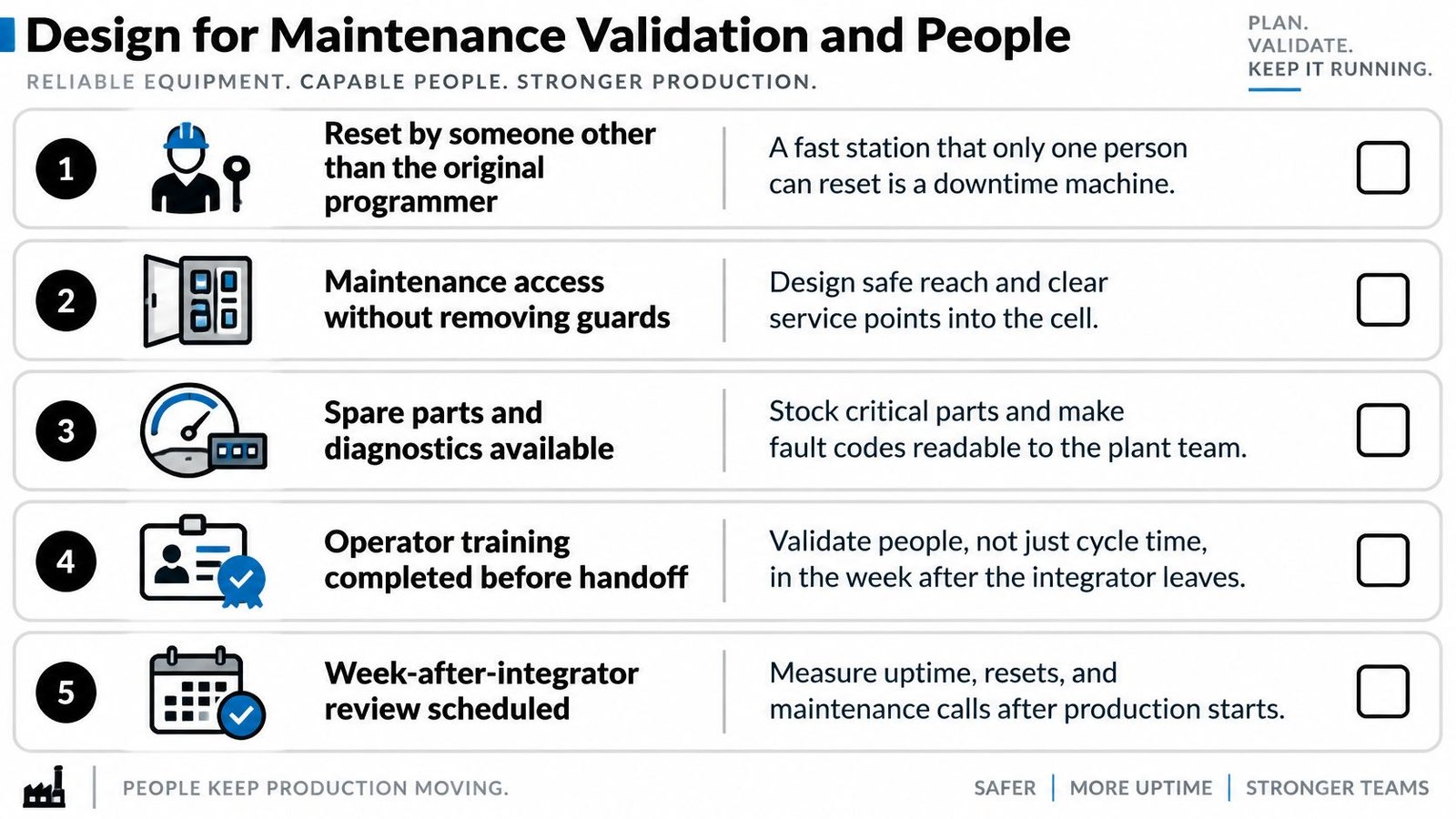
U.S. manufacturing data cited in a 2025 workforce report indicates that roughly 3.7 million of 13.2 million manufacturing workers, about 28%, are approaching retirement. Between 2016 and 2025, industrial machinery mechanics grew 31% and industrial engineers nearly 43%, while machinist employment declined by more than 25%. Design controls and recovery steps for the electrician on second shift, and make changes understandable to the engineer who will own them.
What that crew needs on the machine
Label circuits and make wear parts accessible without removing the full guard set. Use consistent alarm language across stations, and provide a fault list an electrician can follow without calling the vendor. The operator interface should make clear what to load, what triggers a lockout, and how to quarantine a rejected part so it cannot return to the production bin.
Specify who clears jams and who approves changes. If the answer to either question is “the vendor,” ownership has not been defined. Put the recovery process in writing and train the people responsible for it.
Validation by design, not after the fact
For medical-device production and other regulated or customer-audited processes, plan traceability, controlled changes, qualification, and data integrity into the machine from the start. Build in a way to collect and document the information needed to assess the process, refine it, and support later revalidation. Capture recipes, user access, calibration, and batch data during early development. Adding records after installation can mean repeating qualification work.
Set maintainability and validation requirements alongside cycle time:
- Technician skill level: Specify the trade and skill level needed to reset the station.
- Spare-parts strategy: Identify critical wear items and use the same part numbers in the drawings and spare-parts list.
- Diagnostic tags: Use fault messages plant technicians can understand without a vendor laptop.
- Controlled recipes: Require a named approver for parameter changes.
- Audit-ready records: Tie torque, force, or pass-fail results to the lot and store them where quality staff can find them.
- Training before sign-off: Train operators and maintenance staff on the finished station before commissioning is complete.
Accessible parts, clear fault recovery, and usable records protect uptime and support audits. Set those requirements early, even when the production plan calls for a staged upgrade rather than a fully automated system.
Start with a Staged Production Review
Pick one bottleneck. Write today's cycle time and today's defect rate on that station. Then choose the row you can fund this year, tooling, a semi-automatic station, or a cell. If the process is still mostly manual, start with tooling or a semi-automatic station and leave a path to add sensing later. If volume, safety, and skills already justify a cell, put maintenance, data, and validation in the same package as the mechanics. Do not buy the cell and hope the records show up.
Bring three things to the review. The bottleneck, with the cycle time and the defect you can count. The headcount on that station, including who covers breaks and who clears a jam. The quality complaint you cannot afford to repeat, named as a failure mode, not as a mood.
We use a no-obligation manufacturing automation consultation to hear current bottlenecks, labor and production constraints, quality or consistency problems, and budget and timeline before anyone proposes hardware. The work is practical manufacturing automation aligned to real production needs. The range covers fully automated equipment, semi-automated systems, manual equipment, tooling and fixtures, and integrated tools. Semi-automatic systems are the usual fit when you cannot pause the line for a full replacement. A one-year guarantee and a path from concept through install matter for one reason. A staged design should not die between the drawing and the day an operator runs the first good part.
Leave the meeting with a machine scope matched to this year's capital. Leave the catalog of the most automated option in the drawer until the first station has a measured cycle and a fault list your own crew can use.
System Engineering & Automation designs and builds the station your line can run, from tooling and semi-automatic workstations through fuller cells when the volume and the crew are ready. If you want production and service optimized around one bottleneck instead of a robot for its own sake, bring your cycle time, headcount, and the defect you cannot repeat. Visit System Engineering & Automation to start that review.