

Most of what gets sold as a quick change fixture is a faster clamp. That's not where changeover time lives. If you've ever watched an operator spend four minutes swapping a pallet in ninety seconds and then thirty-five minutes chasing the first good part, you already know the mechanism isn't the bottleneck. Setup is a system: retrieval, cleaning, staging, locating, clamping, verification, first-piece approval, and the walk between all of them. The fixture touches maybe a third of that list.
I've sat through enough time studies to say it plainly: a quick change fixture pays off only when the measured changeover sequence around it is designed and staged to use it. Buy the plate without the staging and you've bought a faster way to arrive at the same thirty-eight minute changeover.
What follows is the version I'd hand to an operations manager who's about to sign a purchase order. The history and the architecture, the place to look for the time, how to measure it, where repeatability betrays speed, how to match fixture level to production volume, what documentation regulated work demands, and an audit you can run next week before you spend anything.
Table of Contents
- What Quick-Change Fixtures Are and Why They Exist
- Where Changeover Time Really Goes and How Fixtures Cut It
- How to Measure a Changeover Before and After
- Why Fast Clamping Can Still Fail on Repeatability
- Matching Fixture Level to Your Production Profile
- Documenting Fixtures in Medical and GMP Production
- Run a Changeover Audit Before You Buy
What Quick-Change Fixtures Are and Why They Exist
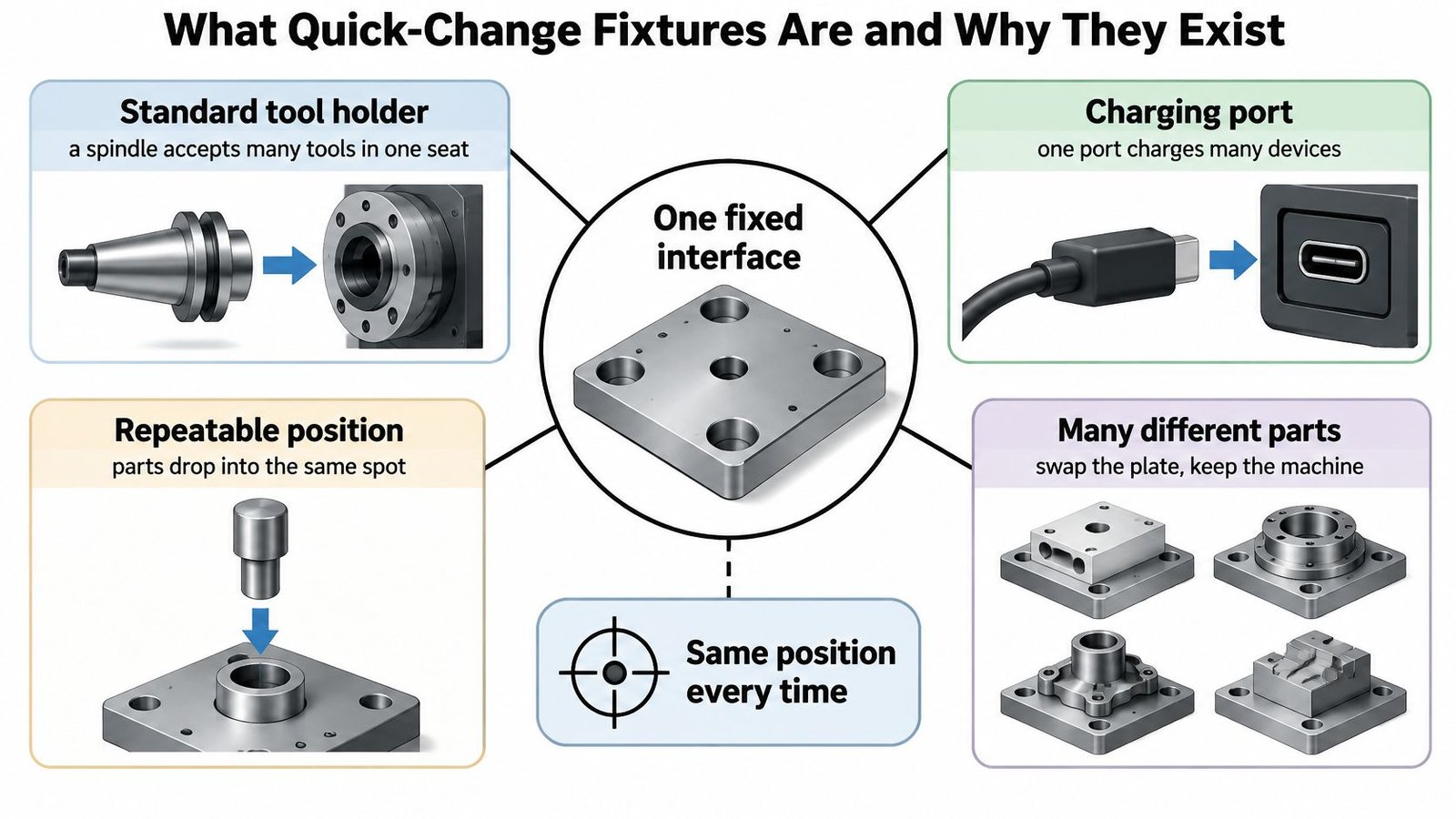
A machining center spindle accepts thousands of different tools through one taper, and every one of them lands in the same place. A USB-C port takes a laptop charger, a monitor cable, and a phone, all through identical geometry. A quick change fixture does the same job for workpieces: one fixed receiver on the table, and a family of plates, nests, and adapters that all present the part to the machine at the same reference position. Swap the plate, keep the machine.
The technical name for that fixed receiver is a zero point, a common reference between the machine, the fixture, and the workpiece. The toolpath, the probe routine, and the inspection plan are all written against that reference. That is what makes a swap a relocation instead of a fresh setup.
Where the idea came from
Zero-point positioning systems were developed to standardize rapid workholding changes: pull the old pallet off its receiver, seat the new one on the same datums, and cut. The deeper effect was on fixture design itself. The discipline shifted away from isolated, part-specific tooling and toward reusable systems built on repeatable datums. A shop no longer engineered every fixture from a blank. It engineered the part-specific nest and bolted it to a common base.
The four parts you'll see in any setup
From a benchtop assembly cell to an ultra-precision lathe, the arrangement breaks into the same four elements:
- The base or pallet, permanently mounted and immovable in practice, carrying the reference geometry.
- The locating elements, pins, bushings, rails, or an end-tooth coupling, that define position in all six degrees of freedom.
- The clamps, which hold the part against those locators without moving it.
- The adapters or nests, one per part family, that translate a specific component into the common interface.
Accuracy is where the receiver earns its keep. The 2021 study of an end-toothed-disc quick-change fixture in Machines reports that comparable systems commonly achieve repeat-positioning accuracy of 2 to 5 micrometers, and in its own ultra-precision diamond-turning application the researchers measured positioning accuracy of 1 micrometer experimentally, with roughly 0.9 micrometers of simulated maximum deformation and a minimum natural frequency of 5,655.9 Hz. Numbers like that are the reason the zero point exists. A fast swap that lands somewhere different each time just repeats the same error faster.
The test I'd apply: walk to your machine and name three things out loud. The reference interface, the clamps, and the part-specific nest. If you can't point to the interface because it's buried under shims, or the nest is the fixture, there's nothing to standardize yet.
That distinction decides whether a purchase is a platform or a one-off. A platform gives every future nest a guaranteed seat. A one-off is a fixture, and you already know how to buy those.
Where Changeover Time Really Goes and How Fixtures Cut It
Here's the answer before the evidence: a quick change fixture shortens a changeover only when it moves work out of machine-stopped time or eliminates the adjustment that follows the swap. Anything else is a faster version of the same internal work.
Two categories decide where the minutes go. Internal work requires the machine stopped: the old fixture coming off, the new one going on, alignment, trial cuts, first-piece approval. External work happens while the spindle is still cutting: staging the next nest, pre-loading the part, gathering tools, reading the setup sheet. The ratio between them is the target. Fixture hardware is one lever among several, and rarely the cheapest.
A machining case study in IOP Conference Series: Materials Science and Engineering breaks one setup into 56 activities: 45 were internal and consumed 36.22 minutes, while 11 were external and consumed 13.2 minutes. Redesigning the jig and running setup tasks in parallel with process operations brought total changeover from 58.36 to 39.22 minutes, a 33% improvement.
Notice what did the work. Part of the gain came from the jig redesign. Part came from parallelizing activities that had run sequentially for no good reason. A fixture purchase delivers the first and ignores the second, which is why so many installations underperform the brochure.
Documented results, side by side
| Case | Before (min) | After (min) | Change |
|---|---|---|---|
| Machining setup, jig redesign with parallel setup tasks | 58.36 | 39.22 | 33% faster |
| Metal fabrication, internal-to-external conversion of model changeover | 78 | 27 | 66% faster |
| SMED study, changeover reduction across the line | 55 | 39 | Nearly 30% reduction, OEE above 70% |
Benchmark each row against a line with similar part counts and batch sizes. The metal-fabrication case, published in the Revista Científica y Tecnológica, got its 66% reduction (78 to 27 minutes) largely by converting internal activities into external ones and by treating fast tool assembly and disassembly as part of the setup-reduction plan. The SMED work in Sustainability reached a similar place by a different route: nearly 30% off changeover, OEE above 70%, and a 10% cut in labor cost.
The 66% row matters most if you are buying fixtures. Tooling was one component of that plan. The team changed when work happened, which costs nothing, before it changed what hardware did the work, which does.
Why the mechanism alone disappoints
A fast-release mechanism can be defeated by any of four things: fixtures that aren't staged when the machine stops, locating surfaces carrying chips or coolant, work instructions nobody can follow under time pressure, and a quality approval step sitting on the critical path. A chip on a locating face erases the repeatability the interface was bought to deliver. Add first-piece rework and the theoretical seconds saved evaporate.
A structured changeover time reduction process belongs ahead of hardware specification. The sequence audit decides what the fixture needs to do, and it usually changes the spec.
What I'd tell a plant manager: don't approve a fixture purchase until someone has watched three changeovers with a stopwatch and written down what the operator did with their hands and feet. The stopwatch findings usually change the specification.
How to Measure a Changeover Before and After
The definition that survives contact with a shop floor is this: changeover time runs from the last acceptable part of the old run to the first acceptable part of the new run. Not from machine stop to spindle start. That interval hides the restart cost, which is where a lot of the money sits.
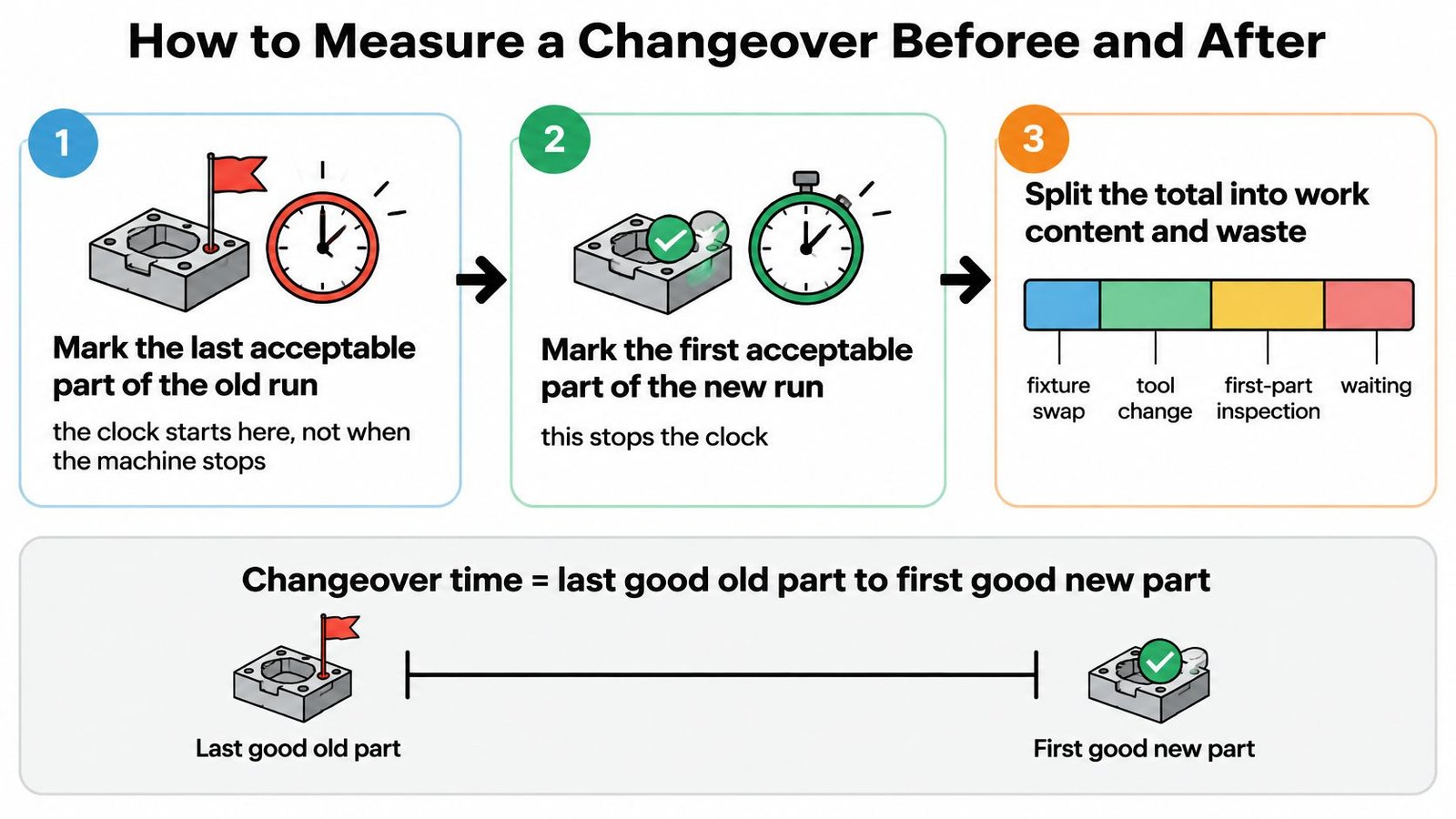
The IOP study's validation protocol recommends exactly this, and adds the step most audits skip: record fixture exchange, alignment, clamping, verification, and trial-part correction separately. That separation is how you tell mechanical quick-change performance apart from operator and process losses.
The six-step protocol
- Mark the last acceptable part of the old run. The clock starts there, not when the machine stops. Starting at machine stop ignores the wind-down, the last-part inspection, and the tooling decisions that happen while the spindle is still turning.
- Mark the first acceptable part of the new run. Not the first part off the new fixture, the first one that passes. If your approval requires a CMM result, the clock runs until that result lands.
- Split the elapsed time into work content. Fixture exchange, alignment, clamping, verification, and trial-part correction get their own lines. A single total tells you nothing about which one to attack.
- Tag every activity internal or external. Include operator travel and fixture retrieval as their own line items. Retrieval from a storage room forty metres away is changeover time, and it disappears entirely once you stage the next nest at the cell.
- Time several changeovers per product family. One run is an anecdote. Variation between runs matters as much as the mean, because the mean doesn't set your schedule, the bad days do.
- Compare four numbers before and after. Mean time, variation, first-pass yield, and adjustment count. All four, or you're measuring a purchase rather than an improvement.
The common slips are predictable. Starting the clock at machine stop makes any changeover look better and hides the restart cost. A single timed run flatters whatever you changed, because the operator was being watched. And a fixture swap that's fast but demands repeated alignment reintroduces the minutes you removed.
The rule I'd put on the wall: if the average falls but the adjustments or the restart rejects rise, the fixture has not improved throughput. It has moved the loss downstream.
Why Fast Clamping Can Still Fail on Repeatability
The assumption that needs breaking is that a fast clamp means a good part. Clamping force and locating accuracy are different problems, and solving the first can worsen the second.
The evidence is in the displacement figures. Simulation research on flexible fixturing reports workpiece displacements in the range of approximately 0.003 to 0.226 mm for a flexible configuration. That's a spread of more than two hundred micrometres, which is not a fixturing curiosity. It decides whether the part returns to its validated position after every exchange, and it dwarfs the 2 to 5 micrometre repeatability the interface itself can deliver if the clamp deflects the workpiece out of the datum.
The four specifications that protect repeatability
- A master locating interface shared across product variants. If each family has its own interface, you've rebuilt the dedicated-fixture problem with extra steps.
- Seating surfaces protected from chips and coolant, with cleaning built into the changeover. Not "clean as needed", a defined wipe and blow-off step in the sequence, timed and audited like everything else.
- Clamps that apply consistent, specified force without distorting thin or compliant workpieces. Test on real parts, not on the thickest coupon in the drawer. Thin sections move first.
- A datum verification step that confirms position before cycle start. A probe routine, a sensor, or a disciplined first-piece check. Verification is not bureaucracy, it's the feedback loop that catches a nesting error before it becomes forty scrapped parts.
A mechanically simpler fixture frequently beats a pneumatic or highly modular design when it's easier to clean, inspect, mistake-proof, and validate. Speed you can't verify is speed you can't run unattended.
Illustrative scenario. A plant running a secondary-product assembly starts seeing scratches near a locating point. Rather than adding sensors or replacing the station, the team adds a small custom insert at the locating point. The custom insert fix stops the scratches, achieves perfect alignment and full engagement of the secondary product, and requires no downtime or major rebuild. The lesson isn't that inserts are magic. It's that the correction was a targeted engineering change at the exact point where the part was failing to seat, and it was diagnosed by reading the geometry rather than by buying capability.
When displacement is the suspect, work the numbers before you touch hardware. A tolerance stack-up analysis will tell you how much of the 0.226 mm you can afford to attribute to the fixture.
Matching Fixture Level to Your Production Profile
Fixture cost is not a rounding error. A manufacturing-engineering study summarized in Engineering, Technology & Applied Science Research's modular fixturing review reports that fixture design and production may account for 10% to 20% of the total cost of a manufacturing system, and that poor fixturing has been associated with approximately 40% of rejected parts caused by dimensioning errors. That second number is the one to sit with. Fixtures are a quality variable, not a tooling expense.
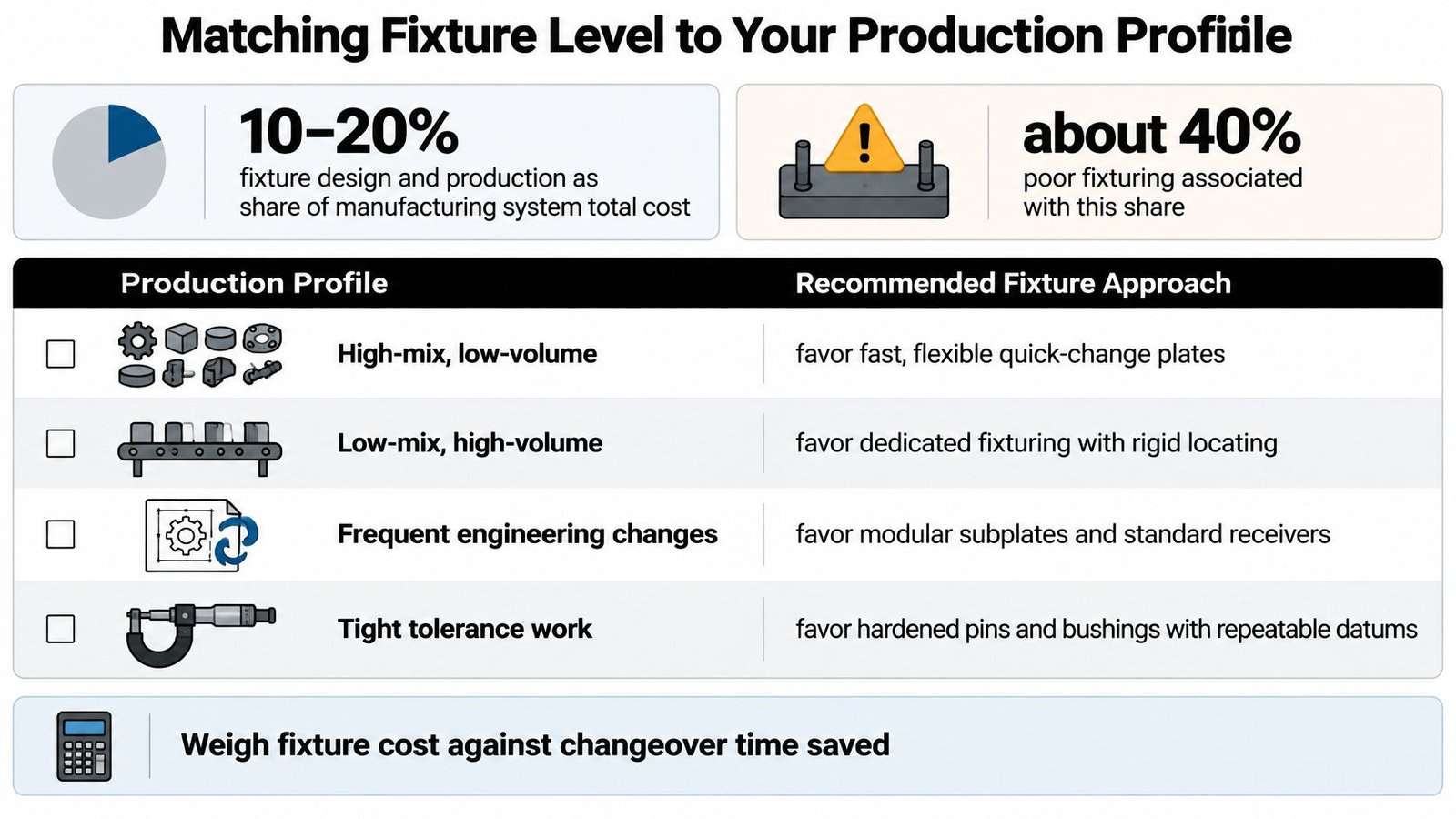
The same review identifies modular fixturing as the most widely used flexible-fixturing approach, and reports that modular fixtures can reduce production-preparation time by more than 80% in applicable job and batch-production settings. A separate technical study cited there states that modular fixtures assembled from standardized components can be built in about 20% of the time required for dedicated fixtures. Five times faster to construct, and reusable when the part family changes.
The decision table
| Production profile | Typical fixture approach | Assessment signal |
|---|---|---|
| Manual, low-volume, few part numbers | Tooling and fixtures on existing benches | Changeovers are rare; cost per change matters most |
| High-mix, small batch | Modular quick-change base with shared nests | Changeovers repeat weekly or daily |
| Semi-automated cell | Table-top semi-automatic system with quick-change tooling | Operator time and first-piece rework set the bottleneck |
| Fully automated line | Automated exchange with keyed locating and sensors | Downtime per change costs more than the automation |
A business still running largely on manual labor might benefit more from better tooling and fixtures than from automation, which is a point worth making to anyone whose default answer to a capacity problem is a robot. Tooling and fixtures improve the efficiency and quality of manual operations, particularly when budgets are limited. Later, a transition to semi-automated systems can offer greater efficiency, and full automation comes when it makes sense.
Four questions before you pick a row
- How often does each part family change? Once a quarter and once a shift are different problems with different budgets.
- What does a minute of changeover cost you? Loaded labor plus absorbed machine rate, not just the operator's wage.
- How often does first-piece rework happen? If it's routine, you have a repeatability problem, and a faster clamp won't touch it.
- Can this line grow into semi-automation without a rebuild? Designing the base for a future automated exchange costs less now than retrofitting one later.
The judgement call: buy one level above where you are today only if you can name the part family that will force the move within eighteen months. Otherwise you're funding someone else's roadmap.
Documenting Fixtures in Medical and GMP Production
For finished medical devices distributed in the United States, the FDA's Quality Management System Regulation applies to the methods, facilities, and controls used for design, manufacture, packaging, labeling, storage, installation, and servicing. It became effective on February 2, 2026, and incorporates ISO 13485:2016 by reference. Fixture design and changeover equipment therefore sit inside a controlled manufacturing system, not outside it on the shop floor.
The framework is deliberately broad. The FDA's QMS regulation guidance explains that manufacturers must develop and follow procedures suited to the particular device and the current state of manufacturing technology. No specific fixture architecture is mandated, which means the responsibility to match controls to device risk lands squarely on you. A manual bench fixture and a servo-driven pallet exchanger can both comply. What has to be true is that the process is defined, controlled, and evidenced.
The records a quick-change program should hold
Record control under 21 CFR 820.35 in the eCFR is the frame. Six record types carry the weight:
- Fixture drawings and revision levels, so a nest on the floor can be traced to an approved design.
- Setup instructions, written for the operator doing the change at 2 a.m.
- Inspection results, including first-piece and periodic datum verification.
- Maintenance logs, covering cleaning, wear checks, and calibration where it applies.
- Engineering change records, linking every modification to its approval.
- Nest identification, mistake-proofed, so a shift can't load the wrong variant.
An exchangeable fixture without clear identification or revision control will introduce variation between shifts, lines, or sites without being noticed. The FDA's overview of device regulation also notes that inspections assess compliance, which is why the ownership question matters as much as the records.
Assign the lifecycle, not just the install
Name the person who inspects, cleans, checks wear, holds spares, and approves replacements. Fixture wear and incorrect replacement components are common causes of drift in positioning accuracy, and a documented maintenance rhythm catches both before they reach a patient. The rule doesn't prescribe one architecture, so build the controls your device risk justifies. Where GMP-aware process design is the constraint, the practical guide to GMP in manufacturing covers how those controls are structured.
Run a Changeover Audit Before You Buy
The cheapest fixture decision you'll make is the one you delay by two weeks. Here's the audit I'd hand to a process engineer on a Monday morning.
- Name the three changeovers that happen most often on your line. Frequency, not duration, drives annual cost. A twelve-minute changeover run four times a shift beats a ninety-minute one run twice a month.
- Time each one with the six-step protocol. Last good old part to first good new part, internal versus external, restart rejects recorded. Don't shorten this step.
- Convert to money. Loaded labor plus absorbed machine rate per changeover, multiplied by monthly frequency, multiplied by twelve. That annual figure is your realistic budget ceiling.
- Find where the largest share sits. If it's fixture exchange, hardware will help. If it's staging, cleaning, verification, or first-piece approval, a better fixture alone won't pay back, and you'd be buying capability you can't use.
- Match the result to the profile table and name the level that fits your volume, from manual tooling through semi-automation. Write the level down.
- Compare two routes, not one. Retrofit the existing cell with a quick-change base and nests, or replace the equipment. Retrofitting is typically about 40% to 70% less expensive than full equipment replacement while delivering 60% to 80% of the performance benefits, and it's faster to implement and less disruptive. A retrofit is the natural first test because it changes less, so you can validate it on a single cell before committing the line.
That last point is where most of the disappointment gets avoided. The hardware you need is usually less than the hardware you were quoted, and it's almost always a smaller change than a purchase order implies. Our own practice is to design tooling and fixtures that work with the equipment a customer already owns, so the machine, the controls, and the validated process stay put and only the interface changes.
When the audit is done, bring the numbers. We'd rather design a fixture against your measured changeover than against a specification sheet.
System Engineering & Automation designs custom tooling and fixtures that reduce setup and changeover complexity while working with the equipment you already run, from a targeted insert on one locating point to a full semi-automated cell. If you're weighing a fixture upgrade against an equipment replacement, we can review your time-study results and design the level of automation your volume and risk profile justify. Visit System Engineering & Automation to start with a conversation about your changeover data.