A production line can have modern robots, capable controls, and expensive inspection equipment, yet still miss its targets every shift. The problem may sit between operations rather than inside a single machine: an operator waits for a machining cycle to finish, a fixture forces awkward handling, inspection happens too late, or a downstream workstation can't absorb the upstream output.
That situation leaves operations managers choosing between two uncomfortable options. They can keep patching manual processes, or invest in a fully automated line whose complexity, cost, and maintenance demands exceed what the plant can realistically support. Custom machine building offers a more practical path when the machine is designed around production outcomes, available skills, quality requirements, and the level of automation the operation can sustain.
Table of Contents
- The Real Production Bottleneck in Modern Manufacturing
- What Custom Machine Building Actually Entails
- The End-to-End Build Process from Consultation to Commissioning
- Understanding Costs and Timeline Drivers
- Navigating GMP and Quality Requirements in Design
- Unlocking Business Benefits and Strong ROI
- Choosing the Right Engineering Partner for Your Goals
The Real Production Bottleneck in Modern Manufacturing
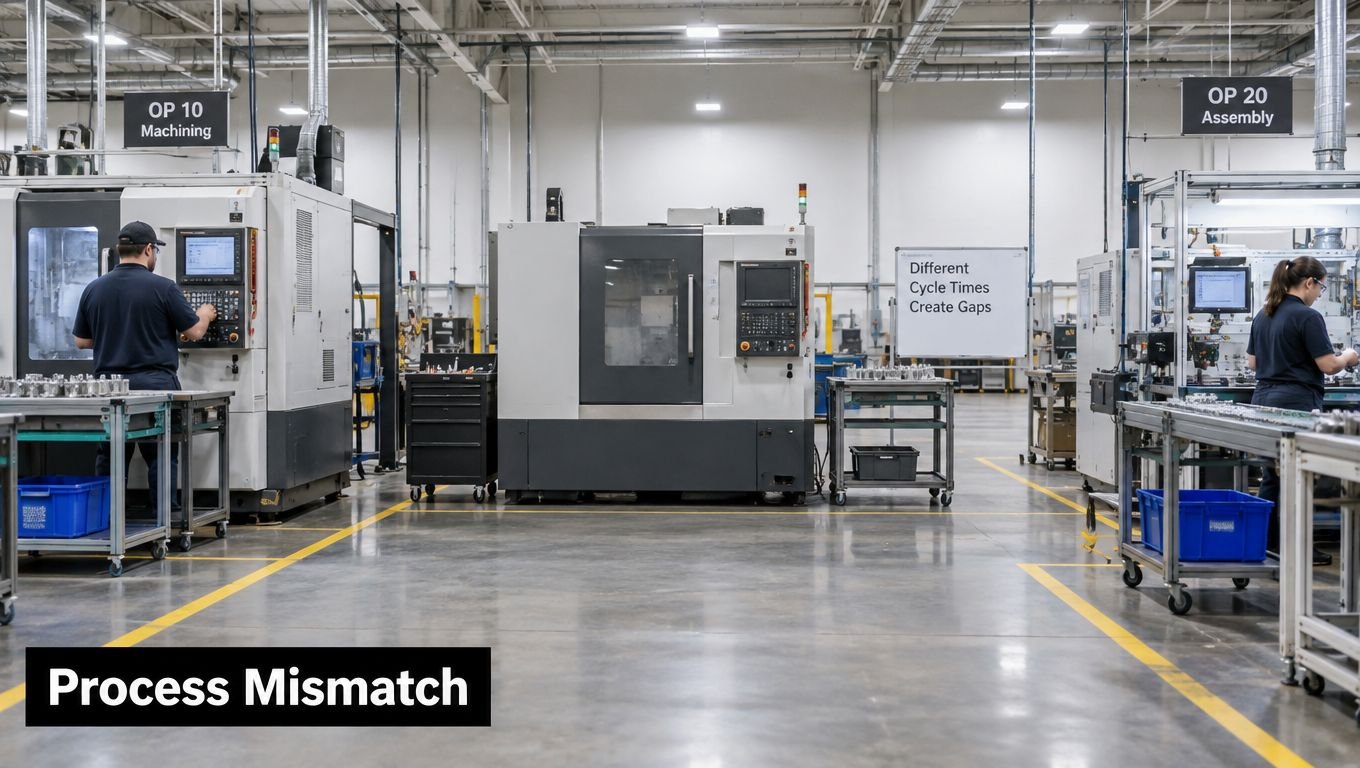
A common bottleneck starts with a reasonable process decision. A plant keeps loading and unloading a component by hand because the volume doesn't justify a large robotic cell. As demand grows, the operator becomes the pacing element. The machining station finishes early, the assembly workstation falls behind, and quality checks get compressed at the end of the shift.
Adding a robot may appear to solve the problem. It might also create a new one if the part presentation, tooling, changeover method, or inspection logic hasn't been designed with it. A robot that waits for inconsistent parts isn't automation. It's an expensive observer of the same process weakness.
Where standard equipment falls short
Off-the-shelf equipment works well when the application matches its assumptions. Standard conveyors, presses, sensors, and robot packages can shorten procurement and simplify replacement. They become less useful when a manufacturer has unusual part geometry, frequent product changes, tight access constraints, regulated documentation, or a process that combines several operations in one compact cell.
The practical choice is rarely “manual or fully automated.” A dedicated fixture can remove awkward handling. A powered clamping system can make loading repeatable. A vision check can move inspection closer to the operation that creates the defect. A semi-automatic workstation can leave judgment and variation-sensitive tasks with an operator while the machine controls positioning, sequencing, and repetitive motion.
Practical rule: Automate the variation you can control, not every human action in the process.
The right engineering solution starts with the production problem, not a preferred component list. That means measuring where parts wait, where operators compensate for poor ergonomics, where defects escape, and where maintenance teams lose time diagnosing failures. A custom machine should close those gaps without creating a system the plant can't operate, troubleshoot, or improve after handoff.
What Custom Machine Building Actually Entails
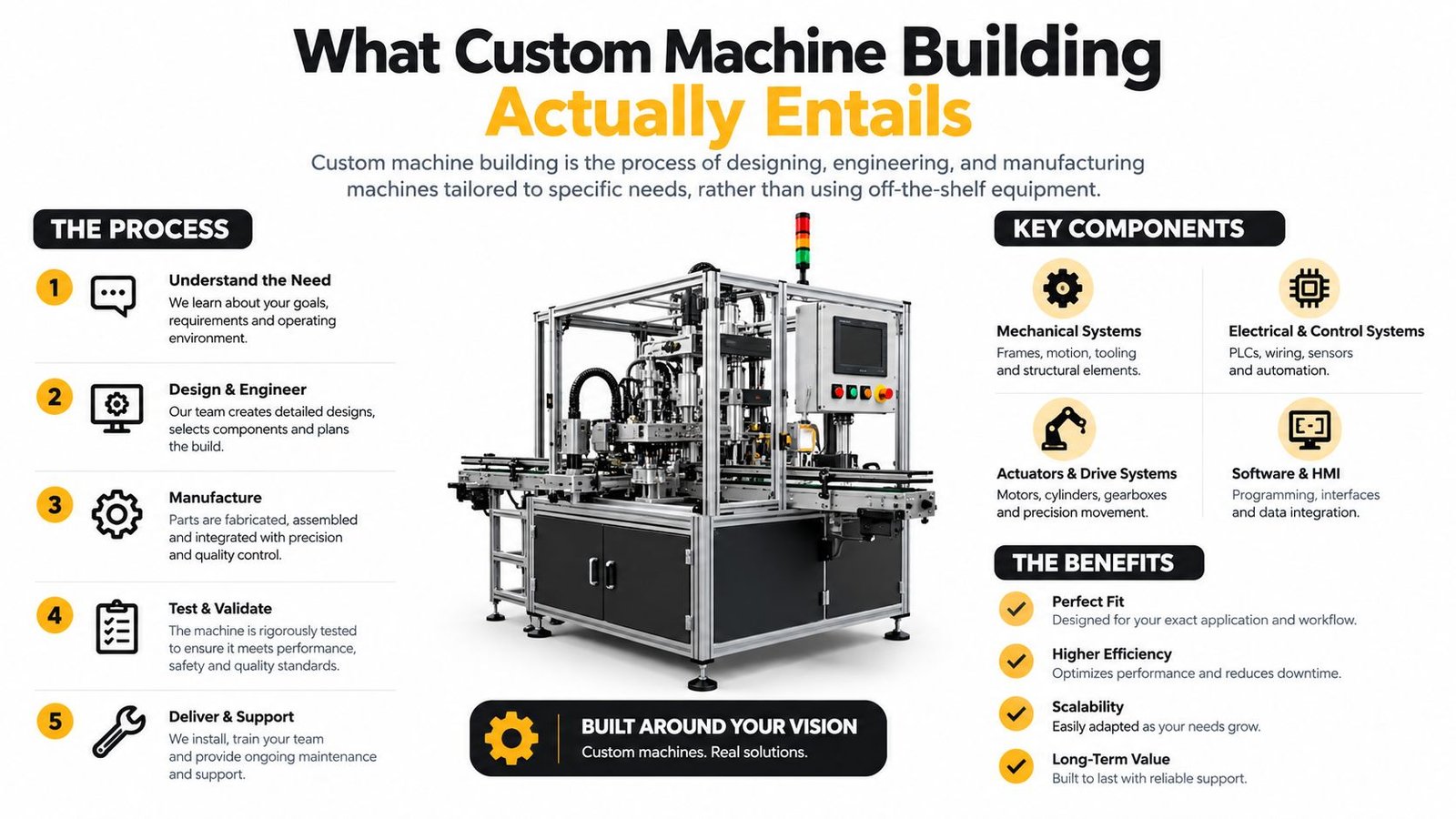
Custom machine building is the design and integration of equipment for a defined product, process, environment, and production objective. It can involve a stand-alone workstation, custom tooling and fixtures, a table-top assembly system, an inspection cell, a material-handling module, or a coordinated production line.
The distinction from standard equipment is important. A catalog machine asks the process to fit its envelope, interfaces, cycle assumptions, and controls architecture. A custom build starts with the part and the operation, then selects mechanisms, sensors, controls, guarding, materials, and operator interfaces around those requirements.
More than fabrication
Fabrication is only one part of the work. The value usually sits in the engineering decisions that make the machine repeatable and supportable:
- Process definition: Identify inputs, outputs, takt requirements, quality checks, operator actions, changeovers, and failure responses.
- Mechanical design: Develop tooling, nests, drives, guarding, access points, and mechanisms that suit the product and plant environment.
- Controls integration: Coordinate PLC logic, HMI screens, sensors, actuators, motion, vision, safety circuits, and data collection.
- Validation and commissioning: Prove that the equipment performs the intended sequence, handles foreseeable faults, and can be maintained by the people who own it.
The market reflects the scale of this work. The global special and custom machinery market was estimated at USD 21.1 billion in 2024 and is projected to reach USD 33.4 billion by 2034. The semi-automatic segment generated USD 7.7 billion in 2024, showing that demand isn't limited to fully autonomous factories. Market figures for special and custom machinery also identify application-specific equipment as a substantial capital-equipment category.
That matters for a plant manager evaluating options. Custom equipment isn't automatically an extravagant alternative to standard automation. It can be a carefully bounded investment that targets one constraint, preserves operator flexibility, and creates a platform for later expansion.
The End-to-End Build Process from Consultation to Commissioning
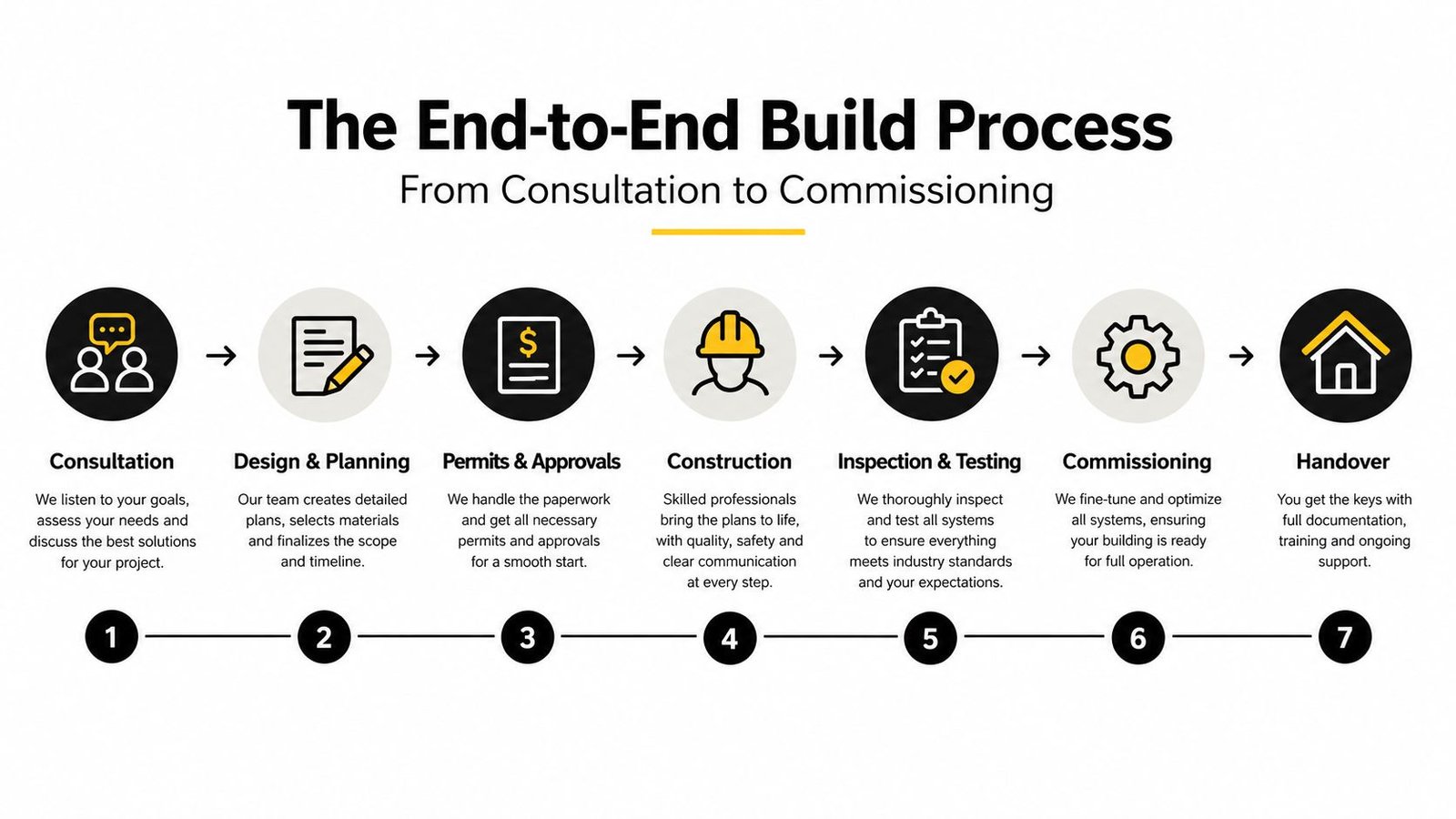
A production line rarely fails because a machine lacks another feature. It fails when the equipment cannot hold the required cycle, recover from faults, support changeovers, or fit the way operators work. A reliable build therefore follows a visible path from the first production discussion through commissioning and handover. The documents may differ by application, but the decisions should remain clear to the customer.
Start with the operation
Consultation defines the production problem before anyone selects hardware. Review the product, current work instructions, cycle constraints, operator actions, defect modes, utilities, floor space, changeover expectations, and maintenance capability. The discussion should also identify tasks that need to remain manual because they depend on judgment, dexterity, or frequent product variation. That information often points to a semi-automatic cell rather than a fully automated line.
Preliminary concepts convert those findings into workable options. The team may compare a fixture-based workstation with a robot cell, or a staged semi-automatic design with a fully integrated line. Each option should show its effect on labor, flexibility, recovery from faults, floor space, and future expansion. A polished drawing is not a decision until those trade-offs are understood.
Design for build and use
Detailed design turns the selected concept into mechanical assemblies, electrical schematics, controls architecture, safety functions, bills of material, and manufacturing drawings. A typical automation build can require 600 to 1,200 engineering hours across mechanical, controls, and software work before fabrication is complete. Treat that figure as a planning range, since product variation, integration requirements, and the maturity of the process change the workload.
Procurement and fabrication give the design physical form. Component availability, material selection, tolerances, and supplier lead times can shift the schedule. Substitutions need engineering approval because changing a sensor, actuator, or fitting can affect software, guarding, maintenance access, and validation.
Prove the machine before handover
Assembly, testing, installation, and commissioning are production-readiness activities, not delivery formalities. Factory testing should challenge sequences, fault recovery, safety devices, inspection logic, operator access, and changeovers before shipment. Site installation must address utilities, floor conditions, interfaces with existing equipment, and the people responsible for running and maintaining the system.
Safety decisions start with the design. A formal risk assessment, technical file, and control architecture aligned with relevant standards such as ISO 12100, ISO 13849, and IEC 62061 help evaluate the complete safety-related control system. Rockwell Automation's functional safety guidance explains why MTTFd, diagnostic coverage, and common-cause failure affect safety performance.
A machine is commissioned when it produces the intended result, responds safely to faults, and leaves the plant with usable documentation.
Understanding Costs and Timeline Drivers
A custom machine's price reflects engineering risk as well as steel, aluminum, motors, and controls hardware. A stable process with a known part may need only a straightforward workstation. Robotics, inspection, traceability, frequent changeovers, safety validation, and integration with existing equipment add design and debugging work. The right question is not merely what the machine costs, but what production result it must deliver.
Engineering can represent 600 to 1,200 hours, with a moderately complex build requiring 120 to 200 additional hours for debugging and runoff. On-site installation by two technicians for a week or more can add USD 20,000 to USD 35,000, including travel and rigging. These custom machinery cost estimates show why a low equipment price may still produce a high project cost once engineering, installation, and support are included.
Lead time follows complexity
| System Type | Typical Lead Time | Complexity Level |
|---|---|---|
| Simple workstation | 6 to 14 weeks | Low |
| Custom equipment | 12 to 24 weeks | Moderate |
| Robotic system | 16 to 30 weeks | High |
| Fully automated line | 20 to 40 weeks | Very high |
These ranges come from an industrial equipment manufacturing guide and serve as planning references, not guarantees. Material selection, tolerances, certification, validation, documentation, and integration constraints can push a project toward the longer end. Procurement delays and late process changes have the same effect.
Semi-automatic versus fully automatic
A semi-automatic system keeps selected operator actions while controlling the steps that most affect repeatability. It can reduce integration scope and preserve flexibility when product variants or demand patterns change. The trade-off is continued reliance on trained operators, supported by clear work instructions and ergonomic access.
A fully automated line reduces direct intervention, but adds interfaces that must operate together. Sensors, robots, conveyors, recipes, safety zones, and recovery sequences can support higher throughput under stable conditions. They also make changeovers, fault diagnosis, and maintenance more demanding.
For many plants, semi-automation provides the better balance of return, flexibility, and available labor. Budgeting should still cover commissioning, training, spare parts, validation, service access, and lifecycle support. A low quotation can become expensive if the plant must redesign utilities, fund undocumented controls work, or call an integrator for every minor fault.
Navigating GMP and Quality Requirements in Design
GMP-aware machine design begins with the product, the environment, and the evidence the manufacturer must produce. A machine for a medical-device process can't be treated as ordinary industrial equipment with a clean enclosure added at the end.
For sterile or controlled environments, stainless steel, anodized aluminum, enclosed wiring and pneumatics, and low-particulate motion components can reduce contamination risk and support cleanability. These choices affect throughput because a surface that traps residue, a fitting that sheds particles, or an exposed cable path can create cleaning difficulties, rework, and production interruptions. Custom automation guidance for medical-device and pharmaceutical manufacturing connects material and enclosure decisions directly to process reliability.
Design evidence into the machine
A GMP-aware specification should define more than the operating sequence. It should address materials, finishes, access for cleaning, lubrication, pneumatic quality, software permissions, recipes, alarm handling, calibration, data integrity, and the records required for qualification.
The controls team should plan PLC and HMI architecture before fabrication. Sensor and actuator selection, test methods, alarm behavior, and failure recovery need to be traceable to the process requirements. That preparation makes IQ/OQ evidence more coherent because the team can demonstrate what was installed and how the equipment performs at its intended location.
Manufacturers should also understand that a custom or customized device isn't automatically outside quality obligations. FDA-related technical and quality guidance states that custom devices remain subject to GMP requirements, even where specific statutory exemptions may apply.
For practical background on the production framework, review this guide to what GMP means in manufacturing. The machine builder's job is to translate that framework into design decisions that operators, quality teams, maintenance technicians, and auditors can verify.
Cleanability, documentation, and validation aren't accessories to a regulated machine. They are part of its production function.
Unlocking Business Benefits and Strong ROI
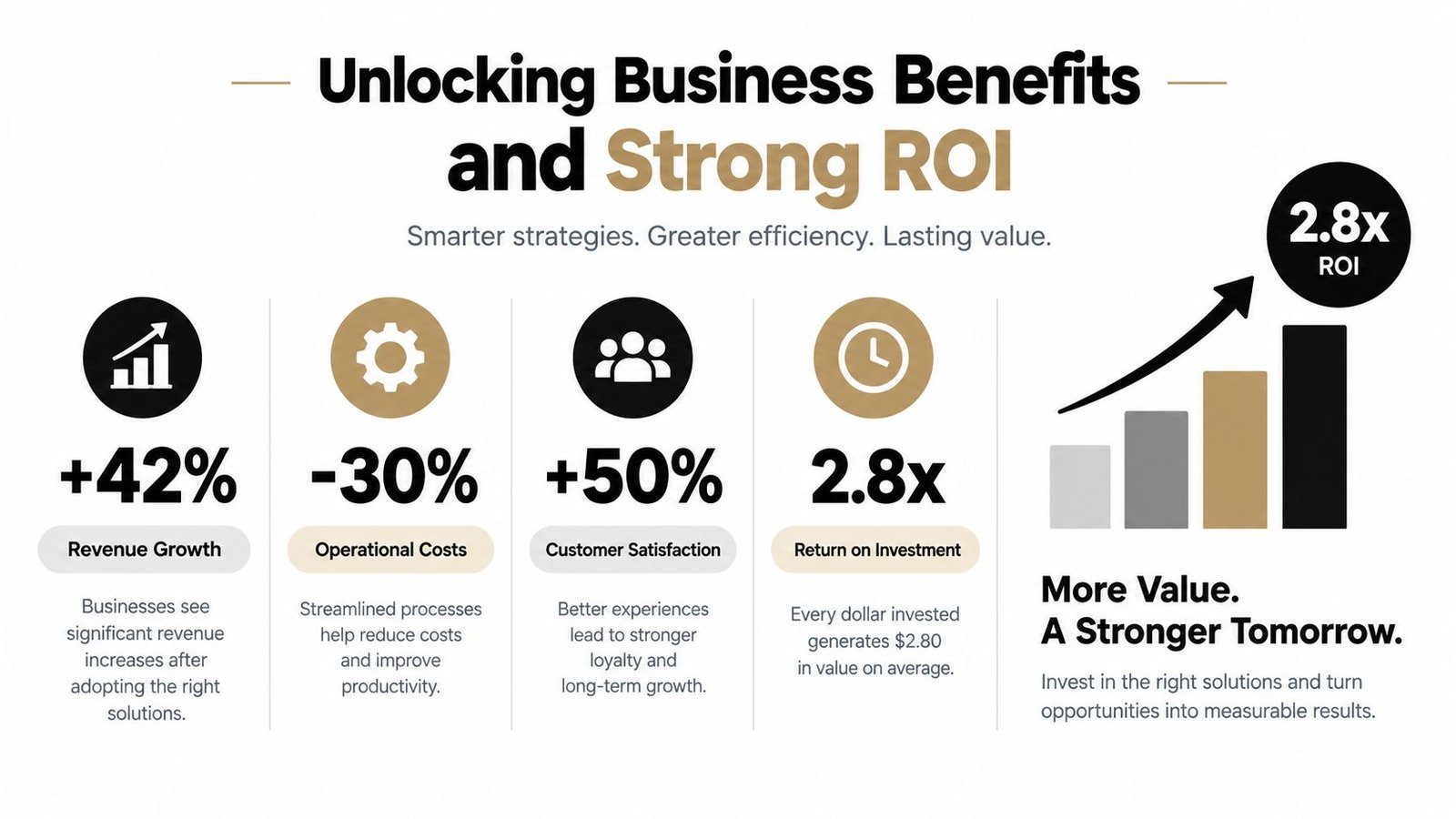
Manufacturers don't invest in custom equipment to own an impressive machine. They invest to improve a production outcome, such as consistent assembly, faster inspection, safer handling, better uptime, or the ability to sustain output with available staffing.
The strongest business case often comes from combining several modest improvements. A fixture can stabilize the part. A sensor can prevent a bad sequence. A guided operator interface can reduce variation. A controlled press or fastening system can make a critical operation repeatable. Together, those changes may protect quality and throughput without forcing the plant into a rigid, fully automated architecture.
Match automation to the business case
The right level of automation depends on product stability, labor availability, required consistency, changeover frequency, and the plant's technical ownership. Semi-automatic equipment often performs well when an operator can handle variable loading or product decisions while the machine manages repetitive, force-sensitive, or timing-critical work.
The payback evidence supports a disciplined evaluation rather than an automatic preference for the largest system. Seven in ten manufacturers report recouping their automation investment within the first year, and many projects deliver positive ROI within 12 to 24 months of deployment, according to this analysis of manufacturing automation investment returns. Those outcomes depend on the application, implementation quality, utilization, and the baseline being improved.
Include service in the return
A machine that produces well during acceptance testing but becomes difficult to restore after a fault isn't a complete production solution. Service planning should include backups, diagnostic screens, spare-parts logic, remote support options, preventive maintenance tasks, and a clear escalation path.
Well-planned maintenance programs aim to maximize uptime, reduce costs, improve safety, and shorten mean time to repair. ABB's industrial automation service guidance also describes field support, system backups, optimization services, and responsive assistance as parts of maintaining operational performance.
A production manager should ask for the expected business effect in operational terms. Which manual steps will change? Which defects should the machine prevent? What happens during a sensor failure? Who can troubleshoot the controls? What documentation will the maintenance team receive? Those answers are more valuable than a long feature list.
Choosing the Right Engineering Partner for Your Goals
The right partner can explain why a process needs custom equipment and when it doesn't. Look for an engineering team that will challenge unnecessary complexity, document assumptions, and compare manual, semi-automatic, and fully automated options against your actual production goals.
Ask to review how the partner handles design reviews, risk assessment, controls standards, factory acceptance testing, installation, training, and post-commissioning support. A capable builder should be comfortable discussing failure modes and maintenance access before the purchase order, not only after the machine reaches the floor.
Evaluate ownership after handover
Labor availability belongs in the selection conversation. One Eaton study found that 79% of machine builders said the skills shortage had a very significant or significant impact on operations, as reported in its study of the labor shortage affecting machine builders. Your automation partner should therefore design for the people who will service the system, not for an idealized plant with unlimited controls expertise.
A strong partner leaves behind usable drawings, software backups, spare-parts recommendations, fault descriptions, training, and a realistic maintenance plan. Responsive support matters too, particularly when a production interruption requires rapid diagnosis rather than a generic service response.
System Engineering & Automation provides semi-automatic systems, fully automated and manual equipment, custom tooling, fixtures, integrated controls, installation, commissioning, and ongoing support aligned with manufacturing goals and budget. That kind of end-to-end capability is useful when the project requires a practical production solution rather than a disconnected piece of equipment.
The best custom machine is the one your plant can operate safely, maintain confidently, validate where necessary, and improve over time. Start with the constraint, choose the appropriate level of automation, and hold the engineering partner accountable for the production result.
If your plant is balancing manual work, inconsistent quality, labor constraints, or an automation project that feels larger than it needs to be, discuss the application with System Engineering & Automation. Share your process goals, product requirements, and current bottleneck so the team can help define a cost-effective manufacturing solution, from custom tooling and fixtures to a scalable semi-automatic or fully automated system.