
The torque fixture shows a pass. Pack-out confirms the label. After hours, a vendor connects to the programmable logic controller (PLC) to fix an intermittent fault. By morning, production, quality and maintenance each have part of the story, but nobody can connect the changed logic to the affected product.
That's a familiar problem in a mid-sized plant upgrading manual work without replacing an entire line. The missing piece isn't necessarily another software platform. It's a shared way to assign responsibility, control changes and retain usable evidence.
Table of Contents
- What an Integrated Internal Control Framework Does on the Line
- Five Components and the Evidence Each One Needs
- Process Controls Quality Traceability and Access Together
- QMSR Checkpoints at Each Station
- Roadmap for a Semi-Automated Line
- Checks to Automate and Judgments to Keep Human
- Measure the Line Before You Add More Automation
What an Integrated Internal Control Framework Does on the Line
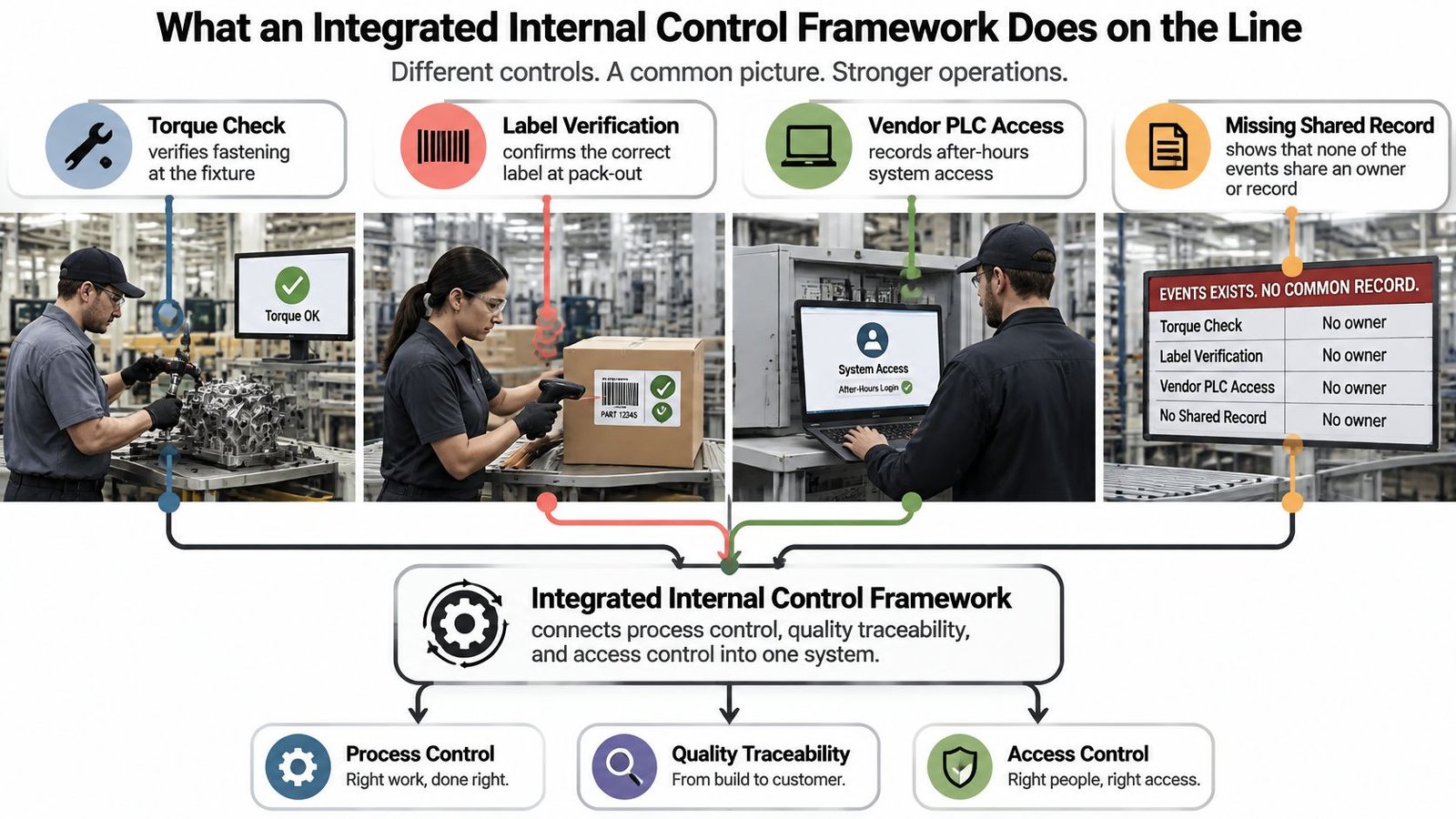
At the fixture, an operator checks fastening torque. At pack-out, another operator verifies the label. Maintenance authorizes remote troubleshooting. Each activity can look satisfactory on its own while leaving a gap between machine settings, product identity and approval authority.
An integrated internal control framework is one architecture for connecting operational decisions, reliable records and compliance obligations, with clear ownership and evidence that controls worked.
The COSO Internal Control–Integrated Framework organizes internal control around operations, reporting and compliance; its 2013 update describes five interrelated components supported by 17 principles. On the floor, those objectives mean making safe, conforming product at the planned rate, reporting what happened, and meeting applicable GMP, regulatory and customer requirements.
Connect the Sensors, Decisions and Memory
Think of the plant as having a single nervous system. Sensors detect conditions, authorized people or machine logic decide what happens next, and records preserve the history. If those connections are missing, a technician can fix a local problem while unintentionally creating a line-wide one.
The skeleton consists of the control environment, risk assessment, control activities, information and communication, and monitoring activities. Those terms become useful only when they describe responsibilities at an actual machine.
The connected control gaps look like this:
Make the Work Instruction Provable
A work instruction might tell an operator to check torque. A functioning control identifies who owns that check, defines acceptable limits, contains a failed cycle and retains the result. It also establishes who can change the limits and what approval is necessary.
That distinction matters when choosing manufacturing solutions to optimize production and services. A well-designed fixture can prevent incorrect assembly without adding much administrative work. A poorly governed digital system can produce attractive dashboards while leaving supervisors unable to explain a rejected batch.
The practical standard is straightforward: map each component to evidence, agree on shared testing, pilot a semi-automated cell and judge the result against operating measures. The paperwork should support those decisions, not become a separate production process.
Five Components and the Evidence Each One Needs
COSO components on a production line
| Component | What it means on the line | Evidence to keep |
|---|---|---|
| Control environment | Named owners for release, recipe change and interlock bypass | Role matrix and approval signatures |
| Risk assessment | Ranked threats to product, data and uptime | Risk log with process and cyber items separated |
| Control activities | Interlocks, checks, and split duties on program changes | Work instructions, alarm setpoints, change records |
| Information and communication | Alarms and records reach the person who must act | Access logs, batch records, escalation path |
| Monitoring activities | Exceptions and drift reviewed before repeat failures | Trend reviews, deficiency log, corrective actions |
Establish Authority Before Adding Controls
The control environment determines who's allowed to release a lot, edit a recipe or authorize an interlock bypass. Give the process a named owner and give each authorized user an individual identity. Without that accountability, a shared maintenance login can make an unauthorized change indistinguishable from approved work.
Risk assessment starts with what can damage product, records or availability. Walk the station and identify parameter drift, incorrect labels, unapproved software, lost batch identity and privileged vendor access. If the team considers only mechanical failure, it may overlook a correct-looking batch produced under the wrong program.
Keep safety and security assessments distinct but connected. A sensor failure and deliberate alteration of the sensor threshold can produce similar output, yet require different prevention and investigation methods.
Specify the Action and the Recipient
Control activities are the actual barriers: a fixture that detects missing parts, a start permissive that checks recipe approval, or separate editing and approval responsibilities for PLC changes. Without these barriers, a procedure becomes a request that operators can bypass under schedule pressure.
Information and communication determine whether useful information reaches someone in time to act. An alarm belongs at the operator interface before another affected cycle starts, with an escalation path when the operator can't resolve it. A fault stored only in a controller buffer won't help a supervisor decide which material to quarantine.
Include abnormal conditions such as lost network connections and full local storage. Otherwise, the machine may keep producing while the batch record stops growing unnoticed.
Review What People Actually Do
Monitoring activities mean reviewing exceptions, drift and unresolved deficiencies, then checking whether corrective action worked. A supervisor should be able to distinguish repeated nuisance alarms from a deteriorating process. Without that review, operators may learn to acknowledge warnings faster rather than remove their causes.
Use COSO's underlying principles to challenge whether each component is present and functioning, not as another list for operators to memorize. Management still needs to examine accountability, oversight and information quality beyond the cell.
For any new fixture, workstation or control upgrade, treat the evidence column as the minimum project file. Add documentation when risk warrants it, rather than collecting signatures because another department has a template.
Process Controls Quality Traceability and Access Together
Say a semi-automated bonding station begins taking longer to reach its temperature setpoint. The completed joint still looks normal, but the material hasn't received the intended process conditions. A final visual inspection won't reliably tell the operator what happened inside that bond.
Before specifying sensors, define the critical parameters: temperature, dwell, force, pressure, torque or inspection thresholds. Give each parameter an allowable range, an alarm limit and a justified calibration interval.
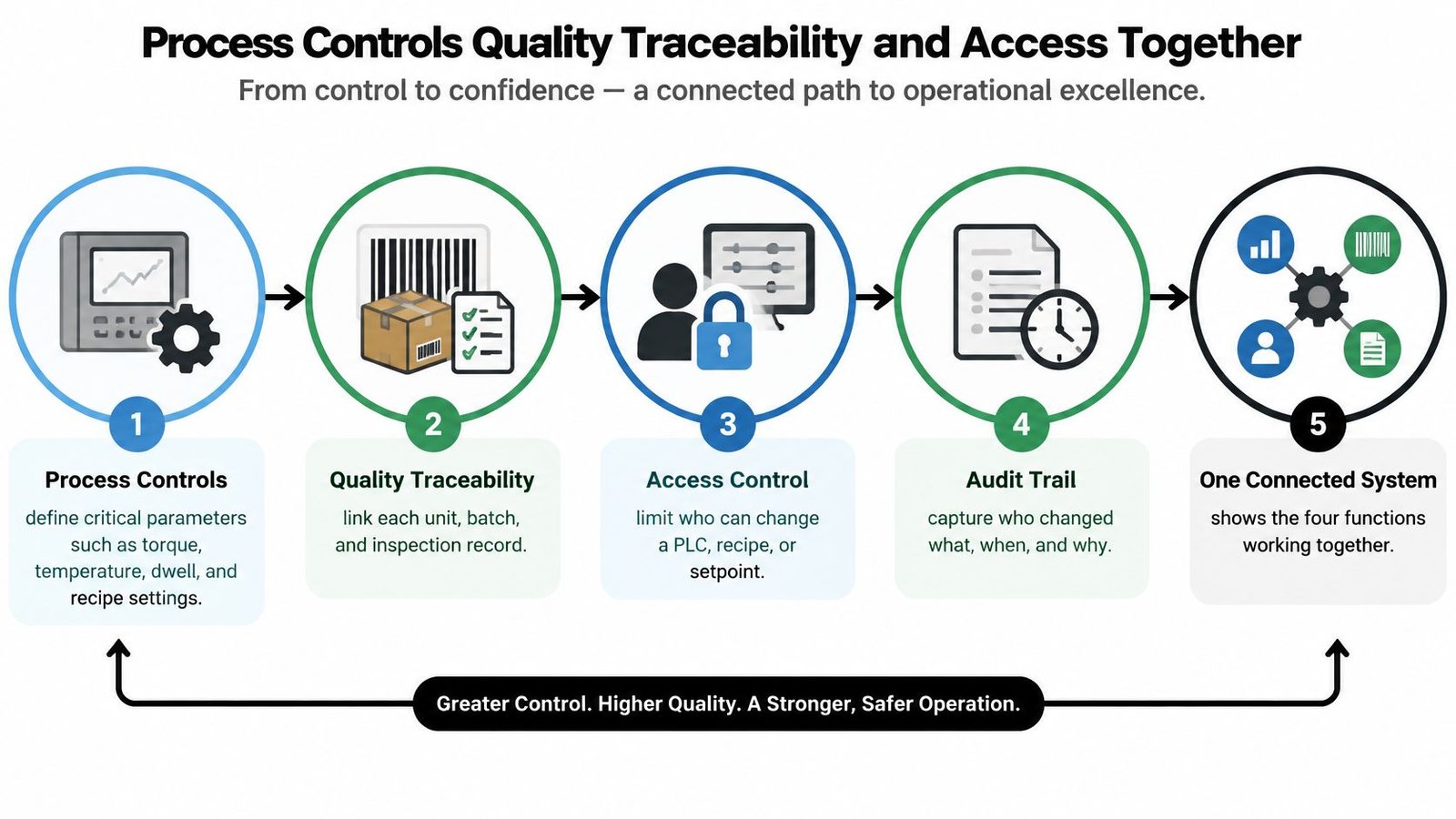
The connected functions should follow the production event:
Follow the Bad Cycle
Uncontrolled drift can create nonconforming output. A sensor alarm detects the temperature problem, and an interlock prevents the fixture from presenting the cycle as acceptable. The station contains the affected part instead of letting it disappear into the next tote.
The FDA's software validation guidance states that software used to automate device production or the quality system must be validated for its intended use, with documentation covering requirements, protocols, acceptance criteria, test cases and results. Where later inspection can't fully verify a process result, validation is necessary rather than reliance on a final visual check alone.
The cycle record should preserve product or batch identity, equipment identity, actual values, approved recipe version and disposition. Protect the original result from casual editing; corrections should remain attributable. Practical traceability requirements start with those relationships, not with the purchase of a barcode scanner.
Connect Service Work to Product History
A trend review can reveal that heating performance deteriorates before the station reaches its reject limit. Maintenance can then investigate the heater, sensor mounting or power supply while quality assesses potentially affected output. Link the service work order to the production event instead of transcribing its details into disconnected spreadsheets.
Traceability should also connect relevant complaint and servicing records, machine history, and label or packaging checks. Access permissions determine who can edit logic, acknowledge alarms and open remote sessions. Recording the change without controlling who can make it leaves the process exposed.
Use this accompanying video as another discussion aid when reviewing the connected system:
One event should generate one authoritative record that quality, engineering and production can all use, with linked supporting evidence rather than competing copies.
QMSR Checkpoints at Each Station
Effective February 2, 2026, the QMSR amended 21 CFR Part 820 and incorporated ISO 13485:2016 by reference, according to the FDA's overview of device regulation. Equipment that performs a production step therefore belongs within the manufacturer's quality-system planning, not just its capital-equipment register.
Translate that responsibility into station acceptance criteria. A machine can meet its quoted cycle time and still be unsuitable if it can't preserve approved settings, identify affected product or enforce the required inspection.
Production and Process Controls
Check that each gage is suitable for the measurement being made. Consider measurement range, resolution, fixture repeatability, part presentation and environmental effects. A precise sensor mounted against a flexible bracket can produce misleading results.
Document the inspection step and how operators challenge it. Acceptance testing should include a known unacceptable condition, not just a succession of good parts. Also test what happens when the sensor disconnects or returns an implausible value.
Records, Labeling and Packaging
The FDA's QMSR inspection guidance identifies record controls under section 820.35 and documented labeling and packaging procedures with accuracy checks before release or storage under section 820.45. Design the station so operators can create and retrieve the applicable evidence without reconstructing production from memory.
A device or batch record should link to relevant conformity, complaint and servicing history, including unique device identification where applicable. The workstation can capture production information automatically, while the quality system maintains links to later complaints and service activity. Don't expect the machine to originate records for events that haven't occurred.
At pack-out, compare the scanned product identity with the approved label and packaging configuration. A scan-and-interlock should prevent a mismatch from moving into stock. Control reprints and rework routes too, because an unchecked replacement label can defeat an otherwise sound check.
Use good automated manufacturing practices to turn these checkpoints into design, testing and handoff requirements.
Put these questions to an equipment supplier before approving the design:
- Measurement suitability: How will we demonstrate that the gage and fixture can distinguish acceptable from unacceptable output?
- Record recovery: Can we retrieve the complete station history by device or batch after a connection failure?
- Packaging accuracy: What prevents an incorrect label, duplicate label or unauthorized reprint from reaching inventory?
- Controlled handoff: Which approved procedures, training records and configuration files accompany commissioning?
The buying test isn't whether the station has a touchscreen. It's whether it supports an approved procedure, repeatable processing, traceability and credible proof of in-specification output.
Roadmap for a Semi-Automated Line
Start with a cell where the team can define the problem and observe the outcome. Don't launch a plant-wide software project to solve an awkward loading fixture or an unreliable presence check. Keep the mechanically sound equipment where it can support the required control performance.
Use the following rollout as a sequence of approval gates. Each step should produce something the next person can inspect before work proceeds.
Define the Cell and Its Responsibilities
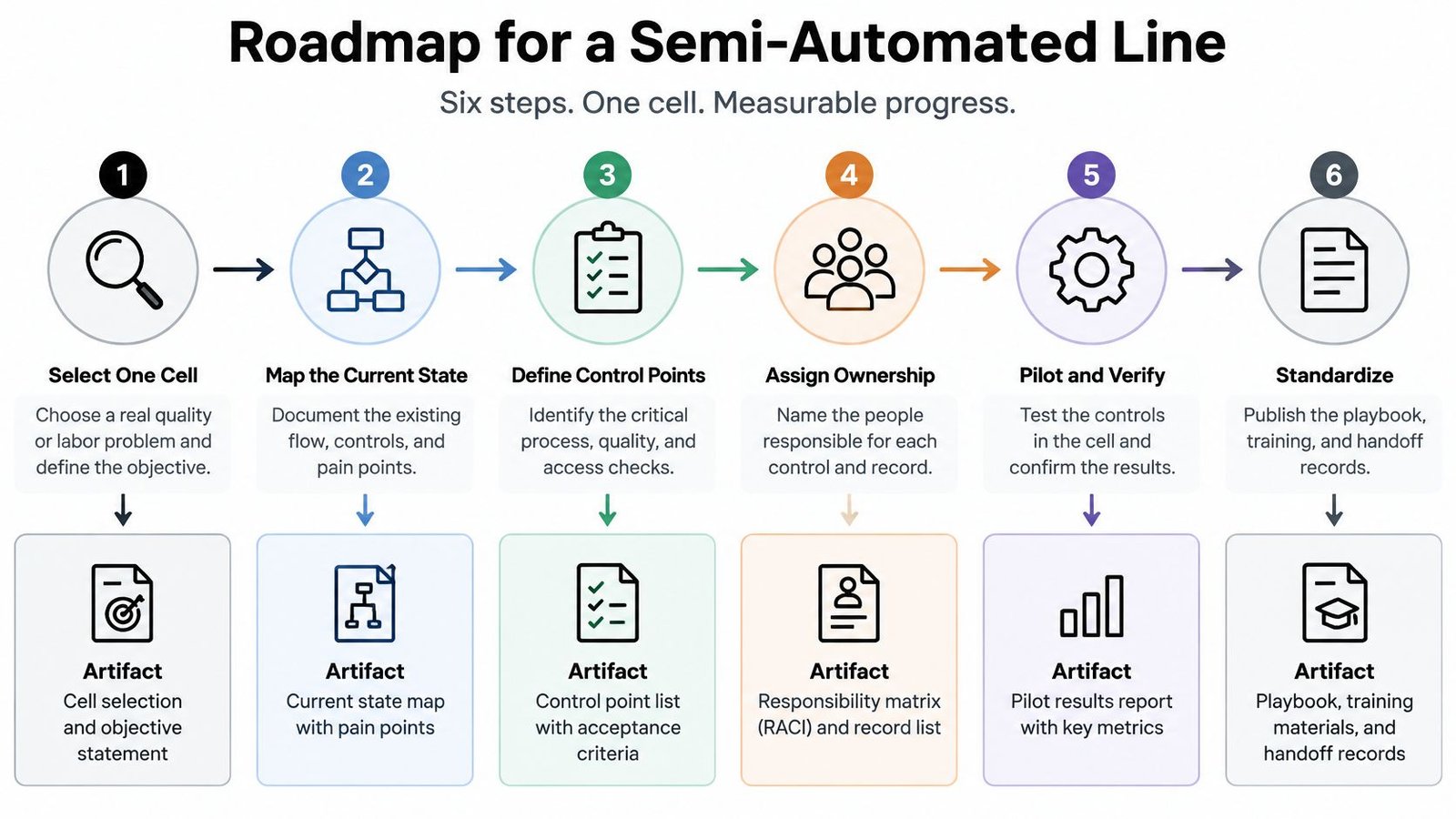
Select the problem and establish the objective. Choose a genuine quality or labor constraint, such as repeated assembly rework or excessive handling between operations. Write a measurable objective using first-pass yield, cycle time, scrap or operator touch time, with targets derived from the plant's baseline. Artifact: a cell objective sheet.
Walk the current process with an operator, technician and quality representative. List critical parameters, label checks and access points, then identify failures that downstream inspection can't detect. Include setup, changeover, cleaning and restart, not just normal production. Artifact: a control list and current-state map.
Assign an accountable cell owner. Operations, quality, engineering and IT still retain their specialist responsibilities, but someone must resolve gaps between them. Establish who requests changes, approves testing, accepts residual risk and owns the retained record. Artifact: a role matrix.
The roadmap keeps the work bounded while preserving a complete handoff:
Build, Verify and Standardize
Design the station's fixture checks, alarm limits, access roles and cycle-record structure. Specify behavior during interrupted power, lost communications, rejected parts and restart. Avoid writing requirements such as “provide full traceability” without defining the fields and retrieval method. Artifact: a control specification.
Verify the intended use. Prepare a protocol that connects requirements to acceptance criteria, challenges software behavior and addresses processes that can't be fully verified downstream. Agree on the test evidence before execution so different functions can accept the same results. Artifact: an approved protocol with results and resolved discrepancies.
Run the cell under normal production conditions and review exceptions weekly. As a pilot rule, require two stable review cycles before copying the design elsewhere, extending the period if changeovers or unusual products remain untested. Publish the operating method and handoff records only after unresolved defects have owners. Artifact: an exception log and standardization package.
Don't build separate test packs for IT, quality and equipment acceptance when they're examining the same requirement. Use a requirements-to-test matrix to show which evidence satisfies each review, retaining additional testing only where the purpose clearly differs.
The resulting specification should also identify decisions that require a person. An automatic pass signal isn't permission to eliminate engineering approval or release authority.
Checks to Automate and Judgments to Keep Human
Digitizing a weak process can concentrate risk in a PLC, a privileged account, an undocumented logic change or a vendor laptop. More screens don't compensate for unclear authority or unreliable recovery. The COSO internal-control framework guidance provides a principles-based foundation, not a mandate to maximize digitization.
Automate frequent, objective checks. Keep accountable people on decisions that require context.
What to automate and what stays human
| Control | Automate | Keep human | Shared evidence |
|---|---|---|---|
| In-cycle parameter check | Sensor or fixture interlock every cycle | Review of rejects and drift | Cycle record with setpoint and result |
| Recipe or logic change | Block unapproved limits from running | Second-person approval before release | Change record and version ID |
| Calibration of gages | Station lockout when overdue | Decision to adjust or replace the gage | Calibration certificate and due date |
| Product or batch release | Compile the pass-fail data | Named release judgment | Signed release tied to the batch |
| Remote or vendor access | Unique login, time limit, logging | Approval to open the session | Access log and work order |
| Exception and alarm handling | Alarm, stop or contain the cycle | Disposition of the unit and the cause | Alarm history and corrective action |
Separate Repetition From Judgment
A torque or presence check belongs in the fixture because people become less reliable at repetitive inspection. The operator still needs an understandable reject reason, while engineering reviews whether repeated failures indicate tool wear, part variation or a poor detection method.
Recipe changes need a different division of work. Engineering proposes the revision, an authorized reviewer approves it, and the controller prevents the unapproved version from running. This is a practical application of human-in-the-loop automation, not an argument against automation.
Calibration software can flag due dates, but it can't decide the product impact of a failed gage by itself. A failed or overdue instrument should block the affected operation until authorized personnel establish an acceptable route. Likewise, electronic compilation of passing results doesn't replace the named product-release decision.
Test Resilience Within Each Control
Obsolete controllers, shared passwords and unlogged remote service remain operational risks. Apply authentication, authorization, logging and recovery checks to PLC logic, remote sessions, supplier-provided components and production data.
The FDA's final 2025 medical-device cybersecurity guidance recommends integrating security risk management throughout the product quality system, with separate but accompanying safety and security assessments. For production controls, use that distinction to examine both accidental failure and unauthorized interference without confusing their causes.
Evidence standard: Keep enough to demonstrate that the control operated, the result remained trustworthy and someone handled the exception.
Periodic alarm challenges, backup restoration tests and segregation of duties deserve priority over additional dashboards. A backup file isn't proof that the team can restore a usable station.
Measure the Line Before You Add More Automation
Baseline units per labor hour, cycle time, uptime, first-pass yield, rework rate and labor cost per unit before approving additional hardware. Use comparable production windows, product mixes and shift conditions. As a starting measurement plan, collect four weeks before and four weeks after the change, extending either window when demand or changeovers make the comparison unrepresentative.
Record scrap, downtime, labor hours and changeover time alongside those measures. The comparison should distinguish better equipment performance from reduced staffing or easier orders.
Use a before-and-after view to keep the decision grounded:
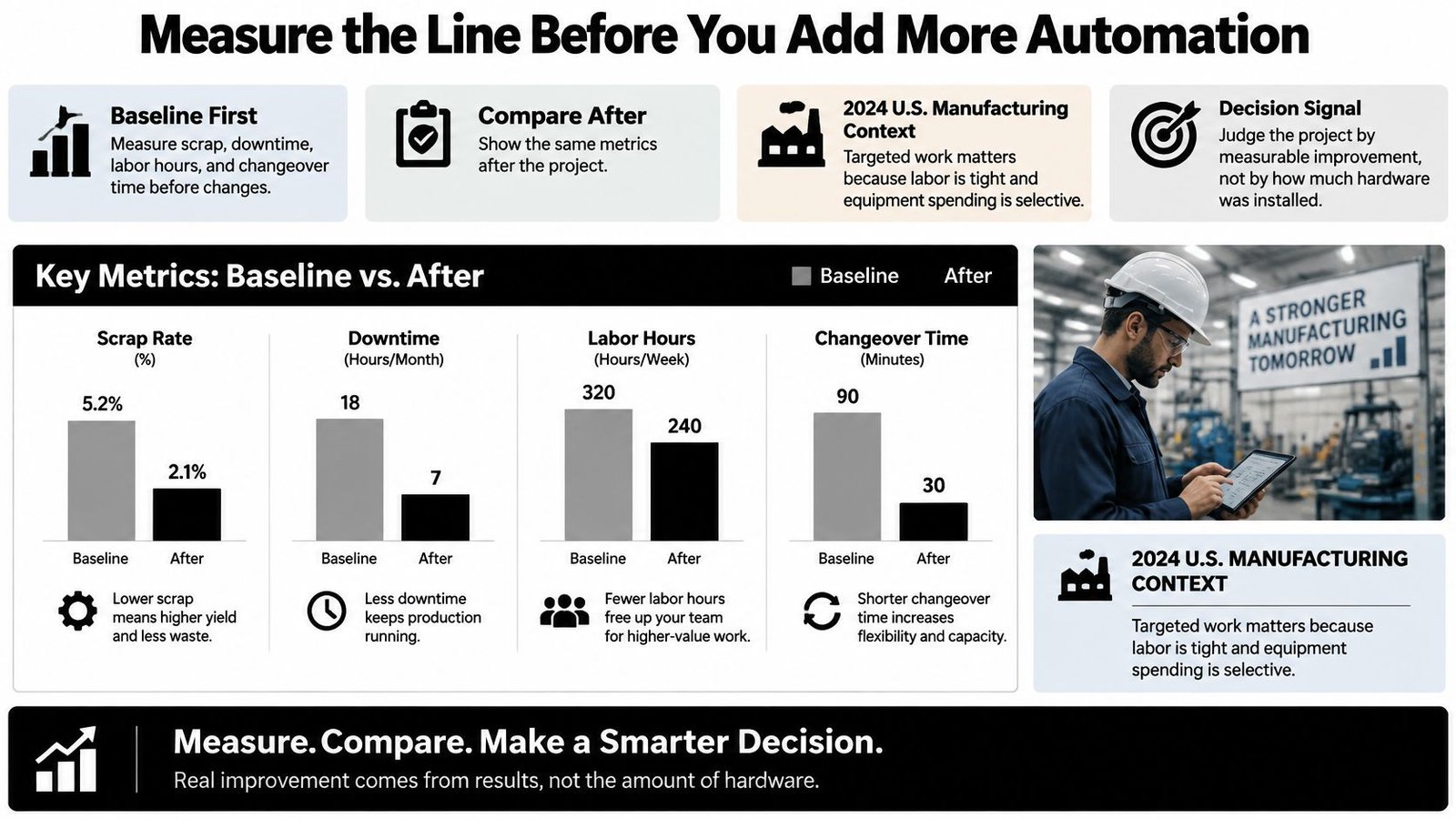
Judge Outcomes, Not Installed Hardware
For U.S. manufacturing in 2024, the Bureau of Labor Statistics reported labor productivity increased 0.6%, output declined 0.4%, hours worked declined 1.0%, unit labor costs increased 3.3%, and hourly compensation rose 4.0%. Those figures provide context for targeted improvement, not proof that any particular plant should automate.
Track control health as well as production:
- Overdue deficiencies: Identify issues beyond their agreed closure time.
- Incomplete dispositions: Flag acknowledged alarms without a documented product decision.
- Unapproved changes: Find software revisions without linked authorization.
A successful project produces stable cycle performance, fewer repeat deviations and an evidence package that supports quality and customer review. More screens with unchanged scrap is a failed business outcome.
Keep or retrofit a mechanically sound station when tooling, sensors and controls can close the actual gaps. Among the available routes, System Engineering & Automation offers semi-automatic equipment, custom tooling, integrated controls and GMP-aware design and commissioning sized to production goals and budget rather than requiring full line replacement.
System Engineering & Automation provides equipment design, fixtures, integrated controls, installation and ongoing service for manufacturers upgrading production. Visit System Engineering & Automation to discuss a cell-level project with defined control points, shared acceptance evidence and a practical commissioning plan.