You're hitting the output target on good days and missing it on ordinary ones. One workstation waits for parts, another waits for an inspector, and the operator who's best at changeovers is out sick. Nothing is broken exactly, but the process only works when specific people are in place, and that's not a production system you can plan around.
End to end automation is a way to fix that fragility without automating everything at once. Done well, it connects equipment, controls, material flow, inspection, records, and human tasks around a defined result, then proves that result can hold up shift after shift.
Table of Contents
- Why Production Managers Choose End to End Automation
- How End to End Automation Works
- Design Controls Integration Commissioning and Maintenance
- Benefits Quality Throughput and Return on Investment
- Choosing the Right Level of Automation
- Manufacturing Automation Case Studies
- Plan Integration Training and Validation
- Build an Automation Roadmap That Performs
Why Production Managers Choose End to End Automation
A medical device assembler I worked with had a familiar problem. The manual station wasn't slow when the senior operator ran it. It was slow when anyone else did, and the inspection check at the end depended on who was checking, how tired they were, and whether the previous station had handed off parts in the same orientation.
The instinct was to speed up that one station. That's understandable, but it usually misses the point. If upstream feeding is inconsistent and downstream inspection is subjective, a faster station just produces inconsistent parts faster.
What the term actually means in a plant
End to end automation means designing the sequence as one system. You're coordinating material arrival, processing, inspection, records, and finished output, not buying a machine and hoping the gaps between machines sort themselves out. Robots may be part of it. They don't have to be.
That broader adoption is already visible at scale. The global operational stock of industrial robots reached 4,281,585 in 2023 after 541,302 new installations, which points to sustained investment rather than a short lived trend. The useful lesson isn't the total itself. It's that manufacturers are building systems, not collecting standalone equipment.
Practical rule: Define the production result first, in terms of quality, throughput, and evidence. Equipment selection comes second.
This approach can address labor dependency, inconsistent checks, disconnected stations, and weak traceability. It can't fix an undefined process. If you can't describe what good looks like, which parameters matter, and where variation enters, automation will lock in the confusion. The distinction matters. Adopting automation is a business strategy tied to output and control. Commissioning equipment is only one milestone inside it.
How End to End Automation Works
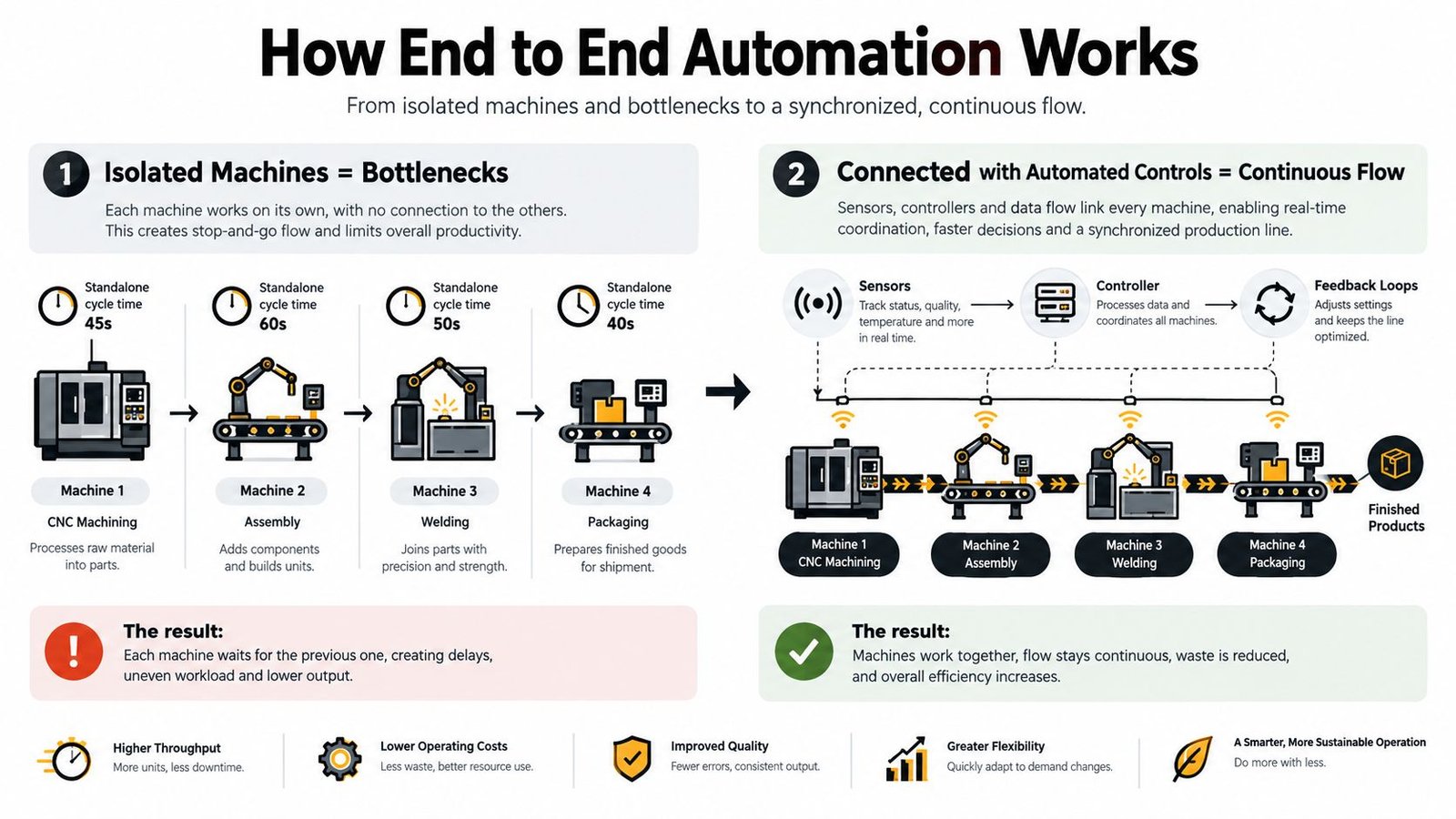
Think of a line as a relay race where each runner trains alone. Each person may be fast, but the baton drops at every handoff. That's what isolated automation looks like in practice. A press runs at its rated cycle, a vision camera inspects correctly, and a conveyor moves parts, yet the line still stops because nobody designed the handoffs, the fault responses, or the shared data.
The diagram below shows that shift from isolated machines to a coordinated workflow.
From standalone cycle time to system flow
A connected system coordinates material handling, assembly, inspection, machine tending, and production control so each step knows what the previous step produced and what the next step expects. Sensors confirm presence and position. Controllers sequence motion and enforce interlocks. Feedback loops let the system reject a bad part, stop safely, or prompt the operator instead of passing a problem downstream.
That's why understanding what systems integration involves matters before you specify hardware. Integration is where tooling, controls, and data stop being separate purchases.
The infrastructure for this is now widespread. Global average robot density reached 162 operational robots per 10,000 manufacturing employees in 2023, more than double the 74 recorded seven years earlier, while the United States reported 295. Density varies sharply by market, which tells you adoption is uneven and facility level decisions still drive results.
Three levels, one boundary decision
- Manual with tooling: Operators do the work, but fixtures control location, force, or sequence.
- Semi-automatic: The machine performs repeatable motions and checks, while a person loads, verifies, or handles variable steps on purpose.
- Fully automatic: Feeding, processing, inspection, and discharge run without routine intervention, with people handling exceptions and maintenance.
Semi-automatic isn't a half finished version of the full process. It's often the correct boundary when product variation is high or a human judgment step is valuable. Your first job is to define the process boundary and intended result. Technology choices get much easier after that.
Design Controls Integration Commissioning and Maintenance
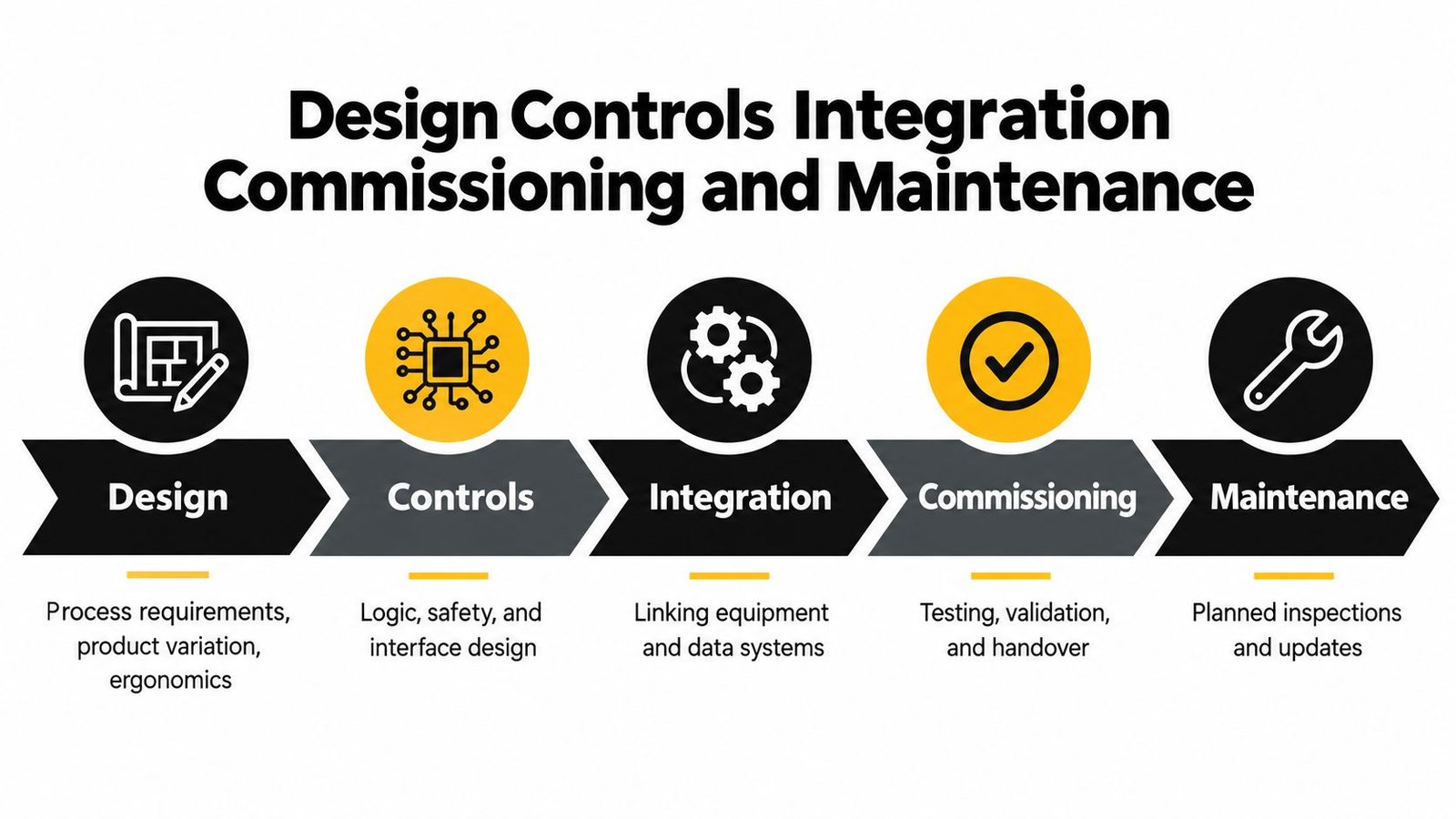
Most automation projects don't fail at one dramatic moment. They bleed value at the transitions, where design assumptions meet controls logic, or where a commissioned cell meets a maintenance team that didn't help specify it. Treating the lifecycle as five connected stages prevents that.
The flow below maps those stages and the decision each one owns.
Design and controls set the ceiling
Design establishes process requirements, product variation, ergonomics, safety, throughput assumptions, and future flexibility. Get specific here. Which dimensions vary between product variants? Where does an operator reach, lift, or make a judgment call? What happens when volume changes? A design that ignores variation produces a cell that works beautifully on the demo part and struggles on everything else.
Controls translate those requirements into machine and operator behavior. PLC logic, HMI screens, recipes, alarms, and safety interlocks decide what the system does on a normal cycle and, more importantly, on a bad one.
For regulated production, controls carry compliance weight. FDA guidance states that software automating manufacturing, testing, component acceptance, labeling, packaging, distribution, or quality system activities must be validated for its intended use, including risks such as incorrect recipes, sensor failures, unauthorized parameter changes, incomplete records, and communication loss. That means you should specify requirements traceability, alarm testing, user access controls, audit trails, and backup and recovery tests during design, not after installation.
Integration, commissioning, and what happens after
Integration connects equipment, tooling, sensors, inspection, interfaces, and material flow. You discover here that a feeder's output orientation doesn't match the nest, or that a barcode reader needs lighting the enclosure blocks. Finding that on the build floor is normal. Finding it after delivery is expensive.
Watch how a coordinated cell handles sequencing and handoffs in the example below.
Commissioning proves operation under representative conditions, with real parts, real operators, and real fault scenarios. It isn't finished when the machine cycles. It's finished when your team can run it, change it over, and recover from a stop without calling the builder.
Maintenance sustains all of it. Decide ownership early, covering spare parts, preventive tasks, change control, training, and responsive support. A cell nobody owns degrades until throughput and quality both slip, and by then the original design intent is hard to recover.
Benefits Quality Throughput and Return on Investment
The business case for automation gets oversold when it starts with promises. Start with a baseline instead. Measure your current cycle time, defects, scrap, ergonomic risk, changeover loss, downtime, and maintenance cost before you change anything. Without that, you can't prove a return, and you can't tell whether a problem moved or disappeared.
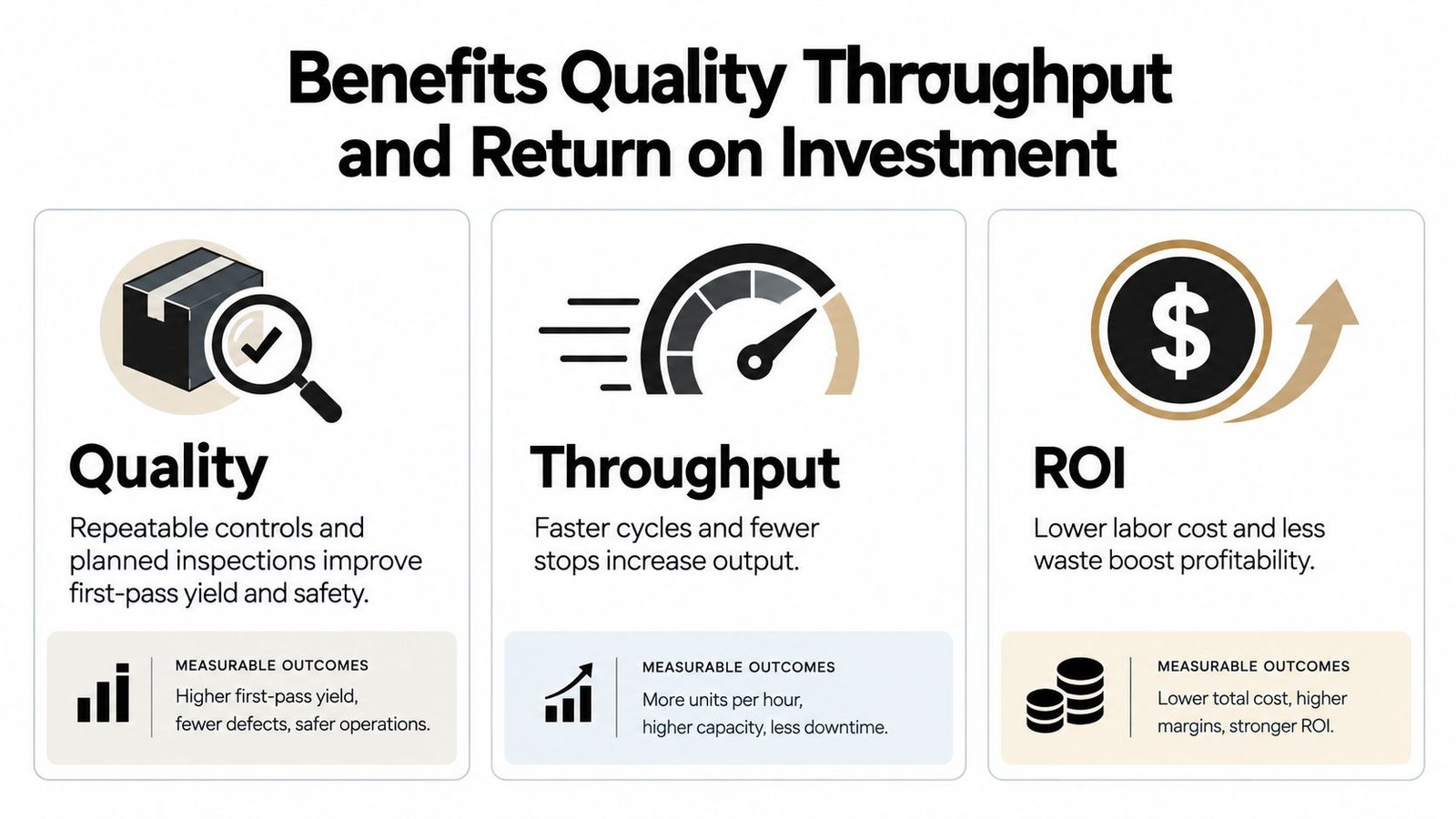
The summary below connects the three outcome areas managers usually care about most.
Where the gains actually come from
Quality improves when repeatable controls and planned inspections replace judgment calls that vary by person and shift. A fixture that controls location, a sensor that confirms a step happened, and a recipe that prevents the wrong parameters from loading will do more for consistency than asking operators to be more careful. Traceability improves alongside it, because the system records what happened instead of relying on memory.
Throughput improves less from raw speed than from fewer stops, less handling, and shorter changeovers. A station that runs slightly slower but rarely faults will outproduce a faster one that needs constant attention. Coordinated steps also cut the waiting that hides between operations, which is where a lot of capacity sits.
A cell that runs a little slower and almost never stops will beat a fast cell that needs a hero standing next to it.
Making ROI measurable
For regulated work, define success in process terms. FDA process validation guidance recommends defining critical process parameters, acceptable operating ranges, sensor and actuator tolerances, inspection performance, recipe controls, deviation responses, and ongoing monitoring, with acceptance metrics including first pass yield, defect escape rate, capability indices, downtime by fault category, alarm response time, and electronic record completeness.
Those same metrics make a sound ROI case for any manufacturer. Labor dependency drops when responsibilities are clearer, not when people vanish. Operators move toward setup, quality checks, and maintenance. Measure performance only after conditions are representative, with trained staff and normal product mix. That's the evidence that justifies the next stage of investment.
Choosing the Right Level of Automation
Full automation is not the automatic endpoint. It's one option, and for many operations it's the wrong one. The right level depends on volume, variability, and the capability you can support on your floor.
Capital is usually the first constraint, and it isn't the only one. Auburn University's 2025 Smart Manufacturing Adoption Study identified high cost as the most frequently cited adoption barrier at 21%, followed by capital requirements at 16%, lack of a business case at 14%, and workforce skill gaps at 14%, while workforce shortages affected 8% to 12% of respondents across technologies. That spread tells you the decision is financial, technical, and human at the same time.
A decision framework you can reuse
Score each candidate operation on production volume, product variability, process capability, labor availability, capital exposure, changeover frequency, and quality requirements. High volume with low variability favors full automation. Low volume with frequent changeovers favors tooling or semi-automation. If your process capability is poor, fix the process first, because automating an unstable step gives you scrap at machine speed.
Reading up on the different levels of automation and where each fits helps frame that conversation with operations and finance in the same language.
Automation Options by Operating Context
| Approach | Best Fit | Primary Strength | Key Trade-off |
|---|---|---|---|
| Manual methods | Low volume, high mix | Lowest capital, maximum flexibility | Labor dependency, variable quality |
| Custom tooling and fixtures | Repeatable manual steps with error risk | Error proofing at modest cost | Cycle time still operator paced |
| Semi-automatic systems | Moderate volume, meaningful variability | Repeatability with deliberate human checks | Requires trained operator presence |
| Fully automated lines | High volume, stable product design | Highest throughput and consistency | Highest capital and maintenance demand |
Semi-automation deserves emphasis because it reduces capital exposure while preserving manual intervention where variability makes full automation impractical. It's a deliberate strategy, not a compromise. For smaller manufacturers, it also creates a safer path toward future data integration, since you can add sensing and records incrementally instead of betting the budget on one large build. Scale when volume and capability justify it, and let each stage pay for the confidence to fund the next.
Manufacturing Automation Case Studies
The scenarios below are representative patterns, not customer results. They're useful because they show how the same engineering approach bends around different goals, budgets, and constraints.
A regulated workstation that needs evidence, not just speed
A medical device manufacturer wants to upgrade one manual assembly and inspection station. The station works, but records are paper based and the inspection step depends on operator judgment. Here the project starts with validated controls, integrated inspection, tooling that controls part location, and electronic records tied to each unit.
Acceptance isn't a cycle time demonstration. It's documented evidence that the equipment produces conforming devices and that the software controlling the step performs as intended. FDA's quality system framework is nonprescriptive and calls for controls proportionate to device risk, process complexity, and organization size, while still requiring monitored production, controlled changes, suitable inspection and test equipment, and objective evidence that selected processes consistently produce conforming devices. That proportionality is what lets a single station upgrade be both compliant and affordable.
A high mix shop that keeps a human checkpoint on purpose
A small manufacturer runs many variants in short batches. Feeding and orientation vary enough that full automation would need complex changeover tooling the volume can't justify. A modular semi-automatic cell fits better. The machine performs the force controlled, repeatable operation and confirms it with sensors. The operator loads variants, verifies an attribute that's hard to sense, and handles changeovers with swap out nests.
The business case rests on reduced ergonomic risk, fewer assembly errors, and faster training for new operators, while the design leaves room to add automated feeding later if one variant family grows.
A proven station that becomes a coordinated line
A production engineer has one semi-automatic station performing well and wants to scale. The next step isn't a bigger machine. It's integrating several stations with conveyors or transfer tooling, shared recipe control, and a single data record per unit. Here a provider such as System Engineering & Automation fits as one option, offering consultation, design, manufacturing drawings, material sourcing, installation, commissioning, and ongoing support that can be assembled around the scope you need.
Each pattern succeeds for the same reason. The team defines production goals, budget, validation obligations, and acceptance measures first, then builds only as much automation as those goals require.
Plan Integration Training and Validation
Equipment delivery is the easy milestone to photograph. It's not the finish line. A mechanically successful cell that your people can't operate, troubleshoot, or validate will sit underused while everyone routes work around it.
Planning with operators and maintenance in the room early changes that outcome.

A pre-project checklist that goes past the machine
- Baseline the current state: Capture manual cycle time, scrap, changeover loss, and maintenance cost across realistic demand scenarios.
- Map legacy interfaces: Confirm how new equipment exchanges signals and parts with what you already own.
- Draw network boundaries: Separate machine network controls from enterprise IT, and define access control before anything gets connected.
- Plan validation from concept: For device work, build in intended use documentation, design verification and validation, process validation, software validation, and traceability.
- Define handoff criteria: Set measurable targets for yield, downtime, recovery, and operator independence.
Understanding what commissioning of equipment should actually cover helps you write those criteria into the purchase scope instead of negotiating them at the end.
Staffing the system you bought
Workforce readiness is where returns leak. Deloitte's 2025 survey found that 35% of manufacturers viewed adapting workers to the factory of the future as a top concern, while 48% reported moderate to significant difficulty filling production and operations management roles and 46% reported the same for planning and scheduling roles.
Build a skills matrix covering operation, troubleshooting, changeover, quality checks, lockout and tagout, and escalation. Use a train the trainer model so knowledge doesn't live with one person. Treat the system as ready for routine production only when your own team can run it, inspect output, change it over, and recover from faults safely, with change management controlling what happens next.
Build an Automation Roadmap That Performs
A roadmap beats a wish list. Start by defining the production problem in plain terms, whether that's inconsistent inspection, an ergonomic risk, a changeover bottleneck, or output that depends on two specific people. Then baseline the current process so you know what improvement is worth and how you'll recognize it.
From there, pick the highest value scope, not the largest one. Choose the automation level that fits your volume, variability, capital, and technical capability. Design validation, training, network boundaries, and maintenance ownership into the project from the start, because retrofitting any of them costs more and works worse.
Prove performance through commissioning under representative conditions, with acceptance metrics agreed in advance. Then maintain the system deliberately, with spare parts, preventive tasks, controlled changes, and support you can reach when something stops at an inconvenient hour.
The best automation strategy isn't the most autonomous one. It's the one that improves quality, throughput, safety, and return while keeping your operation under practical control.
That principle scales in both directions. A single workstation with smart tooling and fixtures can be the right answer. So can a semi-automated cell that grows into an integrated line, or fully automated equipment where volume and stability justify it. What matters is that each step is engineered, validated, staffed, and measured, so the return you modeled on paper survives contact with your production floor.
If you're weighing a single workstation upgrade against a semi-automated cell or a fully integrated line, System Engineering & Automation can help you scope the right level of automation for your production goals and budget, from consultation and design through installation, commissioning, and ongoing support. Bring your current cycle time, quality, and labor constraints, and get a practical engineering assessment of where automation will pay back first.