
A line can meet its inspection checklist and still send a defective unit to rework or, worse, out to a customer. The shift lead may be checking parts consistently, but a manual check can vary with workload, interruptions, and how clearly the acceptance criteria are defined.
Automated testing solutions can make repeatable checks more consistent, but buying a camera or test station doesn't guarantee a worthwhile result. The practical question for a plant manager is where automation will reduce risk or effort enough to justify its cost, and whether that step should be manual, semi-automated, or fully automated.
Table of Contents
- What Automated Testing Solutions Are and Why They Matter
- Types of Automated Testing From In-Line to Fully Automated
- Core Technologies Inside a Modern Test Station
- Measuring Benefits and Estimating Return on Investment
- How to Choose the Right Level of Automation
- Rolling Out Automated Testing From Pilot to Scale
- Common Pitfalls and Illustrative Examples
- Next Steps Toward a Test Strategy That Pays Off
What Automated Testing Solutions Are and Why They Matter
On a production line, a test station might check whether a connector is present, measure force, run an electrical test, or confirm that a label can be read. Automated testing solutions combine equipment and software to carry out these checks and record whether each unit passes or needs attention.
The station works like a repeatable checkpoint. Engineers define what to measure and what counts as a failure; the equipment follows that sequence, while people handle exceptions. This can help teams compare results across shifts and connect test records to individual units. It does not guarantee that a defect will be found: the check must match the failure the team needs to detect.
Buying equipment alone does not ensure a return. The 2020–2021 World Quality Report surveyed 1,750 senior technology professionals across 32 countries, not manufacturers. In that software and technology setting, 68% said their organizations had the necessary test-automation tools, while 37% believed their organizations were achieving a return on that investment, according to the World Quality Report survey announcement. These figures are a general signal that access to tools does not guarantee value, not a benchmark for factory equipment.
For a manufacturer, the practical test is whether a station addresses a real production need. It may be poorly matched to the product, difficult to maintain, disconnected from quality records, or unable to identify when a defect occurred. Each added check also brings costs, including setup, upkeep, and operator time. For small and mid-sized manufacturers, and medical device makers working with GMP requirements, a targeted or semi-automated check may deliver more value per dollar than automating every step.
Start with the risk and the task: which check needs to be more reliable, and what is the least complex setup that can meet that need? That question keeps the investment tied to production realities.
Types of Automated Testing From In-Line to Fully Automated
A part fails inspection at one station, but the defect began several steps earlier. Where a test sits can determine how soon the problem is caught, while the degree of automation determines how much handling and oversight remain with the operator. These are separate choices, and neither automatically calls for a fully automated line.
In-line testing checks a product during production, near the operation being verified. A sensor or camera can flag an incorrectly installed component before the unit reaches later steps. For visual checks such as presence or orientation, an in-line vision inspection system can examine the feature at that point. The trade-off is fit: the station must work within the line's pace and available space.
End-of-line testing takes place after assembly, before shipment or the next major production step. It works like a final inspection of the whole unit, checking requirements such as electrical function, leak performance, or labeling. This can catch issues missed upstream, though more production effort may already have gone into a unit that fails.
Automation level is another decision. In semi-automatic testing, an operator loads or positions the part and starts the cycle; the equipment carries out specified checks and records the results. Like a staffed checkpoint using a scanner, the station standardizes measurement while the operator handles loading and exceptions. This can be a practical choice when production varies or full integration would add more cost and upkeep than the process warrants.
Fully automated testing reduces routine operator involvement. Equipment can feed, position, test, and sort units in a programmed sequence, much like a scanner at every gate. It may suit stable, repetitive work, but requires more integration and maintenance. For a small or mid-sized manufacturer, that extra complexity should earn its place through the task it takes on, not through a higher automation level alone.
| Test Setup | Where It Runs | Typical Strength | Main Trade-Off |
|---|---|---|---|
| In-line | During production | Finds process issues near the operation | Must fit the line's pace and layout |
| End-of-line | After assembly, before release | Checks a completed unit | Defects may be found later in production |
| Semi-automatic | At an operator-assisted station | Standardizes key checks while retaining flexibility | The operator still handles part of the cycle |
| Fully automated | Integrated into a production cell or line | Runs repeatable sequences with limited handling | Greater integration and maintenance demands |
Use these categories to make an initial comparison, not as a ranking. A useful scoring method is to rate each candidate setup against the failure risk, operator effort, production fit, and upkeep it requires. Then estimate the equipment and integration costs alongside the work it could reduce. The most automated option may score well on handling, while a semi-automatic station may offer better value when flexibility and manageable maintenance matter more.
Core Technologies Inside a Modern Test Station
A test station works like a medical checkup. A clinician uses different instruments to check different signals, then considers the results together. A manufacturing test station does the same with product features and process requirements.
Start with what the station needs to sense
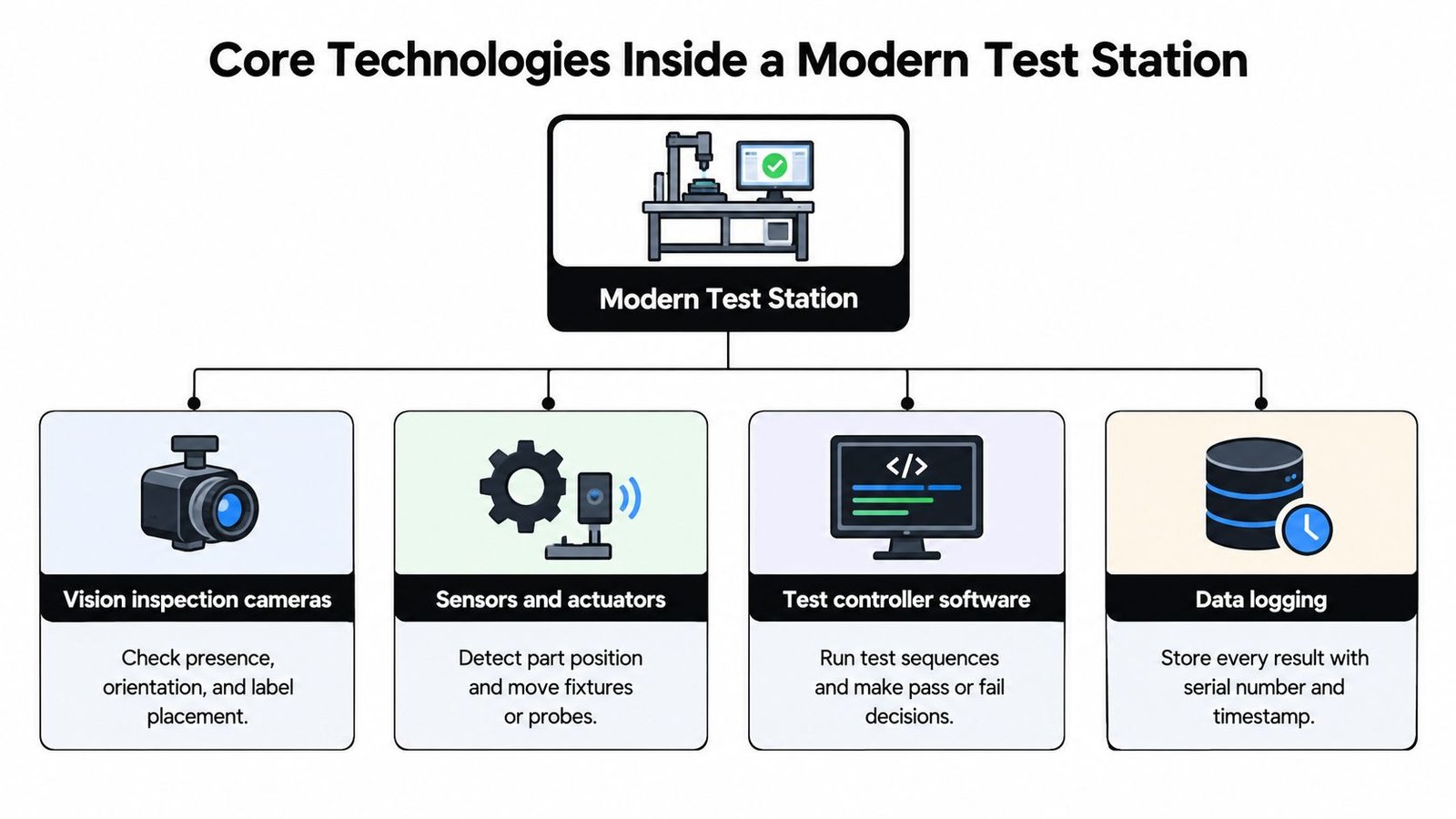
Vision inspection cameras check visual features such as whether a component is present, whether it's oriented correctly, and whether label placement or legibility meets the requirement. Lighting, camera position, and the criteria used to judge an image all affect whether the check is useful.
Sensors and load cells measure physical conditions. Depending on the station, they can confirm position or measure force and pressure. Actuators may move a fixture or probe into place, so the test can be repeated in a controlled way.
Electrical and functional test circuits check whether an assembly behaves as designed. They might confirm a connection or run a defined operating sequence. The key is to match the test to a requirement that can be observed, not merely to run a cycle and assume the product is sound.
Turn measurements into a decision and a record
A PLC can sequence the test, coordinating sensors, actuators, and other equipment. The HMI gives the operator instructions and displays the outcome, such as a pass, a failure, or a request to check a part's position.
Barcode or serial capture links the result to a specific unit. Without that connection, a pass/fail signal may be difficult to trace back to production history or review alongside other quality records. The station's records should preserve what was checked and the result, in a format that fits the manufacturer's quality process.
When discussing a system with a supplier, ask which component makes each required measurement, how the software decides pass or fail, and how a result is tied to the unit. Custom test fixtures can help hold parts in a repeatable position, but the fixture still needs to suit the product and the test being performed.
The video below offers another look at test-station equipment in context.
Measuring Benefits and Estimating Return on Investment
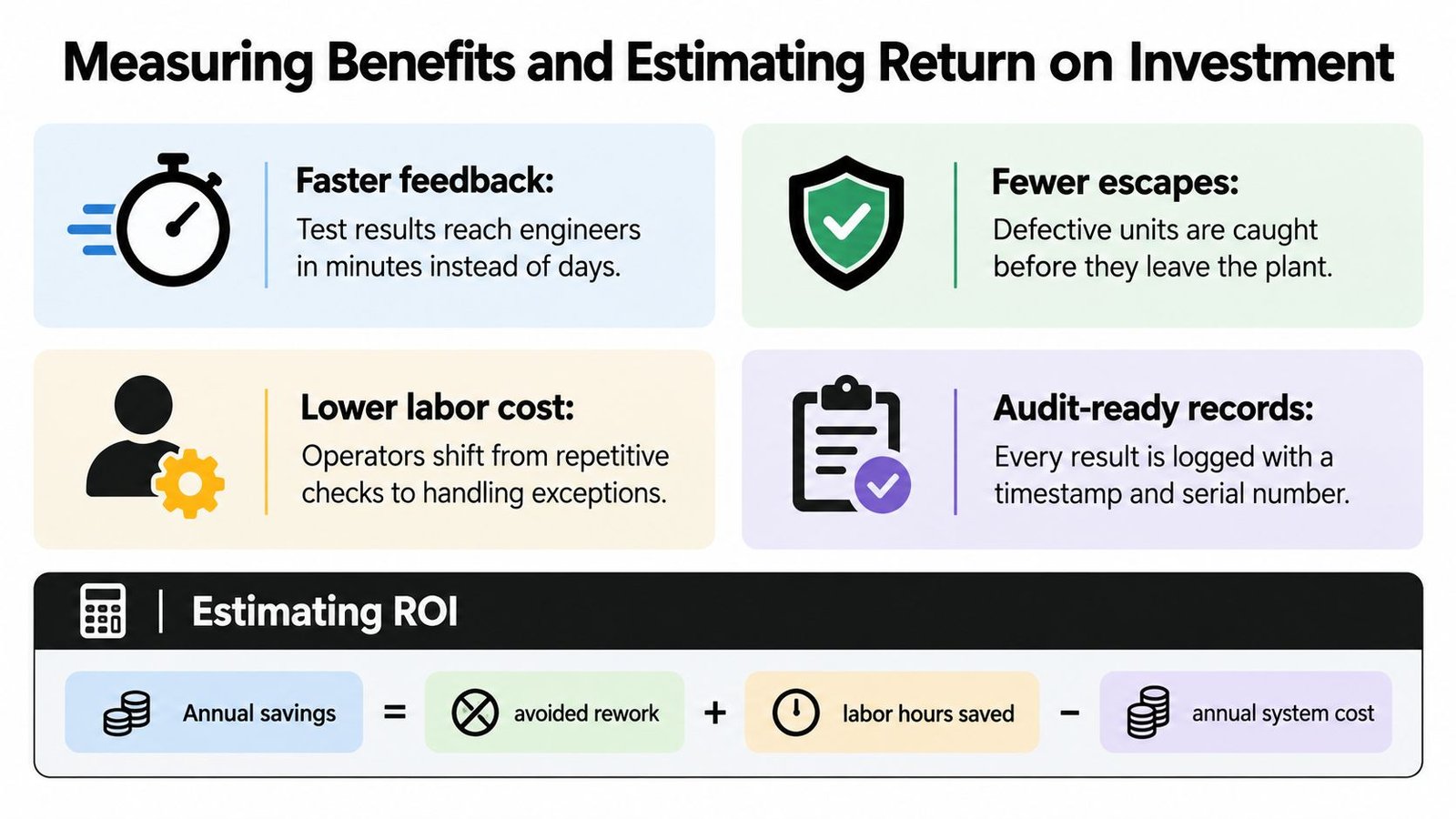
A test station earns its place when it helps the plant act on problems sooner, avoid unnecessary rework, or make better use of people's time. Look for changes in defect detection, measurement consistency across shifts, and how quickly teams can investigate a failure. The value depends on the test and the process around it, not merely on whether the station runs automatically.
A five-project evaluation reported higher defect detection and shorter testing time after software test automation was introduced. The evaluation of automated testing across five projects concerns software projects, not factory test stations, so its results are not a manufacturing benchmark. In a plant, outcomes depend on which faults a test can detect, how well it fits the production process, and whether the information it produces helps staff make decisions.
Estimate costs and savings using your plant's records
Start with the costs the proposed station could realistically change. Review labor spent on repetitive checks, scrap and rework that might be avoided, and expenses from defects that reach customers or later production steps. Then account for annual equipment support and maintenance. Keep the initial purchase and integration cost separate; it is the starting point for estimating payback.
Use a consistent calculation:
Annual net benefit = avoided rework and escape costs + labor savings − annual system and maintenance costs
Payback period = initial equipment and integration cost ÷ annual net benefit
For example, a hypothetical station costing $30,000 to purchase and integrate, with an estimated annual net benefit of $15,000 after maintenance, has a simple estimated payback period of two years. These figures illustrate the calculation, not a quote or forecast. Build a plant estimate from production, labor, scrap, and service records, and include only savings the team can reasonably capture.
A faster test does not automatically cut costs. The released time has value if it reduces labor expense, creates useful production capacity, or lets operators focus on exceptions. For small and mid-sized manufacturers, a targeted or modular station may deliver more value per dollar than automating every step. Compare the cost of the specific task improved with the cost of adding and maintaining automation.
How to Choose the Right Level of Automation
The right level of automation is a risk-and-cost choice, not a contest to see which station has the fewest people near it. Compare manual, semi-automatic, and fully automated approaches against the same criteria, then choose the arrangement that fits the product and the team that will operate and maintain it.
Score the options against real operating needs
Use a simple scorecard: rate each option as a weak, adequate, or strong fit for each criterion. The score is a structured discussion, not a substitute for engineering review.
| Criterion | Manual | Semi-Automatic | Fully Automated |
|---|---|---|---|
| GMP and documentation | Can work when procedures and records are controlled | Can combine operator actions with documented machine checks | Can generate consistent records but needs controlled software and change history |
| Throughput needs | Suits work that doesn't require a repeated machine cycle | Supports faster, standardized checks while keeping operator handling | Can support repetitive high-volume sequences when the process is stable |
| Measurement accuracy | Depends heavily on method and operator consistency | Fixtures and instruments can standardize critical measurements | Integrated measurement can be consistent, with calibration and validation needs |
| Budget and payback | Lower equipment cost, but ongoing labor remains | Targets the steps where equipment can make a clear difference | Greater integration cost, with potential value when sustained use justifies it |
| Maintainability | Familiar to the team, though results may vary by operator | Often easier to troubleshoot in modules | May require specialized support across controls and equipment |
For a small or mid-sized manufacturer with changing products, semi-automatic or modular equipment often offers more quality improvement per dollar than a fully integrated line. A fixture that prevents incorrect loading, paired with a sensor or vision check, may address the main source of variation without automating every movement. Conversely, a stable, repetitive process with clear requirements may justify deeper automation.
Medical-device makers need to include quality-system fit in the decision. In the United States, FDA requirements for device manufacturers cover controls and verification throughout production, not just final inspection. The FDA overview of quality-system requirements and human-factors implications explains why equipment and process controls should support the manufacturer's quality system.
Fully automated equipment may reduce routine handling, but it can also bring more validation, change-control, service, and recovery work. A scorecard makes those costs visible before you request a quote. System Engineering & Automation designs and builds manual, semi-automatic, and fully automated manufacturing equipment, including custom tooling, fixtures, and integrated controls, with support from early concepts through installation and commissioning.
Rolling Out Automated Testing From Pilot to Scale
A test station beside a busy production line can look ready for automation, yet product changes or unclear pass/fail rules can make its results unreliable. Start with a stable check and treat the pilot as a small trial: it should show whether the equipment catches the intended faults before the process depends on it.
The 2024 World Quality Report findings point to a general challenge: existing systems and incomplete automation strategies can complicate adoption. For a small or mid-sized manufacturer, that is a reason to check interfaces and start with one useful task, not assume a full-line replacement is needed.
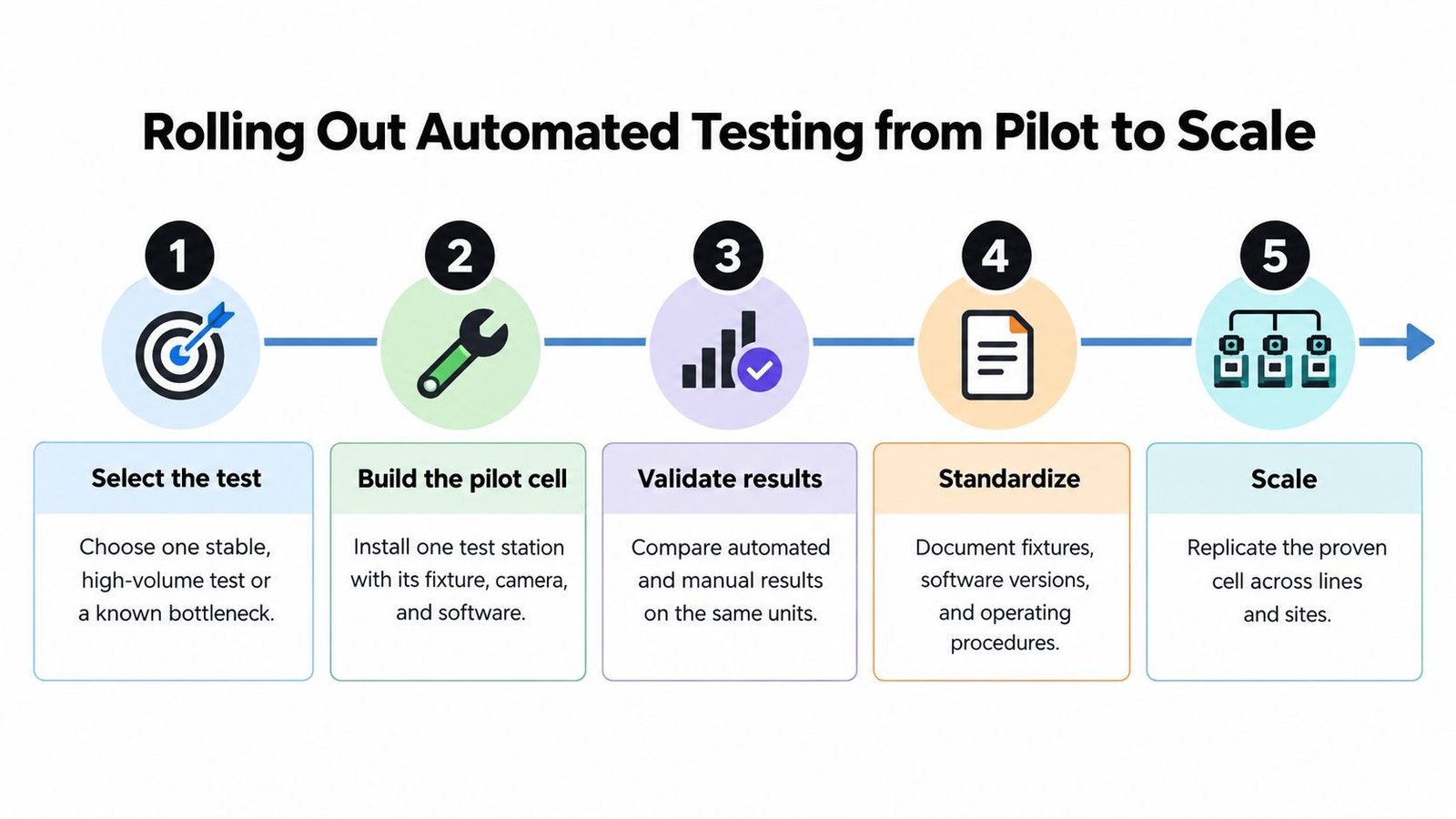
Set decision gates before expanding
- Select the test. Choose a repeated check or a known bottleneck. Set acceptance criteria and identify what a wrong result could cost.
- Build the pilot cell. Fit only the fixture, sensor or camera, and software needed for that check. Like testing one tool before equipping a whole line, a focused setup makes faults easier to trace.
- Compare results. Run automated and manual checks on the same units. Investigate disagreements rather than assuming either method is correct.
- Standardize the method. Record the fixture, software version, operating steps, and evidence used to approve the test. Assign maintenance ownership and define how changes will be reviewed.
- Scale selectively. Copy the proven setup only to processes that are sufficiently similar. Connect results to quality records where needed.
Keep a person involved when results are unusual, product conditions fall outside the expected range, or the system cannot interpret a result confidently. Pause the pilot if readings vary, communication with existing controls fails, or the quality team cannot use the records.
Before expansion, agree on pass/fail criteria and retain the evidence behind the decision. Factory acceptance testing checks equipment functions and sequences before installation; commissioning then shows how the station behaves on the actual production floor. A semi-automated cell may be the better next step if it meets the quality need with less integration and upkeep than a fully automated line.
Common Pitfalls and Illustrative Examples
A large test library can still miss important faults. In a study of 357 real faults in the Defects4J Java benchmark, automatically generated tests detected 55.7% of the faults. Only 19.9% of the generated test suites detected at least one fault, according to the study of automatically generated tests and real faults. In plain terms, that second figure counts the share of test suites that caught any fault. Defects4J is a software benchmark, not a manufacturing study, so its results apply only by analogy: a high test count does not show whether tests catch meaningful failures.
A manufacturing station can run many cycles and still miss a faulty sensor, an incorrect alarm state, or a product that fails a critical requirement. The useful check is whether each test covers relevant failure modes and whether its pass/fail limits separate acceptable units from defective ones.
Hypothetical rollout pitfalls
Consider a plant that automates a manual process before standardizing the work. The station may repeat inconsistent instructions reliably, producing consistent output without making the test sound. In another hypothetical scenario, a team assumes a new tester can communicate with an older PLC, then discovers interface limits during integration. In both cases, the avoidable cost comes from automating before checking the process or confirming compatibility.
Upkeep can be missed, too. Scripts need review as requirements change, fixtures wear, and sensors need appropriate checks. If records are assembled only when an audit approaches, staff may have trouble identifying which procedure or configuration produced a result. For a small or mid-sized manufacturer, those support demands are part of the automation cost, not an afterthought.
Hypothetical manufacturing examples
Small medical-device maker. A team replaces a repetitive manual electrical check with a semi-automatic fixture. The operator loads the device and handles failures; the station runs the check and records the result against the unit identifier. This approach standardizes the measurement and makes records easier to retrieve while keeping human judgment in the process.
Mid-sized plant. A plant adds smart tooling at one workstation to confirm part position before a functional check. The team compares the new setup with the existing method and resolves differences before expanding the cell. It measures its own rework, check time, and maintenance needs rather than assuming automation will deliver a particular result. For both examples, semi-automation offers a way to target repeatability without paying for full automation where operator handling still makes sense.
Next Steps Toward a Test Strategy That Pays Off
Before buying equipment, answer three questions. Which process steps carry the highest defect or labor cost? What level of automation fits your budget and quality-system obligations? Who will maintain the station after commissioning? If the team can't answer those questions, a large integrated system may add complexity before it solves the production problem.
Start with a practical list of current test steps. For each one, note what it checks, who performs it, where failures are found, and what records the process produces. Mark the steps with the greatest defect or labor burden, then identify which requirements are stable enough to test consistently. That list will make a consultation more concrete than a general request to automate a line.
Keep the decision grounded in the work. A manual process may remain the sensible option where judgment is essential or production needs change often. A semi-automatic station may standardize the measurement or capture records while leaving flexible handling with the operator. Full automation can be appropriate when the process is repeatable and the added integration and support effort makes sense.
A sustainable plan also covers what happens after installation. Agree on who responds to faults, how the team will document changes, and what support is available if a fixture or control needs adjustment. A system's value depends on its continued fit with production, not just its performance during commissioning.
Bring your list of test steps and estimated costs to a consultation with System Engineering & Automation. Ask the team to review which checks could benefit from custom tooling, a semi-automatic cell, integrated controls, or a different approach, and how the proposed system would fit your production and quality records.
System Engineering & Automation provides manufacturing equipment, custom fixtures, integrated controls, installation, and ongoing support, with solutions designed around production goals and budgets. Share your test-step list with System Engineering & Automation to discuss a practical automation level, commissioning needs, and support for keeping the system working on your floor.