Your operators can already name the problems. A fixture drifts, a changeover runs long, rework piles up at the same station, and maintenance has no window to fix any of it properly. Production targets, quality controls, and staffing limits compete for the same people and the same hours. That's the environment where learning how to implement continuous improvement either becomes a working discipline or dies as a poster campaign.
Table of Contents
- Build a Continuous Improvement Operating System
- Assess Manufacturing Readiness Before Launching
- Choose the Right Continuous Improvement Method
- Set Baselines and KPIs That Drive Action
- Design a Pilot and Build Operator Ownership
- Measure Results and Scale What Works
- Avoid Pitfalls and Plan the First 90 Days
Build a Continuous Improvement Operating System
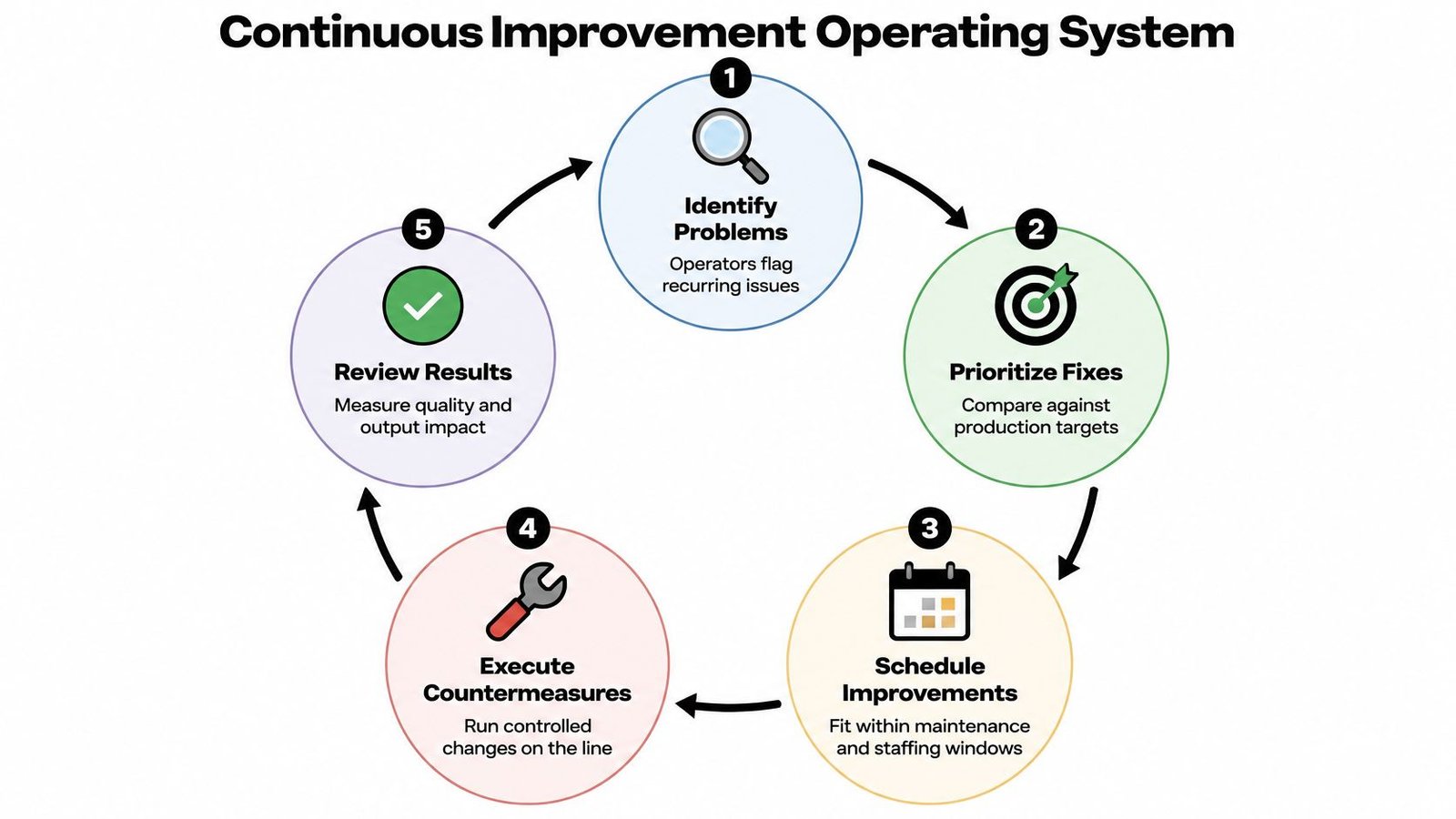
Treat continuous improvement as a closed-loop, measurement-led operating system, not a collection of disconnected projects. A project ends. An operating system keeps finding the next constraint, testing a countermeasure, verifying the gain, and transferring what worked into normal work.
The loop below is the map you'll use for every improvement, whether you're fixing a manual bench, a semi-automated cell, or a full line.
Run the Same Loop Every Time
Start with one business-critical constraint. Pick first-pass yield, cycle time, changeover duration, or defect escape rate, not five priorities at once. Establish a validated baseline, verify the root cause, pilot the countermeasure at limited scale, compare against the baseline, then standardize through work instructions, control plans, training, and routine audits.
Resist optimizing one workstation in isolation. NIST defines smart manufacturing as a fully integrated and collaborative system that responds in real time to changing conditions, and your improvement loop should borrow that logic by connecting equipment, process data, engineering decisions, and customer requirements. Capture operating information, spot the deviation, adjust, and verify.
Where Outside Engineering Help Fits
Map support to the stage where you're weakest. You might need manufacturing engineering to characterize the constraint, automation help to instrument a bottleneck station, custom tooling to reduce manual variation, or service support to keep a proven change performing after handoff. System Engineering & Automation, for example, works across those stages with manual, semi-automatic, and fully automated equipment, tooling, fixtures, and integrated controls aligned to production goals and budget.
Practical rule: Judge every improvement by stable performance after handoff to normal operations, not by the best shift during the pilot.
That standard changes your decisions. You'll pick smaller, reversible changes, assign an owner before you start, and define escalation rules for drift before anyone declares victory. Do this consistently and improvement becomes predictable work your plant can schedule, staff, and defend during audits, rather than heroic effort that evaporates when the project team moves on.
Assess Manufacturing Readiness Before Launching
Don't deploy tools until you've checked whether your plant can sustain them. Advanced methods can't compensate for absent ownership, unreliable data, or operators who have no time and no authority to act.
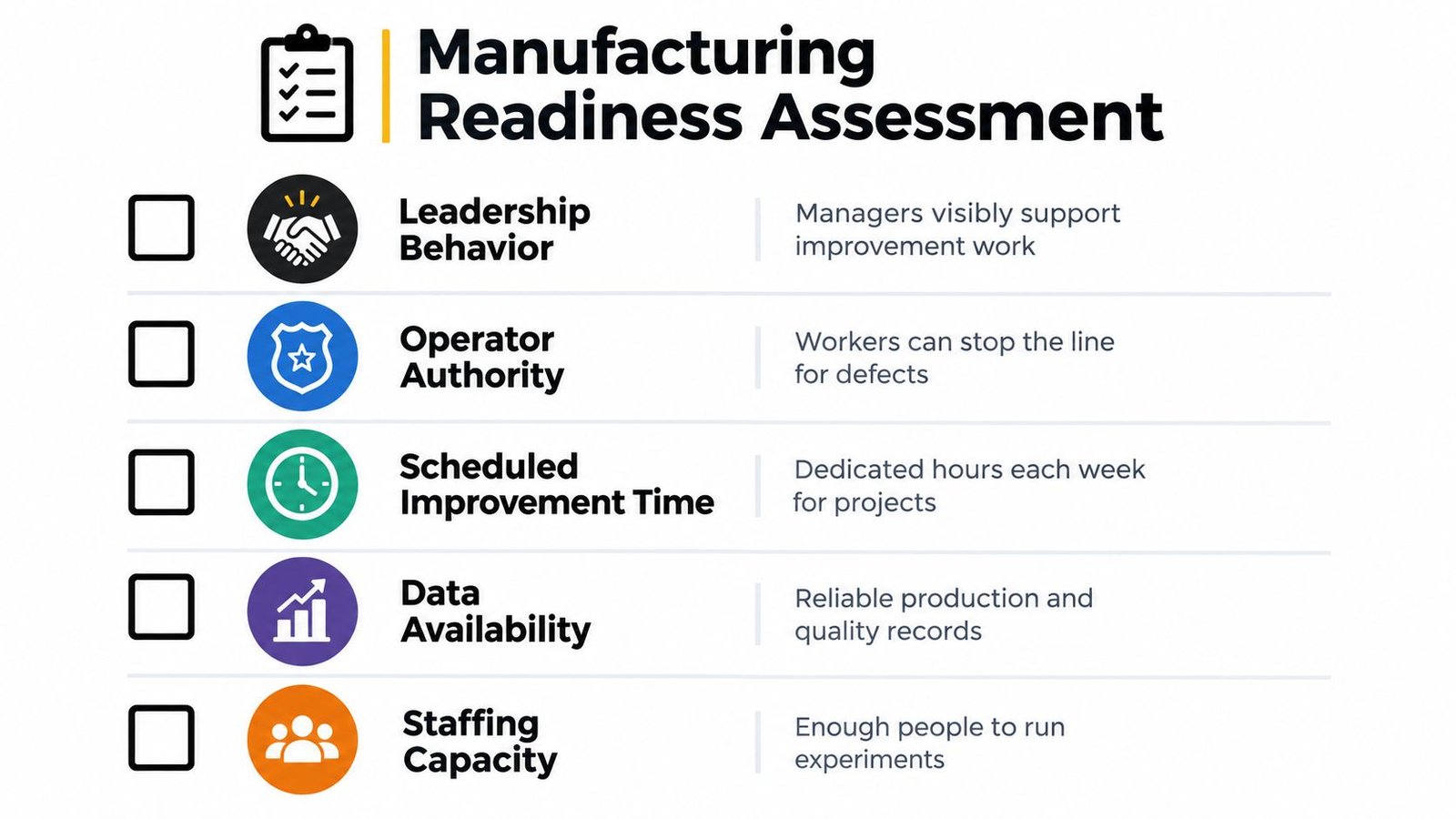
Use the readiness view below as a starting screen before you charter projects or commission automation work.
Read the Evidence Honestly
Leadership behavior comes before method selection. In a survey of 600 organizations with approximately a 17% response rate, management commitment, cultural change, strategic linkage, and leadership style ranked as the most important Lean Six Sigma implementation factors. Linking the program to HR rewards and extending it to the supply chain ranked among the least important. Take that seriously. If managers won't protect time or follow up, training your staff in another tool won't fix it.
Build a cross-functional team that includes operators, maintenance, quality, engineering, and production planning. Don't outsource improvement to a specialist team that hands finished answers to the floor. Use structured process mapping with that group so disagreements about how work flows surface early, before you spend money.
Close These Gaps First
Work through this checklist and fix the weakest items before launch.
- Process ownership: Name one owner who can approve changes, stop a failing pilot, and own results after handoff.
- Operator authority: Confirm frontline staff can flag defects, suggest countermeasures, and get a timely answer.
- Scheduled improvement time: Put hours on the calendar around production and maintenance windows, don't borrow them informally.
- Data reliability: Check that counts, timestamps, and defect categories mean the same thing across shifts and machines.
- Quality-system maturity: Verify how changes move through review, documentation, and training, especially in GMP-aware areas.
Then add safeguards. Set a portfolio limit so you don't launch too many projects, run a weekly tiered review, make owners visible, and close the loop with operators on every suggestion, including the ones you reject. If you can't staff the review cadence, you're not ready to scale the project list. Shrink the scope until the governance fits your real capacity.
Choose the Right Continuous Improvement Method
Pick the method that fits the problem, not the one with the strongest reputation in your building. PDCA, Kaizen, Lean, 6S, and DMAIC aren't rivals. They're different structures for different questions, and you'll often combine them.
Match Structure to the Question You're Asking
Use PDCA when you have a defined process and want a controlled test. You're changing a torque sequence to lift first-pass yield, for instance, and you need a plan, a limited trial, a check against baseline, and a decision to standardize or revert. PDCA is your default engine for most workstation and cell level changes.
Choose Kaizen for rapid, operator-led experiments at a single workstation. A team repositions parts presentation, tests it over a few production cycles, and keeps or discards the change quickly. Kaizen works because the people who feel the problem run the test, but it still needs a target and a before-and-after comparison.
Reach for Lean when waste lives between stations, not inside one. Queues, overproduction, excess motion, and waiting across a value stream need flow thinking, not a local fix that pushes the bottleneck downstream. Lean gives you the lens to find that waste, while PDCA gives you the discipline to remove it one verified step at a time.
Start with 6S when the work cell itself is the problem. If operators hunt for tools, parts get mixed, or safety hazards are normalized, organize, set in order, clean, standardize, sustain, and address safety before deeper process changes. A chaotic cell produces noisy data, and noisy data ruins every other method.
Use DMAIC when a defined problem needs deeper statistical verification of root causes before you invest. It's heavier, so reserve it for problems where the cost of being wrong justifies the analysis.
Continuous Improvement Methods at a Glance
| Method | Primary Focus | Best-Fit Use | Evidence to Keep |
|---|---|---|---|
| PDCA | Controlled test of a countermeasure | Yield, cycle time, changeover changes | Baseline, pilot results, standardized work |
| Kaizen | Rapid operator-led experiments | Single workstation fixes | Problem statement, before-and-after check |
| Lean | Waste across the value stream | Flow, queues, waiting, overproduction | Current-state map, waste removed, flow measures |
| 6S | Workplace organization and safety | Disorganized cells, mixed parts, hazards | Audit checklist, photos, standard locations |
| DMAIC | Statistically verified root causes | Complex, high-cost defects | Measured baseline, analysis, control plan |
Training is not implementation. A method only counts when a named owner runs it on a real constraint and produces evidence.
Assign the owner when you choose the method. If nobody owns the evidence, you've scheduled training, not improvement.
Set Baselines and KPIs That Drive Action
A vague goal like improving quality gives a team nothing to run. Convert every idea into a quantified charter that management can review and operators can act on.
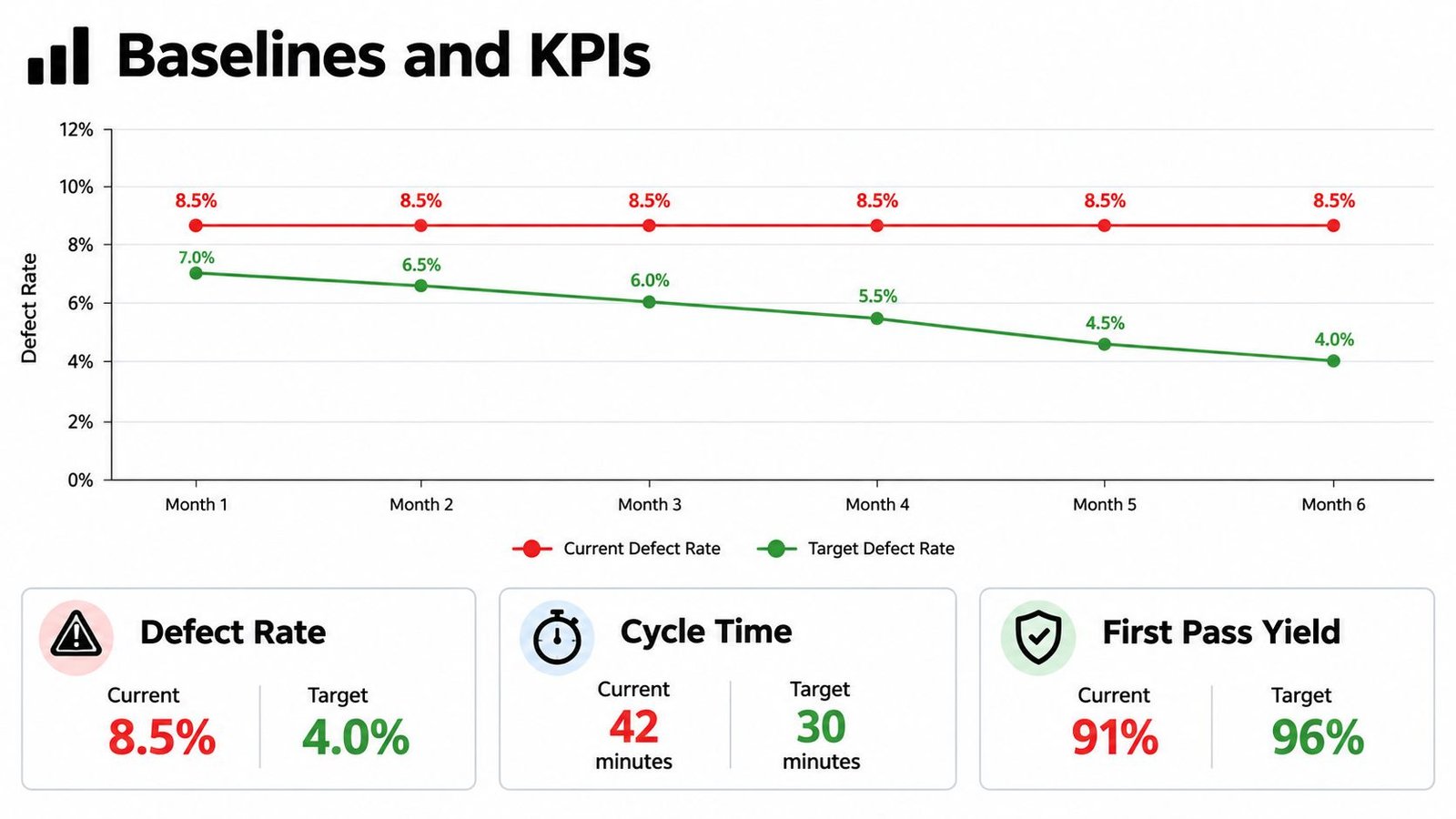
The visual below shows the discipline you're aiming for, a current state you can defend and a target you can measure against over time.
Build a Baseline You Can Defend
Define the customer and business requirement first, then map the current process and select one primary constraint, such as first-pass yield, cycle time, changeover duration, or defect escape rate. Write operational definitions so everyone counts a defect, a cycle, and a changeover the same way. Use calibrated measurement systems, because a baseline built on a drifting gauge will mislead every later decision.
Stratify data by product, shift, machine, and operator to find patterns, not to assign blame. If one shift looks worse, investigate what's different about staffing, material, or machine state before you touch the people. Stronger manufacturing data practices make that stratification faster and keep teams arguing from the same numbers.
Pick KPIs that drive action. Use OEE when equipment availability, performance, and quality interact at a bottleneck. Use yield when rework and scrap are the constraint, cycle time when throughput is, and defect escape rate when downstream detection worries you. Connect each lagging result to leading indicators the team can influence during the shift, such as completed checks, changeover steps finished on time, or fixtures verified before startup.
Use control charts and capability measures when the measurement system is sound and your question concerns variation. They help you separate routine noise from signals that deserve action, which protects you from tampering with a stable process.
The short video below walks through measurement thinking you can apply while charting your own baseline.
A Sample Charter for Manual Assembly
- Problem: First-pass yield at a manual assembly station is the constraint, with rework concentrated at final fastening.
- Baseline and target: Measured yield by product, shift, and station, with a stated target and completion date.
- Scope and owner: One station, one product family, named owner, operators included in testing.
- Countermeasure under evaluation: Semi-automated tooling to reduce manual variation, piloted only after ergonomic and quality checks.
- Financial or quality impact: Expected rework reduction and escape risk, verified after implementation.
If you can't fill in those lines, don't start the pilot. Tighten the charter first.
Design a Pilot and Build Operator Ownership
Your pilot is where improvement either earns trust or loses it. Design it small, reversible, and with operators inside the decision, not receiving a finished answer from engineering.

Protect Time or the Pilot Will Starve
Leaders often overestimate how embedded improvement already is. Recent survey evidence shows only 39% of manufacturing supervisors say improvement is embedded in daily work, compared with 72% of leaders who believe it is. Supervisors in that same research cite insufficient resources or budgets, lack of leadership sponsorship, and added workload as major barriers, and many report fragmented workflows from weak system integration. So don't add improvement tasks on top of an unchanged workload. Schedule the time, give rapid feedback, and credit operators visibly when their test works.
Run the Smallest Reversible Test
- Define the limits first: Set safety, quality, ergonomics, maintenance, and production constraints before the trial begins, with a clear stop rule.
- Frame the problem together: Have operators describe where variation, reaching, waiting, or rework occurs at the station.
- Baseline manual variation: Measure the current method, including ergonomic risk, before you discuss automation.
- Test the smallest change: Try a low-cost fixture, tooling adjustment, or semi-automation step that you can measure and reverse without compromising safety or product quality.
- Compare honestly: Run several production cycles, compare against the baseline, and document the new standard only if the change earns it.
Consider a semi-automated cell where inconsistent hand placement creates rework. A simple locating fixture, tested with the operators who run it, can reduce manual variation while preserving their judgment on parts that don't fit the pattern. If yield doesn't improve, you remove the fixture and you've spent little. That reversibility is what makes people willing to experiment again.
Treat training as a role-specific transfer of the new method, not a generic class. Use practical operator-focused training tied to updated work instructions, controls, and escalation rules, so each person learns what changed in their job, what to check, and when to call for help. Keep a fast feedback loop during the first cycles, because operators will spot integration problems, awkward reaches, and documentation gaps before your metrics do.
Give operators authority, scheduled time, rapid feedback, and visible credit. Without those four, engagement is a slogan.
Measure Results and Scale What Works
The control phase is the test. Many pilots look good for a week, then drift back because nobody standardized the change, monitored it, or owned the handoff.
That failure pattern is well documented. One manufacturing study found 17% of surveyed experts reported 11 to 20% failure during the Analyze phase, while another 17% believed more than 50% of projects failed during Control because gains were not sustained. Plan your control period before the pilot starts, not after early results look promising.
Verify Before You Standardize
Compare pilot results with the validated baseline using the same operational definitions. Investigate meaningful differences, and don't change the process again until you've distinguished common-cause variation from special causes. Reacting to routine noise as if it were a signal makes processes worse, and it teaches operators to ignore the data.
Once a countermeasure has earned its place, standardize it completely.
- Work instructions: Update the method, sequence, and inspection points at the station.
- Control plans: Define what's monitored, how often, by whom, and what triggers escalation.
- Training records: Confirm every affected role, including relief and off-shift staff, is trained on the new standard.
- Maintenance tasks: Add fixture, sensor, or tooling checks to preventive maintenance so the gain doesn't depend on memory.
- Routine audits: Verify the standard is followed during normal production, not only during reviews.
Monitor both leading and lagging indicators, verify benefits at 30, 60, and 90 days, and set drift escalation rules with a named owner. If performance slides, the owner investigates the process first, not the nearest operator.
Scale in a Deliberate Sequence
Replicate on a similar line, standardize the design, train the receiving team, and expand only while results stay stable. For semi-automated systems, expand integration as goals and budget permit, starting where feedback is measurable. Instrument the problem station, capture failure and delay data, make control decisions from that data, and extend after the station performs consistently.
For GMP-aware and medical-device production, retain objective evidence of risk assessment, validation, training, deviation handling, traceability, and change control. Design reviews, drawings, commissioning records, maintenance procedures, and process changes should be organized so you can demonstrate the equipment consistently supports intended requirements, which aligns with the FDA transition materials describing documented evidence under the revised quality regulation. Build that evidence during the pilot. Reconstructing it later is slower and weaker.
Avoid Pitfalls and Plan the First 90 Days
Improvement is not a software purchase, automation is not automatically a lean solution, and training is not implementation. Weak governance will defeat good tools every time, and one academic review summarized in earlier research reports roughly 60% of continuous-improvement programs fail to deliver expected outcomes. That figure should push you toward fewer, better governed projects, not bigger launches.
Failure Modes That Do the Most Damage
- Too many projects: Recovery action, impose a portfolio limit and finish controls on current work before chartering more.
- No reliable data: Recovery action, pause the countermeasure, fix operational definitions and measurement, then re-baseline.
- Frontline excluded: Recovery action, bring operators into problem framing and testing before you finalize tooling or automation.
- Waste shifted downstream: Recovery action, measure the receiving process, not just the improved station, before scaling.
- Controls never stabilize: Recovery action, keep the project open through its control period with audits and a named owner.
- Disconnected workstation fixes: Recovery action, connect the change to the wider flow, supply conditions, and customer requirement.
Poorly integrated automation can increase administrative work and fragment workflows, so evaluate every upgrade for its effect on process control, traceability, corrective action, and the people who'll run it.
For medical-device manufacturers, the FDA Quality Management System Regulation became effective on February 2, 2026, amending 21 CFR Part 820 and incorporating ISO 13485:2016, so tooling, controls, documentation, validation, maintenance, and change management must operate within your documented quality system, as set out in the FDA Quality Management System Regulation guidance. Address compliance during concept development, not at installation.
Your First 90 Days
Select one constraint, establish ownership and a defended baseline, run one reversible pilot, and verify benefits at 30, 60, and 90 days. Scale only after stable evidence, and keep the portfolio small enough for weekly review.
Adoption checklist: one quantified charter, one named owner, protected operator time, a reversible pilot, updated standards and training, a monitored control period, and quality-system evidence where your market requires it. That's how to implement continuous improvement that survives handoff.
If you're ready to turn one bottleneck into a controlled, measurable pilot, System Engineering & Automation can help you assess the right level of manual, semi-automated, or automated equipment, tooling, and controls for your production goals and budget. Visit the site to start a consultation on your workstation or line, from early concepts through installation, commissioning, and ongoing support.