The machine has arrived, production has a start date, and the first dry cycle looks clean. Then actual material goes through it, the upstream station pauses, and an operator has to recover a half-finished part. Suddenly, the question isn't whether the machine runs. It's whether your team can trust it to hold output without creating quality, safety, or maintenance problems.
A machine commissioning procedure should answer that question with recorded evidence. Commissioning isn't finished when the first cycle runs. It ends when the installed machine holds the agreed output under normal, fault, and restart conditions, and another engineer can trace exactly what was tested, what passed, and who approved release.
Table of Contents
- Machine Commissioning Phases at a Glance
- Prepare Acceptance Criteria Before the Machine Ships
- Testing Beyond a Successful Dry Cycle
- How to Run FAT and SAT Step by Step
- Commissioning on Site and Reaching Target-Rate Production
- Documentation Your Release Package Needs
- Sign Off Only When the Evidence Holds
Machine Commissioning Phases at a Glance
Commissioning phases, checks and exit criteria
| Phase | Key check | Evidence to keep | Exit criterion |
|---|---|---|---|
| Requirements freeze | Requirements, design specs, risk controls and acceptance limits | Signed requirement and specification set | Every acceptance criterion is measurable |
| Factory Acceptance Test (FAT) | Machine tested against the design before shipment | FAT protocol and deviation log | No open critical deviations |
| Site installation check | Utilities, guards, e-stops, calibration, software versions and access | Installation checklist and calibration certificates | All utility and safety items verified |
| Site Acceptance Test (SAT) | Run under real site conditions | SAT report with run data | Output stable at the agreed rate |
| Commissioning run | Extended run covering normal, fault and restart cases | Run logs, alarm and interlock records | Reliable operation across the agreed window |
| IQ, OQ and PQ handover | Qualification protocols built on commissioning evidence | IQ, OQ and PQ reports | Release approved by quality |
Use Gates Rather Than Calendar Milestones
Requirements freeze establishes what the buyer and builder will accept. Approve the operating envelope, product characteristics, safety controls, and measurement methods before authorizing the build, not while negotiating an unsuccessful test.
FAT checks the completed build against that approved design. Record any limitation of the factory setup, especially where the vendor can't reproduce plant utilities, connected equipment, or production materials.
Site installation verification establishes whether the delivered equipment is ready for controlled operation. Reassembly, utility connections, calibration status, software configuration, mechanical condition, and maintenance access all need an identified check.
SAT then challenges the installed system in its actual environment. The production team should witness the interfaces and operating conditions it will own after handover.
The commissioning run extends testing beyond a demonstration. Plan an extended run covering a full production shift, including normal interventions, stoppages, and recovery, with its duration justified in the approved protocol.
Qualification handover applies where the process requires it. Commissioning confirms installation, correct function, and readiness for handover; Installation Qualification, Operational Qualification, and Performance Qualification establish suitability for the validated process, a distinction reflected in FDA qualification guidance.
Evidence can serve both activities when the protocols, instruments, execution, and review meet the receiving quality system's requirements. Don't assume a vendor checklist automatically qualifies as an approved qualification record.
Practical rule: If FAT exit criteria aren't met, the machine doesn't ship. If SAT exit criteria aren't met, it doesn't enter production.
Prepare Acceptance Criteria Before the Machine Ships
Vague criteria create disputes that troubleshooting can't resolve. A builder may demonstrate the specified cycle speed while the buyer expects that speed to include loading, inspection, unloading, and routine material replenishment. Both teams can believe they're right because nobody defined the boundary.
Start by defining machine limits: intended products, speed range, cycle time, material variation, operator responsibilities, environmental conditions, and permitted interventions. State whether throughput means machine cycles or accepted finished parts delivered to the next operation.
The risk assessment belongs here, too. ISO 12100:2010 addresses machinery across its lifecycle, including installation, commissioning, use, reasonably foreseeable misuse, maintenance, and decommissioning, using a method of defining limits, identifying hazards, evaluating risks, applying protective measures, and documenting the results.
Turn Requirements Into Decisions
For a semi-automatic dispensing station, a useful requirement specifies the target fill, permitted percentage deviation, measurement instrument, consecutive-cycle sample, and allowable failures. Write those values into the approved protocol before dispensing begins. A requirement to produce consistent fills isn't an acceptance criterion.
Prepare the supporting controls alongside the performance requirements:
- Interface control document: Identify power, compressed air, water, network connections, upstream and downstream handshakes, and PLC or SCADA signal ownership.
- Responsibility matrix: Name the test executor, witness, technical reviewer, and person authorized to accept the result.
- Risk-to-test mapping: Connect each protective measure to a challenge, expected response, and retained record.
- Measurement definition: Specify instrument resolution, calibration status, sampling location, and treatment of rejected or missing observations.
Make the Statistics Fit the Process
Define within-run variability using an appropriate measure, such as the standard deviation of consecutive fill measurements. Define between-run variability separately, for example through differences in run means and an analysis separating run-to-run effects from individual-cycle variation.
The protocol must state a fixed number of consecutive runs and a numerical confidence level, selected through the approved statistical rationale. There's no defensible universal run count for every machine: product risk, expected variation, lot changes, and the claim being demonstrated determine the plan.
For low-volume production, indiscriminately increasing sample size can waste expensive material without testing the important conditions. Prioritize representative variation, then have the responsible statistical and quality reviewers approve whether the evidence supports the intended claim.
If you can't explain how a criterion will be measured and who will accept the result, the plan isn't ready for the factory.
Testing Beyond a Successful Dry Cycle
A dry cycle proves that the machine can execute a sequence without production load. It doesn't establish dispensing accuracy, pressing consistency, part detection, recovery behavior, or accepted output over time.
During OQ, challenge the approved operating window rather than only the comfortable nominal setting. During PQ, use production-equivalent materials, tooling, personnel, and shift conditions; FDA process-validation guidance calls for predetermined acceptance criteria, representative sampling, and statistically justified confidence.
Test cases that prove a machine is ready
| Test case | Challenge | Pass evidence |
|---|---|---|
| Minimum and maximum speed | Run at both ends of the approved operating window | Cycle time and output within limits at each end |
| Material variation | For a hypothetical trial, run two or three lots with different thickness or viscosity | Quality results inside the acceptance limits |
| Emergency stop | For a hypothetical protocol, trigger mid-cycle at three or more risk-selected points | Machine reaches a safe state, and reset needs a deliberate action |
| Utility loss and restore | Interrupt air or power using an approved test method, then restore it | Controlled stop, no unsafe restart, recovery to the recipe |
| Sensor fault | Disconnect safely or simulate a faulty sensor | Alarm raised and cycle halted as specified |
| Interrupted cycle recovery | Stop mid-cycle, then restart | Parts traced, cycle resumes or the part is safely rejected |
| Foreseeable operator error | Load a wrong part or skip a step | Interlock or alarm blocks the cycle |
These are test patterns, not permission to introduce uncontrolled hazards. A qualified person should approve fault-injection methods, isolation arrangements, exclusion zones, and the sequence of testing.
Record the Safety Function, Not Just the Button
For an emergency stop, identify the hazardous motion and stored energy before selecting test positions. Record the initiating device, machine state, expected safe-state response, actual response, and reset behavior.
Reset must not itself initiate hazardous movement. Where response time or stopping distance determines protection, measure it using suitable equipment and compare it with the approved design criterion. A photograph of an illuminated emergency-stop button doesn't establish that the protective function worked.
Expose Practical Weaknesses
Check utility performance during demand, not just while the machine is idle. Physically reach maintenance and sampling points, verify gauge calibration, capture software versions, and reconcile unresolved FAT or SAT items against the installed configuration.
At a semi-automatic workstation, have an experienced trained operator and a newly trained, authorized operator execute the same approved batch procedure under appropriate supervision. Compare loading errors, prompts, interventions, quality results, and recovery steps without substituting informal coaching for the work instruction.
This isn't a contest between operators. It checks whether the equipment and instructions support the workforce expected to use them.
A test without a recorded pass criterion is an observation, not an acceptance result.
How to Run FAT and SAT Step by Step
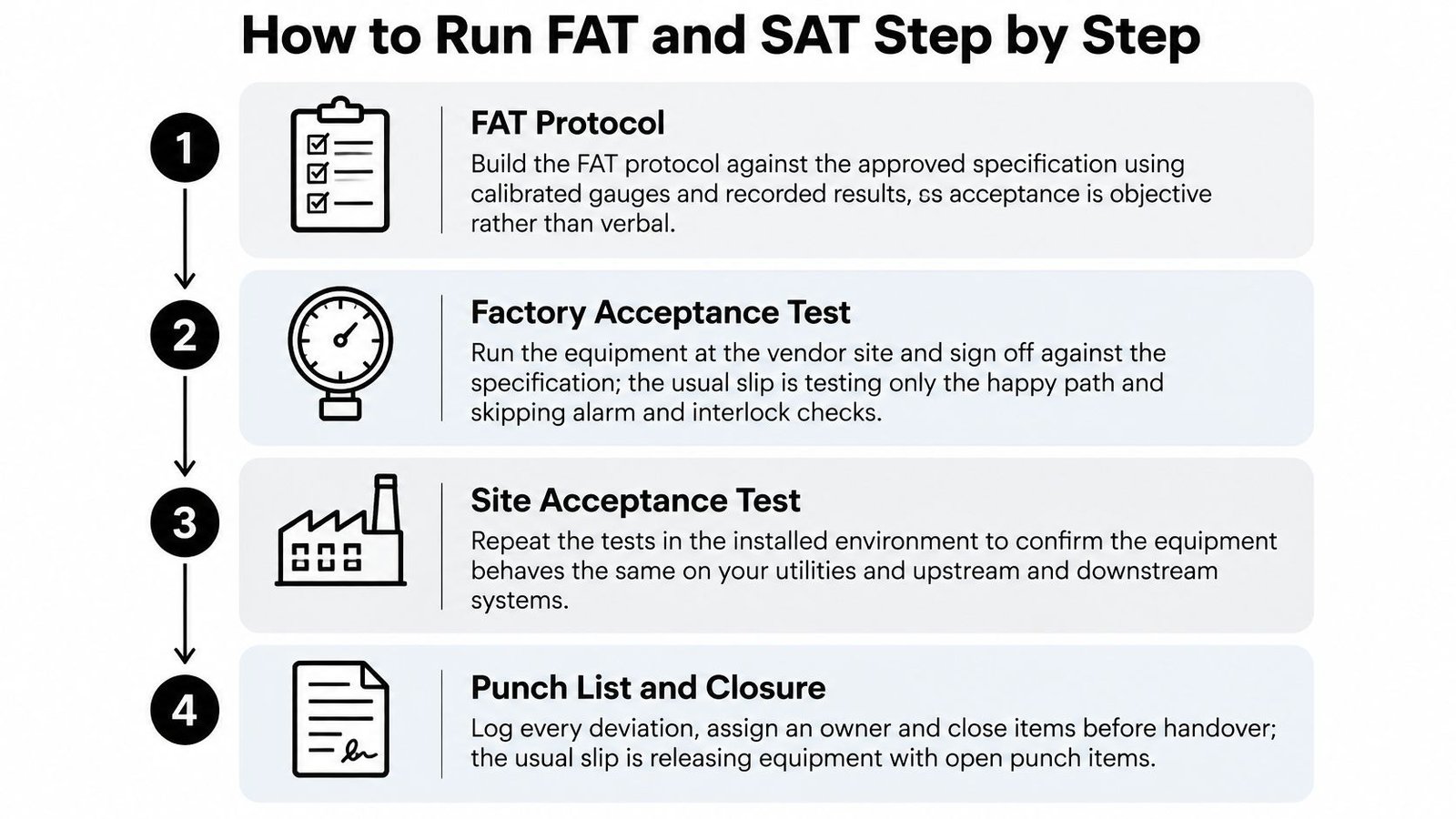
Use a controlled protocol that separates preparation, execution, correction, and approval. The practical framework for factory acceptance testing is to make acceptance objective before witnesses arrive, rather than negotiate it beside a running machine.
The flow below groups the work into factory preparation, factory testing, site testing, and closure.
Execute the Factory Work
Build the FAT protocol against the approved specification. Identify requirement references, calibrated gauges, software versions, test materials, expected results, and the records witnesses will sign, because a test against an obsolete specification proves the wrong build. Usual slip: accepting an edited spreadsheet without confirming which revision the buyer approved.
Verify guarding and safety readiness before powered cycling. Inspect wiring, guards, emergency-stop circuits, and interlocks before authorizing controlled energization, then functionally challenge powered safety functions under the approved safe test plan. Usual slip: assuming a correctly wired device must produce the correct system response.
Progress from dry cycles to production-equivalent runs. Confirm sequence behavior first, then introduce approved materials while recording cycle times, accepted output, rejects, and interventions so the team can distinguish mechanical sequencing from process performance. Usual slip: using convenient material that feeds, dispenses, or locates more easily than production stock.
Give every deviation an owner and disposition. Record the failed requirement, observed condition, product or safety impact, corrective action, and required retest before closing the item or authorizing the next gate. Usual slip: describing an intermittent fault as minor without investigating whether it can affect quality, safe recovery, or sustained output.
Back up the tested configuration and prepare shipment records. Save the PLC, HMI, drives, recipes, configurable devices, and applicable recovery instructions in an identifiable baseline, then reconcile shipped components with the tested assembly. Usual slip: making a final software correction after the backup and sending a configuration that no longer matches the signed test.
Re-establish the Result on Site
Repeat installation verification after reassembly. Inspect transport condition, mechanical alignment, connections, supply suitability, safety devices, calibration status, access, and approved plant-network settings before proceeding, because the installation is now physically different. Usual slip: treating the factory result as proof that a field connection, relocated guard, or changed network interface is correct.
Run SAT with the plant's operators and connected process. Use actual upstream feed, downstream demand, approved production materials, and a planned run covering a full shift, while recording replenishment, changeovers, stoppages, and restarts. Usual slip: allowing the builder's specialist to keep the station running through adjustments that ordinary production personnel aren't authorized or trained to make.
Accept only against the complete SAT record. Confirm every criterion has passing evidence, all critical deviations are closed, and other items have approved dispositions that don't undermine release; retain the signed report with the tested configuration. Usual slip: signing attendance or a demonstration sheet as though it were formal production acceptance.
Have the controls engineer, maintenance representative, production owner, and quality reviewer resolve contradictory results before the acceptance meeting. If an adjustment changes an approved parameter or sequence, assess its effect and repeat the affected tests rather than attaching an unexplained successful rerun.
A SAT that looks acceptable at startup but drifts outside limits by the end of the shift hasn't passed.
Commissioning on Site and Reaching Target-Rate Production
Say a factory-tested dispensing station arrives beside an existing manual assembly bench. The dispenser meets its programmed cycle, but the operator can't replenish components and unload finished parts quickly enough, and a shared air supply dips when adjacent equipment starts.
Observe the connected operation, not just the machine enclosure.

The gap is integration. CxPlanner's machine-commissioning guide identifies integration with other machines as a major challenge when equipment moves from the manufacturer's facility to the customer's environment.
Measure the Whole Workstation
Time the operator's loading, initiation, unloading, inspection, replenishment, and walking alongside the automatic sequence. Identify which tasks can overlap safely and which require the machine to wait. A faster automatic stroke won't remove a bottleneck caused by awkward part presentation.
Check upstream and downstream handshakes, plant-network communication, SCADA or MES exchanges, material variability, and utility behavior under concurrent demand. Record blocked and starved states separately from equipment faults, so the team doesn't tune the machine to compensate for a supply problem.
FAT is time-boxed. Site commissioning continues through parameter tuning, production trials, calibration to actual materials, and operator training until the connected process meets the agreed conditions.
A site review should include these operator and equipment interfaces.
Define Stable Production Before Buy-Off
For a hypothetical acceptance plan, require target output across three consecutive production shifts, rejects within the agreed limit, and no unresolved interface faults. That example isn't a universal qualification rule; the approved duration must reflect the process, operating pattern, and risks.
Use site acceptance testing to verify these conditions with the people who will operate and maintain the installation. Record good output against elapsed production time and explain any excluded periods, rather than presenting a favorable instantaneous cycle rate.
Our turnkey project management covers concept through commissioning, including design, programming, installation, and support. Our shipping and setup service includes delivery to the customer's location, on-site setup and installation, unpacking, and full buy-off, keeping those handoffs within the same service scope.
Close the site phase with a joint walkthrough, documented run, and written handover. Production accepts the operating method, maintenance accepts service access and recovery information, and the authorized approvers accept the evidence, not merely the equipment's presence.
Documentation Your Release Package Needs
The release file is the trail that connects an accepted machine to the conditions under which it was built, installed, tested, corrected, and released. Without that trail, the next engineer has to infer whether a parameter was intentional, a software edit was tested, or an alarm was ever challenged. That is where production loses confidence in the equipment, even when the machine itself runs well.
For finished medical devices, the U.S. Quality Management System Regulation governs relevant methods, facilities, and controls and requires a quality management system appropriate to the manufacturer's devices. Commissioning records should therefore explain installation conditions, equipment suitability, operating controls, and service arrangements within that system.
Assemble an Indexed Release File
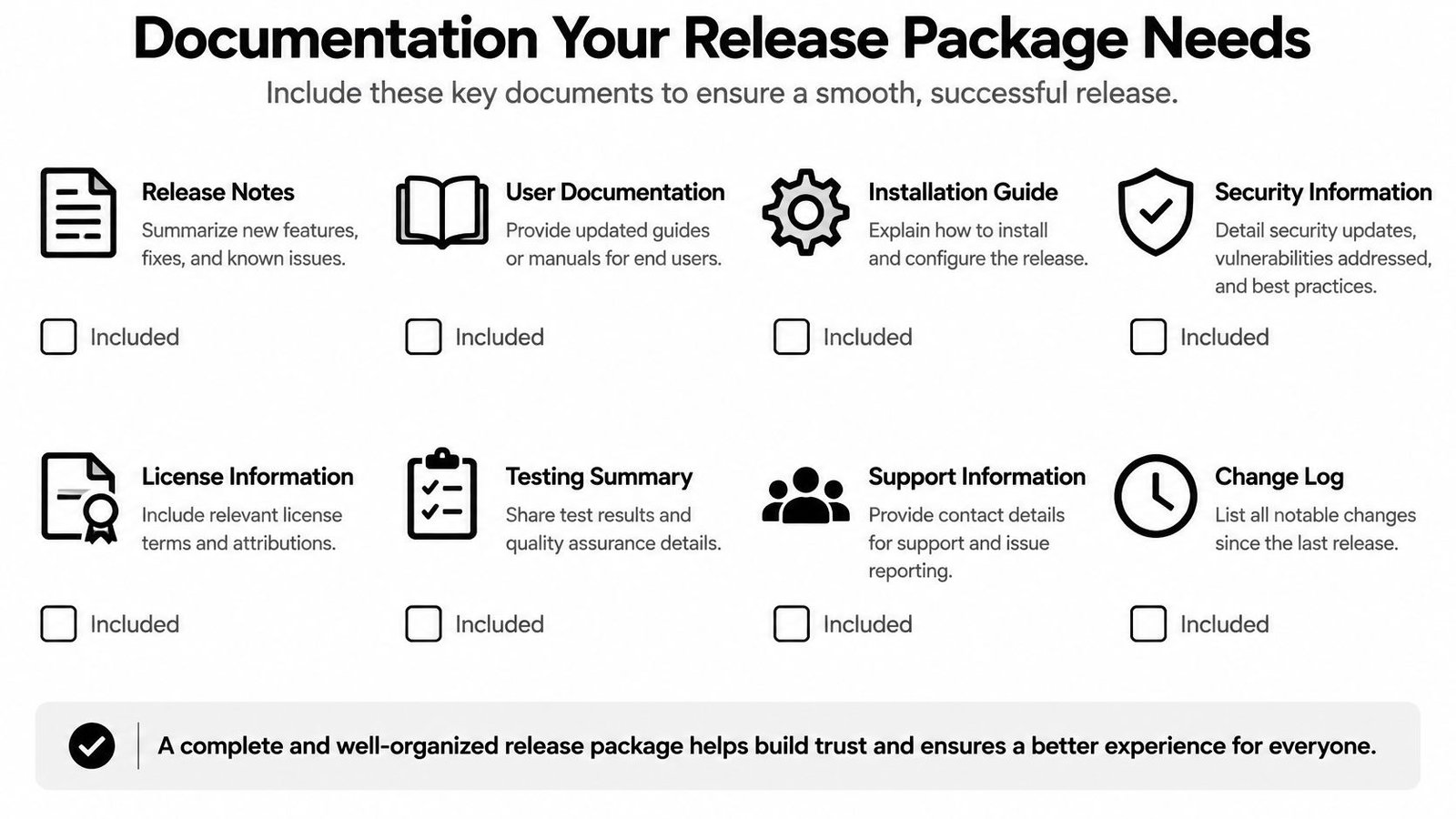
Use the checklist as a completeness check, then verify the contents against the actual installation. A file can look complete by title and still fail when someone tries to follow a requirement to a result, a revision, or an approval.
Release records and what each proves
| Record | What it proves |
|---|---|
| Requirements traceability | Each requirement links to a test and its result |
| FAT and SAT records | The machine met the design and site acceptance criteria |
| IQ, OQ and PQ protocols and reports | The installed system suits the validated process |
| Calibration and maintenance plans | Instruments and service stay under control |
| Alarm and interlock evidence | Each safety function triggers, blocks and resets correctly |
| Closed deviations | Every deviation has a documented disposition |
| Training records | Operators are trained to the approved work instruction |
| Software and parameter baseline | Future changes can be traced through change control |
Treat each row as a release check, not merely a folder name. A protocol without execution results, a deviation without an approved disposition, or a training roster without the work-instruction revision does not answer the reviewer's question.
The practical test is simple: pick a requirement, a safety function, or a critical process parameter and follow it through the file. If the path stops at an unsigned protocol, an unexplained alarm bypass, or a setting with no revision history, the release package is incomplete. Close that gap before pressure from production turns it into an accepted shortcut.
Connect Equipment Evidence to Product Requirements
Link machine settings, tooling identification, control logic, inspection methods, and acceptance results to the applicable product and process specifications. Include as-built drawings and the operating and service information needed to preserve the accepted condition.
For a dispensing process, the record should distinguish the commanded recipe from the measured fill result. For a pressing station, connect the tooling and approved force or displacement settings to the inspected product characteristic. The same discipline applies to torque control, testing, labeling, packaging, and assembly steps where repeat settings determine repeat output. Controlled parameters should be identifiable, and the evidence should show what was set, what was measured, and who accepted the result.
The FDA QMSR overview states that the regulation took effect on February 2, 2026, incorporating ISO 13485:2016 by reference. Map each record to the manufacturer's existing quality system rather than imposing an unrelated generic template.
Apply controlled technical documentation standards so equipment identifiers, revisions, approvals, and file locations remain consistent. That consistency matters when a later engineer must determine which drawing, recipe, or PLC revision was present during acceptance.
Finish with a single index that lets an auditor follow any safety function from requirement to test, actual result, deviation disposition, and approval within minutes. That index is also the handoff point for maintenance, quality, and operations. Each group may need a different view of the same evidence, but all should land on the same controlled record set.
Sign Off Only When the Evidence Holds
Release is a technical decision, not a scheduling concession. If the team can't demonstrate the accepted condition from the records, the machine isn't ready for unrestricted production, even when the delivery date has passed.
Use a release-day check that produces a clear decision:
- Acceptance evidence: Every planning-stage criterion has an identifiable passing result against the installed configuration.
- Deviation status: No critical deviations remain open, and every minor item has an approved disposition and accountable owner where further action remains.
- Operator readiness: Personnel are trained to the approved work instruction, with the instruction revision and training recorded.
- Sustained production: The target-rate run is complete across the agreed shifts, including the required interventions and recovery conditions.
- Authorized release: Quality approval and applicable IQ, OQ, and PQ reports are complete where the process requires them.
Match Support to the Workload
A plant team may have the technical knowledge but lack the capacity to execute FAT, SAT, production support, and documentation in parallel. A turnkey provider such as System Engineering & Automation can carry the project from design through commissioning while plant personnel retain their acceptance responsibilities.
Our no-obligation manufacturing automation consultation addresses current challenges and bottlenecks, labor and production constraints, quality or consistency concerns, and budget and timeline expectations. That discussion helps define a commissioning scope that fits the actual operation rather than an equipment-only demonstration.
The right sign-off leaves production with a controllable process, maintenance with usable service information, and quality with evidence it can defend.
System Engineering & Automation offers manufacturing engineering, installation, commissioning, and ongoing support to help optimize production without losing sight of operating constraints. Visit System Engineering & Automation to arrange a no-obligation consultation about your bottlenecks, acceptance criteria, and the FAT-to-production work your project needs.