You're probably dealing with the same mix of pressure most plant leaders face right now. Output has to go up. Scrap and rework have to come down. Labor is harder to find and harder to keep. Quality can't slip, especially if you're working in regulated manufacturing. And while everyone talks about automation, plant leaders still have to make decisions with limited capital, aging equipment, and operators who already feel stretched.
That's why manufacturing process improvement usually stalls. Not because the need is unclear, but because the options feel too broad. One consultant says run Lean events. Another says launch Six Sigma. A machine builder proposes full automation. Meanwhile, the core question is more basic. What should you fix first, and what level of change makes sense for your floor?
For manufacturers looking to optimize production and services, the answer usually isn't an all-or-nothing leap. The stronger path is practical. Start where the bottleneck is real. Use data from the line, not assumptions from a conference deck. And right-size the solution so it fits the process, the product, the people, and the budget.
Table of Contents
- Beyond the Buzzwords A Smarter Start to Process Improvement
- How to Audit Your Current State and Find Real Bottlenecks
- Identifying and Prioritizing High-ROI Improvements
- Designing and Piloting Solutions to Minimize Risk
- Implementing Changes and Measuring Real Impact
- From a Single Project to a Culture of Continuous Improvement
Beyond the Buzzwords A Smarter Start to Process Improvement
Production leaders rarely have the luxury of fixing one problem at a time. Output is under pressure, quality issues are getting noticed, labor is harder to stabilize, and someone is asking whether a bigger automation budget will solve all of it.
On many shop floors, that decision gets rushed.

Small-to-mid-sized manufacturers often lose money by buying automation that outpaces the process. The common failure is not hesitation. It is adding expensive complexity before the line is stable enough to benefit from it. Full automation can make sense, but only after the product mix, cycle consistency, maintenance support, and material flow are ready for it.
That is why right-sized improvement matters. In practice, the best first move is often semi-automation, better fixtures, or poka-yoke controls that remove repeat problems without sacrificing flexibility.
What right-sized improvement actually means
Right-sized automation means fitting the solution to the constraint, not fitting the operation to a fashionable capital project.
On real factory programs, that usually includes a mix of practical changes:
- Custom fixtures that hold parts consistently and reduce operator-to-operator variation
- Poka-yoke tooling that prevents wrong orientation, missed components, or setup errors
- Semi-automated loading, pressing, dispensing, or inspection where cycle demand is rising but SKUs still change often
- Integrated controls and traceability tools that guide the operator and capture production data without rebuilding the whole line
These are not half-measures. They are often the better business decision.
A fully automated cell can reduce direct labor, but it also brings programming cost, spare parts exposure, debugging time, changeover constraints, and a higher penalty when demand shifts. For many SEA manufacturers serving mixed models or variable order volumes, semi-automation gives a better balance of output, quality, and adaptability.
Practical rule: If operators are still correcting variation by hand every shift, full automation usually hardwires the problem instead of removing it.
A stronger starting point is to stabilize the work first, then automate the parts of the job that are repetitive, error-prone, or physically difficult. Smart fixtures and semi-automation do that well. They improve repeatability, reduce labor dependence in the right places, and let the business scale step by step.
For teams comparing options, this lean manufacturing process improvement approach reflects what tends to work better on actual shop floors than all-or-nothing automation plans.
What works and what usually doesn't
A practical improvement program usually succeeds when the team keeps the scope tight and ties spending to a specific operational problem.
| Approach | What happens on the floor |
|---|---|
| Targeted upgrade | One bottleneck is removed, the gain is measured, and the team expands only after proof |
| Semi-automation first | Labor dependence drops while changeovers and product mix remain manageable |
| Fixture and tooling focus | Quality improves because the process becomes easier to repeat correctly |
Failure patterns are also predictable:
- Automating an unstable process and then discovering the machine now repeats defects faster
- Buying for peak theoretical output even though actual demand and changeovers do not support the investment
- Leaving operators out of the design and finding out during launch that new workarounds were created
- Underestimating maintenance and troubleshooting needs after adding controls, sensors, or robotics
Process improvement starts paying off when the automation level matches the actual need. That usually means fixing flow, repeatability, and labor risk first, then adding complexity only where it earns its keep.
How to Audit Your Current State and Find Real Bottlenecks
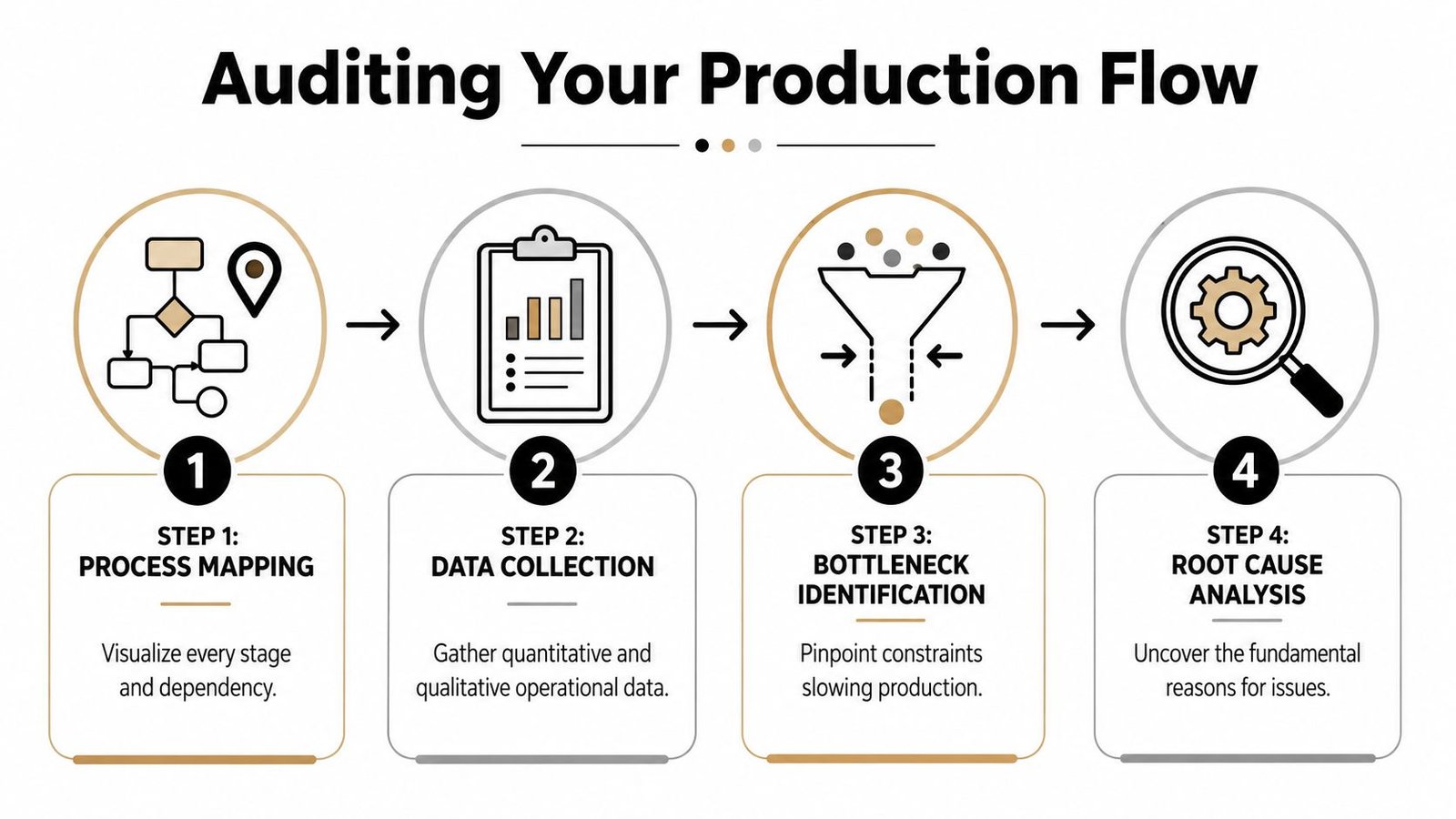
Before changing equipment, map what's happening now. Not what the routing sheet says. Not what last year's process review claimed. What happens during a shift, with the operators, materials, handoffs, interruptions, and rework loops that define the true process.
Start on the floor, not in a conference room
Begin with a Gemba walk. Go to the line and watch the work in sequence. Stay long enough to see a normal cycle, a minor disruption, and how operators recover. If you leave after one clean pass, you'll miss the actual bottleneck.
Look for specific friction points:
- Waiting time: Operators standing by for material, approvals, or machine completion
- Extra motion: Reaching, turning, walking, and searching that adds time but no value
- Repeat handling: Parts touched multiple times because fixtures or staging are poor
- Informal workarounds: Tape marks, handwritten notes, spare bins, or private tricks operators use to keep flow moving
The Toyota Production System overview remains useful here because TPS combines Just-in-Time manufacturing with jidoka, or automation with a human touch, to systematically reduce waste and help teams identify root causes. That mindset matters. Don't just ask where output slows down. Ask why the process needs human rescue in the first place.
A good Gemba walk also depends on the questions you ask. Keep them practical:
- Where do you lose time every shift?
- What causes rework most often?
- Which task would you change first if you could?
- Where does material pile up?
- What forces you to stop and double-check?
Operators usually know the bottleneck before management does. They may not describe it in Lean language, but they can point to the station, the motion, or the handoff that keeps causing trouble.
If cycle time is the pressure point, this kind of floor-level review is often the fastest way to reduce cycle time in a controlled way.
Later in the audit, video can help teams align around what they're seeing. This walkthrough is a useful companion once you've spent time on the floor:
Map the flow and expose the waiting
After the walk, build a basic Value Stream Map. Keep it simple. Start with incoming material, list each operation in order, note where inspection occurs, then add queues, transport, and information handoffs.
You don't need software to begin. A whiteboard is enough if the team captures:
| What to map | What to note |
|---|---|
| Process step | Manual, machine, inspection, pack-out |
| Cycle behavior | Stable, variable, stop-start, operator dependent |
| Queue or buffer | WIP piles, carts, hold racks, waiting parts |
| Decision point | Approval, QC check, paperwork, system entry |
The map usually reveals the same pattern. The process isn't limited by one dramatic failure. It's limited by small layers of waiting, movement, rechecking, and poor flow. That's why auditing feels less like compliance work and more like a treasure hunt. Every unnecessary touch, delay, and detour is a clue.
Once you can see the current state clearly, the next step isn't to fix everything. It's to decide what deserves capital, what only needs discipline, and what should be piloted before anyone scales it.
Identifying and Prioritizing High-ROI Improvements
Once the bottlenecks are visible, the hard part becomes selection. Most plants have more improvement ideas than budget, engineering bandwidth, or change capacity. Good teams don't ask which idea sounds impressive. They ask which one will pay back, carry acceptable risk, and fit the process reality.
Three types of improvements worth separating
Treating every improvement the same leads to poor investment decisions. In practice, the opportunities usually fall into three distinct buckets.
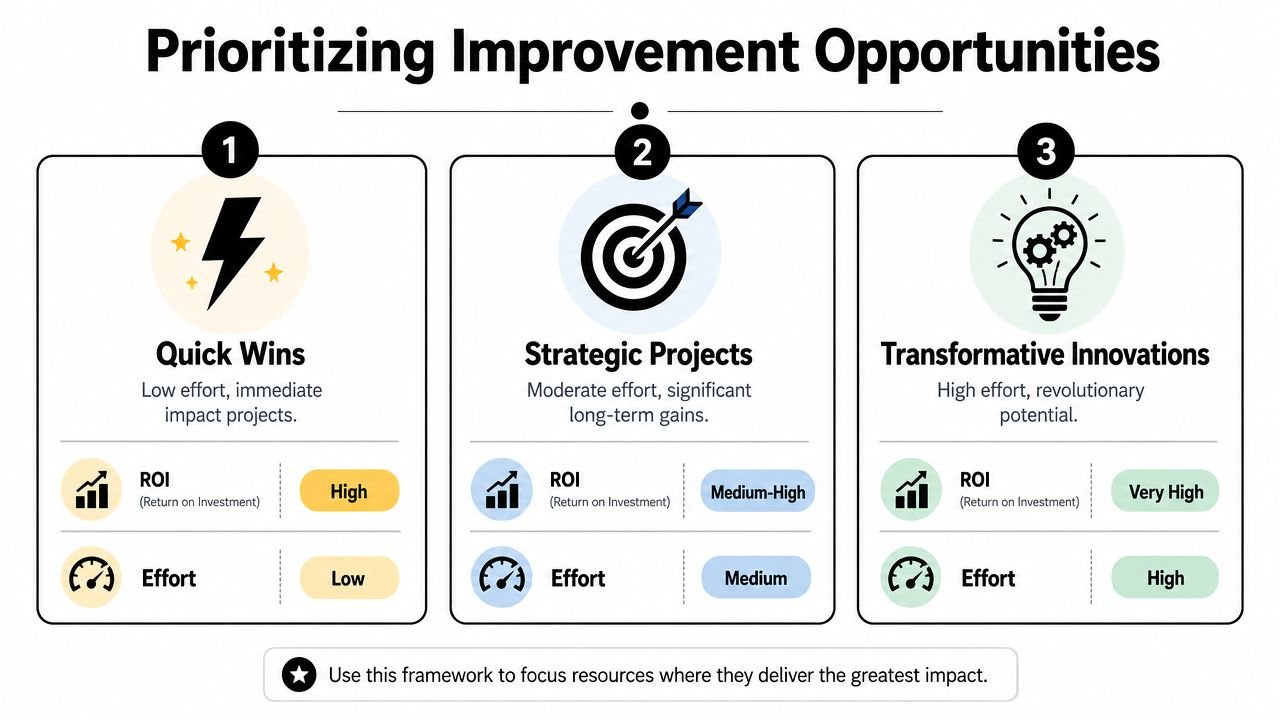
First bucket: process changes.
These are procedural fixes. Standard work updates, workstation layout changes, inspection sequencing, line balancing, and root cause correction. They often cost the least and should be screened first.
Second bucket: tooling and fixture upgrades.
These solve repeatability problems. A nest that holds parts consistently, a fixture that removes orientation errors, or a guided assembly device that reduces dependency on operator feel. These projects often deliver fast quality gains without major disruption.
Third bucket: targeted semi-automation.
Targeted semi-automation often provides manufacturers with the best blend of throughput, labor reduction, and flexibility. Think automated indexing, smart fixtures with sensors, assisted press operations, or in-line checks at a known failure point. These solutions are more substantial than simple tooling but far less rigid than a full automated line.
A semi-automated station is often the best answer when the task is repetitive, quality-sensitive, and labor-intensive, but the product mix or demand profile still changes.
For medical device manufacturers, there's another filter. Any improvement has to support GMP-aware operation. That means easier validation, clearer operator interaction, controlled material flow, better traceability, and less room for undocumented workarounds. A technically clever solution that complicates compliance isn't a good solution.
A simple ROI and risk screen
The most useful prioritization tool isn't fancy. It's a two-axis screen. One axis is expected ROI. The other is implementation risk.
The ROI side should start with a plain formula. According to Azumuta's explanation of lean manufacturing ROI, ROI for a process improvement is calculated by dividing Net Improvement, or New Net Production Output minus Old Net Production Output, by Investment Cost. The same source states that 30% ROI is the standard threshold for a worthwhile lean project, while 50% ROI signifies a very successful endeavor.
That won't make every decision for you, but it gives the discussion a real benchmark.
Use this screen:
- High ROI, low risk: Do these first. They're your quick wins.
- High ROI, higher risk: Pilot before rollout.
- Moderate ROI, low risk: Bundle these with bigger projects if they strengthen flow or quality.
- Low ROI, high risk: Don't do them because they look modern.
A simple comparison table helps keep teams honest:
| Opportunity type | Typical upside | Main risk | Good use case |
|---|---|---|---|
| Process fix | Faster adoption | Gains may fade without discipline | Layout, handoff, standard work |
| Fixture or tooling | Better repeatability | Poor design can create new handling issues | Assembly, placement, inspection |
| Semi-automation | Throughput and labor improvement | Overbuilding too early | Repetitive, quality-critical operations |
When you want a rough estimate before a capital review, an automation ROI calculator can help frame the business case.
Don't let ROI become a narrow math exercise. Include scrap exposure, rework burden, downtime sensitivity, ergonomic strain, operator training complexity, and compliance implications. The highest-return project on paper can still be the wrong first project if it introduces validation headaches or makes changeovers harder than the current process.
The best prioritization decisions are boring in the right way. They're defensible, data-backed, and grounded in how the line really runs.
Designing and Piloting Solutions to Minimize Risk
A lot of improvement projects fail in the gap between idea and execution. The team agrees on the bottleneck. A concept gets approved. Then someone tries to implement the full change at once, under production pressure, with limited operator input. That's where expensive surprises show up.
Pilots exist to prevent that.
What a pilot looks like in practice
Take a common scenario. A manual assembly and inspection station is creating variation. Operators are aligning a delicate part by hand, performing a visual check, then sending the unit downstream. Output depends too heavily on operator experience. New hires struggle. Quality flags show up later than they should.
A full automation proposal might replace the whole station. On paper, that sounds efficient. On the floor, it may add complexity, reduce flexibility, and lock the team into a process that still hasn't been fully understood.
A better path is to design a pilot around the highest-friction part of the task. For example:
- a custom locating fixture that eliminates alignment variation
- a sensor-confirmed clamp sequence so the part can't be processed in the wrong position
- a semi-automated inspection prompt that standardizes pass-fail checks
- operator feedback built into the HMI before the design gets frozen
That pilot can run in a controlled area, with limited production exposure and direct feedback from the people using it each shift.
The discipline behind that approach matters. According to CCiTRACC's manufacturing process improvement guidance, a structured DMAIC methodology that includes pilot-based rollouts reduces implementation risk by 40% compared to wholesale changes. The same source also reports that 75% of failed initiatives stem from insufficient frontline engagement. Those two points belong together. Pilot the change, and involve the operators early enough that they can still influence the design.
If operators first see the new station when it arrives for launch, the team waited too long to ask the right people.
What strong pilot teams do differently
Strong pilot teams don't treat the pilot like a mini version of the final install. They use it to answer specific questions.
Some of those questions are technical:
- Does the fixture hold tolerance consistently?
- Does the sequence create a new bottleneck upstream or downstream?
- Does the control logic support recovery after a fault?
Some are operational:
- Can an operator learn it quickly without hidden tribal knowledge?
- Does the new method reduce rework, or just move it?
- Will maintenance be able to support it without special heroics?
And some are practical in a way engineers sometimes overlook:
| Pilot question | Why it matters |
|---|---|
| How does the operator load and unload the part? | Awkward handling erodes cycle gains |
| What happens during a jam or failed check? | Recovery time can sink real throughput |
| Can the station be cleaned and verified easily? | Critical in GMP-aware environments |
The point of a pilot isn't to prove the concept looked good in CAD. It's to learn what the production environment will do to the concept.
Teams that skip this step usually discover the same issues late. Sensors are in the wrong place. The fixture is accurate but slow to load. The HMI language confuses new operators. A station designed for engineering logic fights against production rhythm.
A pilot lets you fix those problems while the change is still manageable. That's how manufacturing process improvement becomes lower risk and more durable, instead of another rushed installation that everyone works around for the next year.
Implementing Changes and Measuring Real Impact
A validated pilot only becomes a business win when the full rollout holds up under normal production pressure. That means training, documentation, support, and measurement all need to be treated as part of the implementation. Not as cleanup after the equipment goes live.
Build the rollout around standard work
The most common implementation mistake is assuming that a good design will naturally produce a good result. It won't. Operators need clear standard work. Supervisors need escalation rules. Maintenance needs a support plan. Quality needs checkpoints that align with the new process, not the retired one.
For most rollouts, the basics should include:
- Operator training: Show the normal sequence, common faults, recovery steps, and what to do when a part doesn't conform
- Visual work instructions: Keep them at the point of use, with photos or screen captures if needed
- Defined ownership: Make it clear who adjusts settings, who approves changes, and who responds to downtime
- Controlled launch timing: Don't combine a major process change with unrelated schedule disruptions if you can avoid it
Manufacturing automation also becomes more valuable when validation and in-line testing happen early enough to catch defects before they move downstream. The Averna discussion of quality ROI in manufacturing highlights the role of Yield Improvement, Scrap Reduction, and First Pass Yield as critical metrics when teams are trying to improve consistency, accuracy, and traceability.
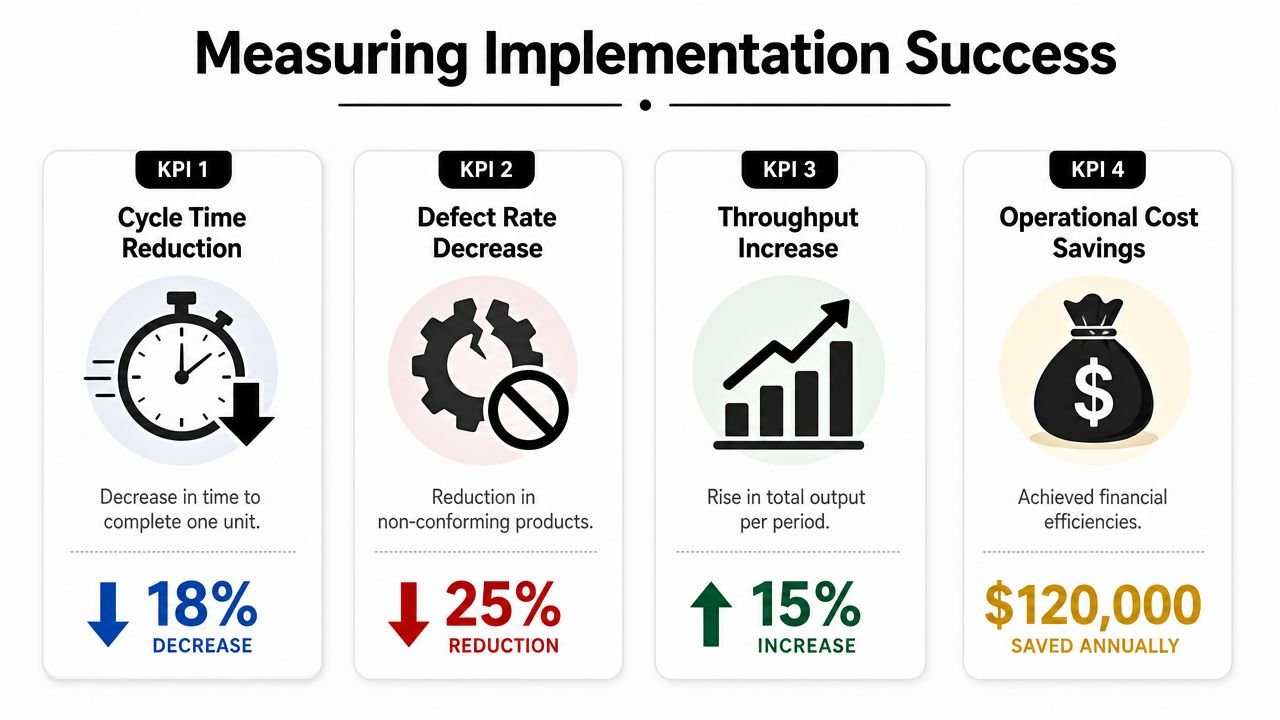
Those are the right kinds of measures because they connect the project to actual production behavior. They help answer whether the change improved output, whether it reduced hidden quality cost, and whether it made the process easier to control.
Measure what changed and whether it stayed changed
A lot of teams declare success too early. The first week looks better. Scrap seems lower. The line feels smoother. Then production variation returns, standard work drifts, and the gains become hard to defend.
That's why baseline discipline matters. According to Shoplogix's guidance on calculating ROI for continuous improvement, a rigorous ROI calculation requires establishing a baseline over 2-4 weeks before implementation and then tracking the same performance metrics monthly for at least 12 months post-implementation.
That approach changes the conversation with leadership. You're no longer arguing from impressions. You're showing sustained movement against a verified starting point.
Track a short set of KPIs that fit the actual bottleneck:
| KPI | What it tells you |
|---|---|
| First Pass Yield | Whether quality improved without rework |
| Cycle time | Whether the constraint really moved |
| Overall Equipment Effectiveness | Whether availability, performance, and quality improved together |
| Scrap or reject trend | Whether hidden cost dropped or simply shifted |
Don't add a dashboard full of numbers nobody will review. A small set of stable metrics beats a large set of ignored ones.
For rollout reviews, use a fixed rhythm. Compare the same measures against baseline. Review operator feedback alongside the numbers. Watch for backsliding in shift-to-shift behavior. If the process depends on one experienced person running it “the right way,” the implementation isn't complete yet.
Real impact is measurable, repeatable, and understandable to people outside engineering. If leadership can't see what improved, or if the floor can't sustain it without workarounds, the project still has work left to do.
From a Single Project to a Culture of Continuous Improvement
The first successful project matters because it proves two things at once. It shows that the bottleneck can be moved, and it shows that the plant can improve without betting the entire operation on a single oversized automation decision.
That's how manufacturing process improvement should work. One solved constraint reveals the next one. A fixture that stabilizes assembly exposes a packaging delay. A semi-automated check reduces rework and reveals a material presentation problem upstream. The work doesn't end. It gets clearer.
Turn one win into a repeatable operating habit
A repeatable improvement habit is built on routine, not slogans. Teams need a way to spot issues, escalate them, test ideas, and hold gains.
The simplest version looks like this:
- Observe the line directly. Start with the actual process.
- Define the bottleneck clearly. Don't chase symptoms.
- Choose the lightest effective solution. Process fix, fixture, or semi-automation.
- Pilot before scaling. Learn while the risk is contained.
- Measure the result over time. Keep the gain from fading.
That cycle is more valuable than a one-time improvement event because it creates organizational memory. People stop seeing process problems as normal background noise. They start seeing them as solvable.
What long-term improvement cultures have in common
Plants that sustain gains usually share a few operating habits:
- Supervisors ask better floor questions. They look for waiting, repeat handling, and informal workarounds.
- Operators are expected to contribute. Their input isn't a courtesy. It's part of how the process gets designed.
- Engineering stays practical. Teams solve the constraint in front of them instead of chasing the most complex technology first.
- Leadership backs staged investment. They accept that smart scaling often beats oversized capital bets.
Continuous improvement also gets stronger when teams resist the urge to declare victory after one install. Every new standard should be checked. Every new station should be reviewed under real production conditions. Every improvement should make the next one easier to identify.
The strongest plants don't treat improvement as a special project. They build it into how the operation runs every week.
That's especially important for small-to-mid-sized manufacturers and regulated producers. You need flexibility. You need quality discipline. You need solutions that support production instead of disrupting it. And you need a path that improves service and output without forcing unnecessary automation too early.
A mature improvement culture doesn't mean doing everything in-house. It means knowing when to bring in the right engineering support, apply the right level of automation, and keep building from practical wins.
If you're evaluating ways to improve throughput, reduce labor dependency, or tighten quality without over-investing in full automation, System Engineering & Automation is built for that kind of work. SEA helps manufacturers right-size solutions with semi-automatic systems, custom tooling, fixtures, integrated controls, and GMP-aware engineering support, so you can optimize production and services with a practical path that fits your process, budget, and growth plans.