Your new machine is installed. The controls are modern, the tooling package wasn't cheap, and the sales team is already counting on higher throughput. Then the first hard truth shows up on the floor. Automation doesn't fix a skills gap. It exposes one.
That's where a training partner matters. If you're responsible for production, quality, or capital planning, you're not just looking for a school. You're looking for a way to protect machine uptime, cut avoidable errors, and get more return from the equipment you already bought or plan to buy. In northeast Ohio, Akron CNC Training Center sits in that conversation because it connects training to real manufacturing environments, not just classroom theory.
For teams we support with manufacturing solutions to optimize production and services, this is the right lens. The question isn't whether training sounds good. The question is whether a program will help operators run equipment correctly, set up jobs faster, inspect parts with confidence, and keep automation assets producing.
Table of Contents
- Why Skilled CNC Operators Are Your Most Critical Asset
- Evaluating a Program's Curriculum and Equipment
- Assessing Accreditation and Instructor Experience
- Navigating Costs Funding and Apprenticeship Models
- Measuring the ROI of Your CNC Training Investment
- Integrating Trained Operators for Peak Performance
Why Skilled CNC Operators Are Your Most Critical Asset
A plant manager installs a faster machine, adds automation, and expects capacity to rise. Three months later, the bottleneck is still setup. Offsets are handled differently by shift, first-article approval takes too long, and supervisors keep getting pulled back to basic troubleshooting. The equipment is capable. The operator bench is not.
That gap is where automation ROI gets lost. CNC equipment depends on people who can move cleanly from print to setup, from setup to stable production, and from production to inspection without creating rework or downtime. If that skill chain is weak, expensive assets spend too much time waiting for decisions, corrections, and escalation.
For that reason, the actual value of a training partner is not classroom completion. It is whether the program helps you build operators who can protect uptime, control scrap, and shorten the path to predictable output. That is the standard I would use for any evaluation, including Akron CNC Training Center.
The school has been operating for years as a vocational CNC program and offers entry-level training for people with limited shop experience, as noted in earlier coverage of the center. That is useful if your hiring plan depends on developing new talent instead of competing for already-trained operators. The trade-off is straightforward. Entry-level programs can expand your labor pool, but they only improve business results if graduates arrive ready to support your process discipline, not just your staffing numbers.
National demand for CNC talent has also remained a factor in hiring decisions, based on prior reporting about the center and the broader machining labor market. Shops that treat training as a side issue usually feel that pressure first. They buy better equipment, then struggle to get consistent output because operator judgment has not kept pace with machine capability.
Practical rule: If you're investing in automation without investing in operator capability, you're only funding half the system.
I advise clients to treat operator development the same way they treat maintenance and process control. It is part of asset performance. A good training partner should help you produce people who can make sound decisions at the machine, follow standards under pressure, and step into a production environment with less hand-holding. If your broader workforce strategy also includes equipment operator training for production support roles, align those efforts early so machine utilization improves across the cell, not just at the spindle.
Evaluating a Program's Curriculum and Equipment
A program's curriculum should tell you, in practical terms, how quickly a graduate can contribute on your floor. If that answer is fuzzy, your team will spend months reteaching the basics, and the return on your automation spend gets delayed.
Start with the skills that affect output
The right question is simple. Does the program teach the decisions operators must make to protect throughput, part quality, and machine uptime?
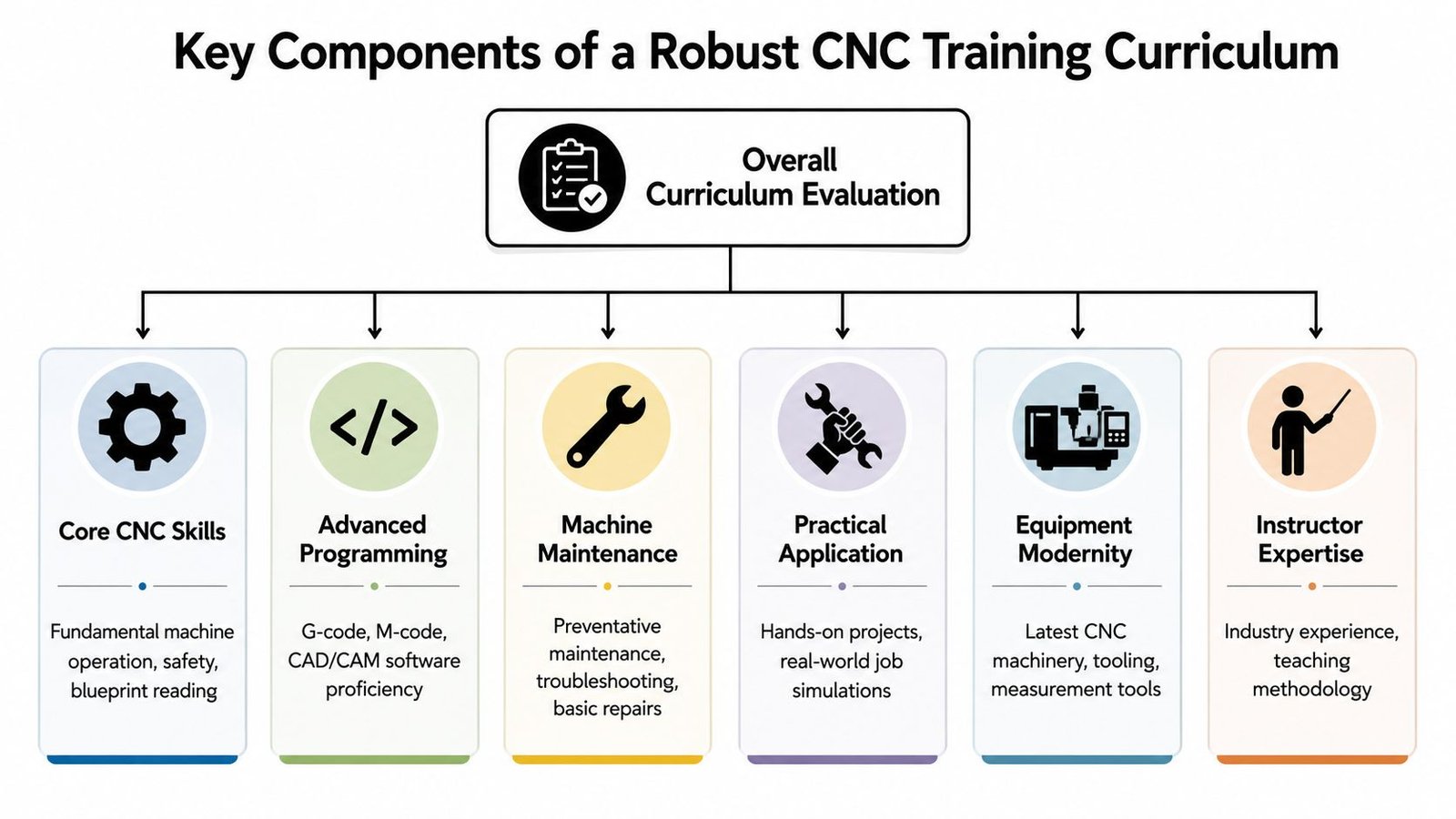
Shops do not get ROI from classroom familiarity alone. They get it from operators who can read a print correctly, set up with confidence, verify the first piece, and catch problems before they turn into scrap or downtime. That means the curriculum should clearly cover blueprint reading, inspection, machining math, workholding, programming fundamentals, and safe machine operation.
I look for these capabilities first:
- Blueprint reading competence: Operators should convert print requirements into setup choices, tooling decisions, and inspection checks.
- Inspection discipline: Students need hands-on practice with verification, not just exposure to measuring tools.
- Workholding judgment: They should understand how clamping affects repeatability, access, and part distortion.
- Programming foundation: G-code and M-code matter because operators often need to read a program, make minor edits, and understand why the machine is behaving a certain way.
- Applied math: Offsets, trig, and dimensional reasoning should be taught in the context of actual setups and part features.
- Safe machine operation: Safety should be built into setup, proving out programs, tool changes, and troubleshooting.
The trade-off is straightforward. Some schools cover many topics at a surface level. Others cover fewer areas but train students to apply them under shop conditions. For an employer trying to raise spindle utilization or support new automation, application matters more than topic count.
A strong curriculum also connects these subjects. Operators do not use blueprint reading separately from inspection, and they do not make programming changes without considering workholding and tooling. If a school teaches each topic in isolation, graduates often know the terminology but still need heavy supervision during setup and first-article work.
Ask what machines students actually touch
Equipment matters because transferability matters. Training on machines and controls that resemble production reality shortens the time between hiring and useful output.
As noted earlier, Akron CNC Training Center has highlighted hands-on machine access in its labs. That is the right direction, but any employer evaluating a provider should get specific before treating that as a real advantage.
Ask direct questions:
- Which machines and controls are in the lab right now?
- Do students perform full setups, or do they mainly observe instructor demos?
- How much time is spent on offsets, tooling, and proving out a job at the control?
- Are students taught to diagnose chatter, dimensional drift, or poor surface finish?
- Does the training environment reflect production pressure, or only clean practice exercises?
Those answers tell you whether the school is building operators who can support an automated cell or just students who have seen a CNC machine before.
If your hiring plan includes roles that move between manual processes, secondary operations, and machine tending, compare the program against your broader equipment operator training program for production support roles. That alignment helps reduce handoff errors across the cell, not just at the machine.
Essential CNC Curriculum Components
| Skill Area | Basic Coverage (Good) | Better Coverage for ROI |
|---|---|---|
| Blueprint Reading | Students identify dimensions and common features | Students connect print requirements to setup choices, inspection points, and likely failure modes |
| Inspection | Basic measuring tool familiarity | In-process verification, first-piece checks, and tolerance-based decision making |
| Workholding | Introductory fixturing concepts | Practical selection, stability judgment, repeatability, and error prevention |
| Programming | Exposure to G-code and M-code concepts | Hands-on editing, machine-behavior awareness, and connection between code and part results |
| Math | General machining math | Floor-level application tied to offsets, dimensions, and setup accuracy |
| Machine Operation | Controlled classroom exercises | Real machine use in production-style scenarios with instructor feedback |
Training that improves ROI develops judgment under production conditions, not just machine familiarity.
Assessing Accreditation and Instructor Experience
A manufacturer installs a new machine, adds a cobot for tending, and expects throughput to rise. Then the first few operators struggle with offsets, inspection discipline, and recovery after a fault. The automation is not the problem. The training pipeline is.
That is why accreditation and instructor background deserve a hard look. If you are selecting a program to support automation ROI, you are not buying classroom hours. You are buying the likelihood that a new hire can protect cycle time, reduce scrap, and make sound decisions without constant supervisor intervention.
Registration is a screening tool, not a decision
As noted earlier, Akron CNC Training Center is state registered. That matters because registration usually signals a defined structure around attendance, program delivery, and basic oversight.
Use that as an opening filter only.
A registered school can still produce graduates who need heavy retraining. An unstructured provider can waste months before the problem becomes obvious on your floor. The right question is whether the program turns that formal status into repeatable shop readiness.
Ask for specifics:
- How is student performance measured under hands-on conditions?
- What standards define passing work in setup, code edits, and inspection?
- How often is course content updated to reflect current shop practice?
- Which local manufacturers hire from the program and keep hiring from it?
Those answers tell you more than a credential line on a brochure. For an employer investing in automation, consistency matters. A training partner should send you people who can follow process, document checks, and respond correctly when the machine, fixture, or part does something unexpected.
Instructor experience determines whether training transfers to production
Instructor credibility shows up in the first week on the floor.
An instructor with current manufacturing experience teaches the judgment behind the task. That includes why a part shifts in the vise, what chatter is telling the operator, when a tool offset change is appropriate, and when the machine should stop so scrap does not multiply. Those lessons matter more in automated environments, where one bad assumption can affect unattended runtime, tool life, and downstream quality.
A classroom instructor can explain G-code structure. A seasoned machinist who has run production can explain why a small edit changed the cut, the finish, and the inspection result all at once.
That difference affects ROI. If your automation plan depends on operators who can recover from alarms, verify first-piece quality, and keep a cell running within process limits, instructor background is not a side issue. It is part of the business case.
Ask direct questions when you vet a school:
- Have the instructors programmed, set up, inspected, and troubleshot real production work?
- How recently have they worked in a shop environment?
- Do they teach from demonstrations only, or do students perform tasks until they meet a standard?
- How do they correct poor decisions, not just wrong answers?
Strong instructors teach cause and effect. They show students how feeds, workholding, tool condition, offsets, and inspection relate to one another under production pressure.
A training partner should deliver graduates who need orientation to your plant, your parts, and your quality system. They should not need a rescue plan for the basics.
Navigating Costs Funding and Apprenticeship Models
Most manufacturers ask the wrong first question. They ask what training costs. The better question is how to structure training so the business captures value without disrupting production.
Compare training models by operational fit
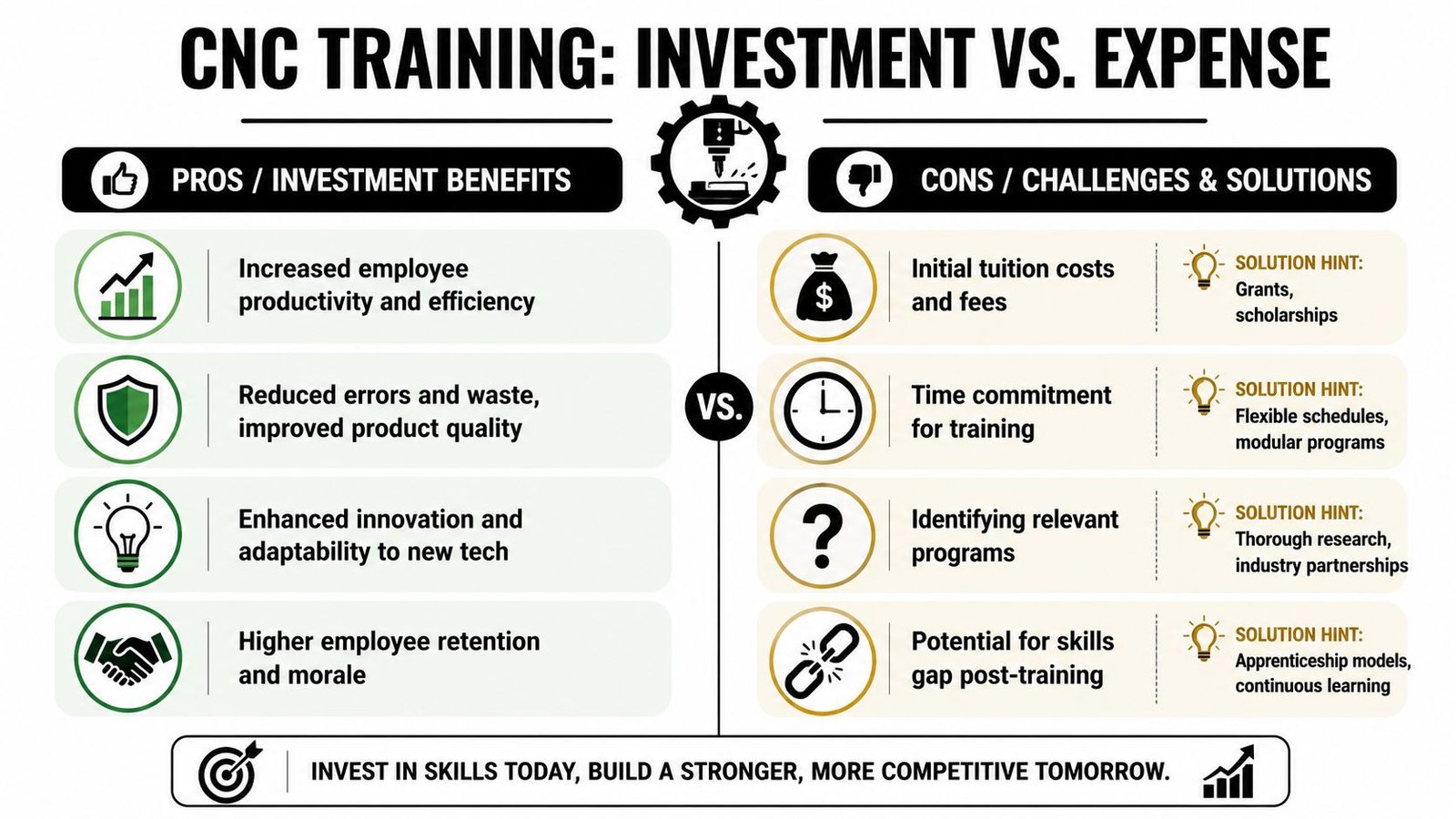
A short certificate program can help when you need entry-level operators faster. It's often a practical choice for building a pipeline into machine operation, setup support, or junior programming roles. The trade-off is depth. You may get faster availability, but you'll still need a disciplined onboarding process inside your plant.
Employer-sponsored upskilling works differently. It keeps your current people in the business while building new capability around your actual parts, tolerances, quality systems, and scheduling pressure. This model usually produces better retention of shop-specific knowledge because the employee already understands your environment.
Then there's the regional workforce angle. Ohio CNC training centers like Akron CNC serve the entire northeast Ohio region, filling workforce gaps that can cost manufacturers millions annually in delayed production and lost opportunities, according to Fabricating & Metalworking's workforce gap report. That's why many smaller and mid-sized manufacturers benefit from partnering with external programs instead of trying to build every training layer themselves.
This visual captures the business trade-offs clearly.
Where apprenticeship changes the math
Apprenticeship is often the strongest option when you need both skill growth and labor continuity. It spreads learning into real production work instead of separating training from output.
Apprenticeship programs such as the CNC Programmer track offer 4,000 hours of paid on-the-job training with 50% reduced tuition, and many employers cover that cost in full, according to AJAC's CNC Programmer occupation overview. That's a meaningful lever because it lets manufacturers upskill existing workers while protecting cash flow better than a purely stand-alone education path.
A useful way to evaluate the options:
- Short certificate program: Best when you need an entry point into CNC roles quickly and can support structured onboarding internally.
- Incumbent worker training: Best when your current team has good shop habits but needs more technical depth.
- Apprenticeship: Best when you want long-term capability, paid learning, and a stronger retention path.
Decision test: Pick the model that matches your production risk. If your issue is immediate staffing, speed matters. If your issue is repeatability and technical depth, apprenticeship usually wins.
Funding availability varies by employer, region, and program structure, so it's worth asking training providers how they coordinate with workforce development or employer-sponsored pathways. Don't accept a generic answer. Ask what support exists for incumbent workers, whether the provider has experience working with employers, and how scheduling affects shift coverage.
The right answer isn't always the cheapest model. It's the one that gets a capable person to stable output with the least operational friction.
Measuring the ROI of Your CNC Training Investment
A shop buys a new machine, adds probing or pallet automation, and still misses throughput targets because the operator cannot set up, verify, and recover the process consistently. That gap is where training either pays for itself or turns into overhead.
The right way to measure CNC training is against production performance, not tuition alone. If training improves setup discipline, first-piece approval, inspection accuracy, and response to minor process issues, it increases the return on the equipment and automation you already own.
As noted earlier, Akron-area CNC roles commonly call for skills such as blueprint reading, math, inspection, and programming support. Those are not academic extras. They affect scrap, uptime, handoff quality, and how often supervisors or lead programmers get pulled back into routine problems.
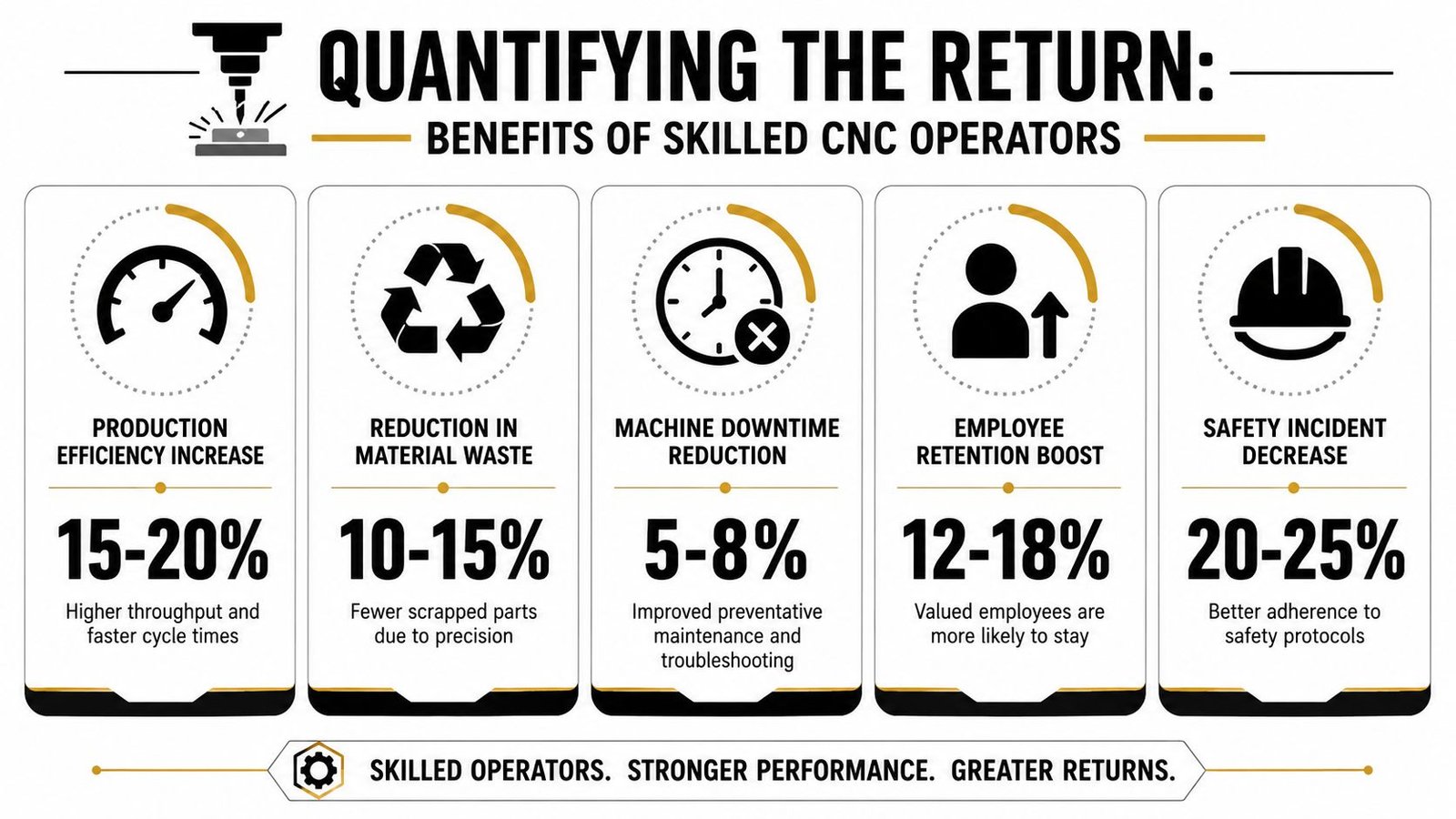
Start with a KPI set your plant already trusts:
- Setup time: Measure whether the operator gets from print to approved first piece with fewer delays.
- Scrap and rework: Track nonconforming parts, especially on first runs and changeovers.
- Operator-driven downtime: Separate equipment failure from stoppages caused by missed offsets, poor tool prep, or preventable setup errors.
- Inspection catches at the machine: Measure whether issues are found before they move downstream.
- Schedule reliability: Watch whether jobs finish closer to plan with fewer escalations.
If your business is adding automation, review training and capital payback together. A trained operator protects spindle time, reduces avoidable interruptions, and makes automated cells more predictable. Using an automation ROI calculator for equipment and labor assumptions can help quantify that relationship.
Keep the review method simple.
Pick one operator, one role transition, or one hiring cohort. Set a baseline before training or before independent machine responsibility starts. Then compare performance after that person is running normal production on similar part families. The cleaner the comparison, the more credible the ROI discussion will be with operations and finance.
A practical review cadence looks like this:
- Set baseline metrics for setup time, scrap, downtime, and inspection holds.
- Choose comparable jobs the operator will run after training.
- Review weekly for the first month so small problems are visible before they get buried in monthly averages.
- Convert the gains into plant impact such as fewer supervisor interruptions, less rework, and more dependable throughput.
One of the strongest signals is reduced dependence on tribal knowledge.
If a trained operator can complete setups, hold tolerance, and catch issues without constant intervention, the payoff is already showing up. That gain rarely appears first as a line item on a spreadsheet. It appears as a calmer shift, fewer production surprises, and better output from the automation investments you expected to carry the load.
Integrating Trained Operators for Peak Performance
Training creates potential. Integration turns it into output.
Turn training into controlled responsibility
Too many shops make the same mistake after training. They either throw the operator into full responsibility too quickly or keep them stuck in low-value tasks so long that the new skills fade. Neither approach works.
A better model is staged responsibility. Start with jobs that matter but won't punish every small miss. Pair the operator with a reliable mentor. Give them clear ownership over setup preparation, first-piece checks, and documentation discipline before moving into more complex work.
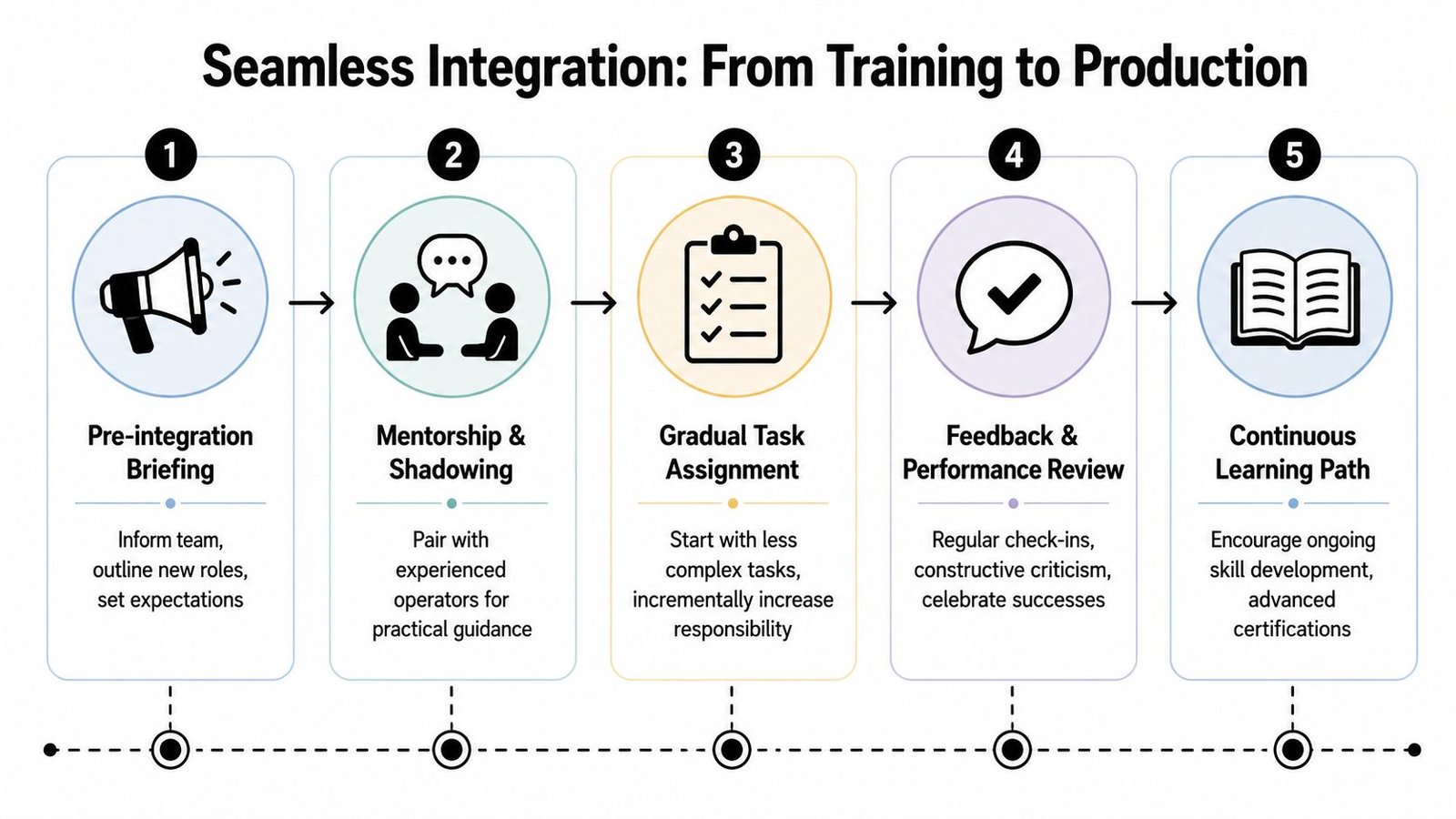
For many plants, this works well as a 90-day rhythm:
- First phase: Shadowing, controlled setups, and print-to-part verification with oversight.
- Second phase: Independent operation on repeat jobs with scheduled check-ins.
- Third phase: Broader task ownership, including troubleshooting and improvement suggestions.
If your operation includes vertical machining work, it helps to align the post-training path with the actual machine architecture and process demands operators will face, including resources tied to a three-axis milling machine.
Protect the investment after day one
Northeast Ohio manufacturers don't just need trained people. They need those people to stick, improve, and become part of a dependable production system. That matters because regional CNC training centers help fill workforce gaps that can cost manufacturers millions annually in delayed production and lost opportunities, as noted earlier in the article.
The best post-training habits are simple:
- Assign one mentor: Don't rotate the operator across too many voices in the first weeks.
- Set review points: Short, regular feedback beats a single formal review much later.
- Document common issues: Build a playbook from real setup mistakes, inspection misses, and recovery actions.
- Create a next-skill target: Operators stay engaged when they know what capability comes next.
A trained operator becomes valuable fastest when the shop gives them structure, feedback, and room to earn trust.
That's how you turn education into production performance. The training partner matters. Your internal follow-through matters just as much.
If you're evaluating CNC training as part of a broader plan to improve throughput, reduce labor dependency, or get more value from semi-automated equipment, System Engineering & Automation can help you connect workforce capability with the right level of automation. SEA works with manufacturers to optimize production and services through practical engineering, custom equipment, tooling, fixtures, and integrated controls that fit real operating constraints.