A semi-automatic control system is a hybrid architecture where the machine executes repetitive or precision-critical actions automatically, while a human operator handles loading, unloading, repositioning, or approving the next cycle. The concept was used in manufacturing as early as 1946, and the landmark SAGE system operated from 1958 to 1984, processing roughly 75,000 operations per second.
That balance still solves a problem many plants face today. Your operators are spending too much time on repetitive handling, but a fully automated line would be expensive, difficult to reconfigure, and poorly matched to a changing product mix. You need better consistency and throughput without locking the operation into one rigid sequence.
Semi-automation gives you a practical way forward. The machine controls force, motion, timing, or sensing, while the operator manages the decisions and physical tasks that still benefit from judgment. For mid-size manufacturers, especially those handling mixed products, small batches, or GMP-aware processes, that isn't a temporary compromise. It can be the most commercially sensible control architecture.
Table of Contents
- The Strategic Case for Semi-Automatic Control Systems
- Core Components and Architecture of Semi-Automatic Systems
- Comparing Automation Levels for Manufacturing Decisions
- Retrofitting Existing Equipment for Semi-Automated Control
- Safety, Quality, and GMP Compliance in Semi-Automatic Operations
- Justifying ROI Through Total Cost of Ownership Analysis
- Implementation Checklist for Semi-Automatic Control Systems
- Future-Proofing Your Manufacturing Operations
The Strategic Case for Semi-Automatic Control Systems
An operations manager usually starts with an uncomfortable choice. Manual production offers flexibility but introduces variation, fatigue, and dependence on individual technique. Full automation promises speed, yet the equipment can become difficult to justify when products change frequently or production volumes don't support a fixed, high-capital line.
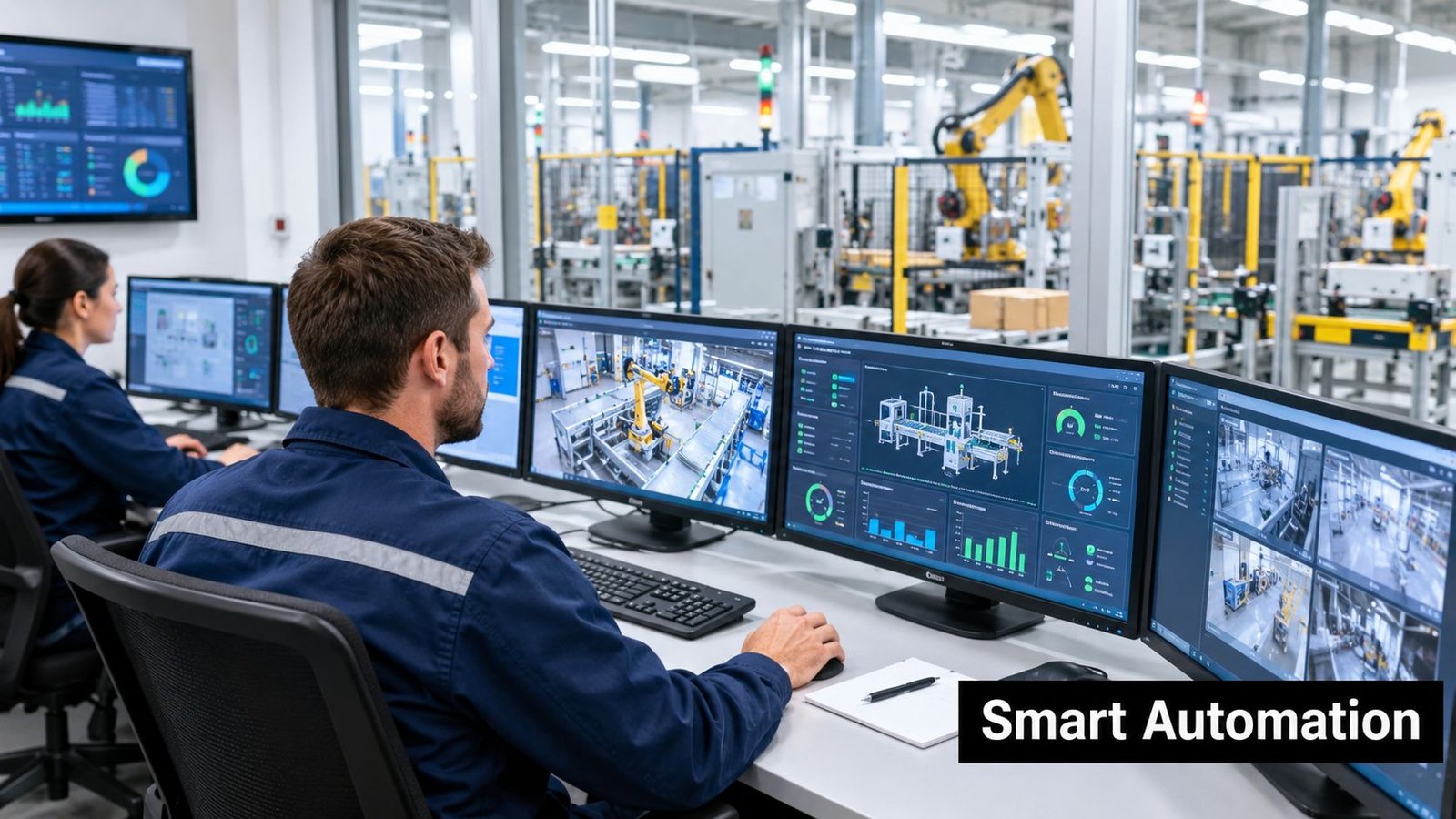
A semi-automatic control system changes the question. Instead of asking whether to automate everything, ask which actions require machine consistency and which still require a trained operator. A press can control force and stroke, a fixture can locate a part, and a vision or presence sensor can confirm positioning. The operator can load the component, start the cycle, inspect the result, and respond to an exception.
Where the hybrid model earns its place
Consider a manufacturer assembling several related products on one workstation. A fully automated cell might require complex tooling, additional part presentation equipment, and extensive changeover logic. A manual station might depend entirely on operator technique. A semi-automatic cell can use interchangeable fixtures, guided loading, recipe selection, and an automated joining or test sequence.
That arrangement is particularly effective when:
- Product variation matters: Operators can handle differences that would require costly automation logic.
- Quality checks need judgment: The machine can enforce sequence and measurement limits while a person approves an unusual condition.
- Production is batch-oriented: The plant can change tooling or recipes without rebuilding an entire line.
- Budgets are constrained: The manufacturer invests in the operations that create the greatest repeatability first.
Historical engineering references describe semi-automatic machine tools as suitable for large production lots because they reduce operator interference while preserving human oversight. The same engineering reference on semi-automatic control also records the manufacturing use of the term as early as 1946, when it was reportedly coined at Ford Motor Company for automatic transfer devices and feed mechanisms.
The architecture also has a useful precedent in supervisory control. SAGE combined automated radar data processing with human decisions, and its system ran from 1958 to 1984. It weighed about 300 tons, consumed roughly 3 megawatts, and processed around 75,000 operations per second, according to this historical account of the SAGE computer.
Practical rule: Automate the repetitive action that causes variation, not every action the operator performs.
For manufacturers seeking production and service improvements, the strategic advantage is control over risk. You can improve repeatability, reduce exposure to strenuous motions, and collect useful process data without sacrificing the adaptability that keeps a mid-size operation viable.
Core Components and Architecture of Semi-Automatic Systems
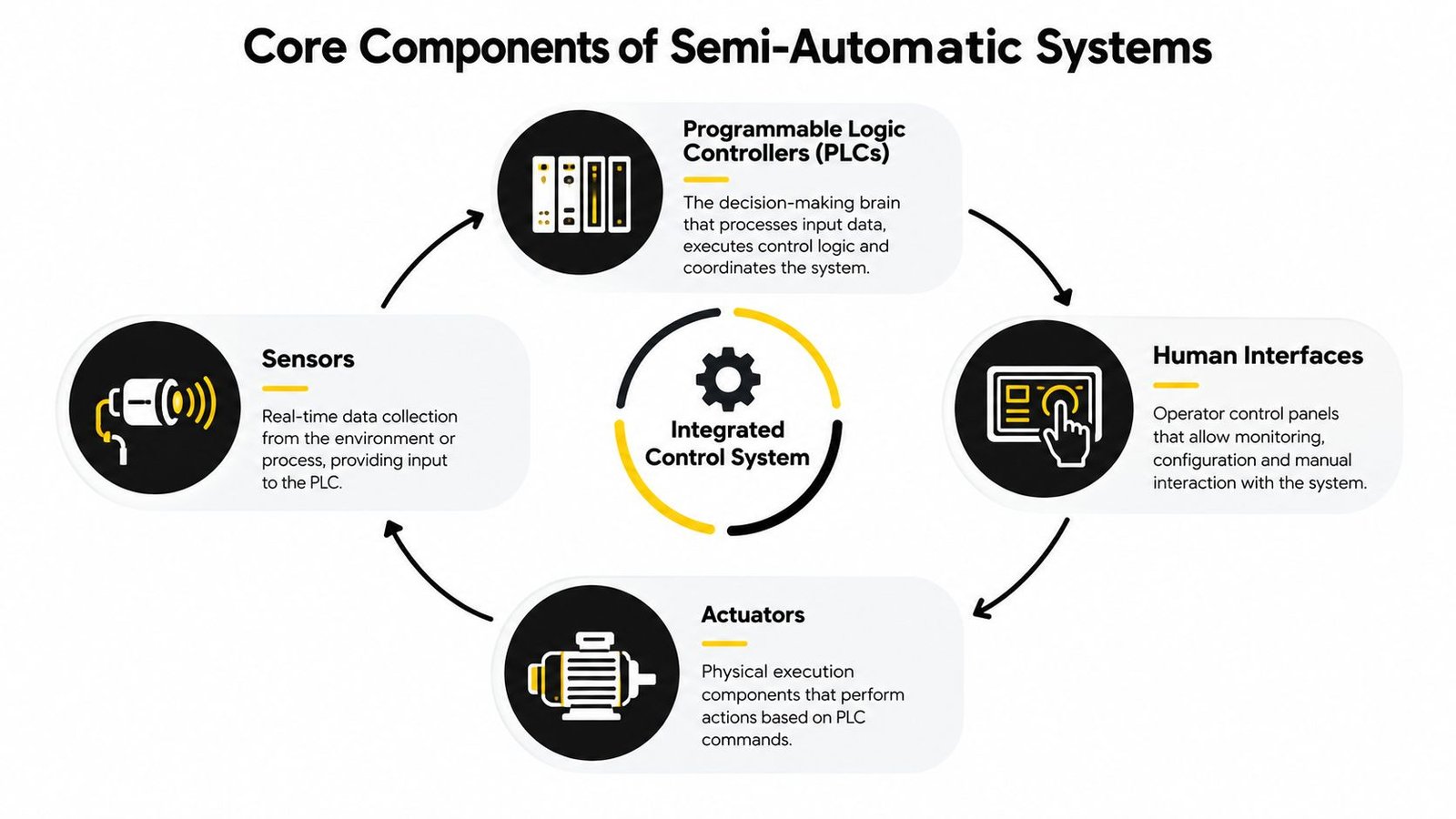
A reliable semi-automatic control system has four working parts: the PLC, sensors, actuators, and the human-machine interface. The value doesn't come from any one component. It comes from how these components share responsibility during automatic and manual modes.
The PLC coordinates the sequence
The programmable logic controller is the decision-making core. It receives signals from sensors, checks the selected conditions, and commands the actuators in a defined order. In a workstation, that might mean confirming a part is present, clamping it, driving a cylinder, waiting for a pressure signal, retracting the cylinder, and releasing the part.
The PLC also manages the two-mode arrangement. In automatic mode, it executes the programmed sequence after the operator initiates the cycle. In manual or setup mode, the operator can jog an actuator, select a position, or confirm a step, subject to safety interlocks and permissions. Modern PLC-based equipment supports reprogramming, real-time monitoring, and diagnostics, which makes it more adaptable than relay-based or purely mechanical control. These capabilities are outlined in this guide to semi-automatic PLC equipment.
Sensors provide evidence
Sensors prevent the PLC from acting on assumptions. A proximity sensor can confirm that a fixture is closed. A pressure transducer can verify that a clamp reached its required condition. A photoelectric sensor can detect product presence, while an encoder can provide position feedback.
Sensor selection should follow the process risk. Don't add sensors just to create a more complicated control panel. Add them where the system needs to verify a position, condition, or completed action before allowing the next step.
Actuators create the physical result
Actuators turn a PLC command into movement or process output. They can include pneumatic cylinders, servo motors, electric motors, valves, grippers, clamps, and tooling mechanisms. The actuator must match the required force, speed, repeatability, environment, and maintenance capability.
A pneumatic clamp may be appropriate for a straightforward assembly fixture. A servo-driven press may be more suitable where the system must control position and motion precisely. The machine should perform the action that benefits most from repeatability, while the operator retains responsibility for loading, inspection, or exception handling.
The HMI keeps responsibility visible
The HMI is the communication bridge between the equipment and the operator. It should show the selected recipe, cycle status, active fault, permissive that is missing, and the action required to recover. A good screen tells the operator what happened and what to do next. It shouldn't force them to interpret a list of unexplained fault codes.
The control architecture should be documented in a way that makes manual and automatic responsibilities clear. Manufacturers can review broader control architecture options through automation control systems from System Engineering & Automation, then define the PLC, sensor, actuator, and HMI requirements around the actual process.
Comparing Automation Levels for Manufacturing Decisions
The right automation level depends on the work, not on an ambition to automate as much as possible. A high-volume product with stable geometry may justify a dedicated fully automated line. A mixed-model process with frequent product changes may produce better economics with a semi-automatic cell. Manual production remains useful for prototypes, unusual assemblies, and tasks where tooling would cost more than the work justifies.
The comparison below is deliberately practical. It focuses on the operating consequences that affect plant managers after installation, not just the purchase decision.
Automation Level Comparison Matrix
| Criteria | Manual | Semi-Automatic | Fully Automated |
|---|---|---|---|
| Initial investment | Generally lowest, especially where existing tools are adequate | Moderate, focused on the highest-value operations | Usually highest because the line must coordinate more functions |
| Operator involvement | High throughout the process | Focused on loading, confirmation, inspection, and exceptions | Lower during normal operation, but skilled support remains necessary |
| Product flexibility | High, if operators can adapt safely | High when fixtures, recipes, and tooling are designed for changeovers | Often limited by dedicated tooling and programmed sequences |
| Changeover | Depends on operator skill and setup discipline | Usually practical for mixed products when tooling and recipes are planned well | Can become complex when many mechanical and software conditions must change |
| Repeatability | Depends heavily on method and training | Strong for the automated steps, with human variation remaining at defined points | Strong across the designed process window |
| Maintenance complexity | Lower equipment complexity, but more wear may remain in manual tools | Moderate, with controls, sensors, actuators, and mechanical equipment to support | High, because more equipment and interfaces must remain available |
| Best fit | Prototypes, unusual work, or low-frequency tasks | Mixed products, batch production, regulated processes, and mid-size operations | High-volume, stable, low-variation production |
Read the matrix through the product mix
Full automation can be the wrong choice when the line spends too much time being reconfigured. Its theoretical throughput may look attractive, but the business loses that advantage if the equipment sits idle during tooling changes, validation work, troubleshooting, or product transitions.
Manual work has the opposite weakness. It adapts easily, but operators carry the burden of positioning, force application, timing, and repeated inspection. That can create inconsistent output and increase exposure to repetitive physical tasks.
Semi-automatic equipment occupies the useful middle ground. It gives the machine a defined job and the operator a defined job. The design succeeds when those responsibilities are visible, safe, and easy to repeat.
A levels of automation guide can help frame the choice, but your decision should come from your product mix, utilization, quality risk, maintenance capability, and changeover requirements. Don't approve a fully automated concept just because it reports the highest possible cycle rate. Approve the architecture that performs reliably across the work you sell.
Retrofitting Existing Equipment for Semi-Automated Control
Replacing an entire workstation is often unnecessary. Many legacy machines have sound frames, useful tooling, and serviceable mechanical components. The opportunity is to add modern control where the existing process is still mechanically capable.
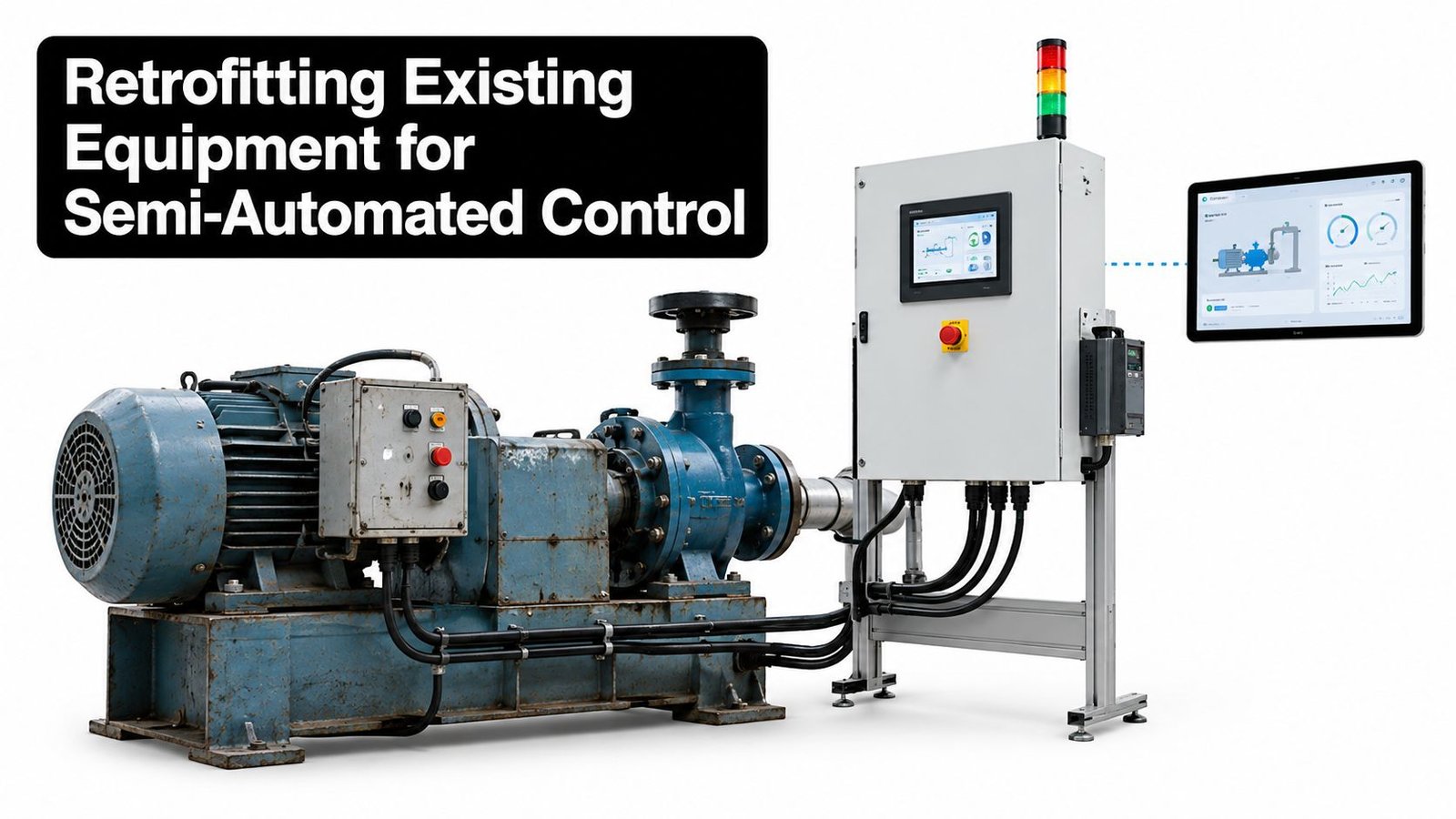
Start with a condition assessment. Check the frame, guarding, bearings, cylinders, drives, tooling, electrical cabinet, and available documentation. A PLC won't fix a worn slide, unreliable clamp, or poorly designed fixture. Identify the mechanical limits first, then decide which actions should become automatic.
A practical retrofit sequence
Document the current method. Record how operators load parts, position tooling, start the action, verify completion, and recover from a fault. The current method often reveals undocumented workarounds that the new controls must address.
Separate useful equipment from obsolete controls. Keep sound mechanical assemblies where they add value. Replace unsafe wiring, unreliable relays, unsupported drives, or controls that can't provide the diagnostics and interlocks the process requires.
Define the operating modes. Setup, manual jog, automatic cycle, fault recovery, and maintenance modes should have distinct permissions and behavior. Avoid a vague manual mode that allows unexpected movement.
Add feedback at decision points. Install sensors where the PLC needs confirmation. Do not assume an actuator completed its stroke just because the output was energized.
Build the HMI around recovery. Display the stopped step, the missing permissive, and the reset condition. Operators should be able to distinguish a part problem from an equipment problem.
Commission in stages. Test inputs, outputs, interlocks, and individual motions before running a complete product cycle. Then validate the cycle with representative materials and realistic operator handling.
A retrofit can keep production disruption under control because the work is concentrated on a defined station rather than an entire line. It also creates a platform for later additions, such as recipe management, measurement capture, or a more capable actuator.
The legacy equipment retrofit approach is most effective when the original machine has a clear process purpose and the retrofit team has access to its mechanical and electrical details.
Design warning: Don't automate a bad manual sequence without first correcting the fixture, material presentation, and recovery method.
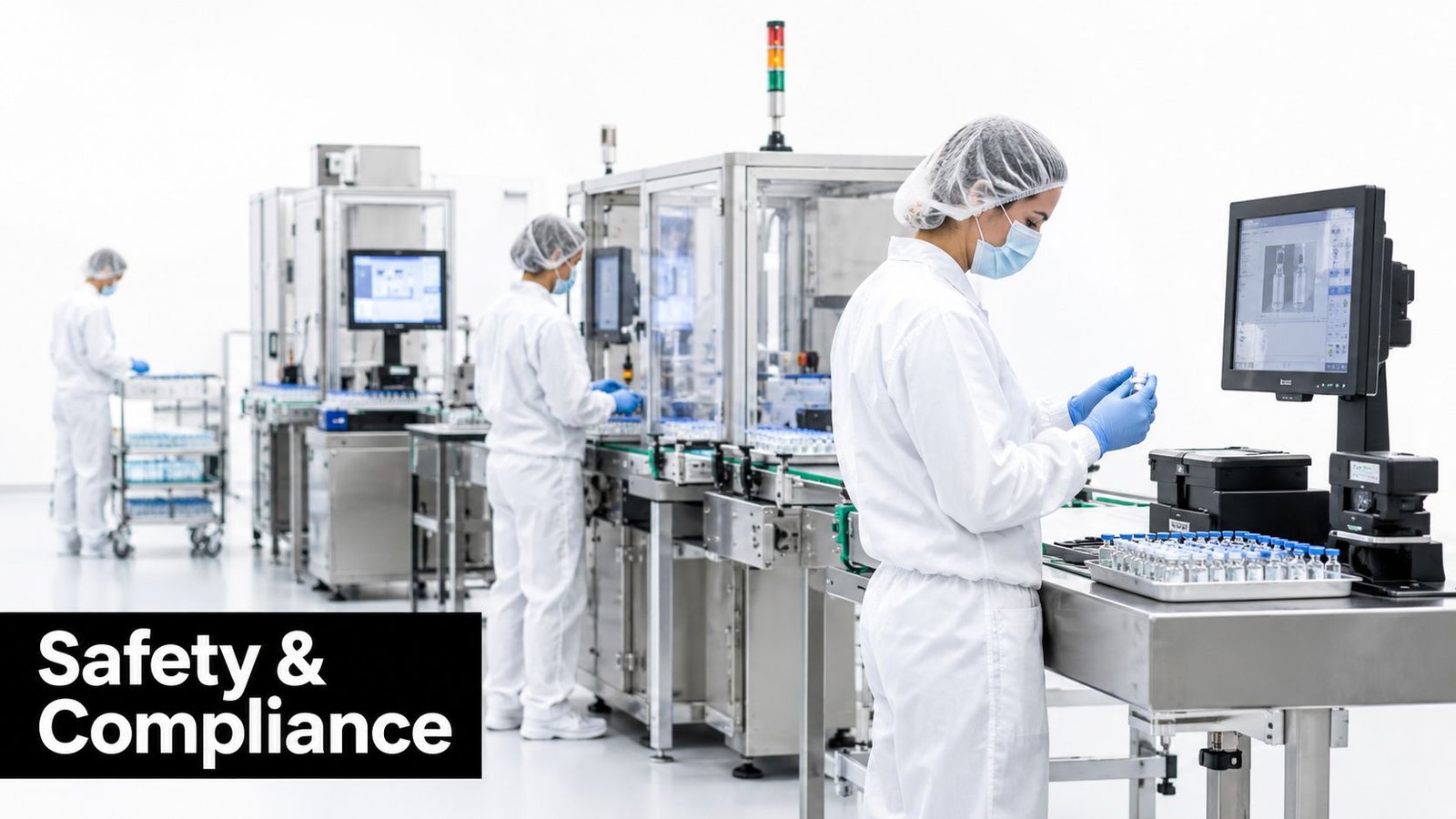
Safety, Quality, and GMP Compliance in Semi-Automatic Operations
A semi-automatic cell earns its place when it controls the hazardous or variation-sensitive steps while leaving practical decisions to a trained operator. That boundary must be designed deliberately. The operator should not need to place a hand in the point of operation while the machine can start. Controls must check the required conditions before motion, and the mechanical layout should make the safe action the easiest action.
Human-assist equipment still combines people with automated functions. Occupational safety guidance covers manual, semi-automated, and fully automated production, with human-in-the-loop work remaining common in assistive systems. Ergonomic benefit should be assessed from the actual task, posture, force, repetition, and handling method rather than claimed from the automation label alone. A commercial example of GMP-aware medical production appears in this review of automation and worker safety, not as peer-reviewed evidence of musculoskeletal outcomes.
Design for controlled intervention
Safety requires a defined response for each intervention:
- Safe loading: The operator can place the component without entering a hazardous motion zone.
- Positive confirmation: Sensors verify fixture position, part presence, and critical clamp conditions before the sequence proceeds.
- Controlled restart: Resetting a fault does not trigger an unexpected automatic cycle.
- Clear fault recovery: The HMI states whether the operator should remove a part, correct its position, or request maintenance.
- Permission management: Setup, recipe changes, and maintenance functions are restricted to authorized users.
Quality controls must support the intended process. In a GMP-aware or medical-device environment, that can mean controlled recipes, approved settings, traceable results, repeatable work instructions, and records showing that the process performs as intended. Semi-automation can enforce sequence and capture process conditions. It cannot create compliance without documented procedures, training, validation, and review.
Medical-device production shows why one automation level rarely fits every operation. Gerresheimer describes fully automated large-series production alongside manual and semi-automatic small-series work, with equipment design, clean-room production, and assembly also part of the operating model. Its medical-device manufacturing overview illustrates how different steps can require different levels of operator involvement.
For mid-size manufacturers, that flexibility is often the practical advantage. Assign validated machine behavior to repeatable, high-risk steps, and retain trained human judgment where product variation or inspection complexity makes fixed automation costly to maintain. Document both responsibilities, acceptance criteria, and escalation rules. Operators should never rely on tribal knowledge to decide whether a cycle is acceptable.
Justifying ROI Through Total Cost of Ownership Analysis
Capital expenditure alone gives a distorted view of automation value. A lower-priced machine may cost more over its working life if it causes long changeovers, more rework, difficult maintenance, or high operator involvement. A fully automated system may also underperform financially when utilization is low or product requirements change.
Use a Total Cost of Ownership model that spans the equipment's operating life. Compare the annualized cost of full automation with the cost of semi-automatic equipment plus labor, maintenance, training, validation, downtime, and expected quality losses. Base the model on your actual production profile and changeover pattern, not a supplier's ideal cycle.
Build the decision around these questions
- How variable is the product mix? Frequent changes can favor adaptable fixtures, recipes, and trained operator involvement.
- How much time does changeover consume? Count mechanical setup, software selection, first-piece approval, cleaning, and troubleshooting.
- What does labor do? Separate productive handling from waiting, inspection, correction, and recovery.
- What is the cost of rework? A controlled semi-automatic step may reduce variation without the maintenance burden of full automation.
- What happens during downtime? Include spare parts, diagnostic capability, technical skills, and supplier response.
- What must be validated? In regulated production, validation and change-control work can reduce the financial benefit of higher theoretical throughput.
For example, compare a five-station semi-automatic line costing $120K with a fully automated line costing $450K. If the semi-automatic line requires more labor but saves eight hours of changeover time each week, calculate the value of that recovered capacity, along with labor, maintenance, validation, and quality costs. The higher initial investment only makes sense if the automated line's utilization and operating savings recover the difference under realistic demand.
Low-volume, high-variability production often favors semi-automatic equipment because operators can support product changes without reconfiguring an entire automated line. The decision should follow the product mix, utilization, and cost of disruption.
The strongest business case is often not “this machine runs faster.” It is “this machine keeps the process controlled while the product and demand continue to change.”
Present several utilization and changeover scenarios. Management can then see when full automation earns its premium and when a semi-automatic control system offers the lower-risk, more resilient investment.
Implementation Checklist for Semi-Automatic Control Systems
A semi-automatic project becomes easier to manage when the team defines the hybrid workflow before choosing components. Use this checklist during concept review, detailed design, and commissioning.
Before design approval
- Map the process: Identify every loading, clamping, sensing, motion, inspection, and release step.
- Define responsibilities: State exactly what the machine does and what the operator does in automatic, setup, and recovery modes.
- Assess the asset: Verify the condition of the existing mechanics, tooling, drives, guarding, and electrical infrastructure.
- Set quality criteria: Define the measurements, inspections, and records that prove the cycle is acceptable.
- Review the product range: Confirm that fixtures, recipes, and operator interfaces can support the products you run.
During engineering
- Select the PLC and HMI together: The PLC must support the sequence and diagnostics, while the HMI must make faults and recovery understandable.
- Design interlocks first: Prevent motion when guards, fixtures, parts, or pressure conditions aren't correct.
- Provide useful feedback: Use sensors at critical decision points rather than relying on timed assumptions.
- Plan maintenance access: Leave room for inspection, replacement, calibration, and troubleshooting.
- Document the modes: Include clear behavior for manual jog, automatic cycle, emergency stop, reset, and power recovery.
Before handover
- Test every input and output: Confirm field wiring and device behavior individually.
- Run realistic cycles: Use actual materials, operators, product variation, and expected production pacing.
- Train for recovery: Operators need more than start-button instruction. They need safe responses to faults and abnormal conditions.
- Approve standard work: Work instructions should match the HMI and physical sequence.
- Create a support plan: Define spare parts, escalation routes, maintenance tasks, and revision control.
Commissioning is complete only when the equipment performs safely and repeatably with the people who'll run it.
Future-Proofing Your Manufacturing Operations
A well-designed semi-automatic line gives a manufacturer room to grow without forcing an immediate decision about full automation. The PLC can support additional recipes, the HMI can expose useful process information, and the mechanical cell can accept improved tooling as the product range develops.
That flexibility matters when demand is uncertain. A plant may begin with operator loading and automated joining, then add part presentation, measurement capture, or a powered handling aid after the process stabilizes. The team can make each investment against a known constraint instead of automating assumptions.
Specialized systems show how far this architecture can extend. ASELSAN's semi-automatic marine control platform integrates gyro, anemometer, MRU, DGPS, thrusters, power systems, and rudder systems, with semi-automatic position control and automatic heading control. The ASELSAN technical description also identifies features such as built-in testing, modular design, blackout prevention, and operation under environmental disturbances.
Return to the manufacturer facing the original choice between an inefficient manual station and a rigid full-automation project. A semi-automatic cell gives that team controlled motion, repeatable sequencing, clearer diagnostics, and the flexibility to change products without redesigning the whole operation. Its value comes from matching automation to the actual work, then leaving a practical path for the next improvement.
System Engineering & Automation offers semi-automatic systems, integrated controls, custom tooling, fixtures, installation, commissioning, and ongoing support for manufacturers that need better production performance without losing flexibility. Visit System Engineering & Automation to discuss your product mix, retrofit requirements, GMP-aware process needs, and the right automation level for your operation.