You're standing on a plant floor that's already busy, already behind on one order, and already waiting on another machine to be fixed. The pressure isn't abstract. It shows up as missed output, frustrated operators, quality escapes that need rework, and managers trying to justify capital spend with a spreadsheet that still doesn't reflect what's happening at the line.
That's where smart manufacturing solutions stop being a buzzword and start becoming a practical decision. The market is already large and still expanding fast, with one estimate placing it at USD 394.35 billion in 2025 and projecting USD 1,339.17 billion by 2034 at a 14.70% CAGR, while Asia Pacific holds 34.40% of global share in 2025, which tells you this is now a core industrial investment category, not a side project (Fortune Business Insights).
The buyers who move first aren't usually chasing a fully autonomous fantasy. They're looking for a smallest viable data and control layer that can prove ROI, support semi-automation, and fit the way real plants run. That's the right frame for small and mid-sized manufacturers, especially when budgets are tight and production can't be taken offline for a science project.
Table of Contents
- What Smart Manufacturing Solutions Mean on a Plant Floor
- The Core Technology Stack Behind Smart Manufacturing
- How OT, IT, and Digital Twins Tie Everything Together
- Measurable Benefits for Manufacturers
- A Practical Roadmap From Manual to Semi-Automated
- Choosing the Right Solution and Integrator for Your Operation
- Post-Installation Support and the Communication Gap Nobody Talks About
- Putting It Together for Long-Term Production Gains
What Smart Manufacturing Solutions Mean on a Plant Floor
A supervisor walks the line at 6 a.m. and already knows which machine is noisy, which shift is short a person, and which customer cannot hear the word “delay” again. That is the reality most plants live in. A polished dashboard will not fix it unless it changes what happens before the bad part gets made.
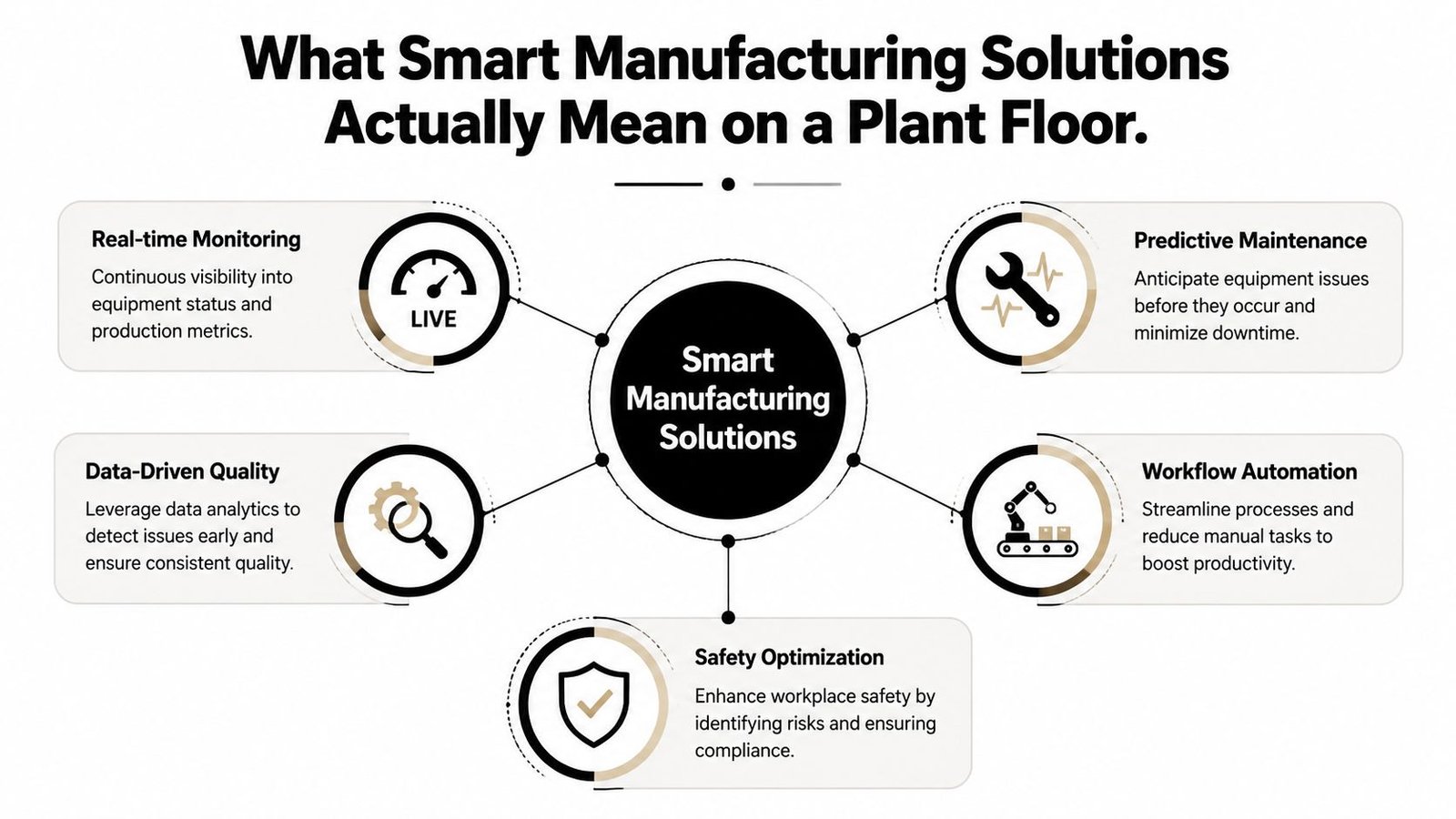
Smart manufacturing solutions are a working combination of connected equipment, data collection, and control logic that improves production and the services wrapped around it. The National Academies define smart manufacturing as the scaled integration of networked data with plantwide optimization, plus physical and sustainable production and resilient, demand-driven supply chains (National Academies). In plain terms, the factory can see what is happening, decide faster, and act before problems spread.
What the label hides
The word “smart” gets overused because it sounds bigger than the actual job. On the floor, the useful part is narrower. You are connecting machines, capturing machine-state data, and using that information to tighten maintenance, quality, throughput, and safety decisions.
The technical core is the integration of OT, IT, and cyber-physical systems, where IIoT sensors stream data into MES and ERP layers for faster decisions and closed-loop control (NIST and INEMI). That matters because a connected line that cannot influence schedules, alarms, or maintenance work orders is just expensive telemetry.
Practical rule: if a project does not change an operator's action, a maintenance decision, or a quality hold decision, it probably is not smart manufacturing yet.
For manufacturers trying to explain this internally, the simplest definition is this. Smart manufacturing solutions are the tools that help a plant see, decide, and respond with less waste and less delay. That is why a working internal conversation should focus less on “smart factory” branding and more on whether the system improves production flow, service responsiveness, and operational control.
If you need a practical starting point, this guide to smarter operations fits the same plant-floor logic.
The Core Technology Stack Behind Smart Manufacturing
A non-technical manager doesn't need to memorize acronyms to make a good decision. It helps more to think of the stack like a body. Sensors feel what's happening, controllers react, software supervises, and robots do repetitive work that people shouldn't have to do all day.
Start with the nervous system
IIoT sensors are the plant's nervous system. They detect vibration, temperature, pressure, counts, presence, and status, then pass those signals upstream. Without that layer, everyone is arguing from memory instead of data.
PLCs are the reflexes. They take sensor input and make fast, deterministic control decisions on the machine itself. If a conveyor jams, a cylinder misses position, or a safety interlock trips, the PLC is usually the layer that responds immediately.
Add the shift supervisor and the hands
MES acts like the shift supervisor. It knows what order should run, what batch or job is active, what step is next, and whether the process is staying within target. Robotics are the hands that never get tired, especially for pick-and-place, loading, unloading, welding, packaging, or inspection tasks that punish human repetition.
Controls tie the stack together. They're the rules, sequences, interlocks, and exceptions that keep automation from turning into a faster way to make bad parts. In regulated or high-mix plants, that control layer has to respect the process, not fight it.
A lot of integration failures happen because plants buy devices instead of architectures. The sensor works, the PLC works, the MES works, but nobody planned the handoff between them, so operators end up keying data manually or bypassing alarms. That's not automation, that's a patchwork.
A good system doesn't ask the operator to become the integration layer.
If you're evaluating retrofit options, this automation and control systems resource is a useful reference point because it reflects the reality that controls, not buzzwords, decide whether a line is maintainable.
How OT, IT, and Digital Twins Tie Everything Together
A plant floor can be fully connected and still underperform if the signals stop at dashboards. The useful setup is the loop between OT, IT, and simulation, where machine data becomes a decision and that decision is sent back to the line. A connected factory that never closes that loop just produces more data to sort through later.
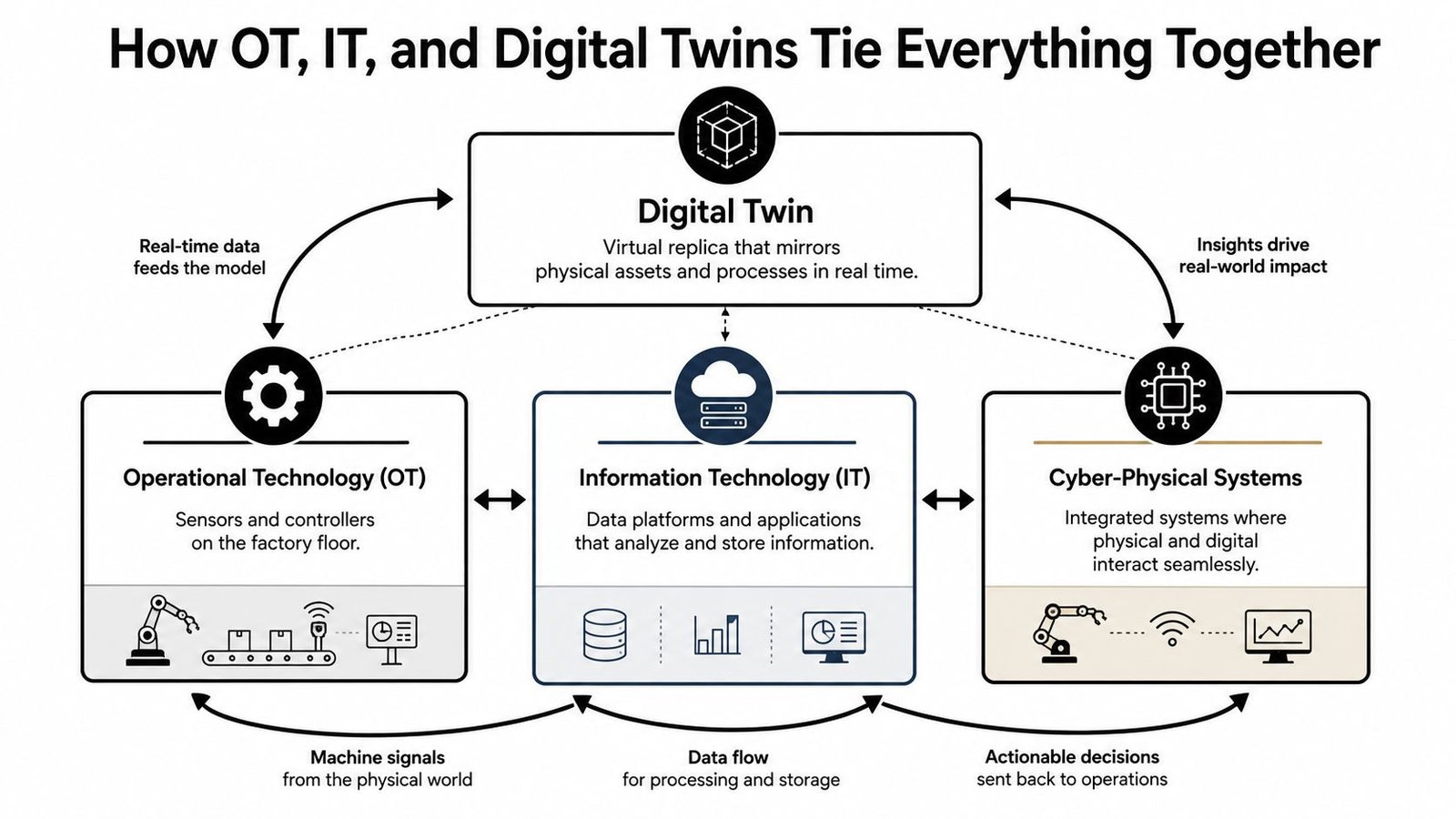
What moves from the line to the business system
On the OT side, sensors and controllers capture machine-state data directly from the process. IT systems, such as MES and ERP, turn that data into production visibility, traceability, planning, and reporting. When those layers are linked well, supervisors can respond to exceptions while the shift is still running, instead of finding them after the fact.
The hard part is not moving data. It is making the data trustworthy enough that operators, engineers, and planners use it. As noted earlier with the NIST and INEMI guidance, value comes from collecting operational data, speeding decisions, and adjusting to changing conditions in real time. That separates live operations from historical reporting.
Why digital twins matter
For higher-value or regulated work, digital twins are one of the few tools that let a plant test a process change before anyone touches the line. That cuts trial-and-error and keeps disruption contained. The practical use is narrow and specific. A team models one change, checks the result against actual process behavior, and decides whether the change belongs in production.
The strongest digital twin applications in manufacturing support real engineering decisions, not slideware. Recent review literature points to digital twins and AI/ML for real-time simulation, virtual prototyping, and adaptive control, while also warning that model fidelity, computational cost, data quality, and algorithm transparency still need to be managed carefully (review literature).
That warning matters on a real plant floor. A weak model can make a confident recommendation that is wrong, and a plant that follows it can create instability faster than it solves it. Simulation-first thinking works best when the model is narrow, grounded in actual process data, and used to validate one change at a time.
Measurable Benefits for Manufacturers
The easiest benefits to promise are the ones a CFO has heard a dozen times already. The harder part is tying the outcome to a control layer or workflow change that drives it. Smart manufacturing earns its keep when it closes the gap between what the plant planned and what the line delivered.
Output, productivity, and capacity
Deloitte's 2025 Smart Manufacturing and Operations Survey found that companies reported, on average, a 10% to 20% improvement in production output, a 7% to 20% improvement in employee productivity, and 10% to 15% capacity gains after implementation (Deloitte). Those are the kinds of improvements that matter because they do not always require a new building or another full line.
The mechanism is usually straightforward. Better visibility reduces changeover surprises, bottlenecks get identified earlier, and operators stop waiting for manual clarifications that slow the shift. In plants I've seen, the gains show up first where the process already has enough stability to benefit from tighter control. That is where a small control upgrade can move throughput without forcing a full redesign.
Quality, downtime, and continuity
Predictive maintenance is one of the most practical tools in the stack because it changes maintenance from reactive to planned. One industry report in the provided results says it can reduce downtime by up to 50% and improve supply-chain integration through real-time data sharing (report summary). That matters in any plant where a stopped asset does not just delay output, it disrupts shipping, staffing, and customer commitments.
The ROI often shows up in less dramatic places than executives expect. Fewer unplanned stops, cleaner handoffs between shifts, and earlier warning on wear patterns can save more money than a large software purchase looks on paper. For small and mid-sized manufacturers, that makes the maintenance layer a practical first win, especially when the plant cannot afford long outages or a large engineering team.
The adoption signal
The adoption picture is already broad. Deloitte reports that 84% of respondents said they had already adopted smart manufacturing or were actively evaluating it with plans to invest in the coming year, and adoption was higher among larger firms, 58% in the top third by revenue versus 40% in the lower revenue bracket. Capgemini's smart factory research similarly reports 76% of manufacturers either already have a smart factory initiative underway or are formulating one, and it estimates smart factories could add $500 billion to $1.5 trillion in global value added over five years (Capgemini).
That does not prove every project will work. It does show that the competitive pressure is real, and that plants waiting for a perfect moment will keep losing ground to teams that start with a smaller, measurable step.
A Practical Roadmap From Manual to Semi-Automated
Most small and mid-sized manufacturers don't need a moonshot. They need a line that runs more consistently, a data layer that proves value, and a path that doesn't break the budget or the workforce. A semi-automation-first strategy usually gets there faster than a full redesign.
Start where risk is smallest
A readiness assessment should answer three questions. What breaks most often, what data is missing, and what skill sets already exist on the floor? The answer usually points to one or two use cases, not ten.
The smartest first project is often the one with limited scope and visible pain. Think repeat quality checks, manual part tracking, or a recurring downtime cause that operators can describe clearly but management can't see in real time. That's the right place to build the smallest viable automation and data layer.
Build in stages, not leaps
A sensible implementation sequence looks like this:
- Readiness assessment, confirm infrastructure and staff capability.
- Use-case prioritization, choose the process with the clearest ROI.
- Concept design, map controls, data, and operator interaction.
- Controls integration, connect new logic to existing machines.
- Installation and commissioning, verify operation on the line.
- Optimization and training, tune performance and teach the team.
That order matters because each step reduces rework in the next one. If you skip the design and jump to hardware, you'll pay for it later in maintenance complexity.
Treat regulated production as a design constraint
For GMP-aware environments, the process has to support traceability, repeatability, and clean handoff between people and systems. In medical-device or other regulated settings, semi-automation is often the practical middle ground because it improves consistency without forcing a plant into a brittle, fully automated model that's hard to validate or staff.
The right engineering support can matter here, especially when you need custom tooling, fixtures, controls, and a layout that can grow without throwing away the first phase.
Choosing the Right Solution and Integrator for Your Operation
A machine list doesn't tell you whether a project will succeed. The test is whether the provider understands your process, your workforce, and your tolerance for change. A plant that needs stable semi-automation should not be buying a concept built for a greenfield mega-site.
Compare the criteria that actually matter
| Criterion | What to Ask | Warning Sign |
|---|---|---|
| Industry fit | Have you built for our product type, compliance level, and batch style? | Generic answers that ignore your process details |
| Scalability | Can this start semi-automatic and expand without a full redesign? | A fixed architecture that only works at one scale |
| Support model | Who owns commissioning follow-up, troubleshooting, and training? | “Call us if something breaks” support |
| Total cost of ownership | What will maintenance, spares, and support look like over time? | A low upfront price with no service plan |
The best proposals translate features into production impact. If the vendor can't explain how the system improves output, quality, or labor usage on your floor, the proposal isn't ready.
Ask for the operational proof
Look for details, not adjectives. You want to know how the integrator handles change control, documentation, training, and future expansion. If the system will be used in GMP-aware production, ask how traceability and validation are handled before anyone starts wiring panels.
Practical filter: the best partner is the one that can show how the line will still be serviceable after the original team is gone.
That's where support quality becomes part of the solution, not an afterthought. A one-year guarantee is useful, but only if it's backed by a team that can respond, revise, and stabilize the line when production conditions change.
Post-Installation Support and the Communication Gap Nobody Talks About
A lot of automation projects look successful on day 30 and disappointing on day 300. The hardware still works, but nobody kept the training current, the maintenance rhythm drifted, and operators found workarounds that pulled the system away from its original design. That's not a hardware problem. It's a support problem.
Maintenance is part of the ROI
Predictive and preventive maintenance protect the investment you already made. If the system is instrumented well, maintenance teams can act before wear becomes unplanned downtime, and supervisors can schedule work around production instead of reacting to a stoppage after the fact. That's one of the quiet reasons smart manufacturing holds up in real plants.
The human side matters just as much. A front-line operator often sees the earliest sign of drift, but many plants still don't give that operator a fast, structured path to report it. One 2024/2025 source argues that the critical infrastructure gap is frontline communication systems that connect workers to digital workflows, not just more sensors and dashboards (frontline communication coverage).
What good support looks like
A strong post-installation model usually includes:
- Training that's tied to the actual line, not a generic handoff.
- Maintenance routines that protect calibration, cleanliness, and uptime.
- Operator feedback loops that capture issues in the same data environment as the machine.
- Service access that's responsive enough to keep production moving.
Many SMEs get stuck. The capital purchase gets approved, but the plant doesn't have a mature way to keep the system healthy. Without that support layer, even a smart line turns noisy fast.
The underserved manufacturing challenge is often not “What is the most advanced stack?” It's “How do we connect people, machines, and information in a way the plant can sustain?” That question is especially important for small and mid-sized facilities that need incremental change, not a big-bang transformation.
Putting It Together for Long-Term Production Gains
The plants that get value from smart manufacturing solutions don't start by buying the most advanced package. They start by defining the production problem, choosing the smallest viable layer that can prove value, and then scaling only after the floor shows it can absorb the change. That approach respects budgets, skills, and compliance realities.
The decision points are usually the same. Choose the stack that fits the process, not the one with the longest feature list. Choose an integrator that understands semi-automation, GMP-aware design, and long-term support. Then make sure the post-installation plan is strong enough to keep the system useful after the first month of enthusiasm fades.
For a manufacturer trying to improve production and services without betting the plant on a full rebuild, the next move should be a conversation with an engineering partner who can scope the smallest viable automation step, document the ROI path, and build for maintainability from day one.
System Engineering & Automation helps manufacturers work through that kind of phased automation decision, from semi-automatic systems and custom controls to installation, commissioning, and ongoing support. If you're trying to improve output, quality, and labor efficiency without overbuilding the line, visit System Engineering & Automation and start a conversation about the smallest practical solution for your plant.