If you're running a plant right now, the problems usually don't look futuristic. They look familiar. A line slows down for no clear reason, a semi-automated station drifts out of spec, changeovers take longer than they should, or quality starts slipping just enough to trigger rework, scrap, or compliance anxiety.
That's where most conversations about digital twins go off track. People hear the term and picture a massive smart factory project with 3D dashboards, AI overlays, and a budget that only global enterprises can justify. In practice, digital twins for manufacturing are often most useful when they're much narrower than that. A twin can start with one fixture, one packaging cell, one bottleneck, or one process change that carries real production risk.
Table of Contents
- The Growing Need for a Smarter Production Floor
- From Blueprint to Live Model What Is a Digital Twin
- Real-World Benefits Beyond the Buzzwords
- Digital Twins in Action Manufacturing Use Cases
- A Practical Roadmap for Your First Digital Twin
- Measuring Success and Calculating Your ROI
- Common Pitfalls and Keys to Long-Term Success
The Growing Need for a Smarter Production Floor
Most plant managers aren't looking for another dashboard. They're looking for a way to make better decisions before the next downtime event, validation issue, or capacity squeeze hits the floor. That need is getting sharper as teams try to improve throughput, quality, and traceability without stopping production for trial-and-error changes.
That pressure helps explain why digital twins have moved well past the concept stage. One market estimate projects the global digital twins in manufacturing market to reach USD 42.6 billion by 2034, growing at 28.1% CAGR, while the United States accounted for USD 1.08 billion in revenue and is projected to grow at 26.7% CAGR, according to Market.us reporting on digital twins in manufacturing. That's not a niche technology curve. It's a sign that manufacturers are treating twins as part of their operating toolkit.
The practical takeaway isn't that every factory needs a full digital replica tomorrow. It's that your peers are already using digital models tied to real production data to test changes, troubleshoot constraints, and reduce avoidable risk.
Practical rule: If a production problem is expensive to test on the live floor, it's a good candidate for a digital twin.
For small and mid-sized manufacturers, that matters even more. You don't have spare lines, unlimited engineering hours, or much tolerance for disruption. A well-scoped twin gives you a safer way to evaluate process changes in existing equipment, semi-automated stations, and retrofit projects.
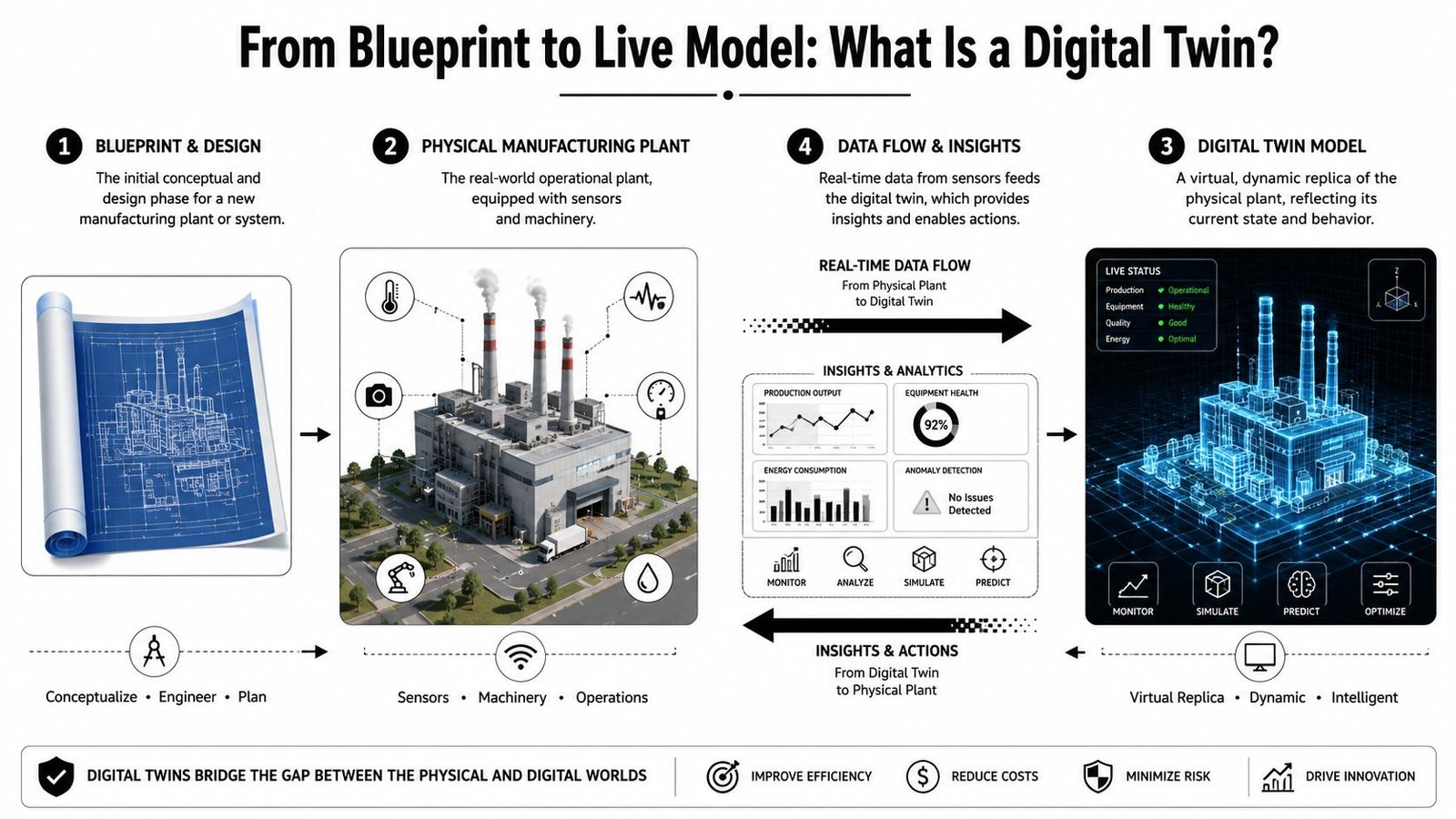
From Blueprint to Live Model What Is a Digital Twin
A digital twin isn't just a 3D model on a screen. It's closer to a flight simulator for your production process. The point isn't visualization alone. The point is being able to see current behavior, test likely outcomes, and make changes virtually before you touch the physical machine, fixture, or line.
Industry coverage traces that shift back to the early 2000s, when the concept expanded from product lifecycle management into live operational use. Today, digital twins are described as dynamic models fed by real-time sensor data that support closed-loop decisions instead of static simulation, as explained in DataPARC's overview of digital twins in manufacturing.
A flight simulator for production
If you think about a packaging station, a robotic load cell, or a semi-automated assembly fixture, the twin is the digital environment where engineers can ask useful questions before making a real-world move.
Can the cycle time hold if product mix changes?
Will that fixture modification create a thermal or positional issue?
What happens to the downstream queue if one station slows for even a short period?
That's why the strongest digital twins for manufacturing aren't built for show. They're built to answer a short list of expensive operational questions.
The three parts that matter
A working twin usually has three essential elements:
- The physical system. This could be a single asset, a workstation, a production line, an entire factory, or even a multi-site network.
- The virtual model. This is the digital representation of how that system is built and how it behaves.
- The data connection. Sensors, PLC signals, machine states, temperatures, pressures, counts, and other inputs keep the model aligned with reality.
Without the third element, you often just have a simulation file or a CAD model. Useful, yes. But not a true operating twin.
In retrofit environments, many projects either become practical or fall apart. If the machine doesn't have clean signals, if naming conventions are inconsistent, or if data is trapped in separate systems, the twin won't help much. That's why teams often start by tightening the data foundation through tools such as machine monitoring software for production visibility, then layer the digital model on top of it.
A twin becomes valuable when it helps a supervisor or engineer decide what to change, what to leave alone, and what to test next.
The technology can operate at four levels: individual assets, production lines, entire factories, and multi-site supply chains. In practice, most successful first projects start lower in that stack. They focus on one real constraint, prove the model against actual behavior, and then expand only if the decision value is there.
Real-World Benefits Beyond the Buzzwords
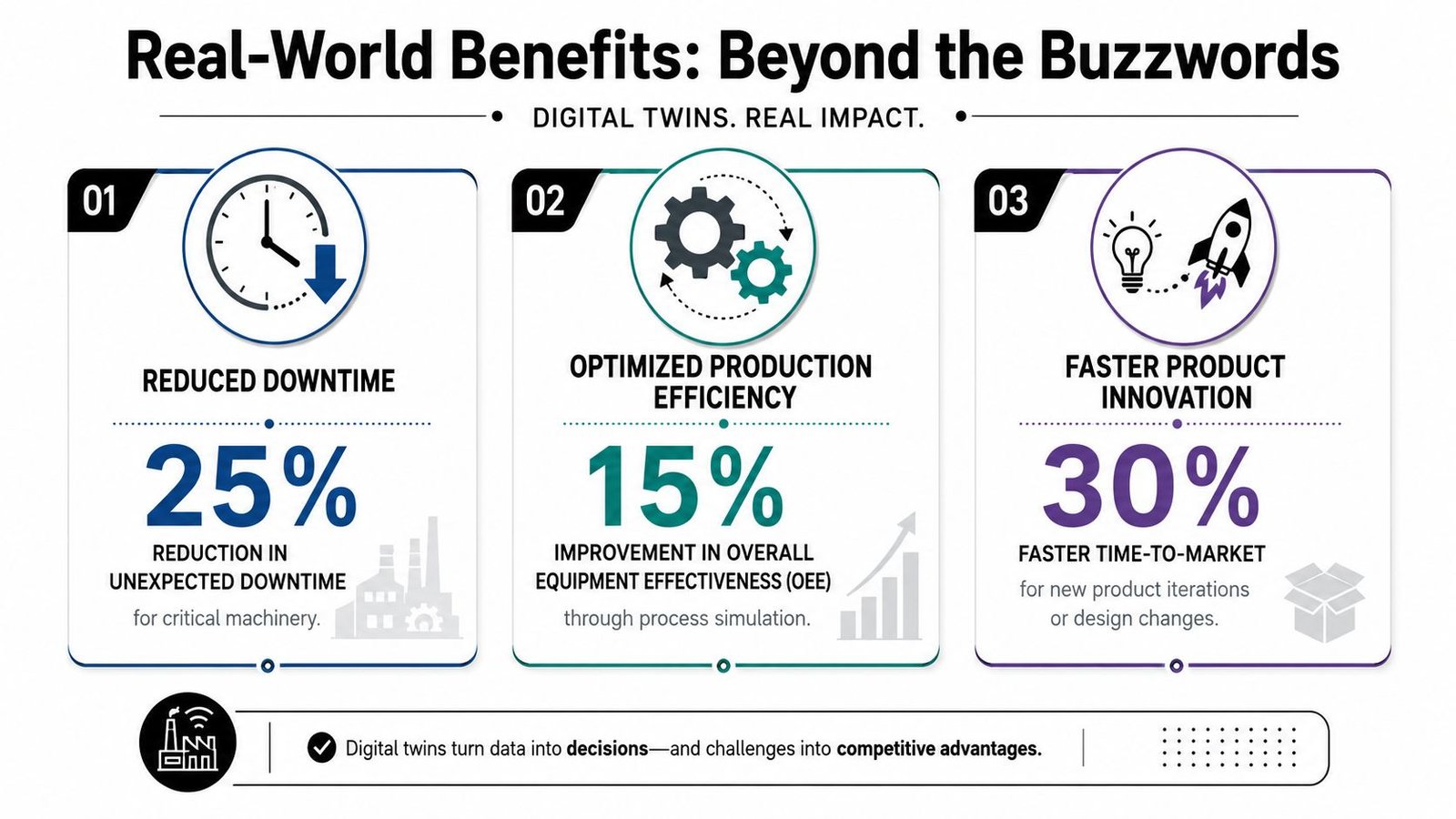
The benefits of digital twins are easiest to understand when tied to floor problems that already cost money. Not abstract innovation goals. Actual losses from downtime, blocked throughput, unstable quality, and repeated engineering trial runs.
Where the gains show up first
When a twin is connected to live equipment data and a usable process model, the maintenance impact is often the first thing operations notices. Verified data indicates digital twins can support a 20 to 30% reduction in unplanned downtime and a 15 to 25% increase in operational throughput by creating a predictive feedback loop between physical assets and virtual models.
That matters because most plants don't lose output in dramatic ways. They lose it in repeat interruptions. A station overheats slightly. A fixture starts wearing unevenly. A pressure reading drifts but stays just inside a wide alarm band. The line keeps running until the pattern becomes a stoppage.
Digital twins help by turning those weak signals into earlier decisions. Instead of reacting to a fault after it hits production, teams can simulate likely failure modes, compare real readings against expected behavior, and move maintenance earlier.
For product development work, the value can be even more direct. Verified data also shows product digital twins can reduce time-to-market by up to 50% by enabling parallel design and simulation cycles rather than relying only on physical prototyping iterations.
| Manufacturing pain point | How the twin helps |
|---|---|
| Unplanned stoppages | Compares live conditions with expected behavior and flags likely failure patterns |
| Throughput bottlenecks | Tests cycle-time and flow changes before changing the floor |
| Repeated prototyping loops | Validates design or process changes digitally first |
Why regulated plants care
In regulated production, the twin does more than improve uptime. It also creates a cleaner path for validation, traceability, and change control. That's especially useful in medical device assembly and other GMP-aware operations where process deviations need a clear cause and a defensible record.
A twin tied to fixture behavior, environmental data, and process parameters gives engineering and quality teams a shared model of what changed and why. That can support compliance reviews, operator training, and more disciplined root-cause work.
The best compliance benefit isn't flashy. It's having one place where process assumptions, operating conditions, and change impacts can be reviewed before the line is disturbed.
That benefit becomes practical when the model stays close to reality. If the twin isn't updated with current machine behavior, sensor inputs, and actual operating states, it quickly becomes shelfware.
Digital Twins in Action Manufacturing Use Cases
The easiest way to demystify digital twins for manufacturing is to stop thinking about factory-wide replicas and look at narrower jobs where the risk of getting it wrong is high.
Medical device fixture validation
Consider a semi-automated medical device assembly fixture that needs a process change. The engineering team wants to increase consistency and reduce manual adjustment, but the product has tight tolerance requirements and GMP expectations leave little room for unverified changes.
In that case, the twin can model fixture motion, thermal behavior, sequence timing, and key process parameters before physical commissioning. Engineers can validate whether a proposed change will hold the process window, whether a fixture movement creates an unintended variation, and whether the updated method remains traceable within the digital model.
The value isn't just speed. It's avoiding a live-floor experiment that creates deviation risk.
Finding the fault inside a semi-automated cell
A second use case is less regulated but just as common. A robotic or semi-automated station starts missing its expected cycle intermittently. No single alarm explains it. Mechanical inspection doesn't show an obvious failure. Operators can tell something is off, but the problem appears and disappears too quickly to diagnose by observation alone.
A digital twin gives the team a structured way to isolate the issue. It can line up real machine states, environmental conditions, PLC events, and sequence behavior against the expected operating pattern. That makes it easier to spot whether the actual problem is motion timing, part presentation, wear in a fixture, or a downstream dependency that's feeding back into the cell.
In a smaller plant, that kind of diagnostic clarity matters more than a flashy plant model. One stubborn bottleneck can dominate the economics of the whole shift.
Planning a retrofit before steel gets cut
Retrofit work is another strong fit. Say you're adding automation to an existing manual line. You need to fit new tooling, preserve operator access, keep material flow sane, and avoid creating a bottleneck one station downstream.
A digital twin can support:
- Layout validation so the team can test footprint, clearances, and operator movement before equipment arrives
- Workflow checks to see whether the new sequence improves flow or just relocates the delay
- Changeover planning so tooling and process changes are reviewed before installation
- Training preparation by letting operators and supervisors understand the new sequence before startup
These projects don't need a futuristic smart factory story. They need a way to reduce integration risk in real buildings with real constraints.
A Practical Roadmap for Your First Digital Twin
Most first digital twin projects fail when the scope is too large. Plants try to model everything, integrate every system, and answer every question at once. That creates a long software effort instead of a useful production tool.
A better path is smaller and more disciplined.
Start with one painful problem
Pick the issue that already costs time, quality, or engineering capacity. Not a vague modernization goal. A real problem.
Good starting points include a troublesome bottleneck, a recurring changeover issue, an unstable semi-automated station, or a retrofit layout decision that can't afford trial-and-error. If you're working with older equipment, this often pairs naturally with legacy system modernization for existing production assets, because the twin is only as useful as the signals and controls you can trust.
Ask three questions before building anything:
- What decision are we trying to make?
- What real-world risk are we trying to reduce?
- What data do we already have versus what do we need?
Build only what you need to decide
Your first twin doesn't need perfect geometry or every machine variable. It needs enough fidelity to answer the question that justified the project.
For one application, that may mean sensor trends, PLC states, and a simplified process model. For another, it may mean a higher-fidelity geometric model because fixture position or thermal behavior drives the result.
This short video gives a useful visual reference for how digital twin thinking is applied in industrial settings:
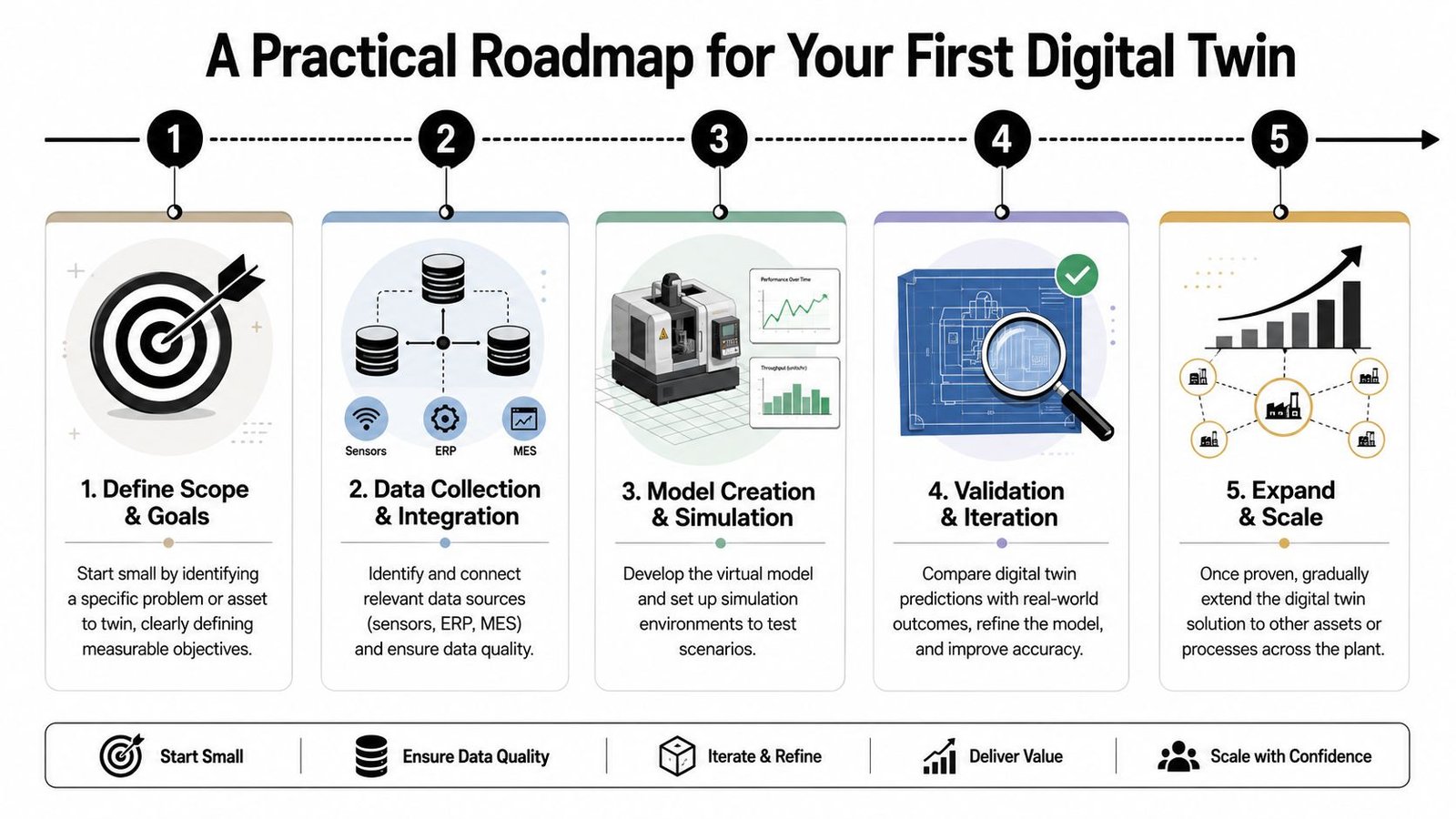
The practical sequence usually looks like this:
- Define scope and success criteria
- Connect the needed data sources
- Build a model that represents actual behavior
- Run scenarios against known production conditions
- Refine only where accuracy affects the decision
Field lesson: A good first twin answers one expensive question reliably. It doesn't try to become your whole digital strategy in version one.
Validate then expand
Before anyone scales the twin, compare its outputs against actual machine or process behavior. If the model says a sequence will choke under certain conditions, test that against the floor record. If it predicts a maintenance threshold, compare that with observed wear or stoppage history.
Once the model proves useful, expansion becomes easier. You can add adjacent stations, broader workflow logic, more sensor inputs, or stronger simulation around quality and maintenance. At that point, the twin has earned the right to grow.
Measuring Success and Calculating Your ROI
The ROI question is where many digital twin conversations become too vague to survive a capital review. If the business case sounds like "better visibility" or "future readiness," most operations leaders will put it in the maybe-later pile.
The stronger case is much tighter. Verified guidance notes that justifying ROI is a key challenge in smaller or semi-automated settings, and that the strongest early return often comes from narrow applications such as layout validation, workstation optimization, or changeover planning, rather than enterprise-wide replicas, as discussed in Info-Tech's research summary on digital twins in manufacturing.
Build the business case around one constraint
Start with the production problem that already has a cost attached to it. That cost may show up as lost output, repeated engineering time, validation delays, unstable changeovers, operator retraining, or scrap tied to one station.
The business case gets clearer when you define the twin as a decision tool for that constraint, not as a digital transformation initiative.
A practical ROI discussion usually sounds like this:
- If the twin helps stabilize one bottleneck, does that free enough capacity to matter?
- If the twin improves changeover planning, does that reduce lost production hours and startup errors?
- If the twin supports layout validation, does it prevent rework, relocation, or a poor equipment purchase?
- If the twin improves a regulated process, does it reduce deviation risk and shorten validation effort?
Those questions work in a semi-automated environment because they tie value to one operation people already understand.
Track operational proof not software activity
Don't measure success by model complexity, dashboard count, or how many data tags were connected. Measure it with plant KPIs the floor already respects.
A useful scorecard often includes:
| KPI area | What to watch |
|---|---|
| Equipment reliability | Frequency of stoppages, maintenance timing, repeat fault patterns |
| Flow performance | Bottleneck behavior, queue buildup, changeover disruption |
| Quality stability | First-pass consistency, deviation patterns, process drift |
| Engineering efficiency | Fewer live-floor trials, faster validation of proposed changes |
In smaller deployments, the most convincing ROI often comes from what didn't happen. The line didn't lose a shift to testing. The retrofit didn't require layout rework. The fixture change didn't trigger a quality event. The operator ramp-up was smoother because the workflow had already been tested.
That's why digital twins for manufacturing don't need to start big to pay off. They need to remove uncertainty from a decision that would otherwise be expensive to make on the floor.
Common Pitfalls and Keys to Long-Term Success
Most digital twin failures aren't caused by the concept itself. They're caused by poor scoping, weak data, and treating the twin like a software artifact instead of an operating tool.
What usually goes wrong
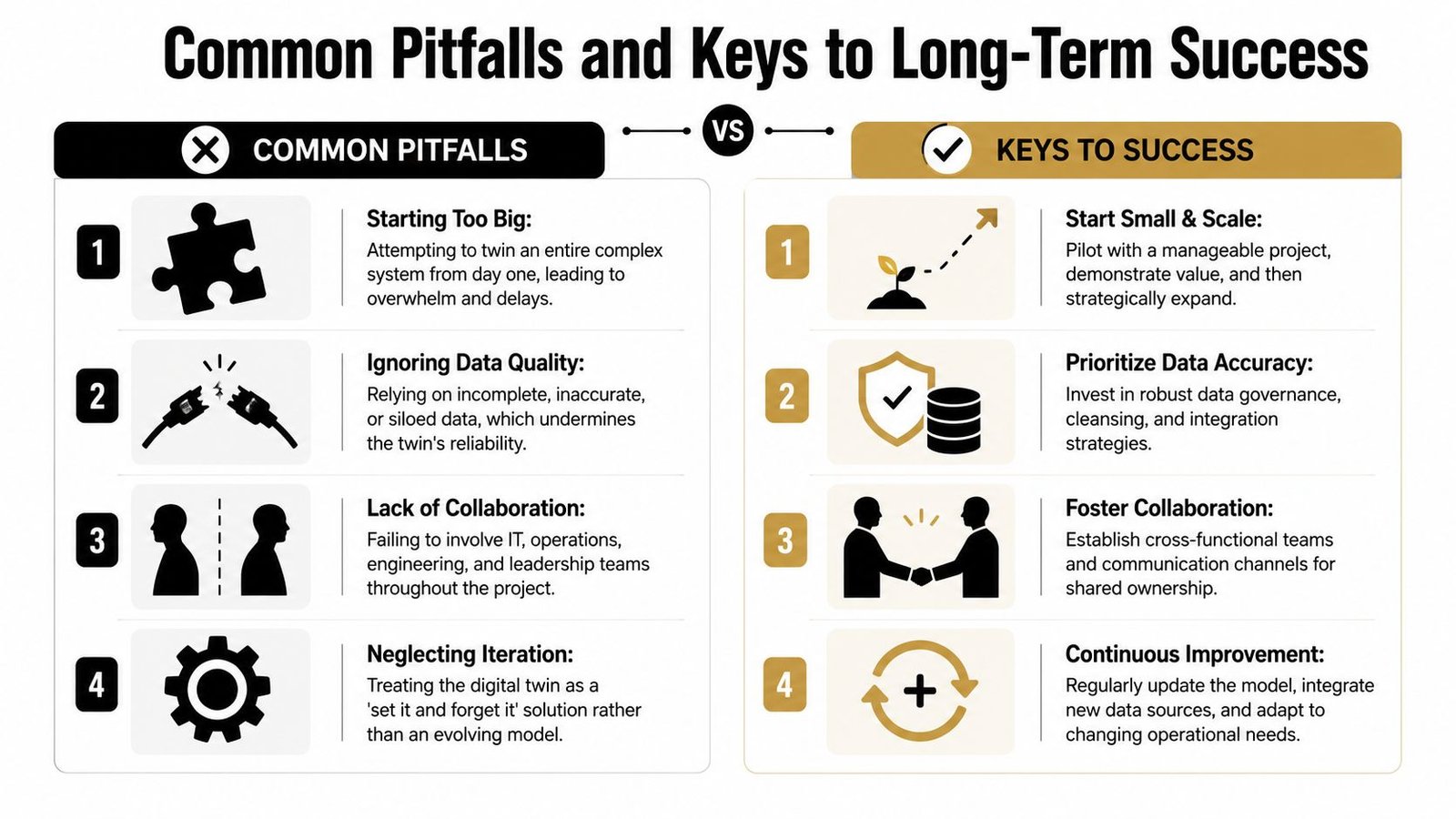
The first mistake is starting too big. A plant tries to twin an entire line or facility before proving the value on one asset or one production problem. The model takes too long, users lose interest, and operations doesn't trust the result.
The second mistake is bad input data. Modern twins increasingly combine IoT, AI, and ML, but their value depends on high-quality sensor data and a real feedback loop between the physical and virtual systems, according to recent analysis on digital twins, AI, and sustainability pressures. If the data is noisy, missing, or disconnected from actual machine behavior, the twin turns into a polished guess.
A third issue is organizational. The twin gets treated as an IT project with little operator or maintenance involvement. That usually leads to a model that looks technically impressive but doesn't reflect the way the line really runs during shift changes, product variation, or routine workarounds.
Before scaling any project, it's worth doing an automation risk assessment for implementation readiness so the team understands data gaps, control limitations, and process risks early.
What makes a twin useful over time
The plants that get value from digital twins tend to follow a simpler discipline:
- Start small and stay tied to a business problem
- Use only the data needed to support a real decision
- Validate the model against floor behavior
- Keep operators, engineering, maintenance, and quality involved
- Add AI only when it improves the decision, not just the presentation
A useful twin isn't the most detailed one. It's the one people trust enough to use before making a costly change.
The long-term success factor is simple. Keep the loop closed. The physical system changes, the digital model updates, and the team uses that model to decide what to do next. If any one of those pieces drops out, the twin stops being operational and starts becoming decoration.
System Engineering & Automation helps manufacturers apply automation in ways that fit real production constraints, budget limits, and compliance requirements. If you're evaluating where digital twins for manufacturing fit into a semi-automated line, a retrofit, a medical device process, or a single high-risk workstation, System Engineering & Automation can help you define the right scope, connect it to practical production goals, and build toward measurable ROI instead of unnecessary complexity.