You're likely dealing with some version of the same daily problem. One line runs well on first shift, drifts on second, and turns into a troubleshooting exercise by the end of the week. Operators compensate manually. Quality catches problems after parts are already built. Maintenance gets called when a machine finally stops, not when it starts showing signs of trouble. Meanwhile, you're being asked to raise output, protect margins, and avoid a capital project that replaces equipment still mechanically sound.
That's where telemetry and process controls start to matter. Not as a buzzword, and not as a giant all-at-once automation program. In practical manufacturing terms, they give your team a better way to see what's happening on the floor and act on it fast enough to make a difference. For small-to-medium manufacturers, especially in regulated work like medical devices, that often means retrofitting smarter sensing, tighter control logic, and better data capture into equipment you already own.
If you provide manufacturing solutions to optimize production and services, or you're looking for a partner who does, this is the layer of automation that usually creates the most immediate operational clarity.
Table of Contents
- Why Smart Data Is Your Next Competitive Edge
- Understanding Telemetry and Process Controls
- The Modern Manufacturing Automation Stack
- The Tangible ROI of Integrated Control Systems
- Your Roadmap to a Smarter Production Line
- Putting Theory into Practice
- Starting Your Automation Journey
Why Smart Data Is Your Next Competitive Edge
A plant manager usually doesn't ask for telemetry first. They ask why scrap is creeping up, why changeovers take longer than they should, or why one workstation depends too much on one experienced operator. The root problem is often the same. The process isn't visible enough in real time to control it consistently.
On a typical floor, the clues are there. A press heats up differently after lunch. A fixture needs frequent adjustment. A feeder slows down under a certain load. But if nobody is capturing that data continuously, the team relies on memory, handwritten notes, and post-shift interpretation. That works until demand rises or quality tolerance tightens.
Where the pressure shows up first
The first pain point is usually variation. The second is reaction time.
When operators only find out something drifted after inspection, the process has already produced questionable parts. When maintenance only sees a problem after a failure, downtime lasts longer than it should. When supervisors have to walk the floor to learn machine status, they're managing by interruption instead of by information.
A smarter approach starts small:
- Track critical variables: Temperature, pressure, vibration, cycle status, and energy use are common starting points.
- Surface the data clearly: A simple HMI or dashboard often solves more than a complicated reporting package.
- Tie data to action: An alert that nobody owns doesn't help. A controlled response does.
Practical rule: If a variable can drift enough to affect quality, uptime, or safety, it deserves either a sensor, a limit, or both.
There's nothing new or experimental about remote visibility. Telemetry has deep industrial roots. Telemetry technology traces its foundational origins to the 19th century, with a milestone in 1845 when the first data-transmission circuit was developed between the Russian Tsar's Winter Palace and army headquarters, marking the beginning of wire-based telemetering, as documented in this history of telemetry development.
Why this matters for smaller manufacturers
Large plants can sometimes absorb inefficiency with staffing depth or redundant equipment. Smaller operations usually can't. A single unstable process can affect scheduling, labor allocation, on-time delivery, and customer confidence in the same week.
That's why telemetry and process controls are a competitive edge. They let you improve the line you have, with a level of visibility and discipline that supports better production decisions without forcing a full rebuild.
Understanding Telemetry and Process Controls
Telemetry and process controls work best when people stop treating them as separate topics. They're two parts of the same operating loop.
Telemetry is the sensing and reporting layer. It tells you what's happening. Process control is the decision and response layer. It keeps the process within the limits you want.
Think of a thermostat, then scale it up
A home thermostat is the simplest example. It reads temperature, compares that reading to a target, and tells the heating or cooling system to respond. Manufacturing does the same thing, just with more variables, tighter tolerances, and higher consequences.
On a production line:
- Telemetry collects the signals: sensor inputs such as temperature, pressure, speed, torque, part presence, or vibration
- Process controls evaluate those signals: PLC logic, relay logic, or control algorithms compare actual conditions to targets
- The system acts: valves open, motors slow, alarms trigger, heaters cycle, conveyors stop, or recipes adjust
- The loop repeats: the system checks the result and keeps correcting
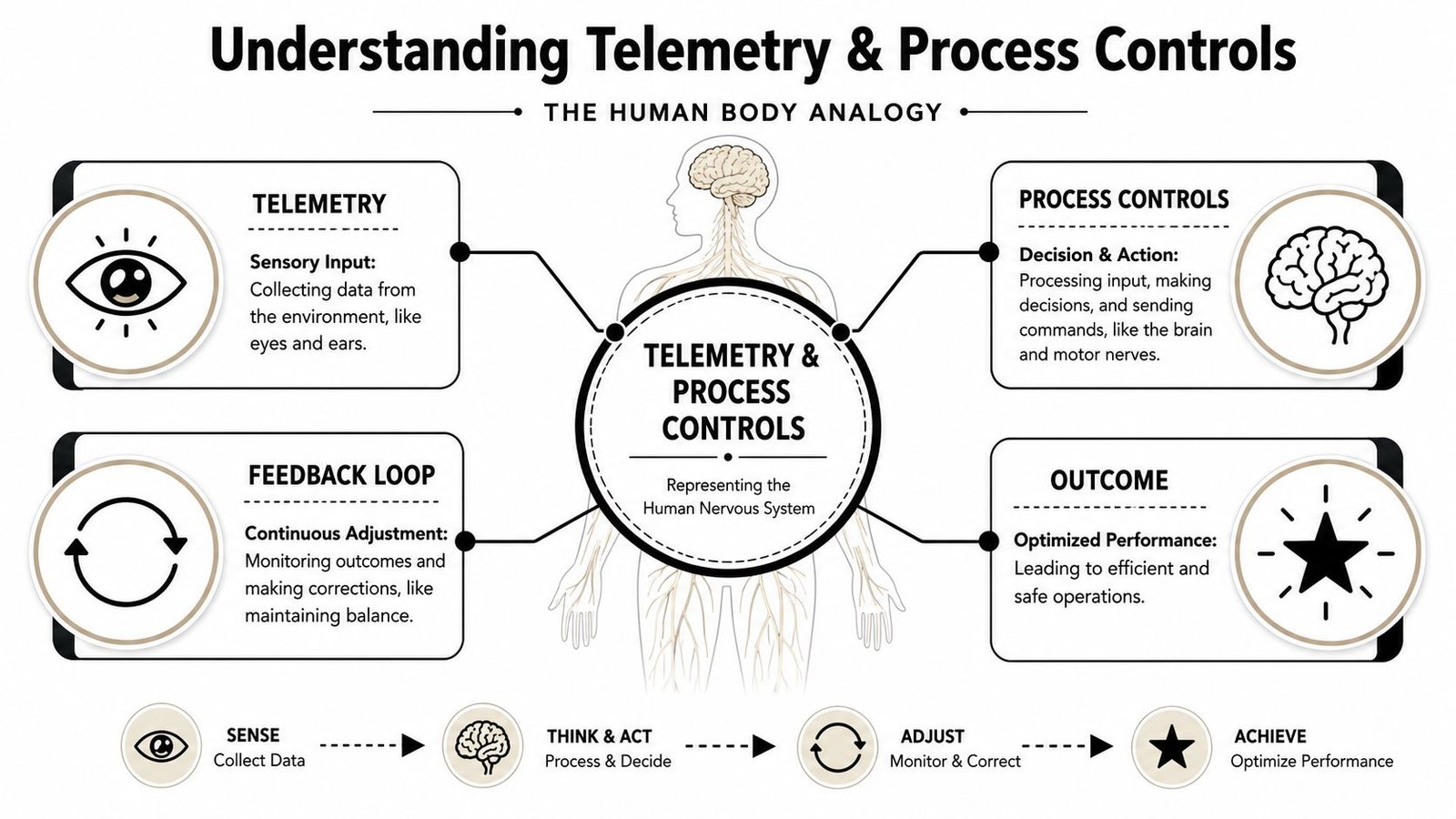
That's why the human body analogy works. Sensors act like eyes, ears, and nerves. Control logic acts like the brain. Outputs act like muscles. The feedback loop is what keeps the whole system stable.
What telemetry does well and what it doesn't
Telemetry is excellent at exposing hidden behavior. It can show when a machine starts trending away from its normal state, when utility use spikes, or when an operator intervention happens more often than expected. It's also how many teams begin building a better maintenance strategy. Machine monitoring software for production visibility often becomes the first practical step because it turns machine states into usable information without demanding a full controls redesign.
But telemetry alone doesn't improve the process. A dashboard that displays bad news faster is still just a dashboard if nobody ties the data to setpoints, interlocks, alarms, or procedures.
Good telemetry without control action creates awareness. Good telemetry with process control creates consistency.
What process controls do well and where teams overreach
Process controls are strongest when they manage a clearly defined variable with a known acceptable range. Temperature loops, pressure regulation, fill control, torque verification, and timed sequence control are all good candidates.
Where teams get into trouble is trying to automate judgment before they've stabilized the basics. If the sensor is unreliable, the control logic will be unreliable faster. If the sequence isn't standardized, adding more software won't fix the underlying process.
That's the partnership. Telemetry tells you the truth about the line. Process controls use that truth to keep the line on target.
The Modern Manufacturing Automation Stack
Most production problems don't live in one device. They move through the whole system. A sensor sees a condition. A controller makes a decision. An operator needs visibility. A supervisor wants trend data. Quality wants records. Management wants output and downtime tied to actual causes.
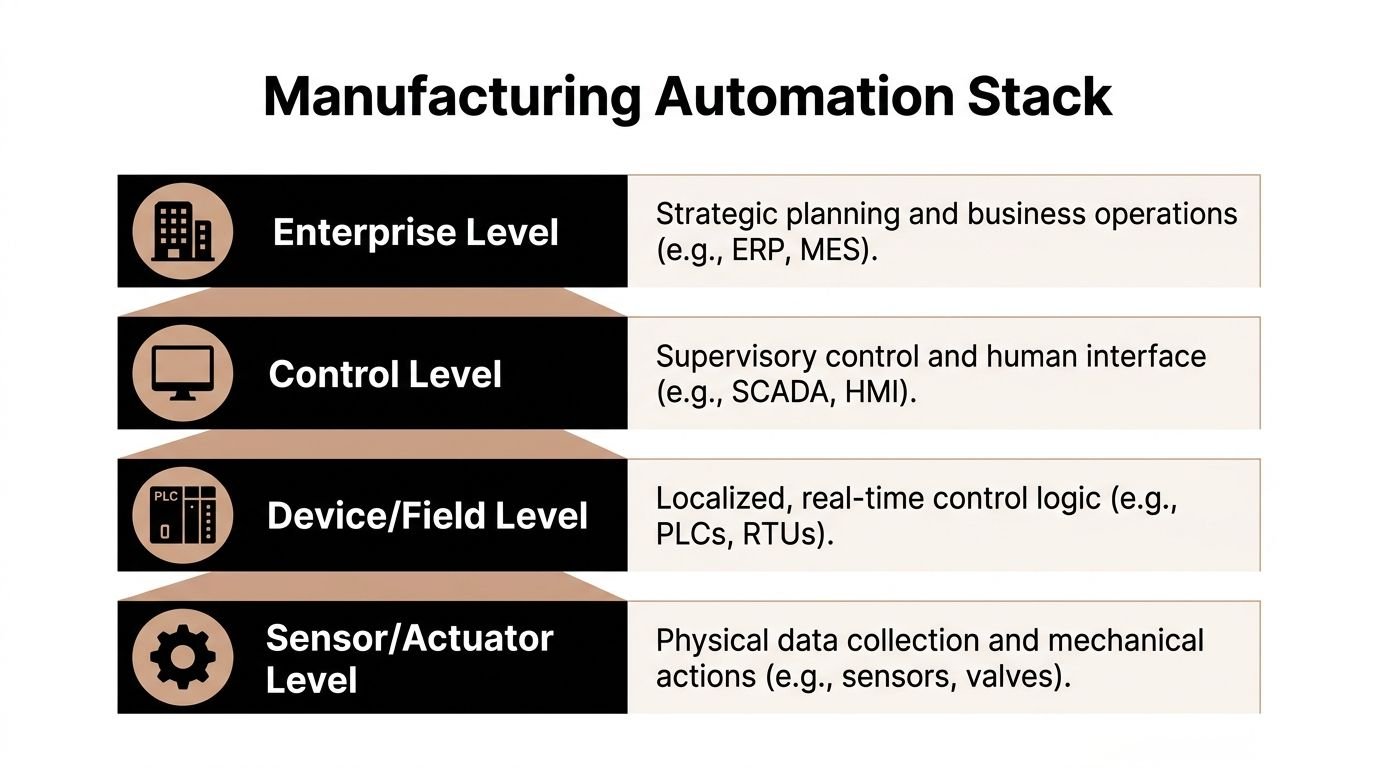
That's why the automation stack matters. In modern industrial automation, the integration of Telemetry, Programmable Logic Controllers (PLCs), and Supervisory Control and Data Acquisition (SCADA) systems forms the definitive backbone of the industry, creating a unified ecosystem that transforms fragmented data into intelligent process management platforms, as described in this overview of PLC, telemetry, and SCADA integration.
How the layers work together
At the bottom are the sensors and actuators. Here, the physical world meets the control system. Proximity sensors, pressure transmitters, load cells, flowmeters, encoders, valves, drives, and cylinders all live here. If this layer is weak, everything above it becomes guesswork.
Next comes the PLC or RTU layer. This is the real-time decision engine on the floor. It reads inputs, runs logic, manages timing, checks permissives, and commands outputs. For many small and mid-sized lines, this is the most important place to invest because it determines whether the machine reacts correctly under changing conditions.
Above that is the SCADA and HMI layer. Operators use it to start, stop, acknowledge alarms, change recipes, and see process conditions without opening electrical panels or relying on tribal knowledge. A well-designed HMI reduces mistakes because it shows only the information needed to run the process safely and consistently.
At the top are systems such as MES, historians, and enterprise tools. These connect production events to work orders, batch records, traceability, downtime review, and long-term analysis. If you work in a regulated environment, this layer often becomes essential for record integrity and review.
A practical data flow
A useful way to think about the stack is as a chain of responsibility.
| Layer | Main job | What goes wrong when it's weak |
|---|---|---|
| Sensor and actuator | Detects real conditions and executes physical change | Bad readings, missed faults, unstable machine response |
| PLC and field control | Makes immediate control decisions | Nuisance faults, poor sequencing, variable output |
| HMI and SCADA | Gives operators visibility and command | Slow troubleshooting, operator inconsistency |
| Historian and MES | Preserves context and performance records | Limited traceability, weak improvement efforts |
A part enters a station. The sensor confirms presence. The PLC checks interlocks and starts a sequence. The HMI shows status and any alarms. A historian records the event. MES links it to the work order or batch. That's a complete chain from action to record.
Where smaller plants should invest first
Not every operation needs the full stack on day one. Many don't. The most cost-effective upgrades usually begin by tightening the field and control layers, then adding visualization and data retention where they support production or compliance. Integrated automation control systems for manufacturers are most effective when they're built around the line's actual bottlenecks, not around a software wishlist.
Build the stack in the order the process needs it. Reliable sensing first. Reliable control second. Wider visibility after that.
The Tangible ROI of Integrated Control Systems
Most managers don't need a lecture on automation theory. They need to know what improves when they spend money on it.
The answer is usually less about headline technology and more about tighter execution. When process control services integrate smoothly with sensors, PLCs, SCADA, HMIs, historians, and MES platforms, they automate critical variables and reduce variation to deliver real-time visibility, which lifts throughput, quality, and safety while creating a scalable foundation for future upgrades, according to this discussion of process control system benefits in manufacturing.
Where the return usually appears
You'll see value first in the areas where variation or delay already costs you money.
- Quality control at the source: If the system checks process conditions while parts are being made, bad output gets contained earlier.
- Lower scrap and rework: Stable inputs and controlled sequences reduce drift.
- Reduced unplanned downtime: Telemetry around vibration, temperature, pressure, or cycle behavior helps teams spot deterioration sooner.
- Safer operation: Interlocks and automated responses reduce reliance on improvised operator intervention.
- Faster troubleshooting: Recorded machine states shorten the gap between “something went wrong” and “here's why.”
Telemetry in manufacturing and processing operations is commonly used to monitor parameters like temperature, pressure, vibration, and energy consumption, helping teams identify inefficiencies and maintenance needs, as outlined in this industrial telemetry overview.
KPIs that actually help
It's easy to drown in dashboards. A better approach is to track a short list of metrics your team can influence.
A useful starting set includes:
- OEE: Best when you want one operational view that combines availability, performance, and quality
- MTBF: Helpful for understanding how often a recurring equipment problem returns
- Cycle time: Essential for seeing whether a line is stable or just occasionally fast
- First-pass yield: Strong indicator of whether process variation is under control
- Alarm frequency by cause: Useful for separating nuisance alarms from real failure modes
If you're building the business case, an automation ROI calculator for manufacturing improvements can help frame the discussion around actual losses, labor burden, and line constraints instead of generic automation promises.
Here's a practical view from the floor.
A system doesn't have to be fully automatic to pay back. Semi-automated control with the right data often closes the biggest performance gaps.
This short video gives a useful visual sense of how industrial control and monitoring improvements affect operations over time.
What usually doesn't pay off
Three things tend to disappoint. First, collecting data nobody reviews. Second, overcomplicating the interface so operators work around it. Third, automating unstable mechanical processes before fixing the mechanical issue.
The best ROI comes from controlling a small number of high-impact variables well, then expanding once the team trusts the system.
Your Roadmap to a Smarter Production Line
The fastest way to waste automation money is to buy hardware before defining the problem. The smarter path starts with process discipline.
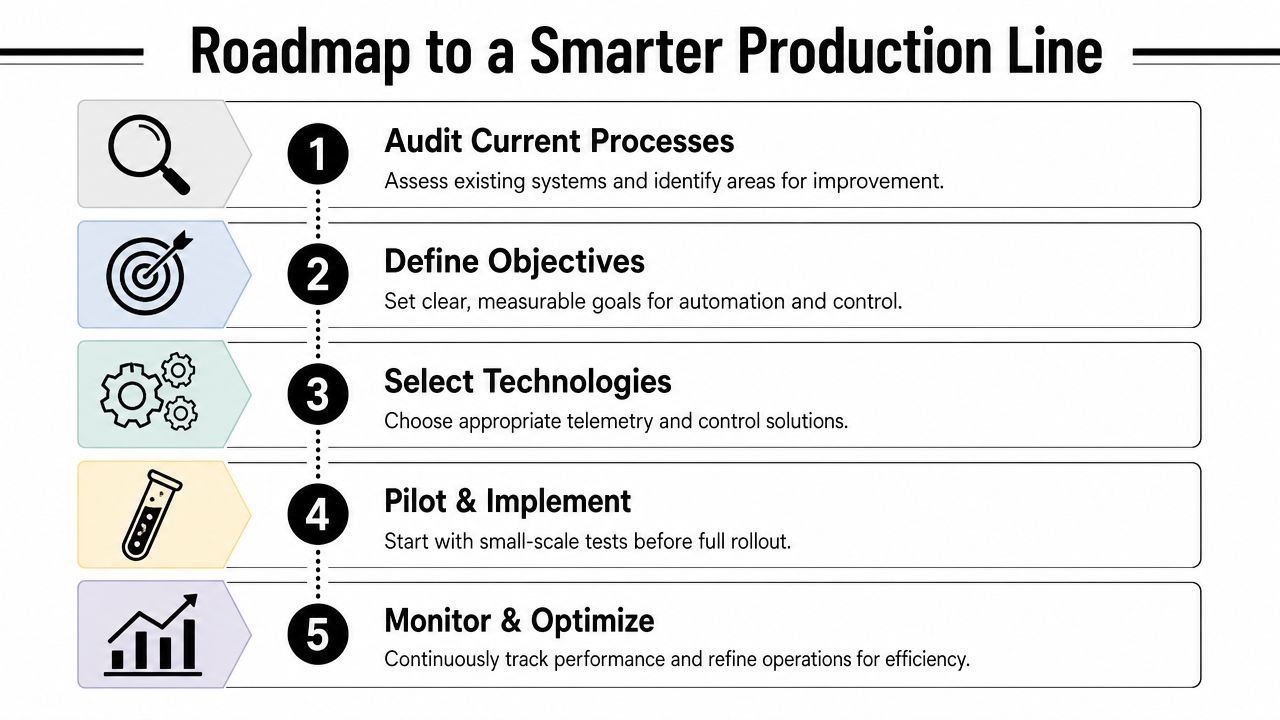
Industrial process control systems rely on real-time feedback loops to monitor and automatically adjust critical variables. Successful implementation requires a prior process audit to identify high-variability areas, establishment of clear success metrics such as improving First-Pass Yield to 97%, and robust documentation of setpoints and alarm thresholds, as explained in this guide to industrial process control systems.
Start with the process, not the hardware
Before adding sensors or revising PLC logic, walk the line with operations, maintenance, quality, and engineering. Look for the points where output varies, operators make repeated manual adjustments, or defects are only discovered after the fact.
A useful audit usually answers five questions:
- Which variable drives the problem
- How is it measured today
- Who reacts when it drifts
- How quickly can they react
- What happens if no one notices
That audit tells you whether you need better sensing, tighter control, clearer operator visibility, or a combination.
Build in manageable phases
A phased upgrade usually works better than a full shutdown-and-rebuild approach.
- Phase one: Add basic sensing and status visibility to expose machine behavior.
- Phase two: Tighten control logic around the most important variable or sequence.
- Phase three: Add data logging, alarm history, and reporting where they support decision-making or compliance.
- Phase four: Connect upstream and downstream systems once the station itself is stable.
That sequence protects budget and reduces disruption. It also gives the team time to learn from the process rather than committing to assumptions too early.
Field note: If the first phase doesn't improve operator understanding, the later phases will be harder to justify.
Account for GMP and regulated production
Medical device manufacturing raises the stakes. It's not enough to run the process well. You also need records that stand up to review.
That means thinking early about:
- Data logging: What needs to be recorded at the station level
- Validation readiness: Whether software changes, HMI functions, and control logic need formal verification
- Electronic records: How the system will support environments influenced by 21 CFR Part 11 expectations
- Change control: How setpoint changes, recipe revisions, and alarm edits are documented
In regulated work, a simple semi-automated cell with validated data capture is often more valuable than a flashier system that's harder to document and maintain.
Don't bolt on connectivity without security discipline
New visibility also creates new exposure. In older plants, the practical answer is restraint. Connect only what has a defined operational purpose. Limit who can change parameters. Segment machine access from broad business traffic where possible. Keep software and controller change procedures disciplined.
Security in these environments is a trade-off. Stability, safety, and maintainability matter just as much as remote access convenience.
Putting Theory into Practice
The strongest automation projects don't begin with replacing everything. They begin with one stubborn production problem and a realistic fix.
A fabrication shop upgrades a manual fixture
A small metal fabrication shop had a manual welding fixture that was mechanically solid but process-dependent. Throughput varied by operator. Rework increased when setup drifted. Supervisors knew the cell was inconsistent, but they didn't have enough hard information to pinpoint when and why.
The right move wasn't a robotic welding cell. It was a retrofit.
The shop added part-presence sensing, simple status indication, timing capture, and a basic HMI that guided the operator through the sequence. The fixture still depended on people for loading and unloading, but the station now enforced sequence order, recorded cycle events, and flagged repeat delays. Once the data was visible, the team found that setup variation and incomplete clamp confirmation were driving a large share of inconsistency.
The result wasn't a lights-out system. It was a controlled workstation that produced more repeatable output and gave the supervisor a factual view of parts per hour and stoppage causes.
A medical device assembly station adds validated controls
A medical device manufacturer had a semi-automated assembly process where fasteners had to be tightened correctly and production records had to support GMP expectations. The line already had custom tooling and operator involvement that made full replacement difficult to justify.
Many projects encounter failure due to challenges in this area. A 2024 McKinsey report notes that 68% of industrial automation failures stem from poor legacy-modern integration, a point highlighted in this discussion of telemetry monitoring and SCADA integration challenges. That's especially relevant when telemetry has to work with custom fixtures, older PLCs, or non-standard logic.
So the project focused on bridging, not replacing.
A torque-capable assembly station was built around controlled fastening, operator prompts, and event logging tied to each assembly step. The controls verified that the process occurred in the right order. The HMI reduced ambiguity. The data layer preserved the information quality and production teams needed for review. Existing fixtures and semi-manual handling stayed in place where they still made sense.
Poor integration usually doesn't show up in the demo. It shows up in the handoff between old equipment, custom logic, and the way operators actually work.
What both examples have in common
These two situations look different, but the pattern is the same:
- They preserved useful mechanical assets instead of forcing unnecessary replacement.
- They focused on one critical source of variation before expanding.
- They used telemetry to expose truth and controls to enforce consistency.
- They matched the design to the production environment, including regulated requirements where needed.
That's the practical side of telemetry and process controls. They don't have to start big. They have to start where the process is losing control.
Starting Your Automation Journey
Most manufacturers don't need more technology for its own sake. They need production systems that are easier to run, easier to troubleshoot, and easier to improve. That's what makes telemetry and process controls valuable. They turn hidden process behavior into visible operating conditions, then use that information to hold the line where it belongs.
For small and mid-sized manufacturers, the best path is usually incremental. Add sensing where the process is blind. Add control where variation hurts quality or throughput. Add data retention where traceability, maintenance, or compliance requires it. Keep the mechanics that still serve you well. Upgrade the layer that makes the equipment smarter.
That approach works especially well in semi-automated environments. It protects capital, limits disruption, and gives your team time to adopt better operating habits around better information. In medical device manufacturing and other regulated work, it also creates a more realistic path to compliant, documented improvement than an oversized automation project that's difficult to validate and sustain.
Good automation isn't defined by how much equipment you buy. It's defined by how well the process performs once the controls, data, and operator interaction are aligned.
If you're assessing where smarter controls, better telemetry, or a phased semi-automated upgrade could improve your line, System Engineering & Automation is a practical engineering partner to talk to. SEA builds cost-effective manufacturing solutions that optimize production and services, from custom tooling and fixtures to integrated control systems and scalable semi-automated equipment. With GMP-aware experience and a focus on matching automation to real production goals and budgets, the team can help you evaluate what to retrofit, what to automate, and what will deliver the strongest return without overbuilding the solution.