A production system is the structured combination of people, equipment, materials, processes, and controls that turns raw inputs into finished goods. Historically, lean production was described as using about half the human effort, half the manufacturing space, and half the capital investment of mass production for the same output, which shows why the system design matters to cost, quality, and ROI. Lean Enterprise Institute
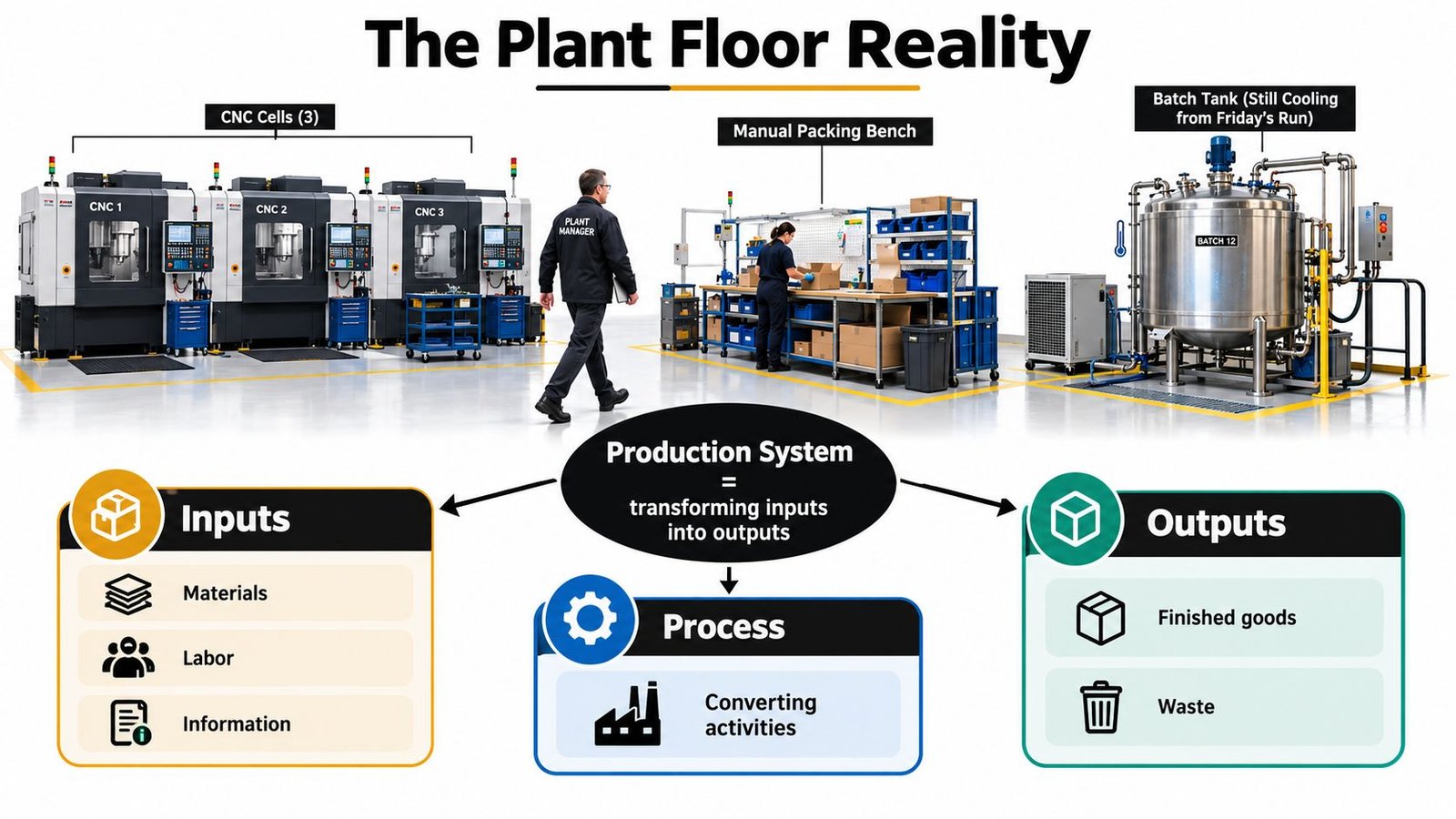
You inherit the line on a Monday morning. Three CNC cells are running, a manual packing bench is waiting for components, and a batch tank is still cooling from Friday's run. The equipment appears to be the problem because it's visible. In practice, the actual constraint may be unclear ownership, poor material flow, weak controls, or a process that nobody has defined as a complete system.
Table of Contents
- The Plant Floor Reality and a Working Definition
- The Five Core Types of Production Systems
- Core Components That Make Every System Function
- Matching the Right Automation Level to Your Reality
- Design Considerations That Shape Real Systems
- KPIs That Tell You Whether the System Is Working
- An Implementation Checklist for Smarter Upgrades
- Tying It All Together for Better Manufacturing Decisions
The Plant Floor Reality and a Working Definition
A production system isn't a machine list. It's the coordinated operating structure that determines how work moves, how people make decisions, how materials are transformed, and how deviations are detected and corrected.
Start with the inputs:
- Materials: Raw parts, ingredients, packaging, consumables, and work in process.
- Energy: Electricity, compressed air, water, heat, cooling, and other utilities.
- Labor: Operators, technicians, supervisors, quality personnel, and engineering support.
- Information: Orders, specifications, recipes, work instructions, production status, and quality records.
The outputs include finished products, by-products, waste, rework, and performance data. That last category matters. A completed unit without reliable information about its process history may be difficult to release, investigate, or improve, particularly in regulated manufacturing.
Set the boundary before calculating ROI
Most definitions stop at transforming inputs into outputs. That's too narrow for a real plant. A useful production-system boundary includes the work, equipment, people, controls, quality checks, material movements, and feedback loops required to produce and release the item.
Support functions such as HR, sales, procurement, and logistics may sit outside the operating boundary, but their interfaces must be explicit. If logistics owns replenishment yet production owns shortages, the system has a gap. If quality approves records but operators can't see the current specification, the control loop is broken.
Practical rule: If nobody can name the owner of a step, that step isn't controlled.
This boundary affects accountability, ROI calculations, and audit readiness. In a GMP or ISO environment, you need to know which records prove that the process ran correctly, who responded to an exception, and whether a change affected validated conditions. Define the boundary on a value-stream sketch, assign ownership at each handoff, and only then decide whether a machine upgrade addresses the actual problem.
The Five Core Types of Production Systems
The right production structure follows the relationship between volume, mix, customization, and process continuity. Don't force a high-mix job shop into an assembly-line model, and don't run a stable, high-volume product through a layout designed for one-off work.
| Type | Volume | Mix / Customization | Best Fit |
|---|---|---|---|
| Job shop | Low | High customization and high mix | Custom machining, repair work, engineered products |
| Batch | Low to medium or variable | Groups of similar products | Formulation, food, packaging, and small-batch manufacturing |
| Mass | High | Limited variety and repeatable products | Assembly lines with stable demand |
| Continuous | Very high or uninterrupted | Low variety, process-driven output | Liquids, gases, chemicals, and bulk materials |
| Cellular | Medium and family-based | Moderate variety within product families | Flexible production with grouped machines and operators |
Job shop and batch
A job shop wins when every order needs different routing, tooling, or technical judgment. CNC work, custom fixtures, and repair operations often benefit from skilled operators and flexible equipment. It breaks when management expects predictable line balance without first reducing variation.
A batch system groups similar products and processes them together. It suits a plant that changes recipes, sizes, colors, or packaging formats but can't justify a dedicated line for every product. Its weak point is waiting. Cooling, cleaning, inspection, and changeover can create long gaps between process steps.
For manufacturers weighing flexible layouts, the distinction between product families, routing, and equipment coordination is central to flexible manufacturing system design.
Mass, continuous, and cellular
Mass production wins when demand, product design, and cycle requirements are stable enough to justify dedicated flow. It offers repeatability and throughput, but it becomes expensive when variants multiply or changeovers are frequent.
Continuous production is built around uninterrupted processing. Stopping a batch tank, chemical process, or bulk-material operation can create quality, safety, or recovery problems. The plant needs solid process control, maintenance planning, and clear abnormal-condition procedures.
Cellular production groups machines and operators around a product family. It often gives a mixed-age plant a practical middle path, preserving flexibility while reducing travel and handoffs. Choose it when products share enough routing and tooling to create a meaningful family, but not enough stability to justify a dedicated mass line.
Core Components That Make Every System Function
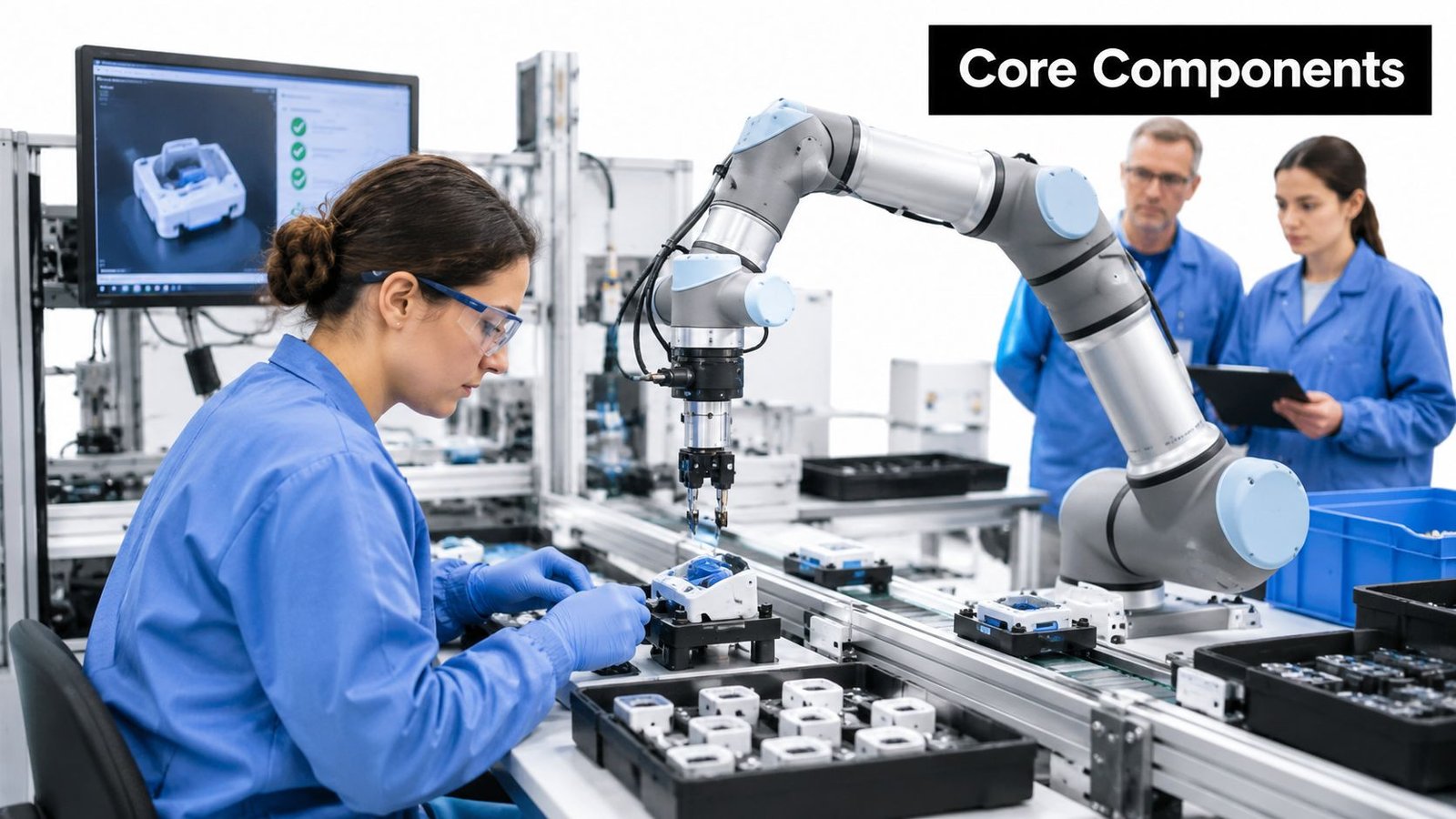
Consider a semi-automated medical-device workstation. An operator loads a component, a fixture holds it in position, a sensor confirms orientation, a controlled tool performs the joining operation, and the system records the result. That small station contains the same four components found in a full factory.
People
People include operators, technicians, supervisors, engineers, and quality staff. Their roles aren't interchangeable. An operator may authorize a restart after a minor stoppage, while a technician handles a fault and quality approves a disposition. If decision rights aren't written down, the line either stops unnecessarily or continues with uncontrolled risk.
Equipment
Equipment covers machines, tooling, fixtures, sensors, robots, conveyors, utilities, and safety devices. Condition data matters as much as the hardware itself. A fixture that gradually loses repeatability can create defects long before the machine shows an alarm.
Materials
Materials include incoming parts, work in process, packaging, lubricants, cleaning supplies, and rejected units. Trace where each item enters, waits, transforms, and exits. Excess movement often signals a layout problem, while missing components may indicate a replenishment or ownership problem rather than a labor shortage.
Controls
Controls are the rules and feedback that keep the process stable. They include SOPs, recipes, work instructions, PLC sequences, SCADA signals, MES records, alarms, interlocks, inspection criteria, and escalation paths. A control only works when the person receiving the signal knows what action to take.
Explore how automation control systems connect sequence control, safety functions, recovery logic, and production equipment. The engineering principle is simple: every critical process condition needs a defined response, not just a data point.
The weakest component usually exposes itself first. Missing training appears as inconsistent setup. Weak equipment control appears as drift and repeated stoppages. Poor material control appears as searching and shortages. Weak process control appears as workarounds that operators believe are necessary to keep production moving.
Audit one workstation from input to release. Ask who acts, what the equipment confirms, which material is allowed, and what record proves the step was completed correctly. That audit will reveal more than a generic equipment inventory.
Matching the Right Automation Level to Your Reality
Choose automation based on process stability, ownership, and return on investment. Manual, semi-automated, and fully automated systems each fit a different combination of volume, variation, workforce capability, safety risk, and GMP control.
| Dimension | Manual | Semi-Automated | Fully Automated |
|---|---|---|---|
| Flexibility | Highest for changing work | High with suitable tooling and recipes | Lower with frequent product variation |
| Throughput | Limited by operator pace and ergonomics | Higher at defined constraints | Highest with stable flow and demand |
| Investment | Lower equipment cost | Targeted tools, controls, and stations | Highest capital and integration commitment |
| Workforce need | More direct labor | Operators supervise and interact with equipment | Fewer direct interventions, greater technical skill |
| Best fit | High mix, low volume, frequent changes | Repetitive work with meaningful constraints | Stable products, high volume, predictable routing |
Where manual still wins
Manual production works when product mix changes often, quantities remain limited, or the task depends on judgment that would cost too much to encode. A skilled operator can adjust faster than a rigid cell. Assign clear ownership for each step, then control variation with fixtures, poka-yoke features, visual instructions, torque tools, and simple data capture. Manual does not mean unmanaged.
Where semi-automation earns its place
Semi-automation is often the right answer for a mixed-age line. Add sensors, pneumatics, controlled tooling, PLC logic, or a guided fixture to the operation causing defects, ergonomic strain, or delay. The operator owns judgment, loading, or exception handling. The machine owns repeatable motion, force, timing, or verification.
Choosing between these rungs is easier when you review the levels of automation and match each rung to process stability and volume. Start with the constraint, define who owns every action, and automate only the portion that produces a measurable improvement.
Use the PDCA cycle, Plan, Do, Check, Act, to test the change before expanding it across the line. Focused improvements can reduce inventory, downtime, space, errors, overproduction, and unnecessary transport routes. SME lean automation guidance
When full automation makes sense
A fully automated cell can justify its capital burden when the product is stable, volume supports utilization, changeovers are controlled, and the plant can maintain the controls. Robotics and vision systems cannot correct unstable specifications, poor part presentation, or unreliable upstream supply.
Do not automate a process you cannot describe, measure, and recover.
Before selecting a robot, document changeover frequency, product variants, operator interventions, fault recovery, and maintenance capability. If those conditions vary too widely, automate the constraint first and prove the economics with a semi-automated station. That approach protects flexibility, limits risk, and gives the plant evidence for its next investment.
Design Considerations That Shape Real Systems
A production system has to satisfy several constraints at once. GMP compliance, safety, throughput, and flexibility aren't separate checkboxes. They shape layout, equipment selection, cleaning methods, validation, staffing, and release decisions.
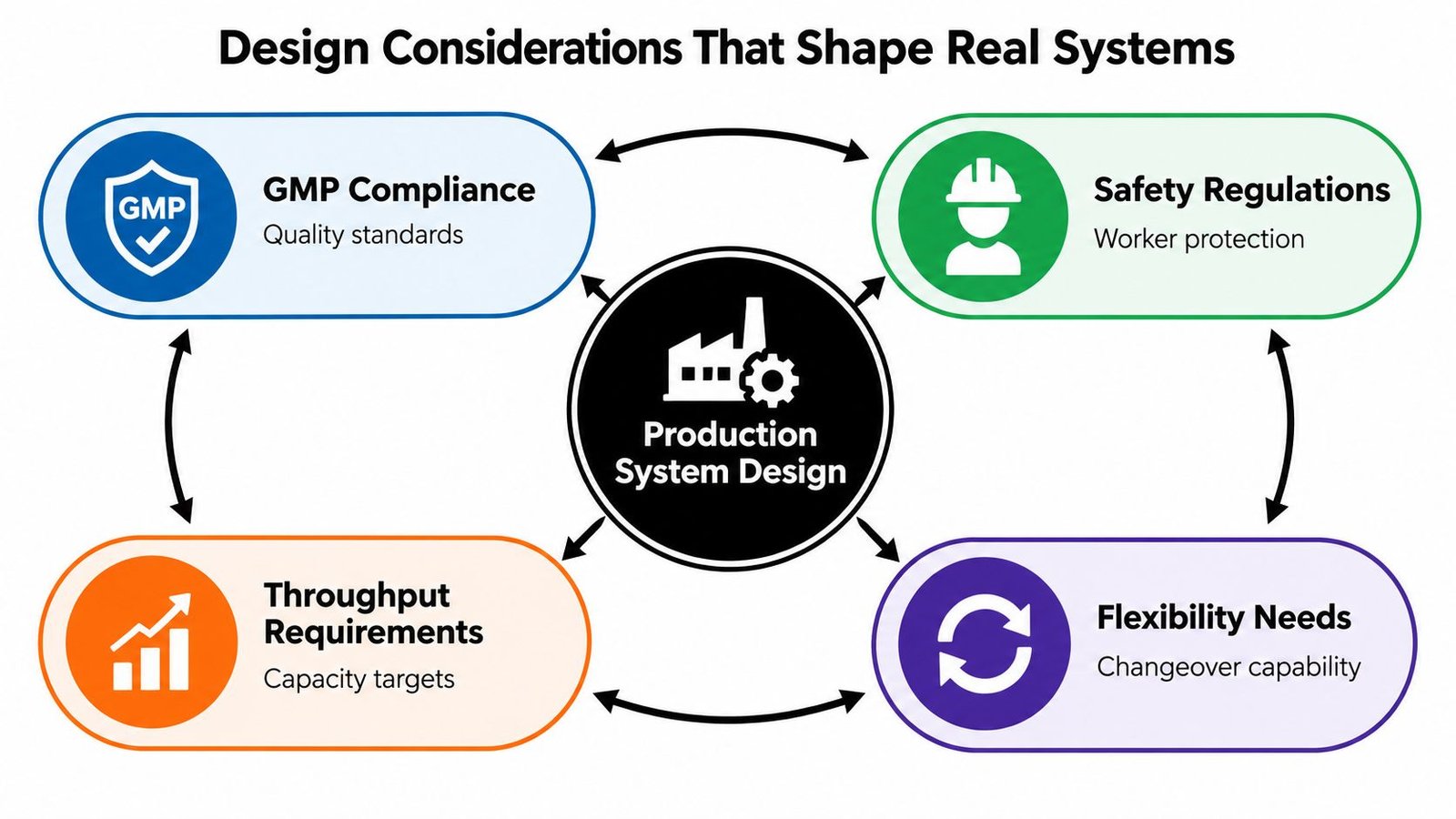
Start with GMP and safety
For medical-device assembly, segregate materials and processes according to contamination, traceability, and quality risks. Design fixtures and surfaces for inspection and cleaning. Make the approved method easy to follow, and make unsafe bypasses difficult.
Safety features should support production rather than become an obstacle operators defeat. Guarding, interlocks, emergency stops, ergonomic reach, access for maintenance, and controlled recovery all belong in the initial concept. Standardized cleaning can reinforce both GMP control and worker safety when the design reduces exposure, awkward access, and uncontrolled residue.
Resolve the throughput and flexibility conflict
Throughput improves when the system removes waiting, unnecessary movement, repeated handling, and unstable cycle conditions. Flexibility requires accessible tooling, recipe control, quick changeover, and enough space to manage variants without mixing materials.
Small-batch manufacturing makes the trade-off visible. A dedicated conveyor may increase speed for one product but consume space and slow the next changeover. A modular table-top station with interchangeable fixtures may produce less peak output, yet deliver better overall value when the line runs many variants.
Use these design questions:
- Layout: Does material move in a clear sequence, or do operators cross paths?
- Segregation: Can accepted, rejected, and waiting material be identified physically and electronically?
- Changeover: Which tooling, recipe, cleaning, and verification steps must be completed before release?
- Ergonomics: Can the operator load, inspect, and recover the station without excessive reach or force?
- Validation: Which software, parameters, fixtures, and records require documented approval?
A flexible system isn't one with unlimited options. It's one that changes in a controlled, repeatable way.
KPIs That Tell You Whether the System Is Working
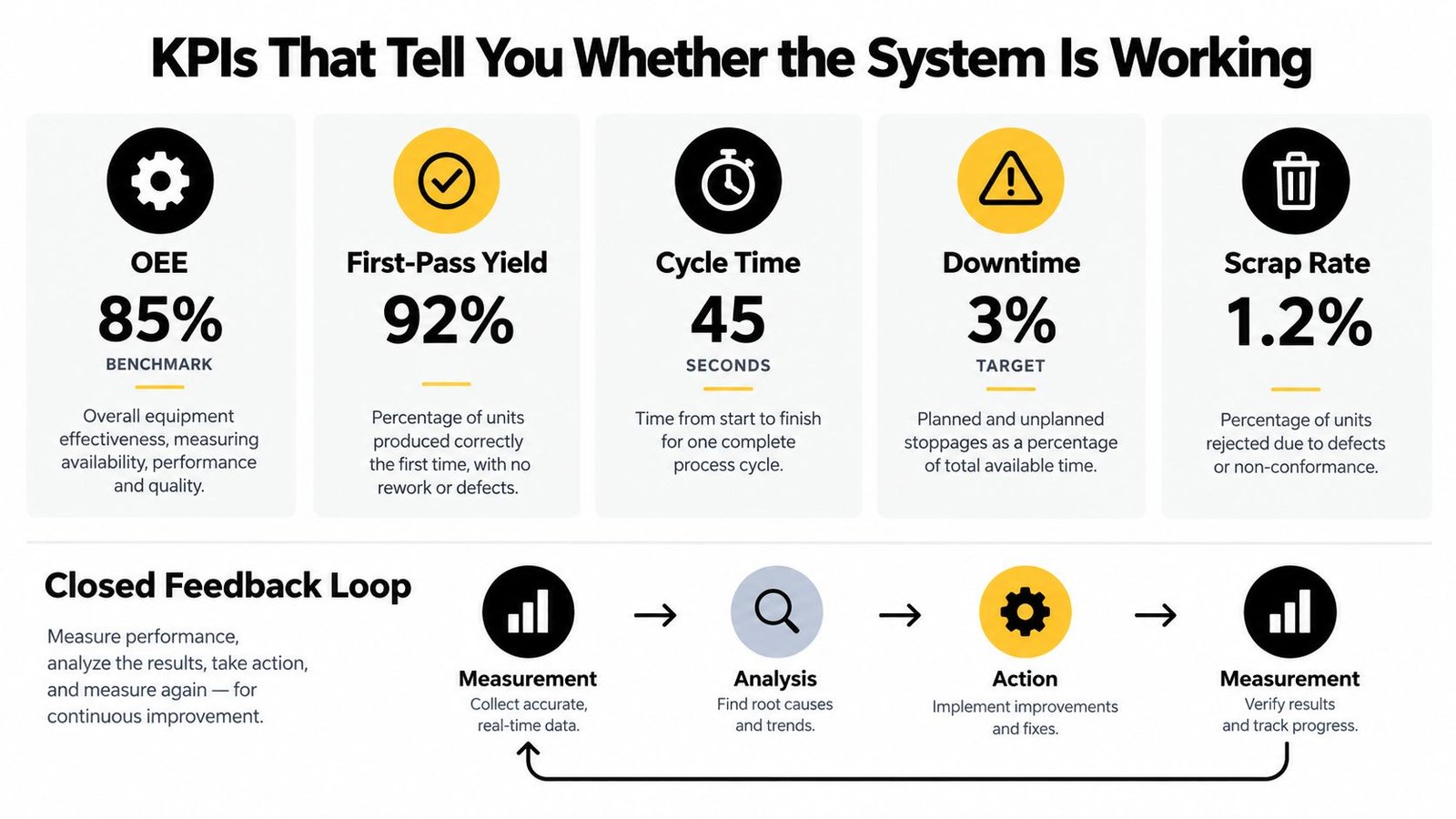
Plants rarely suffer from a total lack of data. They suffer from data that doesn't trigger a decision. OEE, first-pass yield, cycle time, downtime, and scrap become useful only when someone reviews them, identifies a cause, takes an action, and checks whether the result holds.
Define each metric in operating language
OEE combines availability, performance, and quality. It can expose a hidden constraint, but a single score can also hide the reason the line is underperforming. Always break it into its components.
First-pass yield asks how many units pass the process correctly without rework. It tells you whether the process is producing good output the first time, not merely whether the final shipment looks acceptable.
Cycle time is the time required to complete a defined operation. Define the start and stop points precisely, or different teams will report different answers.
Downtime includes planned and unplanned periods when the equipment can't produce the required output. Separate causes such as breakdowns, changeovers, waiting for material, and quality holds.
Scrap is material or product that can't be recovered for its intended use. Track the process step and reason, not just the total quantity.
Close the loop with ownership
A daily review should connect the metric to a named owner and a next action. If downtime rises because a fixture slips, the maintenance or engineering owner needs a documented countermeasure. If first-pass yield falls after a changeover, the process owner should verify setup conditions and training.
NIST identifies value stream mapping as a frequent first step in lean process improvement, because it helps teams see delays, waste, and process connections across manufacturing and office work. Use that map to choose the KPI that exposes the current constraint rather than collecting every available signal.
A KPI without an owner is a report. A KPI with an owner, action, and review date is a control system.
Use PDCA for improvement work. Plan the change, test it in a controlled area, check the result against the baseline, and act by standardizing or rejecting the change. The cycle should return to measurement, not end at the meeting.
An Implementation Checklist for Smarter Upgrades
A good upgrade sequence protects the plant from buying automation before fixing the process. Apply each step as a decision filter. If the change can't be tied to a visible KPI gap or compliance requirement, defer it.
1. Map the current state
Sketch the value stream from incoming material through release. Mark queues, handoffs, rework loops, inspection holds, transport, and information delays.
Checkpoint: Can the team identify the longest wait and the most expensive rework loop?
2. Choose the production structure
Classify the work by volume, mix, customization, and process continuity. Decide whether the line needs job-shop flexibility, batch control, mass flow, continuous operation, or cellular grouping.
Checkpoint: Does the proposed structure match actual order patterns, or does it reflect a preferred technology?
3. Select the automation rung
Choose manual, semi-automated, or fully automated operation for the specific constraint. Don't make the entire line follow the same automation philosophy if different operations have different economics.
Checkpoint: Is the process stable enough to justify automation, and can the team recover it when something fails?
4. Align the design constraints
Review GMP, safety, throughput, flexibility, layout, segregation, changeover, ergonomics, and validation before finalizing equipment.
Checkpoint: Can quality, production, maintenance, and safety each approve the concept for a clear reason?
5. Baseline the KPIs
Define OEE, first-pass yield, cycle time, downtime, and scrap at the process level. Assign an owner and specify how often the result will be reviewed.
Checkpoint: Will the measurement lead to a decision, or will it only populate a dashboard?
6. Run a focused PDCA pilot
Start with the bottleneck cell. Test one defined change, collect comparable data, and document abnormal conditions. A controlled pilot exposes integration and recovery problems before they spread across the plant.
Checkpoint: Did the pilot improve the target condition without creating a new quality, safety, or maintenance problem?
7. Standardize and scale
Update work instructions, training, maintenance requirements, spare-parts planning, and quality records. Roll out in waves tied to clear ROI or compliance milestones.
Checkpoint: Can another shift operate and maintain the improvement without relying on the person who designed it?
Tying It All Together for Better Manufacturing Decisions
The decision rule is straightforward: classify the product by volume, mix, and regulatory regime first. Then choose the production type and automation level that match. Instrument the system with KPIs, close the feedback loop, and upgrade only after the value stream is stable.
Production systems evolved from isolated tasks into integrated operating models. Ford's 1913 flow-production work at Highland Park combined standardized work with moving conveyance, and Toyota later developed the Toyota Production System from related ideas. The term lean production appeared in MIT Sloan Management Review in 1988 and gained wider recognition through the 1990 book The Machine That Changed the World. Historical overview of lean production
That history supports a practical conclusion. The system matters more than any individual machine. A robot won't solve poor part presentation. A dashboard won't solve unclear ownership. Lean tools won't fix a continuous-flow process that needs different controls. Automation won't create flexibility if the product family, tooling, and changeover method remain undefined.
Whether you run a job shop in Bangkok, a batch packaging line in Manila, or a GMP medical-device cell in Singapore, use the same sequence: define the boundary, assign ownership, select the structure, right-size automation, govern with measurable feedback, and iterate. A production-system excellence framework similarly emphasizes customer value, pulled flow, waste removal, direct observation at the gemba, and scientific improvement.
Apply this rule before the next capital request. If the proposal doesn't identify the constraint, the owner, the required control, and the KPI that will verify the result, it isn't ready.
System Engineering & Automation provides custom manual, semi-automated, and fully automated equipment, including tooling, fixtures, integrated controls, installation, commissioning, maintenance, and ongoing support. Visit System Engineering & Automation to discuss a production-system upgrade that fits your product mix, GMP needs, safety requirements, and budget.