You're likely dealing with a line that looks stable on paper and messy in practice. A tooling change lands on a semi-automatic station, quality is waiting on a corrected drawing, maintenance wants a clearer test sequence, and the customer still expects a shorter lead time. Traditional document-heavy systems engineering slows that work down because it pushes architecture, verification, and decision-making through serial handoffs instead of keeping them together.
That's where agile systems engineering earns its place on the shop floor and in regulated manufacturing. It's not software theater transplanted into hardware. It's a way to keep the team moving while preserving the evidence, traceability, and control that manufacturers and medical device programs can't afford to lose.
Table of Contents
- The Production Reality That Calls for Agile Systems Engineering
- What Agile Systems Engineering Actually Means
- Why Waterfall Systems Engineering Struggles on Modern Lines
- How Design Loops Replace Monolithic Design Cycles
- Staying Audit-Ready While Releasing in Small Increments
- Two Short Cases From the Shop Floor and the Device Line
- A Practical Adoption Roadmap With Roles, Tools, and Metrics
The Production Reality That Calls for Agile Systems Engineering
A production engineer on a semi-automatic line doesn't get the luxury of waiting for a perfect specification package. The fixture is late, the updated drawing is still under review, and quality wants proof that the revised station won't create a new defect mode. That's the environment where agile systems engineering matters.
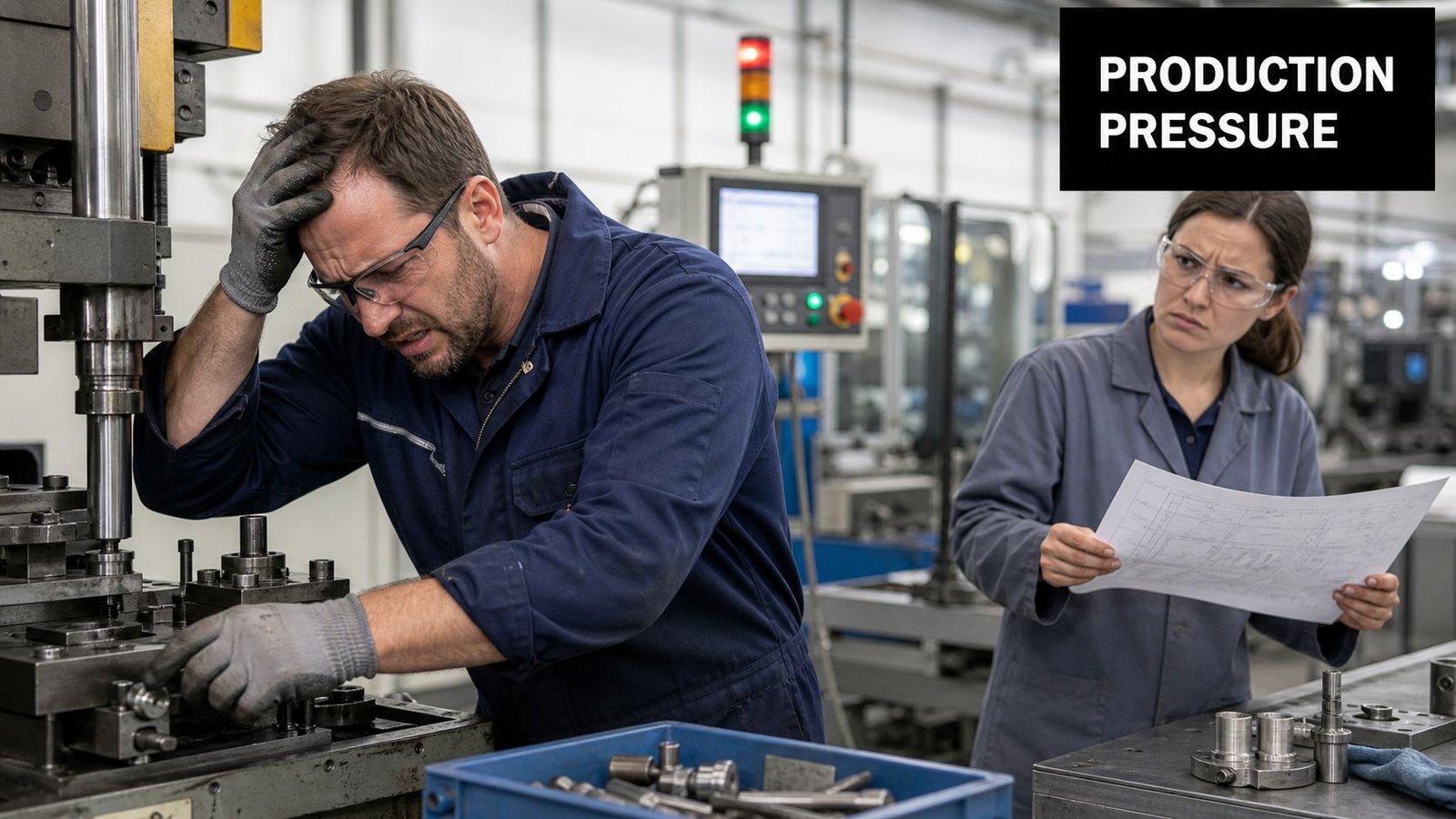
The old approach assumes requirements can be frozen long enough for everyone to finish their part in sequence. On a modern line, that assumption breaks the moment a supplier revises a component, a customer changes throughput needs, or validation exposes a gap in the fixture concept. The problem isn't that people aren't competent. The problem is that document-heavy sequencing makes competent people wait on each other.
Practical rule: if the line can change faster than the paperwork can move, your process is already out of sync with production reality.
Agile moved from software into engineering-heavy work because the operating conditions changed. In the 17th State of Agile report, 48% of Agile practitioners were in product and R&D teams, up 16 percentage points since 2022, and 71% of organizations used Agile in software development, with 63% of team-level users running Scrum and only 13% saying Agile was embedded across the business, according to Breeze's summary of the State of Agile report. That matters to manufacturers because engineering and R&D are the closest analogs to systems work on a shop floor, and the data show adoption is broad while maturity is still uneven.
For plant managers, production engineers, and medical device teams, the point is simple. You need a method that keeps architecture, verification, and decisions moving together instead of waiting for the next gate. That's what makes agile systems engineering useful in a factory, not just in a software org.
What Agile Systems Engineering Actually Means
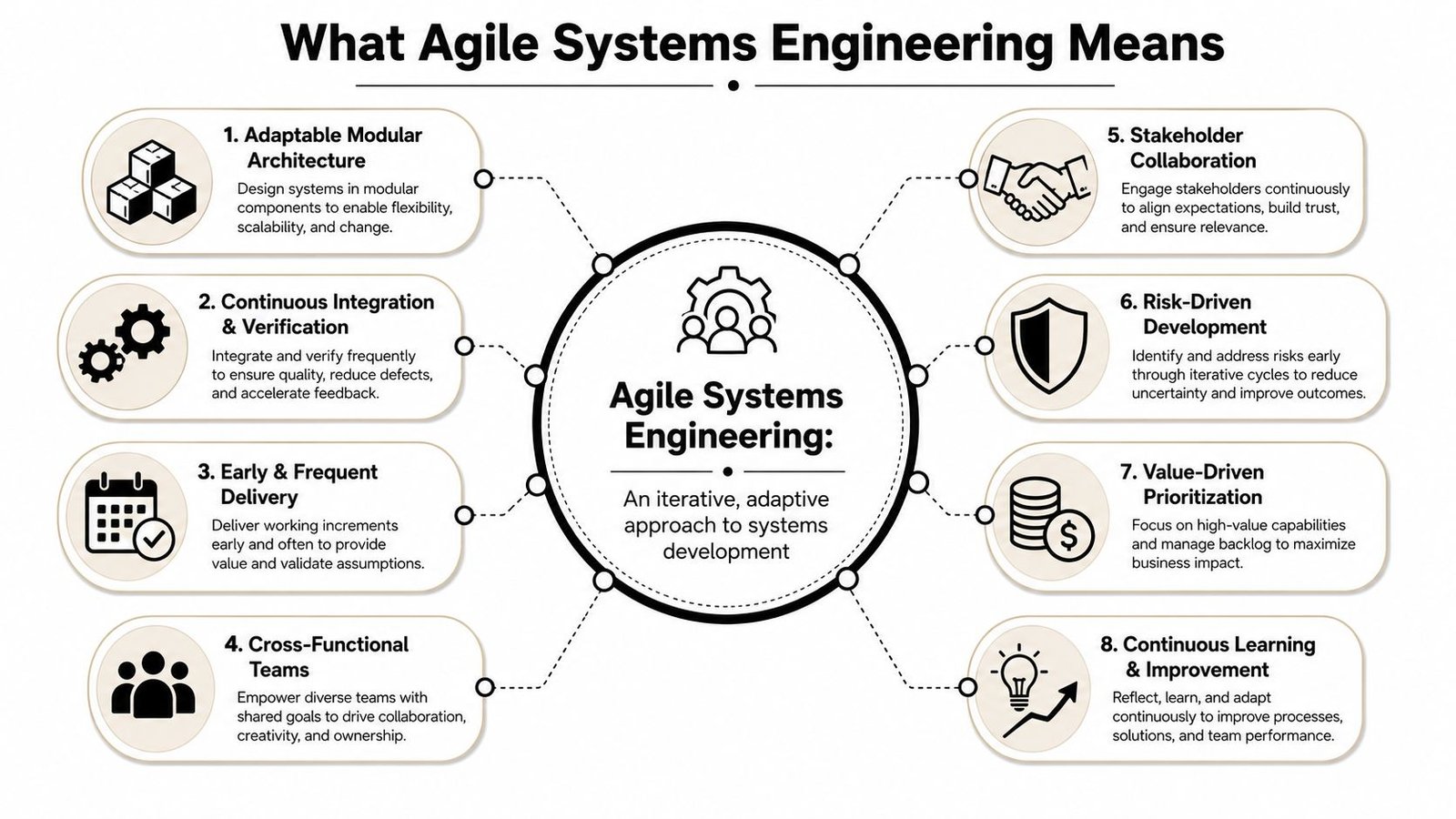
Agile systems engineering is a principle-based lifecycle method. It takes the discipline of systems engineering and runs it through iterative delivery, shared knowledge, and continuous verification. SEBoK frames it through eight strategic aspects, and that structure is useful because it stops people from confusing agility with speed alone.
Start with architecture that can absorb change
The first aspect is adaptable modular architecture. In plain manufacturing terms, that means breaking the system into modules with stable interfaces so one change doesn't force a redesign of everything else. On a machine retrofit, that could mean separating the tooling module, controls module, and inspection module so the team can revise one without reopening the whole line.
The second aspect is iterative incremental development. Instead of betting everything on a final release, you build in slices that can be reviewed, tested, and corrected. For a medical device line, that might mean validating the fixture concept before cutting production steel, then refining the control logic after the mechanical base proves itself.
Keep the work visible and synchronized
The third aspect is attentive situational awareness, which means the team keeps a live view of what changed, what's blocked, and what still needs proof. The fourth is attentive decision making, which means decisions are tied to current evidence, not stale assumptions. That's how a quality engineer and a controls engineer stop arguing over version drift and start aligning on the same baseline.
The fifth aspect is common-mission teaming. In a plant, that means production, quality, maintenance, and supplier contacts are all working toward one output, not optimizing their own silo. The sixth is shared-knowledge management, which is just a disciplined way of keeping drawings, models, test results, and notes available to the people who need them.
A good agile systems engineering team doesn't “share updates,” it shares the facts that the next decision depends on.
The last two aspects are continual integration and test and an agile operations concept. The first means verification isn't saved for the end, it runs continuously as the design evolves. The second means the operating model is built to keep adjusting without losing control of the system.
The mental model I'd give your team is this. Agile systems engineering is a lifecycle method that keeps architecture, verification, and decisions synchronized while requirements change. If that isn't happening, you're not doing agile SE, you're just moving meetings around.
Why Waterfall Systems Engineering Struggles on Modern Lines
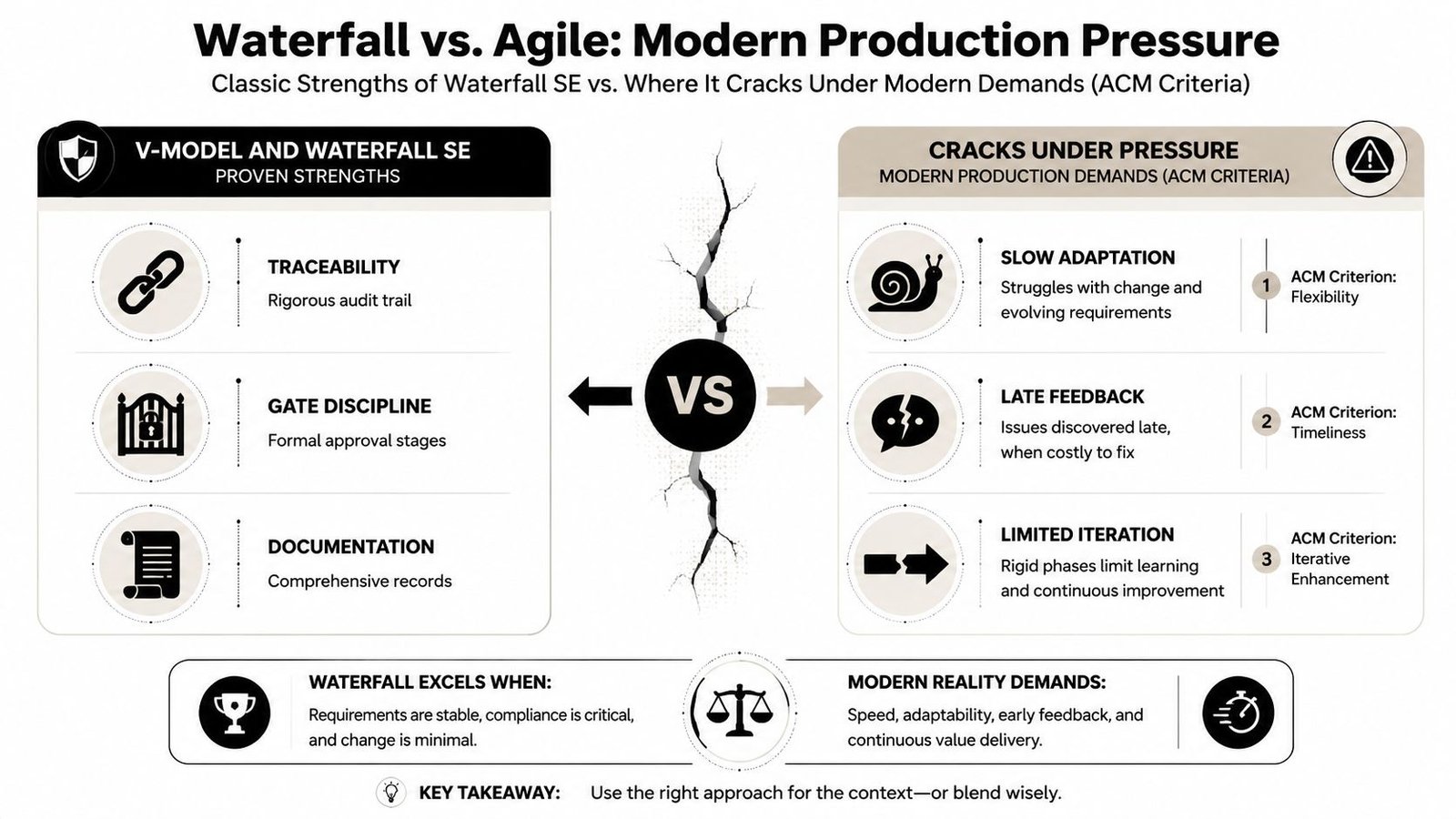
Waterfall and the V-model still have real strengths. They force traceability, they create gate discipline, and they produce documentation that auditors and safety teams can follow. I wouldn't throw that away in manufacturing or medical devices. I'd just stop pretending it works well when the line, the supplier base, and the customer demand are all moving at once.
A criteria-based comparison in ACM draws the distinction clearly: systems engineering is structured and top-down, while Agile is iterative, flexible, collaborative, and transparent. That difference shows up on the factory floor fast. Waterfall assumes enough stability to finish the design before integration questions arrive. Agile systems engineering assumes change is normal and plans for it.
Where the cracks appear
Late discovery is the biggest problem. If tooling and validation happen only after the design is “done,” then the first serious integration issue arrives after money and schedule have already been spent. That's exactly when production feels the pain, because the line can't absorb a surprise without touching operators, quality, and maintenance at the same time.
Frozen BOMs create another failure mode. They protect one kind of control, but they also block legitimate customer changes and process improvements. On a semi-automated retrofit, that means the engineering team can end up protecting paperwork instead of improving throughput.
The fix isn't less rigor. It's earlier rigor in smaller increments. NASA's 2022 case study on agile use in systems engineering describes continuous verification and validation, with emphasis on early risk mitigation and better feedback loops in project management and modeling, which is a much healthier pattern for modern production work than a single end-of-program validation push. If the build and the proof travel together, engineering and production stop fighting each other over timing.
The other mistake is treating documentation as the work instead of the evidence of the work. Waterfall can still be valuable for control, but on modern lines it needs help from iterative methods or it turns into delay with good intentions.
How Design Loops Replace Monolithic Design Cycles
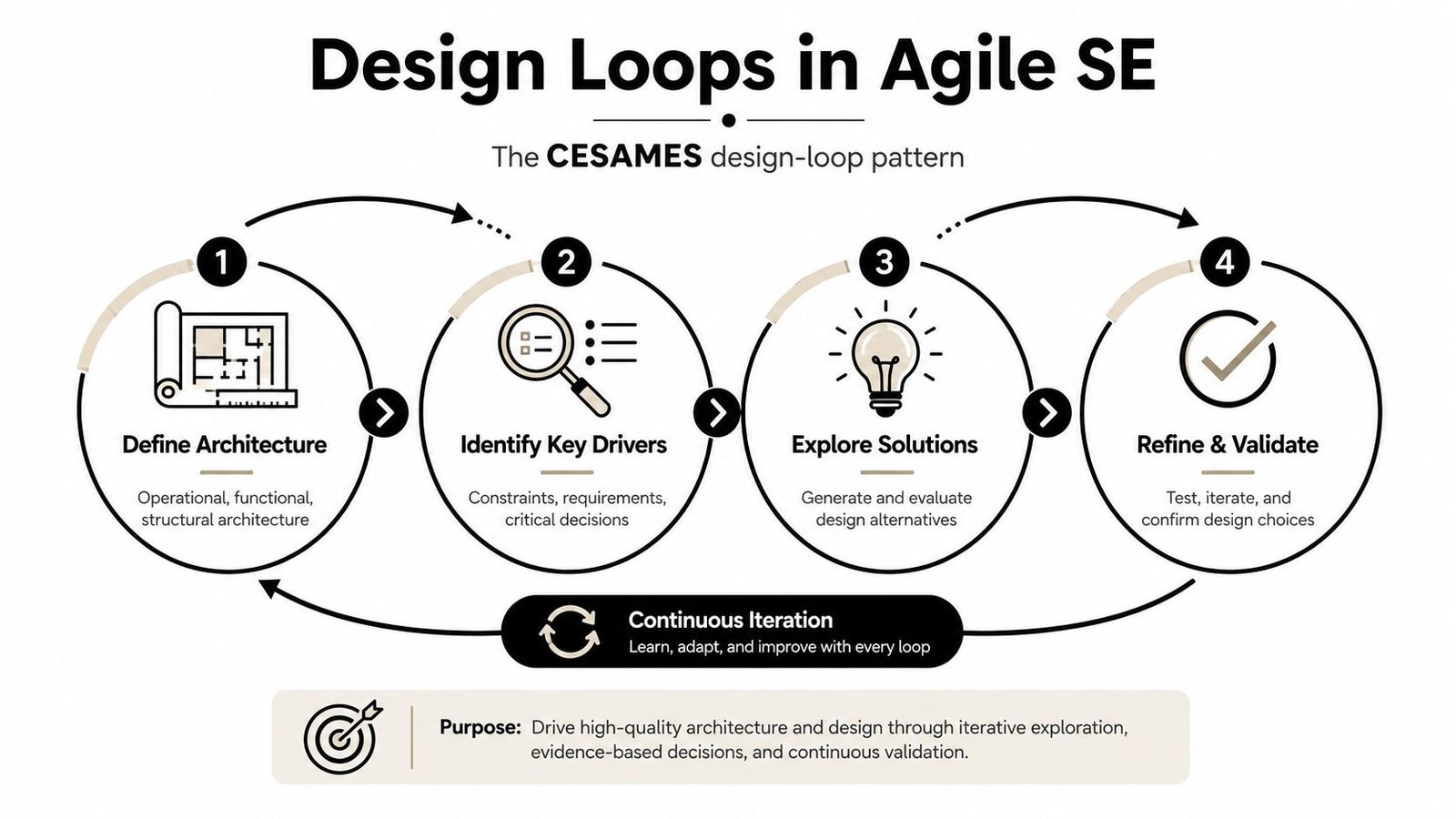
The cleanest way to run agile systems engineering in manufacturing is through explicit design loops. The CESAMES framework lays out the mechanics in a way that makes sense to plant teams, because it turns uncertainty into bounded work packages instead of one giant design commitment. The loop starts with architecture and ends with feedback, not the other way around.
Define the loop before you start cutting metal
First, define the operational, functional, and structural architecture. That sounds abstract until you put it on a line. Operational architecture says what the station must do in the plant. Functional architecture says how the functions interact. Structural architecture says what physical and logical pieces will carry the work.
Second, identify the key design drivers across disciplines. On a retrofit, those drivers might include cycle time, tooling access, control safety, maintainability, and inspection access. The point is not to collect every possible requirement. The point is to isolate the few that shape the design decisions everyone else will inherit.
Plan each loop with real outputs
Third, plan the loop with clear objectives, duration, drivers managed in that loop, modeling and simulation activities, and engineering data flows. That's where people usually get sloppy. If a loop doesn't say what evidence it will produce, it's just a meeting with a calendar invite.
Fourth, run the iterations while incorporating feedback at each loop. Digital and functional mockups act as synchronization pivots, which is why they're so useful on a shop floor. Mechanical design, controls, and quality can all react to the same working model instead of arguing over disconnected documents.
Good practice: use the mockup to settle interfaces early, then use the physical build to confirm what the mockup couldn't prove.
This is also where the idea of parallel work becomes real. When the loop is defined properly, requirements, design, and verification don't have to wait in line behind each other. They can mature together, as long as the interfaces are stable and the evidence is kept current.
A useful internal reference for teams building out model-based practices is SEA's model-based systems engineering resource, because MBSE is often the practical backbone that makes these design loops visible enough to manage. For a compact walkthrough of the loop logic, the CESAMES design-loop video shows the same four-step flow in a visual format. The payoff is simple. You get measurable inputs and outputs at each loop, which is how uncertainty turns into manageable engineering work instead of a schedule disaster.
Staying Audit-Ready While Releasing in Small Increments
Regulated manufacturers ask the right question first. How do you release a partially complete system without losing control of safety, compliance, or traceability? The answer is not to pretend the release is finished. The answer is to treat each increment as a controlled evidence package.
The MITRE AIDA guidance on agile systems engineering points to continuous verification and validation, careful transition into operations, and the need to avoid update fatigue during handoff. That's the right frame. If people are going to accept partial increments, they need proof that the system can be released at that stage, not just confidence that the team is moving quickly.
Evidence has to travel with the work
The Agile-V model responds to this by mapping sprints to systems-engineering lifecycle phases and embedding compliance and gate deliverables into the backlog. That matters because auditors care about traceability, while the team cares about iteration. Both can be satisfied if the evidence is built in from the start.
| Iteration Gate | Required Evidence | Owner |
|---|---|---|
| Backlog refinement | Acceptance criteria tied to requirement IDs | Systems architect |
| Design loop review | Updated model, interface notes, decision record | Integration lead |
| Verification checkpoint | Integration test results, test logs, configuration baseline | Test or verification lead |
| Release gate | Approval record, open-risk list, traceability package | Quality or safety officer |
The important detail is automation. SEI research on Agile software teams shows that stakeholders often struggle to use frequent progress signals, and that weak automation hurts testing and transparency. In manufacturing terms, that means your documentation, test capture, and baseline control need to be generated as part of the work, not reconstructed after the fact.
A practical reference on good automated manufacturing practices is useful here because the same logic applies. If the team has to manually assemble proof after every increment, the process will either slow down or get sloppy. Automated evidence generation is what turns iterative work into auditable proof.
The contrarian point is the one leaders need to hear. The barrier is usually not agility versus rigor. It's the absence of automated evidence and governance that can convert iteration into release-grade documentation.
Two Short Cases From the Shop Floor and the Device Line
A mid-sized manufacturer upgraded a manual workstation into a semi-automated cell with smart tooling, fixtures, and integrated controls. The team started with a digital mockup, then built a physical fixture trial before cutting production steel. That one choice saved them from locking in a bad fixturing concept and let quality review the interface before validation became expensive.
What changed on the line
The production engineer, controls engineer, and quality lead worked the design loop together instead of passing drawings around in sequence. The surprise was how quickly the first mockup exposed an operator access problem that no one had flagged in the original layout review. The schedule stayed intact because the team corrected the concept before the build hardened.
A medical device manufacturer had a different problem. Hardware, software, and supplier work were spread across sites, and each group kept arriving at reviews with slightly different assumptions about the current baseline. Modular architecture and shared-knowledge management kept that program from fragmenting, and synchronized design loops gave the supplier team the same decision points as the internal engineers.
The lesson from that program was sharper. The team didn't need more meetings. It needed one shared source of truth and stricter interface discipline. What saved the schedule was the fact that everyone was looking at the same mockups, the same requirements, and the same release evidence.
A retrofit on a single workstation can fail for the same reason a multi-supplier program fails, the work isn't synchronized early enough.
Both teams would do one thing differently next time. They'd lock the evidence structure earlier, before the first prototype build, so nobody has to guess later which test result belongs to which configuration. That's the difference between a controlled increment and a lucky one.
A Practical Adoption Roadmap With Roles, Tools, and Metrics
Start small and be deliberate. Pilot agile systems engineering on one program, scale it to one product line, then extend it across the engineering organization only after the team can produce clean evidence without drama. If you try to transform everything at once, you'll get neither agility nor control.
Put the right people in the loop
You need five roles, and they can't be symbolic. The systems architect owns the architecture roadmap and interface discipline. The scrum lead with SE fluency keeps the design loops moving without turning them into a ceremony trap. The integration lead owns cross-domain synchronization. The safety or quality officer protects release readiness. The supplier coordinator keeps outside partners aligned to the same baselines.
The artifacts are essential. Build an architecture roadmap, a design-loop plan, an integrated backlog with compliance items, and a configuration baseline. If those four things are missing, the program is improvising, even if the team is holding meetings every day.
Use tools that support proof, not just planning
The tooling stack should connect requirements, models, tests, and version control. That means requirements and modeling platforms, digital mockups, automated test harnesses, and a requirements-traceability tool that links cleanly to version control. The SEA process improvement and automation resource is relevant here because this kind of adoption only works when engineering and automation are treated as a connected system, not separate projects.
Track progress with a small set of metrics that tell you whether the method is working.
- Iteration lead time: how long it takes to move from a design decision to verified evidence.
- Percent of requirements verified continuously: how much proof is coming in during the work, not after it.
- Change impact cycle time: how fast the team can assess a change and decide what it touches.
- Audit-finding rate: how often the evidence package leaves gaps that reviewers catch.
If those metrics improve, the method is taking hold. If they don't, the team is probably using agile language while still running a serial process underneath it.
System Engineering & Automation helps manufacturers apply the same discipline you just read about, with semi-automatic systems, custom tooling, fixtures, and integrated controls built around real production constraints. If you're trying to improve throughput, reduce labor dependence, and keep GMP-aware evidence intact, visit System Engineering & Automation and see how a practical engineering partner approaches modern manufacturing without breaking traceability.