Every plant manager knows the feeling. A line is moving, an upstream process slips, alarms stack up, and the people closest to the work have to decide fast without losing sight of safety, quality, or the schedule. Air traffic controllers live inside that same pressure every day, except the margin for error is even smaller, and that is exactly why air traffic control automation offers such a useful model for manufacturers who need more throughput without turning operations into a black box.
The main lesson is not that aerospace is more advanced. It's that decades of human-in-the-loop automation have shown how to reduce routine load, preserve judgment for exceptions, and scale control without handing the whole system over to software. That's the same balance manufacturers need when they're modernizing a medical device cell, a packaging line, or a multi-station assembly operation with a practical ROI target.
Table of Contents
- From the Control Tower to the Factory Floor
- What Air Traffic Control Automation Really Is
- The Core Technologies and Their Industrial Parallels
- Balancing Efficiency Gains with Critical Safety Factors
- A Phased Roadmap for Practical Automation Integration
- Real-World ATC Systems and What They Teach Us
- Applying Aerospace Principles to Your Production Line
From the Control Tower to the Factory Floor
A controller watching an airport at peak movement isn't staring at planes, they're managing a living system of spacing, sequencing, weather, comms, and exception handling. That pressure looks a lot like a production manager balancing machine uptime, WIP, operator handoffs, and rush orders, except the airspace version has spent decades refining what can be automated safely and what still needs a human call.
That's why air traffic control automation is worth studying. A good control tower doesn't try to replace controllers with software, it gives them cleaner data, better sequencing, and earlier warnings so they can act with confidence. The same logic applies on the shop floor, where operators and supervisors don't need more screens that distract them, they need systems that reduce guesswork and surface the next best action.
Practical rule: automate the routine first, not the judgment. If a task is repetitive, data-heavy, and easy to verify, it belongs near the top of the automation list.
The historical arc matters too. SKYbrary notes that ATM automation started with data exchange functions like flight plans, NOTAMs, and estimates in the 1950s, then expanded in the 1970s as computers took on more work, and the FAA says ERAM became the largest single automation overhaul in FAA history when it reached full operational deployment in 2015 across all 20 Air Route Traffic Control Centers. That shift from clerical handling to operational infrastructure is the same pattern manufacturers follow when they move from isolated machine upgrades to plant-wide control and data integration. SEA's mindset around automation fits that pattern well, because the key win is not technology for its own sake, it's a better operating model.
What Air Traffic Control Automation Really Is
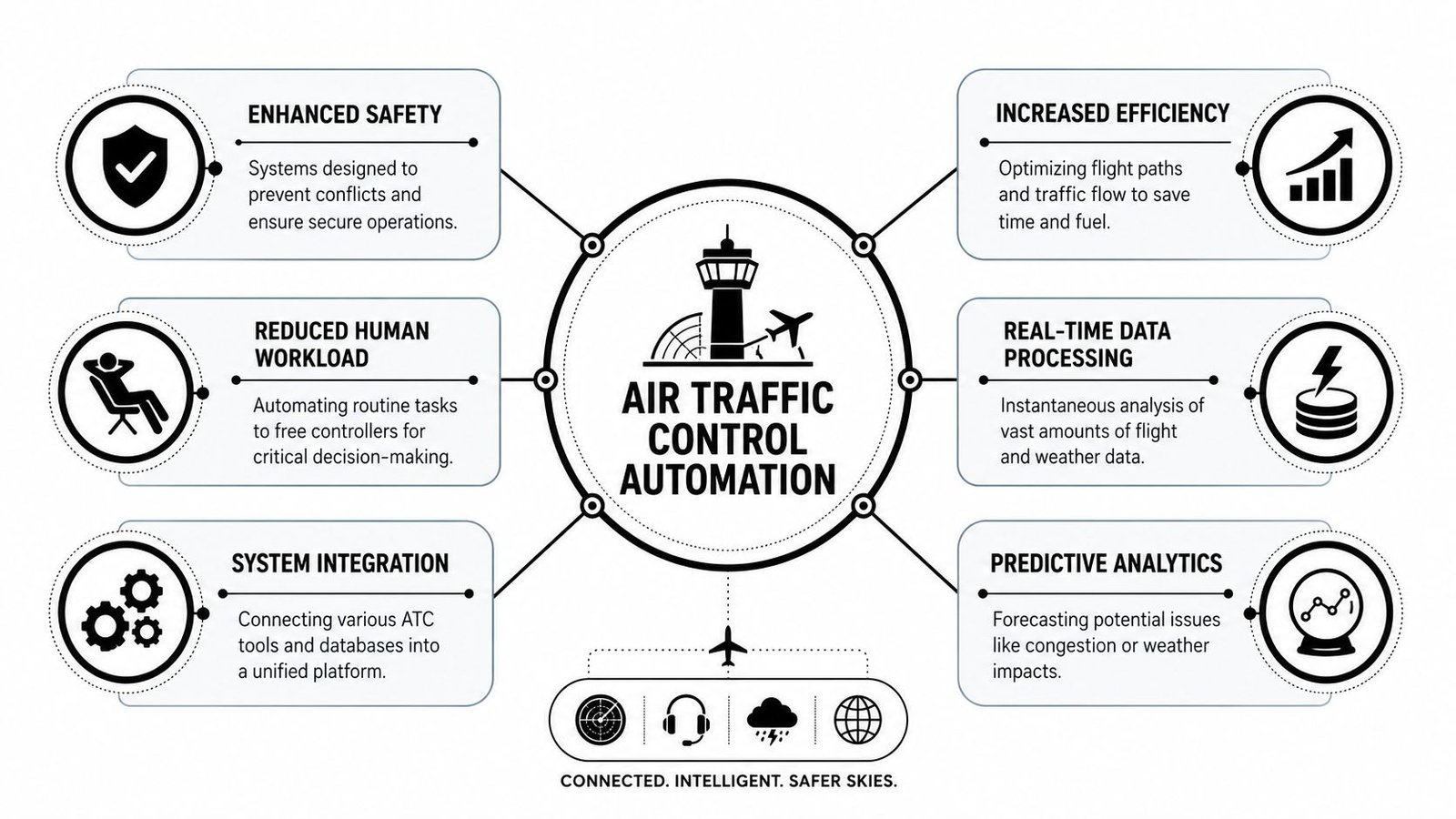
ATC automation is a system for helping people see more, decide faster, and coordinate better. On the factory floor, it works like a control layer that gathers sensor readings, schedules, alarms, and recommended actions so supervisors are not stuck reconciling fragmented information by hand.
Three jobs, one operating model
First comes surveillance, the system's ability to know what is happening in the airspace. In manufacturing, that maps to machine status, part presence, location tracking, and quality checkpoints. If operators do not have a trustworthy view of the line, every other improvement weakens.
Second is communication and data processing, which keeps the system from turning into a collection of disconnected tools. In a plant, that is the difference between a machine alarm, an MES update, and a supervisor call that all tell the same story, versus three versions of the truth.
Third is decision support, where ATC automation adds value without taking away accountability. The National Academies' review says automated ATC systems have historically focused on improving information quality, automating routine tasks, and supporting functions like failure detection, weather prediction, and multitrajectory optimization, while tactical decisions remain human-led. Manufacturers should recognize that structure because it matches how good industrial systems work when uptime, quality, and safety all matter at once. real-time automation for operational awareness plays a similar role, turning scattered signals into usable insight instead of forcing managers to interpret raw data one point at a time.
Why that structure matters on a factory floor
A central control system that only archives data is weak. A system that only alarms is noisy. A system that only suggests actions without context creates distrust. ATC automation works because it combines real-time state awareness with routine-task automation and decision support, then leaves the final call to the person accountable for safety.
Air traffic control did not become safer by asking software to replace pilots or controllers. It became safer by making the human's picture of the system more complete.
The manufacturing parallel is straightforward. If you are upgrading a line, start by asking whether the system can show the truth faster, coordinate tasks more cleanly, and reduce the burden of repetitive checks. That operating philosophy is more durable than chasing full autonomy too early.
The Core Technologies and Their Industrial Parallels
The strongest ATC tools aren't flashy. They're specific. They solve one part of the workflow well, then connect into a broader control picture, which is exactly how effective industrial automation should be designed.
Modular tools beat monolithic promises
NASA's Center TRACON Automation System, or CTAS, was built around three named tools, Traffic Management Advisor (TMA), Descent Advisor (DA), and Final Approach Spacing Tool (FAST). In simulation of single-runway operations, those tools reduced delay by 4–6 minutes per aircraft depending on traffic mix and also cut controller workload, which is a strong reminder that modular design beats vague all-in-one claims. NASA's CTAS study shows the value of targeted automation where the bottleneck sits.
That same principle translates directly to manufacturing:
- Automated handoffs in ATC resemble smooth work-cell transitions on a line. If one cell finishes but the next cell isn't ready, the whole system stalls.
- Conflict alerts map to process alarms and interlocks. Both exist to catch risk before the operator discovers it the hard way.
- Trajectory prediction is the ATC cousin of predictive maintenance and flow forecasting. Both help managers intervene before disruption grows.
- Integrated traffic pictures are like a well-implemented MES or historian layer, where multiple inputs become one operational view.
Decision support is the maturity zone
The clearest pattern in the evidence is that ATC automation is most mature in decision support, not full replacement. That's important because it separates useful automation from fragile overreach. Controllers still own tactical decisions, while software handles the information synthesis, sequencing suggestions, and repetitive coordination that slow people down.
For manufacturers, that means the right first projects often look modest from a headline perspective, but powerful in practice. A system that helps an operator catch a drift condition early, a scheduler that suggests better sequencing, or a dashboard that cleans up status visibility can all outperform a broader project that tries to automate every decision at once. SEA's work in air traffic control and air traffic management systems is relevant here because the discipline of integrating automation around human oversight is the same whether the environment is a TRACON or a regulated production cell.
Balancing Efficiency Gains with Critical Safety Factors
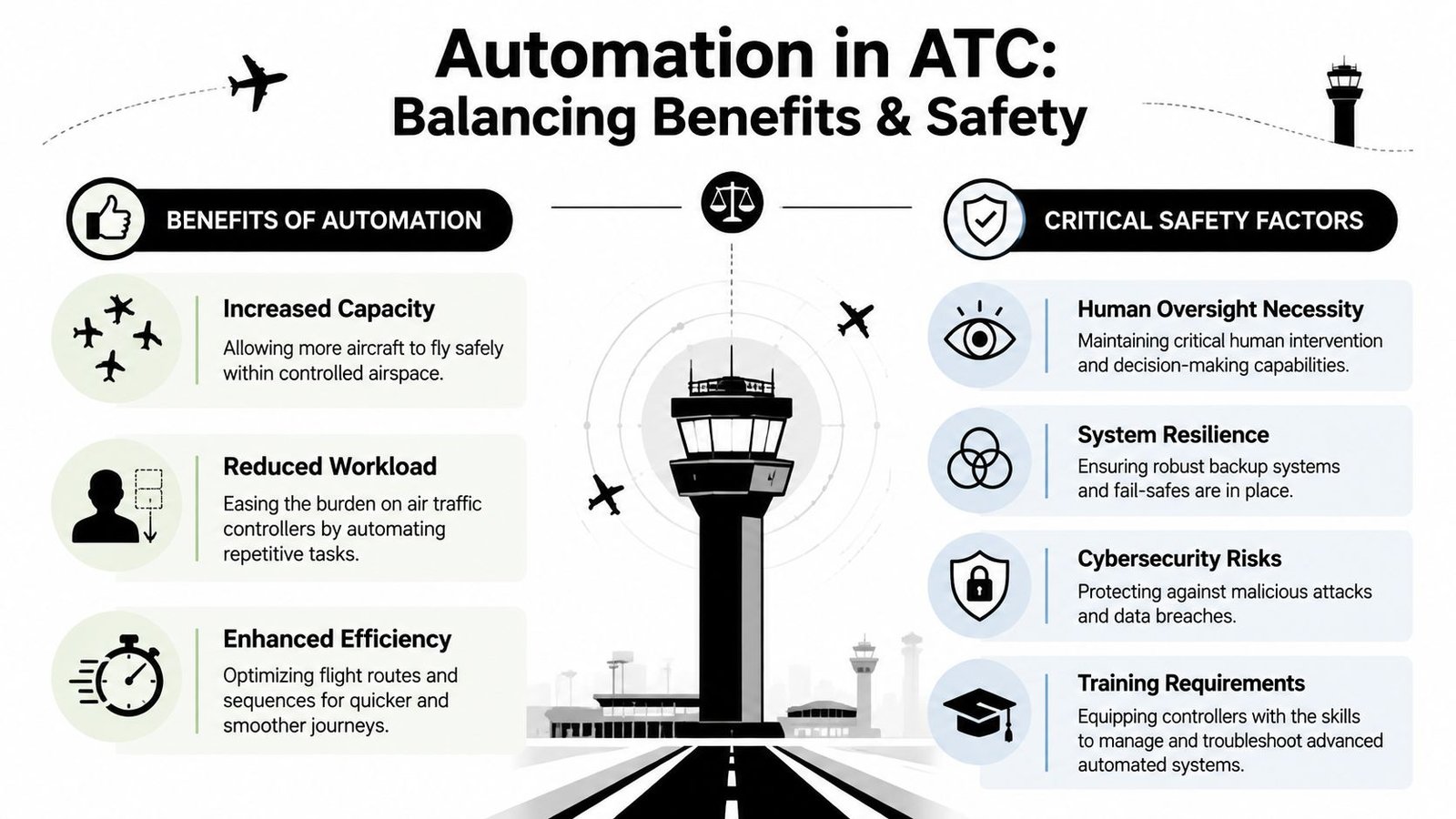
Automation earns its keep when it improves throughput, but the best systems also protect human attention. That trade-off is easy to ignore in a sales deck and hard to ignore in operations, especially when the site has quality constraints, staffing pressure, or regulated workflows.
The upside is real, and measurable
A classic FAA study on ARTS III reported that automation increased system capacity by 10.5% and boosted productivity by 8.5%. In one TRACON example, aircraft handled per hour rose from 37.8 to 39.5 with the same staffing level. That's the kind of evidence manufacturing leaders should respect, because it shows automation can improve output without requiring a parallel jump in headcount or line redesign. The ARTS III study is a reminder that even older automation, when designed well, can produce concrete operational gains.
Safety has to be designed in, not bolted on
The hard part is not getting a system to optimize normal operations. The hard part is knowing what happens when something unexpected breaks the plan, such as weather, a sensor fault, or an emergency. Research reviews on ATC automation explicitly raise the issue of how systems behave during abnormal situations, and that question maps directly to manufacturing, where downtime, quality escapes, and emergency stops demand fast human judgment.
That's why system resilience, cybersecurity, and operator training can't be afterthoughts. If automation makes routine work easier but leaves the team less able to recover from exceptions, the plant becomes more brittle, not more efficient. The best installations preserve situational awareness, keep overrides understandable, and make sure humans can still recover the process when software confidence drops.
Bottom line: if automation improves the average day but weakens the bad day, it's the wrong design.
For regulated manufacturers, especially in medical device and GMP-aware environments, that lesson is imperative. You need traceability, clarity, and the ability to explain why the system recommended a course of action. That is why a measured human-in-the-loop design usually outperforms a high-risk leap to full autonomy.
A Phased Roadmap for Practical Automation Integration
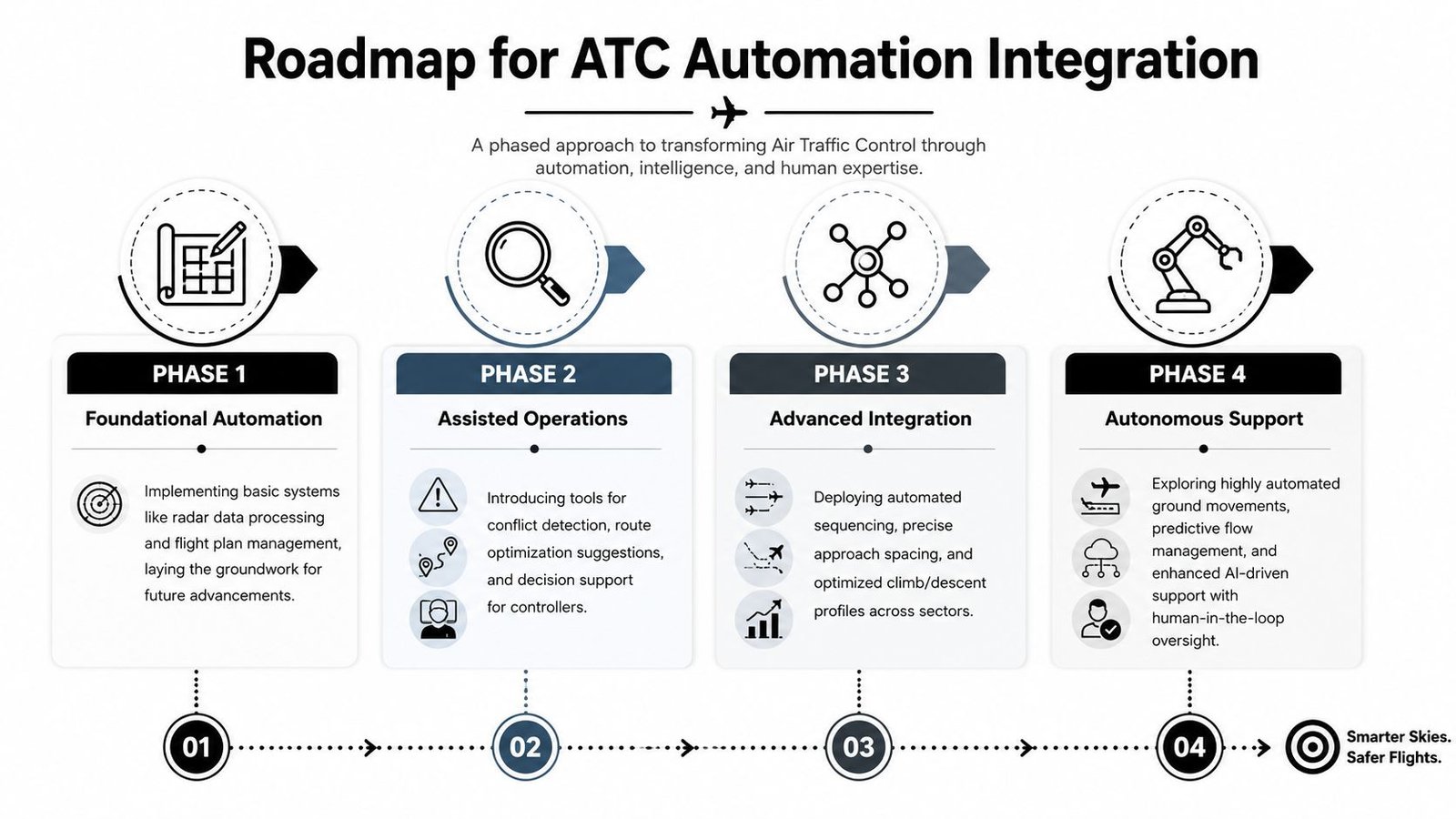
The safest way to modernize operations is usually the least dramatic one. ATC didn't jump from manual control to fully autonomous traffic management, it evolved through layers of better data handling, better assistance, and better prediction. Manufacturers can use the same playbook.
Phase by phase, not all at once
Phase 1, Foundational Automation. Start with clean data, reliable machine states, and unified visibility. If the current process still depends on handwritten logs, disconnected spreadsheets, or status calls, that's where the waste is hiding.
Phase 2, Assisted Operations. Add tools that guide operators, flag exceptions, and support sequencing or prioritization. These are the decision-support functions that improve output without removing the person who understands the process.
Phase 3, Advanced Integration. Connect predictive logic, optimization rules, and multi-station coordination so the system can recommend better flows across the plant. At this stage, the line starts behaving like a coordinated network instead of separate machines.
Phase 4, Autonomous Support. Use carefully bounded automation where the task is repetitive and the consequence of error is controlled, while keeping human oversight intact. In aerospace, higher-order support is provided; however, it still stops short of full tactical replacement.
A NASA/FAA-era study estimated that the most favorable extent of automation was when 64% to 86% of ATC tasks were machine-performed, with about 70% of tasks assigned to machines in the proposed architecture. That's a rare numeric benchmark for anyone trying to avoid both under-automation and the trap of automating too much too fast. The NASA/FAA task-allocation study gives a practical principle for manufacturing too, the right mix is usually partial, not absolute.
What to measure as you go
Track whether operators spend less time chasing information, whether exceptions are caught earlier, and whether supervisors can intervene faster when something drifts. If those things improve, the automation is probably helping the business, not just making the interface more complex. For manufacturers who want a practical starting point, a semi-automated pilot from a partner such as System Engineering & Automation can be a sensible way to prove the operating model before scaling it.
Real-World ATC Systems and What They Teach Us
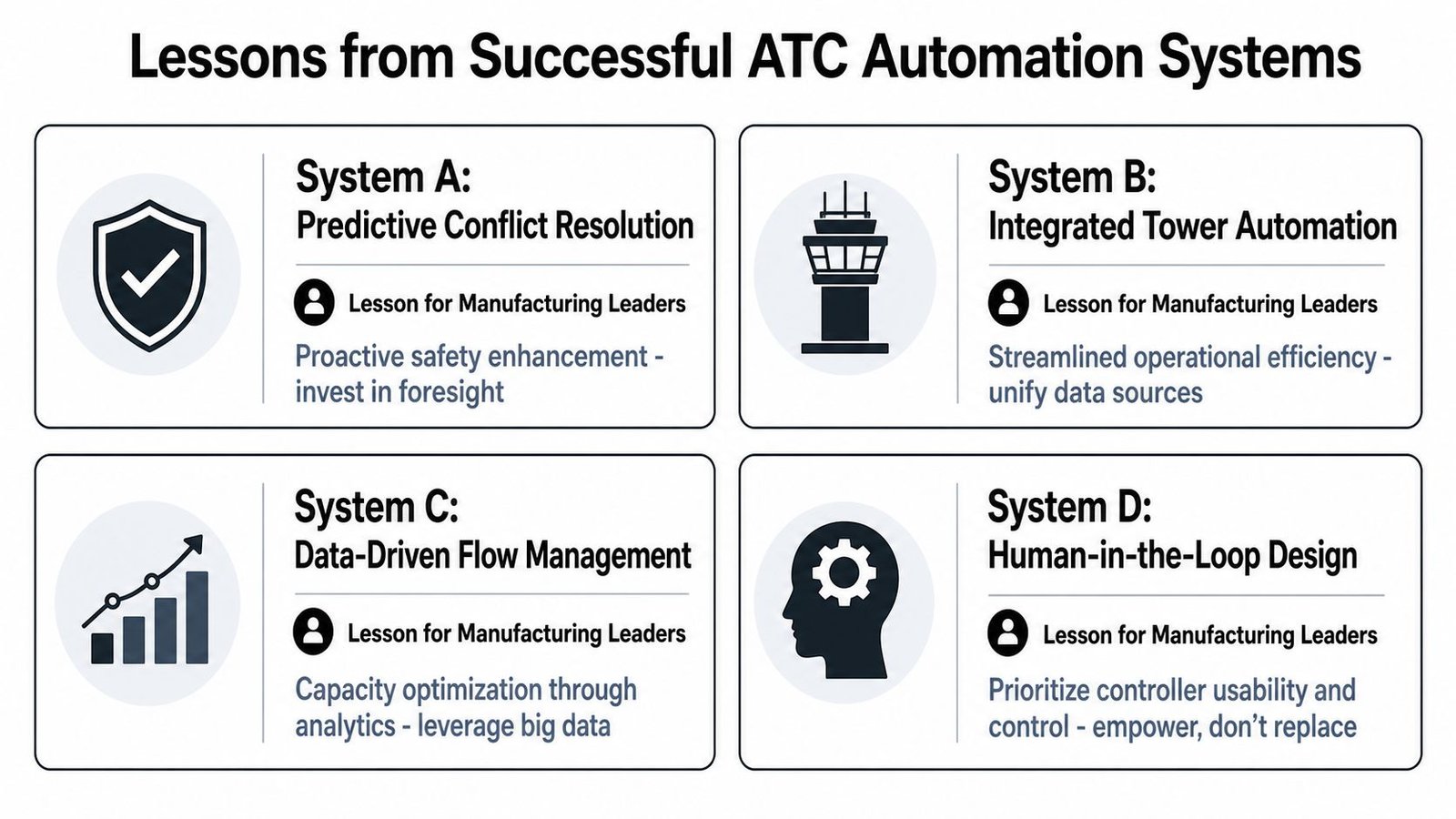
The best ATC systems are useful because they solve real bottlenecks, not because they promise a futuristic end state. That's exactly the mindset manufacturers should borrow when choosing between a control upgrade, a data platform, or a semi-automated cell.
CTAS showed the value of a modular build
NASA's CTAS didn't try to solve every ATC problem with one tool. It used separate functions for traffic management, descent guidance, and final approach spacing, and that modularity is exactly why it's such a strong reference point. Manufacturing takeaway: invest in the specific bottleneck first, then integrate the pieces once each one has proven value.
ERAM showed the power of unified scope
The FAA's ERAM rollout was significant because it moved en-route automation into a broader, modern operating layer across all 20 Air Route Traffic Control Centers. It also processed data from nearly three times as many sensors as its predecessor, which shows how better data scope can support broader control without adding more people. Manufacturing takeaway: if your plant is running on fragmented signals, a unified data backbone may create more value than another isolated machine upgrade.
Older ATC studies still matter
The National Academies note that most ATM automation to date has focused on input-data functions and better integrated radar pictures, and that these improvements have helped both efficiency and safety. That matters because it shows the oldest wins often come from clean information, not aggressive autonomy. Manufacturing takeaway: don't skip the basics. Better data hygiene and better visibility often pay back before advanced optimization does.
Explainability is becoming a gate, not a feature
Recent research on explainable AI in ATC treats transparency and operational trust as live issues, not solved ones. That's the right lens for manufacturing too, especially where quality investigations, regulatory review, or shift-to-shift consistency matter. Manufacturing takeaway: if a system can't be understood, audited, and defended, it's not ready for high-stakes deployment.
Applying Aerospace Principles to Your Production Line
The most useful lesson from ATC is simple. Don't automate for the headline, automate for the operating advantage. That means starting with cleaner data, using decision support before full autonomy, and designing every layer so a human can still understand and recover the process when conditions change.
That approach fits manufacturing because production problems are rarely solved by speed alone. They're solved by better sequencing, clearer visibility, less operator fatigue, and tighter control over exceptions. ATC automation has spent decades proving that human-machine collaboration is usually the highest-value path in a high-risk environment, and that same logic belongs on the factory floor.
If your team is evaluating upgrades, use the ATC model as a filter. Ask whether the system reduces routine workload, whether it improves situational awareness, whether it can be phased in without disrupting the line, and whether operators can still take back control when the unexpected happens. Those are the questions that protect ROI and safety at the same time.
If you're planning a semi-automated upgrade, a controls retrofit, or a smarter data layer for production, System Engineering & Automation can help translate these aerospace principles into practical manufacturing solutions. Their team works on cost-effective automation, custom tooling, fixtures, and integrated controls, with a focus on the right level of automation for your process and budget.