Stop shopping for the cheapest robot. It's the most popular advice in automation, and it's wrong for most small and mid-sized plants. A low equipment price tells you almost nothing about automation cost once tooling, controls, integration, validation, training, and downtime land on the same project.
Buy the lowest automation level that reliably hits your quality, throughput, and labor-risk targets. Sometimes that's a fixture. Sometimes it's a table-top semi-automatic station. Only stable, high-volume work earns a fully automated cell. If you compare installed and lifecycle cost per good unit, you'll make a better capital decision than the plant that chases maximum labor removal.
Table of Contents
- Automation Cost Ranges Manufacturers Actually Pay
- Cost Drivers Hidden Past the Equipment Quote
- Validation and GMP Costs for Device Makers
- How to Estimate Ownership Cost and Payback
- Semi-Automatic and Fully Automated Cost Scenarios
- Choose the Automation Level and Book the Review
Automation Cost Ranges Manufacturers Actually Pay
The same production goal can call for very different capital spends. Choose the lowest automation level that addresses the bottleneck; paying for a more complex system only makes sense when the added capability earns its keep.
Four levels, four different bills
Manual tooling and fixtures are the lowest step. Jigs, poka-yoke features, and ergonomic fixtures can improve the efficiency and quality of manual operations, particularly when budgets are limited. Choose them when positioning, handling, or consistency is the problem and an operator remains the right fit for variable work.
A table-top semi-automatic workstation automates a specific task, such as pressing, torque control, dispensing, testing, labeling, or assembly. The operator loads parts, starts a cycle, or removes finished products while automated components perform the task. Because these systems address individual steps rather than entire production lines, their development and integration costs are significantly lower than those of a full cell.
Robot prices have fallen sharply. A study of U.S. manufacturing adoption reports that industrial robot prices dropped from more than $130,000 in 1995 to below $30,000 near the end of the 2010–2020 decade, a reduction of over 75%. Treat that figure as the robot's purchase price, not a complete project budget. Integration, tooling, controls, safety systems, programming, installation, and commissioning all affect the installed cost.
Fully automated equipment is the highest-cost option. It automates onload and offload and can support multitasking operations, but it requires more design work, specialized components, manufacturing, wiring, and complex programming. The added spend makes sense when stable production volume keeps the system productive.
| Level | Capital context | What the spend covers | When payback is realistic |
|---|---|---|---|
| Tooling and fixtures | Lowest capital; often the right first spend | Jigs, poka-yoke, and ergonomic fixtures; no robotics | Manual work remains appropriate, and handling or consistency is the bottleneck |
| Table-top semi-automatic | Development and integration costs are significantly lower than for a full cell | A specific task such as pressing, dispensing, testing, labeling, or assembly; operator loads, starts, or unloads | A repetitive step is stable, but mix or volume does not justify a full cell |
| Installed robot system | The robot's purchase price is only one part of the installed cost | Robot, tooling, controls, safety systems, programming, installation, and commissioning | A defined task and sufficient utilization justify the integration cost |
| Fully automated cell or line | Highest capital spend; some illustrative calculations use a six-figure investment | Automatic onload and offload, multitasking operations, controls, safety, and programming | Stable, high-volume demand keeps the system productive |
How to use these bands
Use the table to compare automation levels, not as a bid or a promise of payback. High wages and steady utilization can improve the financial case. One shift, frequent changeovers, and long idle periods can weaken it, even when the equipment performs well.
Semi-automatic station costs depend on the task and scope, so don't rely on an unsupported price range. Request quotes for the same installed scope, then compare what each supplier includes. The useful comparison is the cost of the system that meets your production needs, not the robot price alone.
Cost Drivers Hidden Past the Equipment Quote
Stop treating the equipment quote as the project cost. Vendors lead with that number, and it is the worst basis for a buy. The figure that matters is installed and lifecycle cost at the lowest automation level that hits quality, throughput, and labor risk. A full cell that strips out more people can cost more to integrate, train, and keep running than the problem is worth. A fixture, a conveyor, or a table-top station is often the better buy.
The visual below puts the equipment price where it belongs, at the top of a much larger cost stack.
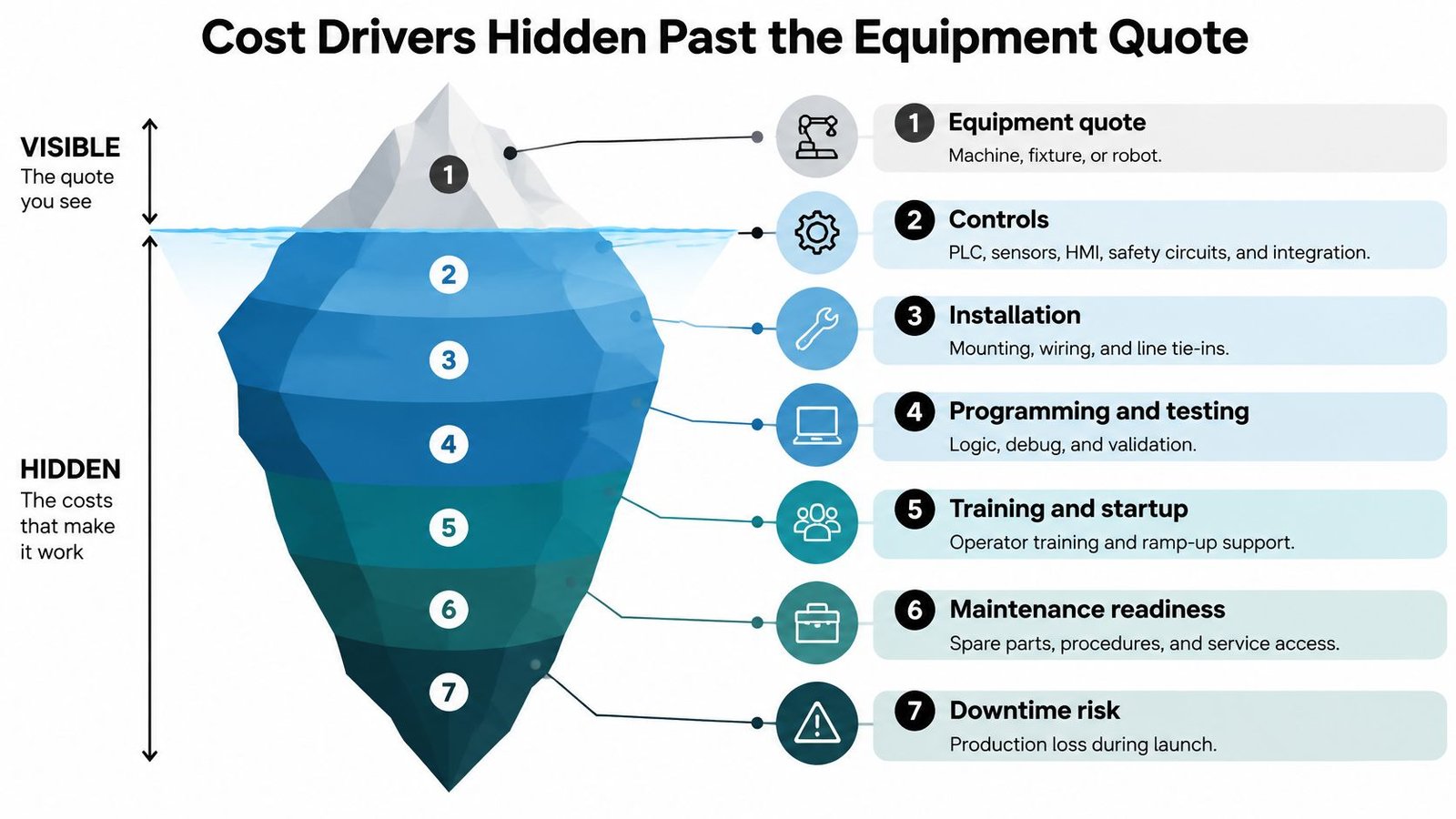
The seven drivers in project order
- Equipment: The machine, fixture, or robot itself. This is the number vendors lead with and the number you should trust least on its own.
- Controls: The PLC, sensors, HMI, safety circuits, and any vision or motion the task needs. Automation can involve mechanical fixtures, conveyors, vision systems or PLC-based controls, and it does not always mean robotics. SEA integrates robotics, vision systems, PLCs, and sensors only where the task needs them.
- Integration: The expensive surprise. A new station has to talk to an older machine, a conveyor, or a data system, and legacy interfaces rarely cooperate. SEA's systems are designed to integrate with existing equipment and processes, so put that interface scope in the first quote, not a change order.
- Installation and commissioning: Mechanical fit, wiring, debug, and the production you lose while the cell is proven. Budget the lost output, not just the installer's hours.
- Validation and GMP documentation: Required when the station touches a controlled process. On medical devices, this line can rival the controls bill if you scope it late.
- Training and skills: Operators need to run it and someone needs to maintain it. The 2025 manufacturing survey found that 32% of manufacturers experienced cost overruns, while nearly 40% lacked sufficient expertise to design, deploy, or maintain automation systems.
- Maintenance, spares, and support: Wear parts, spare sensors, controls support, and service access after go-live. Skip the spares package and a failed photo-eye becomes a line-down event.
Planning rule: Compare labor savings against the full stack. Hold contingency, because cost overruns are common enough that a tight equipment quote is not a plan.
Price integration, training, lost startup output, and support before you sign. Do that on an obvious bottleneck too. Plants get hurt when they subtract a labor estimate from an equipment quote and call the remainder savings. Run the math on the whole stack, at the smallest system that fixes the line.
Validation and GMP Costs for Device Makers
A medical device plant can't price a station on labor savings alone. If software touches production or quality, validation is part of the build, and it belongs in the budget from day one.
The FDA validation guidance states that computer software must be validated for its intended use under 21 CFR §820.70(i), covering software used for device design, testing, component acceptance, manufacturing, labeling, packaging, distribution, complaint handling, and other production or quality-system activities. FDA guidance specifies documented user requirements, an approved validation protocol, acceptance criteria, test cases and results, and a validation summary. Every one of those documents takes engineering and quality time. Price it.
The QMSR raises the documentation bar
The FDA overview of device regulation notes that the Quality Management System Regulation became effective on February 2, 2026, and amended U.S. medical-device current good manufacturing practice requirements by incorporating ISO 13485:2016 by reference for methods, facilities, and controls used in design, manufacture, packaging, labeling, storage, installation, and servicing. Installation records, servicing procedures, and traceability aren't paperwork afterthoughts. They're part of automation cost, and inspectors will ask for them.
Our guide to what GMP means in manufacturing covers the broader framework. The cost point is simple. A faster cycle that can't show a controlled process creates compliance exposure instead of savings.
Use scope as your cost lever
A controlled semi-automatic workstation with one validated function usually carries a smaller protocol than a fully automatic line running multiple software-driven steps. You still get the repeatability that matters. Automated pressing, torque control, dispensing, or testing ensures each component is handled with the exact same parameters every time, locking in press force, torque, dispense volume, or test limits.
Those gains can offset the paperwork. Manufacturers using automation often see reduced scrap and rework, improved inspection accuracy, better compliance with specifications, and lower warranty and customer return costs. Count those savings only if you measure them before and after.
Before you freeze the mechanical design, answer three questions in writing. What's the intended use? Which records must the station create? Who approves the protocol? If you can't answer, you're not ready to approve capital.
How to Estimate Ownership Cost and Payback
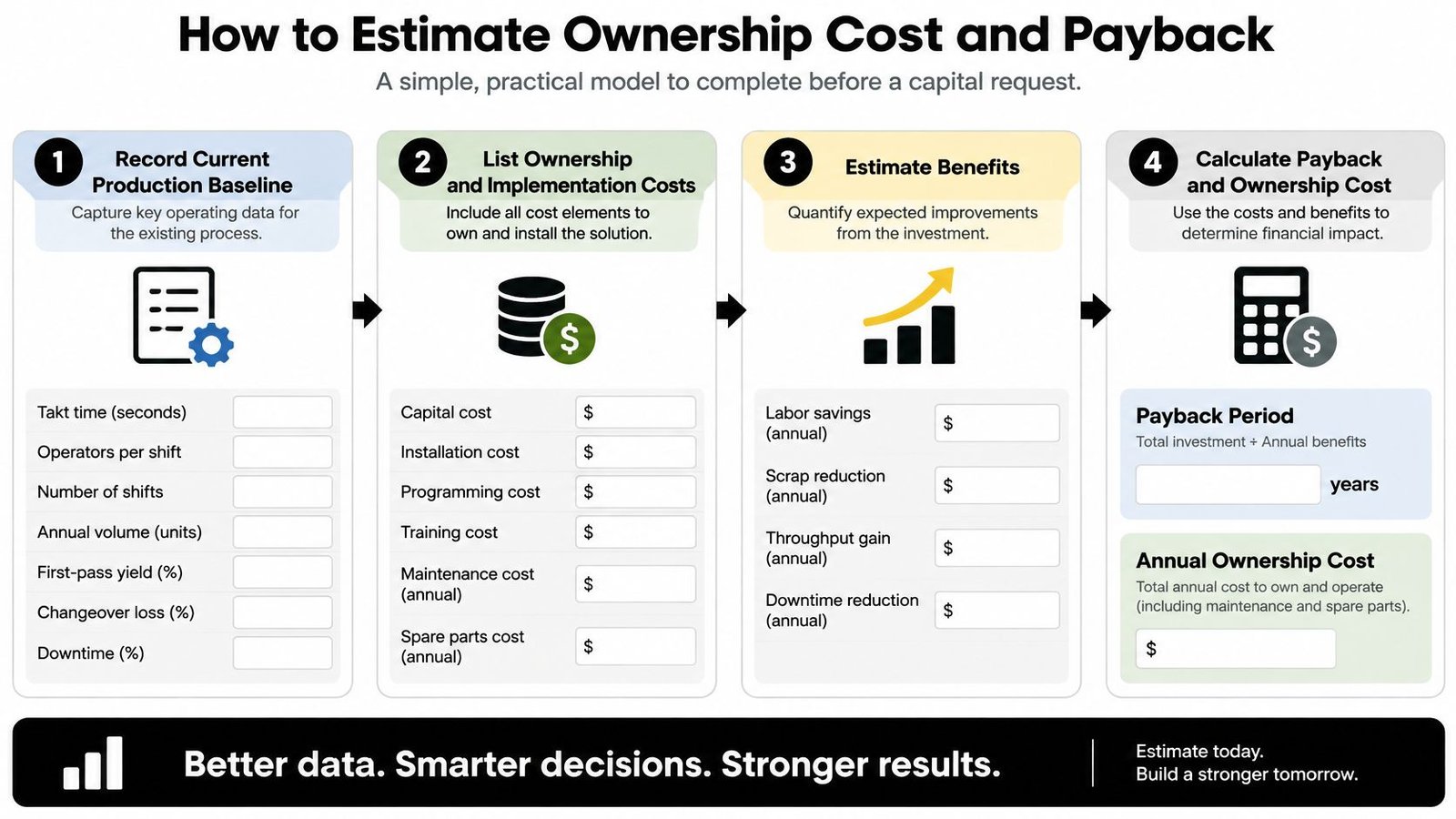
A robot's purchase price won't tell you whether automation pays. Build the estimate around installed and lifecycle cost, using the lowest automation level that meets your quality, throughput, and labor-risk needs.
The six-step model
- Record the baseline: Takt time, operators per shift, number of shifts, annual volume, first-pass yield, changeover loss, and downtime. Without these figures, you cannot test whether projected savings are credible.
- List all capital: Include equipment, end-of-arm tooling or fixtures, guarding, controls, software interfaces, installation, and commissioning. A total cost of ownership analysis also identifies operator training and organizational change as costs to account for.
- Add one-time organizational costs: Include training, procedure updates, and validation when the process is controlled.
- Annualize ownership: Include planned maintenance, spare parts, engineering support, and expected downtime. Spread capital over the system's expected service life, using an assumption that fits your application.
- Estimate benefits from good units only: Count labor hours removed or redeployed, scrap and rework avoided, and extra saleable capacity. Gross output overstates the return if it includes rejects.
- Calculate two numbers: Payback is net capital divided by annual net benefit. Cost per good unit is annualized ownership cost divided by good units produced. Both measures expose a station that looks fast on paper but delivers too few acceptable units.
Our guide to total cost of ownership explains how to account for costs across a system's life.
Watch the video below before presenting the estimate to finance. It reinforces why utilization assumptions need scrutiny.
What changes the answer
Utilization and production stability can change the payback more than the equipment quote. Published analyses report industrial-robot payback periods of approximately 1–5 years for high-volume production with stable demand. A one-shift operation with frequent changeovers may take longer to recover its investment.
Check the assumptions behind any headline calculation. The ITIF robotics report describes an illustrative U.S. calculation using a $250,000 robotic investment to replace two workers, each with annual compensation of $72,000. At $144,000 in annual labor cost, the investment takes about 1.7 years to recover before running costs. Treat that as a starting calculation, not a complete payback estimate.
If a payback claim can't survive your own division, it won't survive your controller either.
For a $150,000 station that saves $60,000 a year in good-unit labor and scrap, simple payback is 2.5 years. If the plant uses only half the station's capacity, fewer good units absorb the annual ownership cost, raising cost per unit. Recalculate at actual utilization and with frequent changeovers before approving the larger cell.
Semi-Automatic and Fully Automated Cost Scenarios
Ranges become useful when you turn them into plant math. Start with a published result, then ask what a smaller build would have delivered on the same kind of task.
The comparison below frames the two money paths side by side.
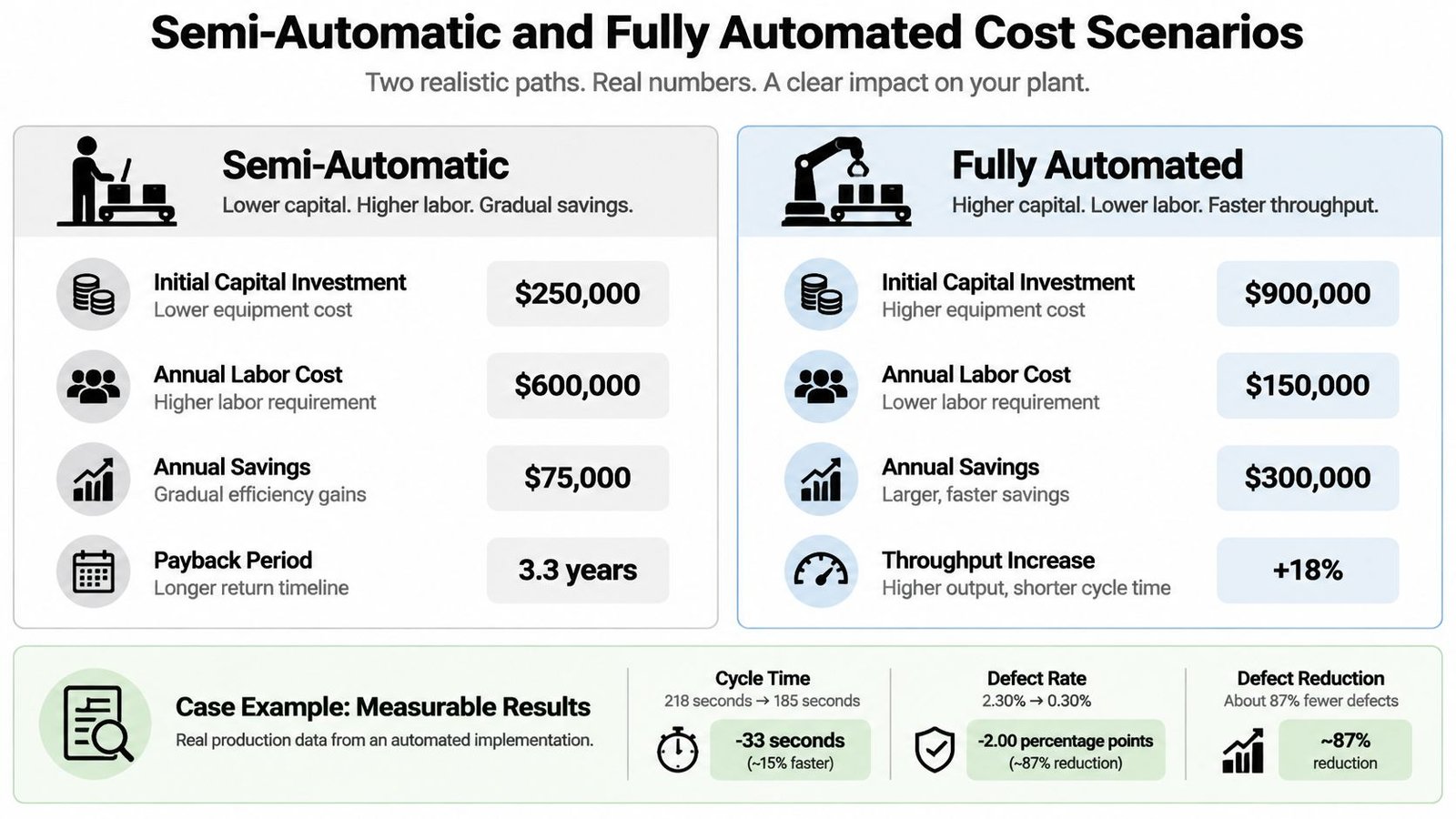
What the robotic assembly case actually shows
The production study of robotic assembly reported a cycle-time reduction from 218 to 185 seconds per unit, a defect-rate decrease from 2.30% to 0.30%, and a labor reduction from three operators to one per shift. Moving from 2.30% to 0.30% represents an approximate 87% relative decrease in defects. Those are three separate savings, not one. Shorter cycle time creates capacity. Fewer operators cut direct labor. Fewer defects cut scrap, rework, inspection, and warranty exposure.
| Measure | Before | After | Cost effect |
|---|---|---|---|
| Cycle time per unit | 218 seconds | 185 seconds | More available capacity from the same shift |
| Defect rate | 2.30% | 0.30% | About 87% fewer defects; dollar savings depend on part cost and rework |
| Operators per shift | 3 | 1 | Direct labor reduction if the two roles are actually removed or redeployed |
Don't import someone else's dollar savings. Multiply the defect reduction by your own material cost, rework minutes, and warranty exposure. A plant pressing cheap brackets and a plant assembling sterile devices get very different value from the same defect drop.
The bench-scale alternative
Now shrink the build. In a table-top semi-automatic system, an operator loads parts, starts a cycle, or removes finished products while automated components perform pressing, dispensing, testing, labeling, or assembly. Semi-automatic workstations can automate repetitive steps such as assembly, packaging, inspection, or testing while operators keep control of the process. Labor savings are partial. Capital is far lower, the station sits on a bench, and utilization stays high when lots change often.
A fully automated system goes further. Fully automated systems automate both the onload and offload processes and support multi-tasking operations, so several steps run together without an operator in the loop. Labor and throughput gains are larger, but only if volume is steady enough to fill the cell.
A cell built for nameplate speed that sits idle between changeovers loses the payback the case study assumes.
Our comparison of semi-automatic versus fully automatic systems lays out the operational differences. The financial rule doesn't change. Target the smallest level that reliably delivers the quality, throughput, and labor-risk reduction you need, and let the bigger build earn its way in later.
Choose the Automation Level and Book the Review
Name the constraint before you price a cell. Excessive cycle time, inconsistent assembly, rework, and operator strain each call for a different build. If you cannot state that constraint in one sentence, you are shopping, not solving.
Stage the money
A plant still running largely on manual labor often gets more from tooling and fixtures than from automation. Tooling and fixtures raise the efficiency and quality of manual work when the budget is tight. Move to semi-automated systems once that base is stable. Full automation comes when volume and labor risk justify the extra design, specialized components, manufacturing, wiring, and complex programming. Spend fixture money on a fixture problem.
Phase the project so this year's hardware is still useful next year. SEA's automation projects can be small or phased, depending on where process automation delivers the most value. A manual system from System Engineering & Automation can be upgraded with semi-automation or full automation without starting from scratch. The fixture bought now can become the base of a later station instead of scrap.
Hold contingency for integration and training on every phase. Do not approve capital from a single-shift labor-savings slide. If the case collapses once you model real changeovers and one shift of use, it was never a case.
Decide by situation
Unstable process or low volume. Buy fixtures and a disciplined manual method that can take semi-automation later. Automating an unstable process produces defects faster and locks a bad method into steel and code.
One repeatable cycle, high mix. Price a table-top or stand-alone semi-automatic station. Operators keep control through changeovers, the station locks the parameters that drive quality, and capital stays low enough that a mix shift will not strand the investment.
Stable volume, high wages, maintenance skill in-house. Price the full cell, including integration, guarding, validation, spares, and support. Maximum labor removal is the right target only here, because utilization can repay the integration bill. Fully automated equipment costs the most for a reason. Buy it when the lowest level that hits quality, throughput, and labor risk is the full cell.
Check every option against the same list before you decide.
- Quality and traceability: Which parameters must be locked, and which records must the station produce?
- Throughput versus takt: Does the station beat takt at real yield, not at nameplate speed?
- Changeover frequency: How many minutes per shift will setup and lot changes consume?
- Maintenance capability: Who troubleshoots the PLC, vision system, or servo fault at 2 a.m.?
- Floor space: Does a bench-top station fit where a guarded cell will not?
- Growth path: Can this build accept the next automation step without a rebuild?
Downtime, quality cost, maintenance spend, and launch time are buckets to baseline, not guaranteed percentages. Measure the current state in each bucket, set a target the station can plausibly move, and verify after installation. A vendor who promises a percentage before seeing your baseline is guessing with your money.
Prefer the flexible option when lot sizes and demand swing. A lower-cost semi-automatic station can beat a full cell on risk-adjusted return because it stays useful when the product mix changes. Flexibility is real money in a high-mix plant. It never appears on an equipment quote. The number that matters is installed and lifecycle cost at the lowest automation level that hits quality, throughput, and labor risk, not the robot sticker price or the maximum headcount you can remove.
Book the review with the right inputs
Bring current bottlenecks, labor and production constraints, quality or consistency problems, budget, and timeline. The first consultation is free and carries no obligation to buy. With those inputs, SEA looks at the constraints, evaluates production workflows, and identifies where automation creates the greatest impact. That review is also where SEA helps you understand the financial benefits, matched to existing equipment and to the automation level the constraint needs. For device work, expect GMP-aware engineering, not a generic cell dropped onto a regulated process.
Stop another budget cycle that compares a quote with a labor slide. Plants that win on automation cost bought the right amount, priced installed and lifecycle cost, and measured what the station delivered.
If you are weighing a fixture, a table-top semi-automatic station, or a full cell, System Engineering & Automation will review your bottlenecks, labor and production constraints, quality concerns, budget, and timeline, then point to where automation pays. Visit System Engineering & Automation to book the manufacturing automation consultation.