You already know the feeling. A line is running, orders are queued, and then one stubborn motor, torque tool, or conveyor segment starts acting up just enough to throw the whole shift off balance. The maintenance team reacts fast, production loses time anyway, and the next planning meeting turns into a discussion about overtime, missed output, and which asset should've been watched more closely.
Digital Twin Predictive Maintenance gives operations teams a better way to handle that problem. Instead of waiting for a fault to become a stoppage, it connects live asset data to a virtual model that can help teams spot deterioration early, test maintenance decisions, and schedule work when it's least disruptive. For manufacturers that need to protect throughput, especially in brownfield plants with mixed manual and semi-automatic equipment, that shift matters because it turns maintenance from a fire drill into a managed process.
Table of Contents
- Introduction to Digital Twin Predictive Maintenance
- Understanding Core Concepts
- Benefits and Key Metrics
- Essential Data Sensors and Integration Architecture
- Implementation Roadmap from Pilot to Scale
- Real-World Manufacturing and Medical Device Examples
- Common Pitfalls and Partner Selection Guidance
- Conclusion and Next Steps
Introduction to Digital Twin Predictive Maintenance
A plant manager doesn't need another buzzword. They need a way to stop the same conveyor drive, fixture, or assembly station from derailing the schedule every few weeks. In many facilities, the pattern is familiar, operators notice a change, maintenance gets pulled in, and diagnosis begins in earnest after the asset has already cost the shift valuable time.
Digital twin predictive maintenance is built for that exact gap between “something feels off” and “we've already lost output.” The idea is simple enough to explain in one sentence, a digital twin is a living virtual version of a physical asset, and predictive maintenance uses that model, along with live data, to estimate when intervention makes sense. The point isn't to replace technicians. It's to give them earlier and better signals so they can plan parts, labor, and downtime with more confidence.
That matters more in smaller and mid-sized manufacturing environments than many people assume. Brownfield plants rarely start with clean-slate instrumentation, and semi-automatic assets often sit in the middle ground between fully manual inspections and enterprise-grade automation. A practical twin can still help when the goal is not perfection, but better scheduling, less uncertainty, and fewer surprise interruptions.
Understanding Core Concepts
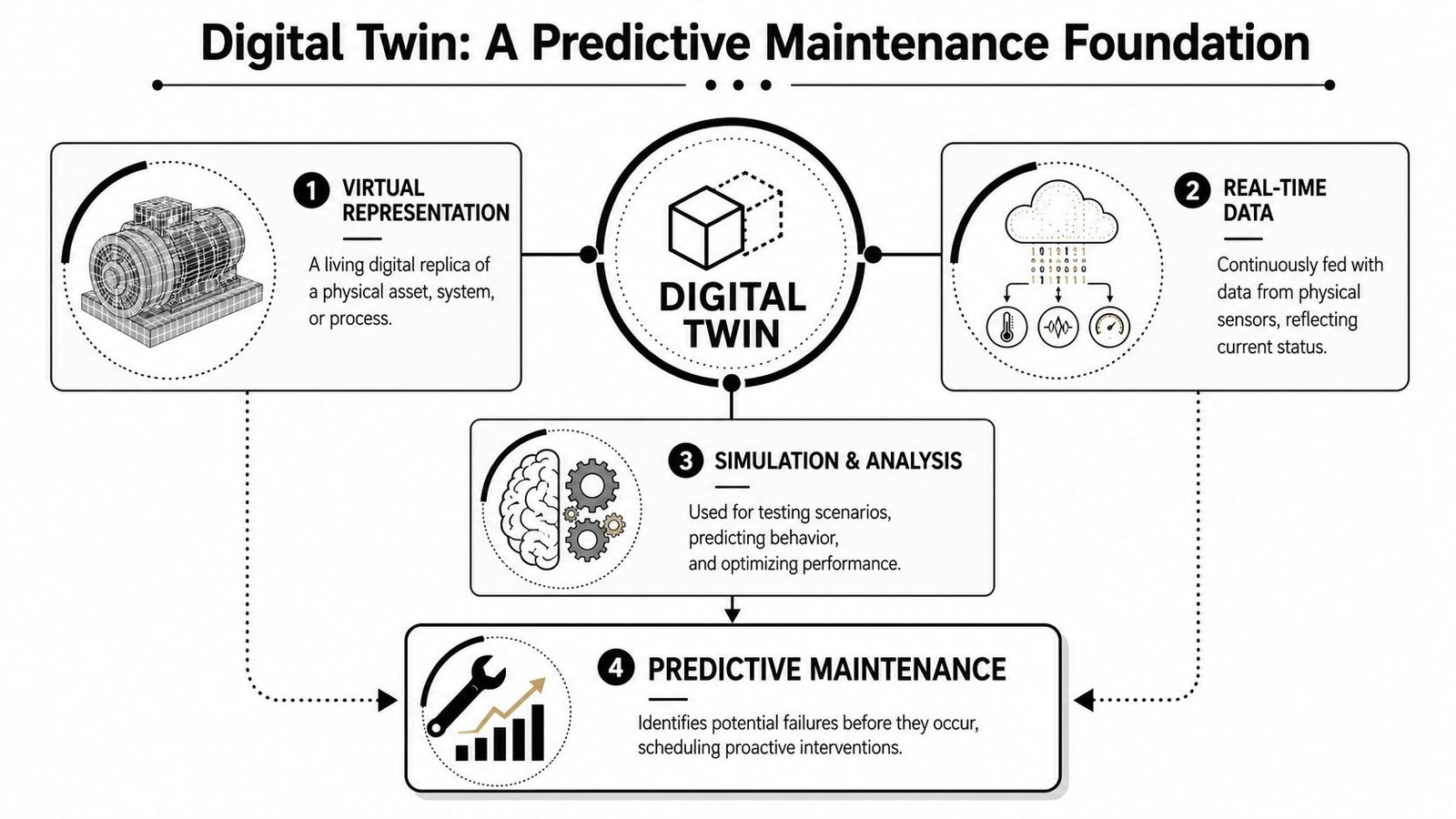
A digital twin works a lot like a flight simulator for a machine, except the stakes are production schedules instead of takeoffs. The virtual model stands in for the physical asset, sensors feed it current condition data, and analytics use that stream to estimate what's happening inside the equipment before a failure shows up on the floor. That's why the twin isn't just a dashboard. It's a decision layer.
The three pieces that have to work together
The first piece is model fidelity, which means the twin has to mirror the asset well enough to be useful. A vague model won't help a production manager decide whether a bearing should be changed this week or next month. In manufacturing terms, that's the difference between a rough sketch and a working simulator.
The second piece is real-time data streaming. A twin that updates once a day behaves more like a report than a predictive system. The literature describes digital-twin predictive maintenance as a closed loop where sensors and controllers stream condition data into the twin, the twin runs diagnosis and prognosis, and the resulting remaining useful life estimate feeds back into a maintenance plan Cardiff University research.
The third piece is predictive analytics. That's where the model turns observations into action, flagging likely degradation, estimating remaining useful life, and helping teams prioritize maintenance work. A 2023 review of the field describes digital twin predictive maintenance as combining real-time sensing, high-fidelity virtual models, and simulation-based prediction, with remaining useful life prediction and maintenance cost prediction called out as core use cases review article.
Practical rule: if the virtual model doesn't feed a work plan, it's not yet predictive maintenance. It's monitoring with a nicer interface.
For manufacturers looking at practical deployment options, the digital replica proves valuable. If your team wants a broader manufacturing context, the digital twin manufacturing overview is a useful companion reference.
Benefits and Key Metrics
The strongest case for digital twin predictive maintenance is not that it looks advanced. It's that it changes the numbers operations people care about every week. Less downtime, higher availability, and longer time between failures all translate into a more stable schedule, fewer expediting decisions, and better labor planning.
A 2024 quasi-experimental study in an energy infrastructure setting found that average downtime fell from 18.4 hours to 9.7 hours per month, a 47.3% reduction, while asset availability rose from 82.3% to 91.8% and mean time between failures improved from 320 hours to 510 hours study. For a plant manager, those aren't abstract wins. They mean fewer surprises on the board and more control over when maintenance happens.
KPI comparison
| KPI | Before | After |
|---|---|---|
| Average downtime per month | 18.4 hours | 9.7 hours |
| Asset availability | 82.3% | 91.8% |
| Mean time between failures | 320 hours | 510 hours |
A useful way to think about the impact is operational, not theoretical. If a twin helps maintenance crews act before a fault becomes a stoppage, then the same asset can stay in service longer between interventions and the team can line up parts, labor, and production windows more cleanly. That's why the metrics above matter together. Downtime drops, availability rises, and the maintenance rhythm becomes more predictable.
For day-to-day management, the most practical dashboard measures are unplanned stoppage hours, asset availability, mean time between failures, and the number of times production is interrupted for reactive troubleshooting. Spare-parts usage and overtime labor are also worth tracking, because a better forecast should reduce both the panic ordering and the last-minute schedule changes. The exact mix will depend on the asset, but those measures keep the discussion grounded in production reality rather than software features.
Essential Data Sensors and Integration Architecture
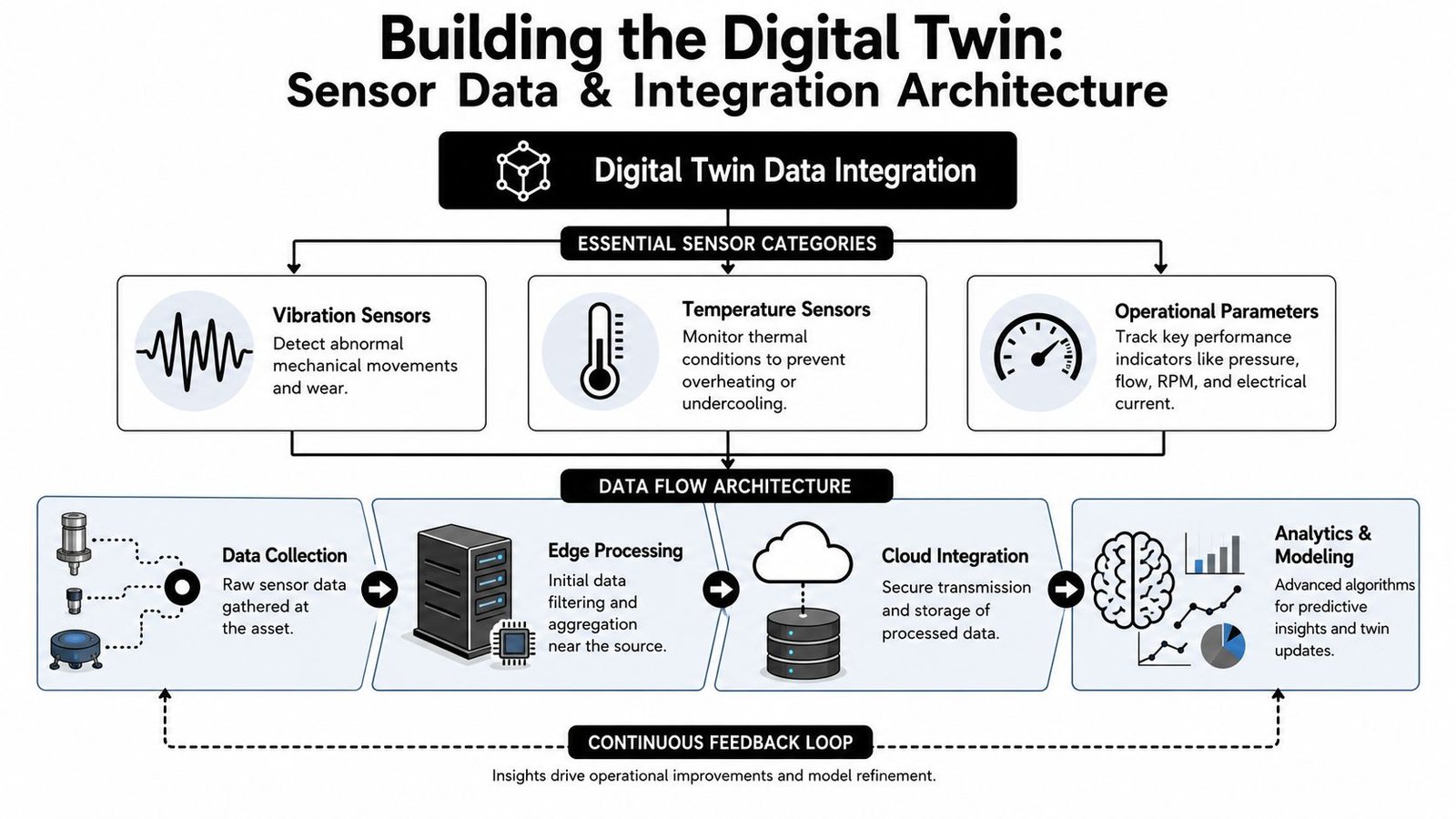
The sensor strategy should be boring on purpose. If the equipment team can't trust the data, the twin won't earn its place in the plant. For many brownfield assets, the minimum viable starting point is usually a mix of vibration, temperature, and operational parameters such as pressure, flow, RPM, or electrical current.
What the data stack has to carry
The sensor layer is only the start. In a real maintenance environment, the twin gets stronger when it also includes service history, asset metadata, and simulation outputs. CESMII notes that mature digital twins require bidirectional data flow among geometry, static asset data, IoT telemetry, service history, simulation results, and control actions, which explains why many projects stall at dashboarding instead of true prediction CESMII.
That architecture matters because a sensor alone can tell you a machine is hotter than usual, but it can't tell you what that means in context. A twin uses the live measurement, checks it against the asset model, compares it with service patterns, and helps maintenance decide whether the issue is normal variation, early wear, or a real fault trajectory. That's the difference between noise and a useful signal.
The practical flow usually looks like this. Data is collected at the asset, filtered close to the machine when possible, sent into a cloud or plant platform, then used for analytics and model updates. A good design also sends the output back into the maintenance system so planners can act on it. The point is not more data for its own sake. It's a loop that turns raw telemetry into a credible maintenance recommendation.
A twin becomes trustworthy when the maintenance team can trace the forecast back to the asset, the service record, and the live data stream.
For readers mapping their own stack, the machine monitoring software guide helps frame how the data layer supports the broader maintenance workflow. It's especially useful when you're deciding whether a small pilot can work with the sensors you already have.
Implementation Roadmap from Pilot to Scale
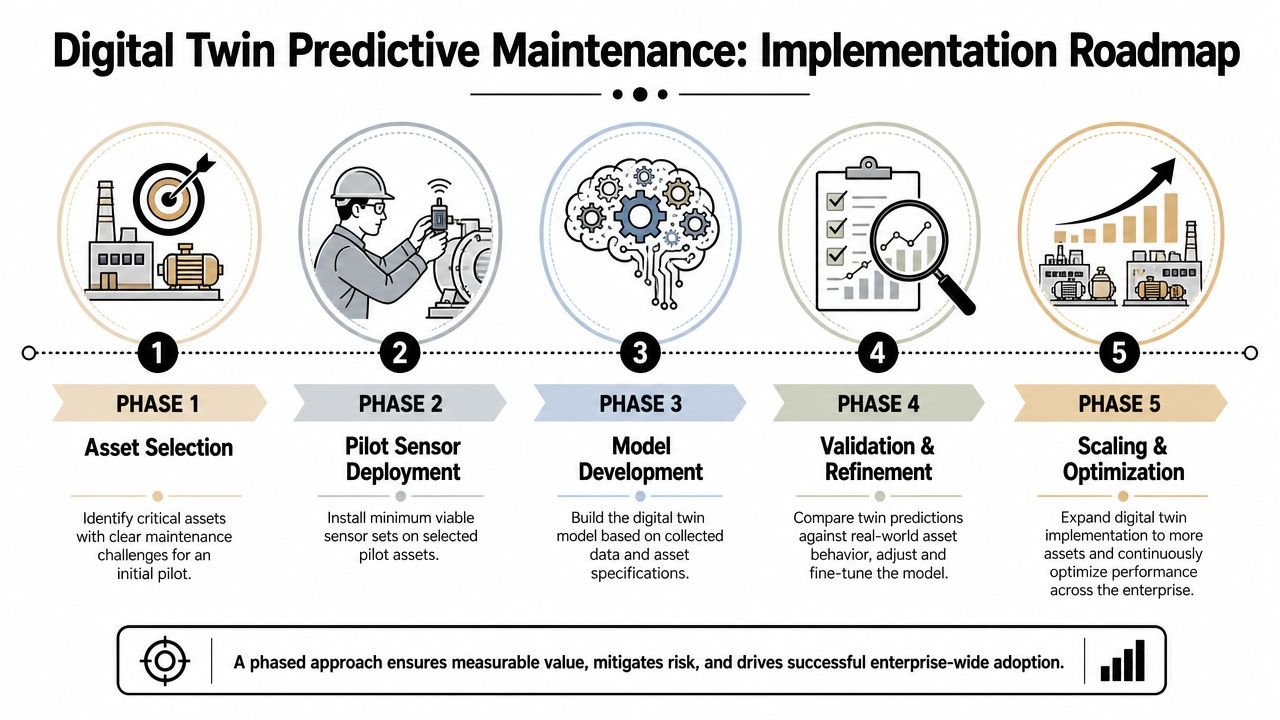
The safest way to start is with one asset family, one maintenance problem, and one decision owner. A pilot that tries to cover every machine in the plant usually turns into a long integration project with no clear finish line. A focused pilot gives you proof, lessons, and a budget story that leadership can understand.
A five-phase rollout that stays grounded
Asset selection. Start with equipment that hurts when it stops, but is still narrow enough to instrument cleanly. In small and mid-sized plants, that often means a conveyor, a torque tool cell, a pump train, or a semi-automatic station where downtime ripples quickly through the schedule.
Pilot sensor deployment. Install only the sensors you can justify. If the asset's failure pattern is mostly mechanical, vibration and temperature may be enough to begin. If the process load matters more, operational signals become the better first choice.
Model development. Build the digital representation, tune it with actual field data, and test whether it reflects the asset's behavior well enough to support maintenance decisions.
Validation and refinement. Compare twin predictions with what the equipment does. Maintenance leads become critical, because they know whether the forecast is useful in the operational schedule, not just in the software.
Scaling and optimization. Expand only after the pilot produces trusted guidance. That keeps the project budget-friendly and stops the organization from overcommitting to sensors or integrations that don't change decisions.
The technical progression behind those steps is reflected in a methodology from the International Journal of Computer Integrated Manufacturing, which describes four phases, modeling, data tuning, simulation assessment, and RUL prediction, as a stepwise path from physics-based models to actionable maintenance schedules journal article. That sequence is useful because it keeps the project honest. You don't jump from raw data to enterprise automation. You earn the right to scale by validating each layer.
For teams planning broader lifecycle improvements, the equipment lifecycle management resource fits naturally into the same conversation. It helps connect the twin to long-term asset strategy rather than treating it as a standalone software exercise.
A useful internal check is simple. If the pilot can't show how it will change a maintenance meeting, a parts order, or a planned shutdown window, it isn't ready to scale. That's why sequencing matters so much. The twin should earn trust before it asks for broader investment.
Real-World Manufacturing and Medical Device Examples
A mid-sized automotive parts plant does not need aerospace-level complexity to see value from a twin. The better fit is often a semi-automated line where a few repeating faults cause most of the disruption. In that setting, the maintenance team usually already knows where the weak points are, and the primary task is turning that practical knowledge into forecasts valuable to the line.
One useful example is a torque tool cell that begins drifting before it fails outright. If the team adds a minimum sensor set that captures vibration, load, and operating conditions, the twin can separate normal variation from a degradation pattern. That matters because the warning window becomes more useful for production scheduling, and the team can move from emergency response to planned intervention. Research reviews have found that adding a digital twin to predictive maintenance models can improve fault detection accuracy and extend failure prediction lead time, which gives planners more room to fit the work into the schedule review.
Why the same idea works differently in medical device assembly
Medical device manufacturing adds a different set of constraints. A GMP-aware assembly cell cannot treat traceability and process discipline as side issues, so the twin has to support reliability without creating new compliance headaches. That usually pushes teams toward cleaner data capture, tighter recordkeeping, and more deliberate validation.
The fastest wins often come from assets that are small enough to instrument but important enough to slow the line when they drift. Torque tools, fixture stations, and inspection steps fit that pattern because small changes can ripple into larger downstream delays. The value is not always dramatic on paper at first. It often shows up as less uncertainty for operators, quality teams, and maintenance leads.
The most valuable pilot is often the one that changes a daily decision, not the one that looks most impressive in a demo.
For manufacturers serving regulated markets, the twin earns trust by helping teams see the asset state earlier, then align maintenance and quality actions before the line has to stop. That is especially useful when the line mix includes both semi-automated equipment and manual handoffs, because hidden delays often appear in those transitions.
Common Pitfalls and Partner Selection Guidance
The biggest mistake is trying to build a perfect twin before proving it can answer one good question. Teams get trapped by over-modeling, weak data cleaning, or a sensor package that's broader than the asset requires. In brownfield plants, the harder problem is usually not the algorithm. It's the data quality, the incomplete service records, and the gap between what the software can calculate and what the maintenance crew can realistically execute.
There's also a tendency to overvalue prediction accuracy as the only success metric. That can be the wrong lens for smaller semi-automated assets, where the business case may come more from reducing uncertainty than from achieving laboratory-grade forecasting. Literature notes a gap in ROI proof for these assets and emphasizes that value often comes from reducing maintenance uncertainty rather than perfect prediction, which is an important point for cost-sensitive plants systematic review.
How to choose the right path
If your internal team already has strong OT integration, data engineering, and maintenance analytics skills, an in-house build can make sense for a tightly scoped pilot. If those capabilities are thin, a systems integrator is usually the safer route, especially when the plant needs help with brownfield interfaces, validation discipline, and practical sensor placement.
The decision should not hinge on software features alone. It should hinge on who can prove a maintenance use case quickly, who can work with partial data, and who can keep the project from becoming a dashboard project with no operating impact. A good partner should also be comfortable with phased rollout, because the first value often comes from a narrow pilot that earns the right to expand.
Selection test: ask whether the proposed twin will change parts ordering, labor planning, or shutdown timing. If it won't, the scope is probably too abstract.
For small and mid-sized manufacturers, the best projects usually balance ambition with restraint. They start where downtime matters, instrument only what's needed, and focus on one measurable maintenance outcome. That approach keeps the business case real and prevents the twin from becoming an expensive science project.
Conclusion and Next Steps
Digital twin predictive maintenance works best when it solves a real production problem, not when it adds another layer of software for the maintenance team to manage. The strongest examples show the same pattern, live data feeds a virtual model, the model helps predict failure more intelligently, and maintenance work gets scheduled with less disruption. The gains can show up in downtime, availability, lead time, and planning stability, but only if the underlying data flow is trustworthy and the scope is disciplined.
For brownfield and semi-automatic assets, the best starting point is usually smaller than people expect. A focused sensor set, a single asset family, and a pilot built around one clear decision can deliver far more value than an overbuilt enterprise rollout. That's especially true when the organization needs a credible ROI story before it asks for broader instrumentation or software integration.
The next three moves are straightforward. First, run an asset criticality analysis and choose the machine where downtime hurts enough to justify attention. Second, define the minimum sensor set that can reveal the asset's most likely failure modes. Third, bring maintenance, production, and IT or OT stakeholders into the same pilot discussion so the forecast can be tied to a real scheduling decision.
If you're planning a pilot for a conveyor, a semi-automatic station, or another asset that keeps tripping up production, start with the process, not the platform. A good twin should help your team cut uncertainty, protect throughput, and make maintenance decisions that fit the conditions of your plant.
A CTA for System Engineering & Automation.