The top 50% of manufacturing facilities using preventive and predictive maintenance achieved 15% less downtime, an 87% lower defect rate, and 66% less inventory increase from unplanned maintenance. Effective equipment maintenance procedures produce those operational gains only when technicians can execute them consistently, with reliable asset data, practical work orders, and clear accountability.
That distinction matters to manufacturers optimizing production and services. A procedure can satisfy an audit and still fail on the shop floor if it asks an understaffed technician to search through outdated records, interpret vague instructions, or work around a spreadsheet that no longer matches the equipment. The bottleneck usually isn't the absence of documentation. It's poor information quality and inconsistent execution.
Table of Contents
- Why Equipment Maintenance Procedures Are Operational Controls, Not Paperwork
- Building Your Asset Inventory and Criticality Ranking System
- Designing Preventive Maintenance Schedules and SOP Templates That Work
- Implementing CMMS with Practical Field Examples and Data Standards
- Training Competency, Contractor Management, and Maintenance Culture
- Measuring Performance with KPIs and Driving Continuous Improvement
- Commissioning, Handover, and Long-Term Maintenance Strategy
Why Equipment Maintenance Procedures Are Operational Controls, Not Paperwork
Maintenance documentation controls what happens before, during, and after a machine intervention. It specifies which sensor to check, which lubricant to use, how to verify a safety device, how to record a calibration result, and what evidence is required before releasing equipment to production. A procedure therefore belongs inside the production control system, where technicians, supervisors, and quality personnel can use it during real work.
A NIST-related analysis of manufacturing maintenance performance found that average practices consisted of 17.3% predictive maintenance, 31.8% preventive maintenance, and 45.7% reactive maintenance. That distribution exposes the execution problem in many plants. Reactive work consumes attention when production is already affected, leaving technicians less time to diagnose the underlying cause or verify whether the repair addressed it.
The performance gap is clear in facilities that rely primarily on preventive and predictive methods. The top 50% in predictive maintenance recorded 15% less downtime, an 87% lower defect rate, and 66% less inventory increase caused by unplanned maintenance, according to the same NIST-related analysis. These outcomes depend on technicians receiving accurate asset information, usable work instructions, suitable parts, and enough time to complete and document the task.
The cost of treating maintenance as support
The economic exposure extends beyond the maintenance department. A separate NIST publication estimated that 2016 machinery maintenance expenditures for NAICS 321-339 manufacturing totaled $57.3 billion, with $16.3 billion more spent on faults and failures and $119.1 billion in preventable losses tied to downtime, defects, and delayed sales. The figures show why procedure quality must be judged against operational risk, not document completeness.
For manufacturers using custom tooling, semi-automatic workstations, integrated controls, or regulated production equipment, a useful procedure tells people what to inspect, when to stop the machine, which condition requires escalation, and what evidence supports release. In GMP-aware environments, that evidence may include completed checks, calibration records, parts traceability, and an authorized return-to-service decision. A task description without those controls can pass a document review while failing during execution.
Practical rule: Judge a procedure by the technician's completed work order and the machine's verified return to service, not by the procedure's page count.
Maintenance and service teams should also participate during equipment design. Access points, diagnostic information, lubrication routes, calibration requirements, and documentation needs determine whether a machine can be maintained reliably over its useful life. Initial throughput matters, but equipment that technicians can inspect, repair, verify, and record will place fewer demands on already limited resources.
Building Your Asset Inventory and Criticality Ranking System
A maintenance program starts with an asset register that reflects the factory as it operates, not the way an engineering drawing happens to organize it. Begin with the production flow. Record each manual station, semi-automated cell, conveyor, robot, fixture, custom tool, sensor assembly, control cabinet, and supporting utility that can affect output, safety, or product acceptance.
Each record should identify the asset, location, parent system, manufacturer information, operating function, applicable manuals, spare parts, and warranty status. For integrated equipment, preserve the relationships between the mechanical assembly, electrical controls, PLC or robot program, sensors, safety devices, and tooling. A technician troubleshooting a gripper or cylinder needs the surrounding context, not an isolated asset number.
Rank risk before assigning maintenance effort
Not every asset deserves the same procedure depth or inspection frequency. Use a criticality ranking that considers:
- Production impact: Determine whether failure stops one station, constrains a line, or creates a bottleneck that affects customer commitments.
- Safety exposure: Identify stored energy, guarding, motion, pressure, heat, and other hazards that require controlled isolation and verification.
- Quality and regulatory exposure: Flag equipment that affects measurement, sterilization, product characteristics, traceability, or GMP-related records.
- Detectability: Ask whether deterioration is visible during routine checks or requires instrumentation, calibration, or condition monitoring.
- Recovery options: Record whether a bypass, alternate machine, spare tool, or qualified contractor exists.
Regulated medical device production deserves particular discipline. A calibration record, replacement-part decision, deviation, and proof of completion may need to support an audit trail and change-control process. An auxiliary facility asset may still need safe maintenance, but it won't necessarily require the same evidence package as equipment that directly influences product acceptance.
Use the ranking to choose the maintenance method
High-criticality assets usually justify detailed time-based procedures, condition checks, and stronger post-maintenance verification. Lower-risk assets may use simpler inspections or run-to-failure where the business has consciously accepted the consequence. The decision should be documented, because “we've always done it this way” isn't a defensible maintenance strategy.
Plant Engineering's report found that 78% of manufacturing facilities used a preventive maintenance strategy, 61% had a computerized maintenance management system, and 56% still used some run-to-failure methods, as reported in Plant Engineering maintenance statistics. The same report found that 53% allocated up to 10% of annual operating costs to maintenance, 30% devoted more than 10%, and the average facility spent 20 hours per week on scheduled maintenance. Those figures reinforce the need to allocate limited labor deliberately rather than spread identical procedures across every asset.
Designing Preventive Maintenance Schedules and SOP Templates That Work
A preventive maintenance schedule becomes useful only when technicians can execute it under real production constraints. It must reflect equipment duty, access, production windows, safety controls, available labor, and technician capability. “Inspect monthly” leaves too much judgment to the shift. “Inspect the gripper jaw for wear, verify sensor response, check mounting fasteners, record results against acceptance criteria, and escalate out-of-range conditions” creates a repeatable task.
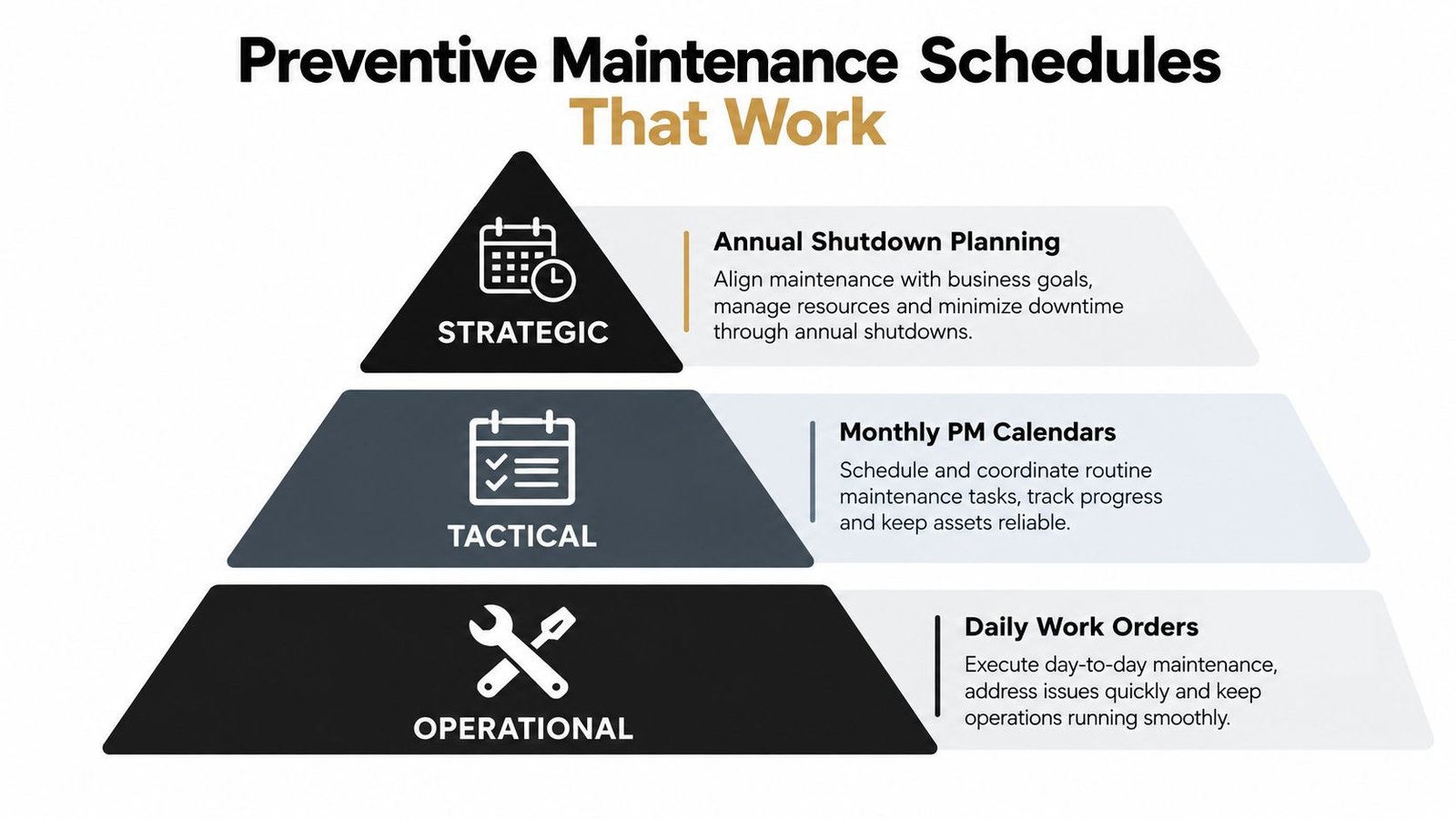
Use three connected planning levels:
- Strategic: Align annual shutdowns, major service, validation needs, and production demand.
- Tactical: Build monthly calendars around asset criticality, labor, parts, permits, and planned access.
- Operational: Release daily work orders with clear steps, expected duration, tools, safety controls, and completion evidence.
Across industrial facilities, 88% use preventive maintenance, 52% have a CMMS, and 51% still use run-to-failure for at least part of their equipment, according to the Plant Engineering maintenance report. The report also describes a closed loop: asset register, task-based intervals, condition checks, work-order execution, post-maintenance verification, and trend review. This model connects written intent to verified equipment condition instead of leaving the schedule as a static checklist.
Build the SOP around execution
A usable SOP should contain:
- Asset identification, location, and procedure revision.
- Inspection points and the reason each point matters.
- Step-by-step instructions in the order the technician performs them.
- Safety precautions, isolation requirements, and PPE.
- Required tools, test equipment, materials, and spare parts.
- Acceptance criteria, including measurable limits where appropriate.
- Technician notes for abnormal findings and follow-up work.
- Sign-off by the person completing the task and any required reviewer.
This structure reflects recommended equipment maintenance checklist elements. In GMP-aware environments, add calibration status, deviation handling, replacement-part traceability, and proof of release. A completed checkbox does not demonstrate control if the work changes a validated condition or leaves a discrepancy unresolved.
A short procedure that technicians follow correctly is more valuable than a detailed procedure that the shift routinely bypasses.
Unplanned repairs cost 3 to 9 times more than equivalent planned interventions, as noted in the Plant Engineering report. Use an equipment maintenance schedule to coordinate service windows with operations, but do not increase task volume without checking its value. Low-value inspections consume the same scarce labor required for critical work. Review missed tasks, repeat findings, and overdue approvals regularly, then revise the procedure where execution fails.
Implementing CMMS with Practical Field Examples and Data Standards
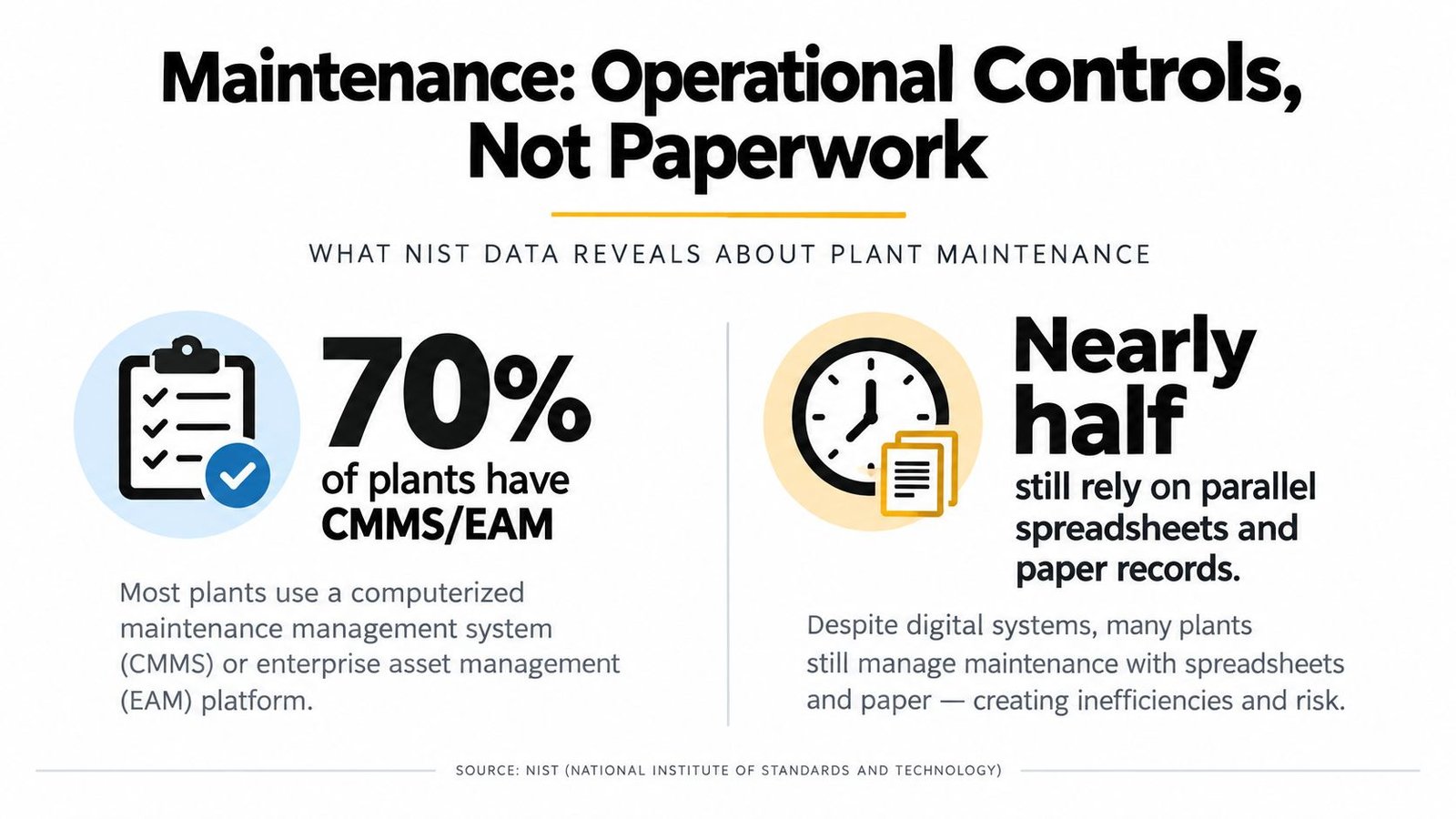
A CMMS only improves maintenance when it controls decisions at the point of work. About 70% of plants have a CMMS or EAM, while nearly half still use spreadsheets in parallel, according to 2025 manufacturing maintenance coverage. That split creates conflicting due dates, incomplete histories, and uncertainty about which record governs the job. The hidden bottleneck is rarely software access. It is consistent execution with reliable information.

Define the minimum data required for each work-order type. An inspection may capture asset ID, task code, operating hours or cycles, condition result, measurement, finding, technician, date, and follow-up action. A corrective order should also record the failure symptom, suspected cause, isolation status, parts used, repair performed, test result, and release approval. A calibration order needs the instrument ID, standard used, before-and-after result, next due date, and disposition when results fall outside acceptance criteria.
Make data entry fit the technician's work
Mobile execution should display the approved procedure at the asset, let technicians scan or select the correct equipment, and avoid repeated typing. It should support findings, useful photographs, and follow-up work within the same workflow. Required fields should serve operations, quality, engineering, or reliability decisions. Fields that nobody reviews will be skipped or completed with low-quality entries.
Use consistent names for assets, failure codes, causes, actions, and units of measure. Build the hierarchy around the plant, such as line, cell, station, tooling, and component, rather than around software folders. Version-control each procedure, document approval, and show the effective revision at the point of work. In GMP-aware environments, the record must also preserve traceability for deviations, replacement parts, calibration status, and release decisions.
Resource limits shape the rollout. 45% of maintenance leaders cite lack of resources as their biggest challenge, and the same industry coverage notes continuing difficulty with standardized work orders, mobile execution, and KPI discipline. Start with the team and data quality available, then improve both through controlled use.
A practical transition checklist is:
- Clean the asset master: Remove duplicates and assign owners to incomplete records.
- Standardize work orders: Set required fields and controlled selections for recurring tasks.
- Load critical PMs first: Migrate work for assets with the highest production, safety, or quality risk.
- Pilot mobile completion: Observe technicians performing real jobs and remove unnecessary clicks.
- Review exceptions weekly: Examine overdue work, repeat failures, missing readings, and unresolved deviations.
- Retire parallel records: Keep a controlled contingency process, but prevent spreadsheets from becoming the unofficial system.
For critical assets, implementing predictive maintenance should follow data readiness. Sensors and models cannot compensate for an asset history technicians do not trust.
A field inspection demonstration follows, showing how captured information can support a repeatable workflow.
Training Competency, Contractor Management, and Maintenance Culture
A written procedure can't compensate for an unqualified person performing the task. Competency includes technical skill, equipment familiarity, safety behavior, ability to recognize abnormal conditions, and ability to document the result accurately. Managers should validate those capabilities against actual work, not only against attendance at a training session.
A practical training matrix maps each technician and operator to the assets and tasks they may perform independently, under supervision, or not at all. Include electrical and mechanical tasks, controls and diagnostics, calibration activities, isolation procedures, and documentation requirements. When an integrator changes a fixture, sensor arrangement, PLC sequence, or safety circuit, update the matrix and procedure together.
Control contractor work as part of the system
Contractors need the same work definition and evidence standard as internal staff. The purchase order or service agreement should identify the asset, scope, safety requirements, deliverables, required measurements, parts documentation, unresolved findings, and release authority. A contractor's service report should enter the same controlled history as an internal work order.
For medical device environments, third-party work may affect validated equipment or product quality. Require review of deviations, calibration evidence, component substitutions, and change implications before production resumes. If a contractor uses a different naming convention or records results in a separate portal, assign an internal owner to reconcile the record.
Put operators inside the maintenance routine
The U.S. EPA explanation of Total Productive Maintenance defines TPM as a plant-wide approach that assigns operators a daily role in equipment care to maximize overall equipment effectiveness. Its autonomous maintenance model includes precision checks, lubrication, parts replacement, simple repairs, and abnormality detection.
That doesn't mean operators should perform work outside their competence. It means they can own basic cleaning, visual checks, abnormality reporting, and defined care tasks while qualified maintenance staff handle specialized intervention. This division reduces the time between detecting a problem and creating a controlled response.
Accountability test: If a technician finds an abnormal condition, the procedure should make the next action obvious, assign ownership, and preserve the evidence.
Review procedures after equipment modifications, recurring defects, near misses, or repeated technician feedback. A maintenance culture grows when managers act on those observations instead of treating deviation from the SOP as only a personnel problem.
Measuring Performance with KPIs and Driving Continuous Improvement
Maintenance KPIs should answer operational questions. Are critical assets available when production needs them? Are technicians completing planned work? Do repairs restore the machine properly? Are failures recurring because the procedure is weak, the interval is wrong, or the asset has a design problem?
Use a compact dashboard rather than collecting every possible measure. A useful set includes:
- Uptime and availability: Show whether equipment is ready for production.
- MTBF: Indicate how frequently failures interrupt operation.
- MTTR: Show how quickly the team restores service.
- Schedule compliance: Reveal whether planned work is completed when due.
- Planned versus reactive work: Show whether the program is moving away from emergency dependence.
- Maintenance cost per unit: Connect maintenance effort to production output.
- Repeat failure and rework: Identify repairs that didn't remove the cause.
- Calibration and deviation status: Support quality oversight in regulated operations.
Set a baseline before changing the schedule. Then review trends with production, quality, engineering, and maintenance together. A rising task completion rate means little if repeat failures increase. More frequent inspections may help a deteriorating bearing, but they may also indicate that the team is compensating for poor equipment design or an incorrect maintenance method.
Treat predictive maintenance as an implementation problem
Industry research reports that 60 to 70% of predictive maintenance initiatives fail to hit target ROI within the first 18 months. Facilities that resolve implementation barriers can reach 85 to 90% successful deployment, 40 to 55% maintenance-cost reductions, and 30 to 45% higher asset availability, according to the predictive maintenance implementation research.
Those figures shouldn't encourage a plant to buy sensors before fixing its workflow. Instrument critical assets, validate sensor and work-order data, build failure models using historical context, and connect alerts to a work-management process. An alert that no technician trusts or owns is just another unclosed task.
Use a regular improvement loop:
- Measure: Capture failures, completion, condition results, and quality consequences.
- Analyze: Separate symptoms from causes with failure-mode review and root-cause analysis.
- Act: Change the procedure, interval, parts strategy, training, or equipment design.
- Improve: Verify the change through subsequent work orders and KPI trends.
For GMP-aware operations, quality and maintenance teams should review deviations and calibration findings alongside reliability measures. That connection prevents the organization from improving uptime by weakening traceability.
Commissioning, Handover, and Long-Term Maintenance Strategy
Maintenance execution is shaped before equipment reaches the production floor. During design and procurement, require an equipment package containing operating manuals, drawings, parts information, safety documentation, recommended maintenance tasks, calibration requirements, and training materials. Specify access points that let technicians inspect and replace wear items without avoidable production disruption.
Commissioning must test the maintenance workflow as well as machine function. Verify that technicians can isolate the equipment, locate critical components, interpret alarms, reach maintenance points, complete each procedure, and record the result in the CMMS. Have operations, maintenance, and the integrator perform the first tasks together. Their questions often reveal missing steps, unclear terminology, or inaccessible components while changes remain practical.
Use a controlled handover package
The handover package should include:
- Asset hierarchy and identification records.
- Approved maintenance procedures and revision history.
- Preventive task frequencies and condition thresholds.
- Critical spare parts and supplier information.
- Calibration and verification requirements.
- Safety and lockout documentation.
- Training records and competency expectations.
- Open issues, warranty conditions, and escalation contacts.
Written instructions should cover identification information, inspection points, step-by-step procedures, safety precautions and PPE, tools and materials, acceptance criteria, technician notes, and sign-off sections, consistent with equipment maintenance procedure guidance. In GMP-aware operations, include the records needed to demonstrate controlled execution, review deviations, and document disposition. A procedure that cannot be followed or recorded during a real shift is not ready for release.
Set time-based preventive work where planning is straightforward, compliance requires it, or failure behavior is established. Use condition-based or predictive methods when deterioration can be measured, the data is trustworthy, and technicians have time and authority to act on the signal. A hybrid strategy usually suits plants with manual, semi-automatic, and automated assets better than one method applied across the entire equipment base.
Lifecycle decisions belong in the original equipment review. Equipment lifecycle management connects commissioning, service, upgrades, spare parts, and replacement planning, so the maintenance strategy does not weaken after warranty expiry. Revisit procedures when production demand, component availability, software, or equipment condition changes.
System Engineering & Automation provides manufacturing solutions including semi-automatic systems, custom tooling, fixtures, integrated controls, installation, commissioning, maintenance planning, and ongoing equipment support. Its team can help convert written procedures into repeatable shop-floor execution aligned with production and GMP-aware requirements.