
Say your new filling line arrives on schedule, passes the supplier's demonstration, then sits idle for three weeks because nobody owned the loop checks. Production wants a startup date, the supplier says the machine worked before shipment, and your maintenance team is tracing signals without an approved test sheet.
That's where installation and commissioning need different definitions and different sign-offs. Installation gets equipment physically built and connected. Commissioning produces the evidence that it works as specified, and transfers enough knowledge for your people to keep it working after the integrator leaves.
Table of Contents
- Installation and Commissioning Stages at a Glance
- Who Owns Each Step From Supplier to Plant Floor
- How to Run FAT, SAT and SIT in Sequence
- Qualification Evidence for Regulated Production Lines
- Safety and Cybersecurity Checks Before Startup
- Handover Readiness and Operator Skills Transfer
- Confirm Your Commissioning Plan Before Production Release
Installation and Commissioning Stages at a Glance
A machine can be level, anchored and powered while still being unready for production. The missing work may be a reversed sensor signal, an undocumented permissive or a utility supply that falls below the equipment's requirement during a cycle.
In the filling-line scenario, energizing the panel won't resolve the ownership gap. Plant engineering must confirm utility readiness, the controls team must prove the signals, and operations must agree on what successful production looks like. Delivery, installation and acceptance are separate milestones.
Use this working stage register to assign the activity, its lead and the record that demonstrates completion.
Commissioning stages, leads and evidence
| Stage | Main activity | Typical lead | Evidence produced |
|---|---|---|---|
| Site preparation and utilities | Foundations, power, compressed air and network connections ready | Plant engineering | Signed utility readiness checklist |
| Mechanical installation | Machine set, levelled, anchored and guarded | Equipment supplier with installer | Installation record and alignment data |
| Electrical and I/O checks | Wiring, grounding and loop checks for each I/O point | Integrator controls team | Loop-check record per I/O point |
| Factory Acceptance Test | Controls and sequences tested at the supplier | Supplier, witnessed by customer | Signed FAT report and punch list |
| Site Acceptance Test | Machine tested on site with real utilities and layout | Integrator with plant team | SAT report with retest evidence |
| Site Integration Test | Handshakes and alarms with upstream and downstream equipment | Integrator and production | Integration test record |
| Performance qualification and handover | Repeat production runs at target rate | Plant quality and operations | PQ report and handover pack |
Read the evidence column as a release gate
The table groups the work packages, not the shipping chronology. FAT happens at the supplier before shipment, while site preparation can proceed in parallel; electrical and I/O checks occur at the relevant build location and are repeated where installation changes the circuit.
Within each dependency, close the preceding stage with a signed record before authorizing the next activity. An empty evidence cell is a warning that someone may be treating an assumption as a completed check.
Practical rule: A verbal “it's ready” should identify the signed record that makes it ready.
Make those records usable on the plant floor. An installation record should show actual alignment readings and the drawing revision used, not just a tick beside “mechanical complete.” A utility checklist should identify the connection and the condition measured while relevant equipment is operating.
You can accelerate a project by preparing protocols and completing independent work in parallel. You can't safely recover time by deleting the checks that authorize energization or operation.
Mark which stages your current project has covered, then circle every stage that still has no named owner or evidence file.
Who Owns Each Step From Supplier to Plant Floor
Treat ownership gaps as the first commissioning problem to eliminate. A technical fault has a troubleshooting path; an unassigned interface can leave the supplier, integrator and plant team waiting for someone else to act.
The supplier knows the machine's design. The integrator knows how its controls connect to the process. The plant team owns operating requirements, site conditions and the consequences of accepting the installation. Those responsibilities overlap, but they shouldn't be interchangeable.
Responsibilities across supplier, integrator and plant
| Task | Equipment supplier | Integrator | Plant team |
|---|---|---|---|
| Design review and sequence of operations | Provides drawings and specifications | Confirms controls logic and interfaces | Approves operating requirements |
| Mechanical build and FAT | Leads and runs the test | Supports with controls checks | Attends and reviews results |
| Site installation and utilities | Supplies manuals and support | Leads controls connection | Provides utilities and site access |
| Cybersecurity sign-off | Discloses remote access and software versions | Configures segmentation and access control | Owns final approval and policy enforcement |
| Operator and technician training | Provides equipment documentation | Delivers controls and fault-finding training | Confirms competency sign-offs |
| Spare parts and maintenance documents | Lists recommended spares | Hands over programs and verified backups | Takes ownership of spares and records |
Choose coordination without surrendering acceptance
A single point of contact simplifies scheduling and interface decisions. It doesn't remove the plant's responsibility to approve requirements or accept results.
At System Engineering & Automation, our turnkey project management covers concept to commissioning, including design, programming, installation and support. Every engagement begins with a detailed, hands-on evaluation of the customer's current systems. That starting point helps connect the proposed work to existing operating constraints rather than treating the new machine as an isolated purchase.
A split-contract arrangement can also work. The trade-off is that the plant must actively coordinate interfaces, drawing revisions, test attendance and corrective work. If a conveyor handshake fails, the contract boundaries shouldn't determine whether anyone investigates it.
Name a plant representative to maintain the master punch list. That person controls item identifiers, owners, due dates and evidence references, while the relevant technical or quality authority approves closure.
Separately, name the person who approves remote and network access before any vendor connects. Don't let an installation technician inherit that authority because they have the laptop.
A single project contact coordinates the work. The designated acceptance authority decides whether the evidence is sufficient.
Settle these questions before signing the purchase order:
- FAT authority: Who signs the supplier test, and what happens if an acceptance criterion fails?
- Code custody: Who owns the controls code, required project files and recoverable backups?
- Site acceptance: Who accepts the site test, including exceptions that affect production or maintenance?
Write the answers into the project responsibilities, not just the meeting minutes.
How to Run FAT, SAT and SIT in Sequence
Structured testing separates electrical, software, mechanical and process faults so they aren't all discovered together at production startup. The Instrumentation Tools commissioning guidance describes FAT, SAT and SIT alongside loop checks and calibration, with functional tests comparing observed responses against specified responses.
A useful protocol tells the tester what condition to create, what should happen and what evidence to retain. “Check automatic operation” isn't a reproducible instruction.
Build the test sequence before testing
Use the following flow to keep supplier verification distinct from site and integration testing.
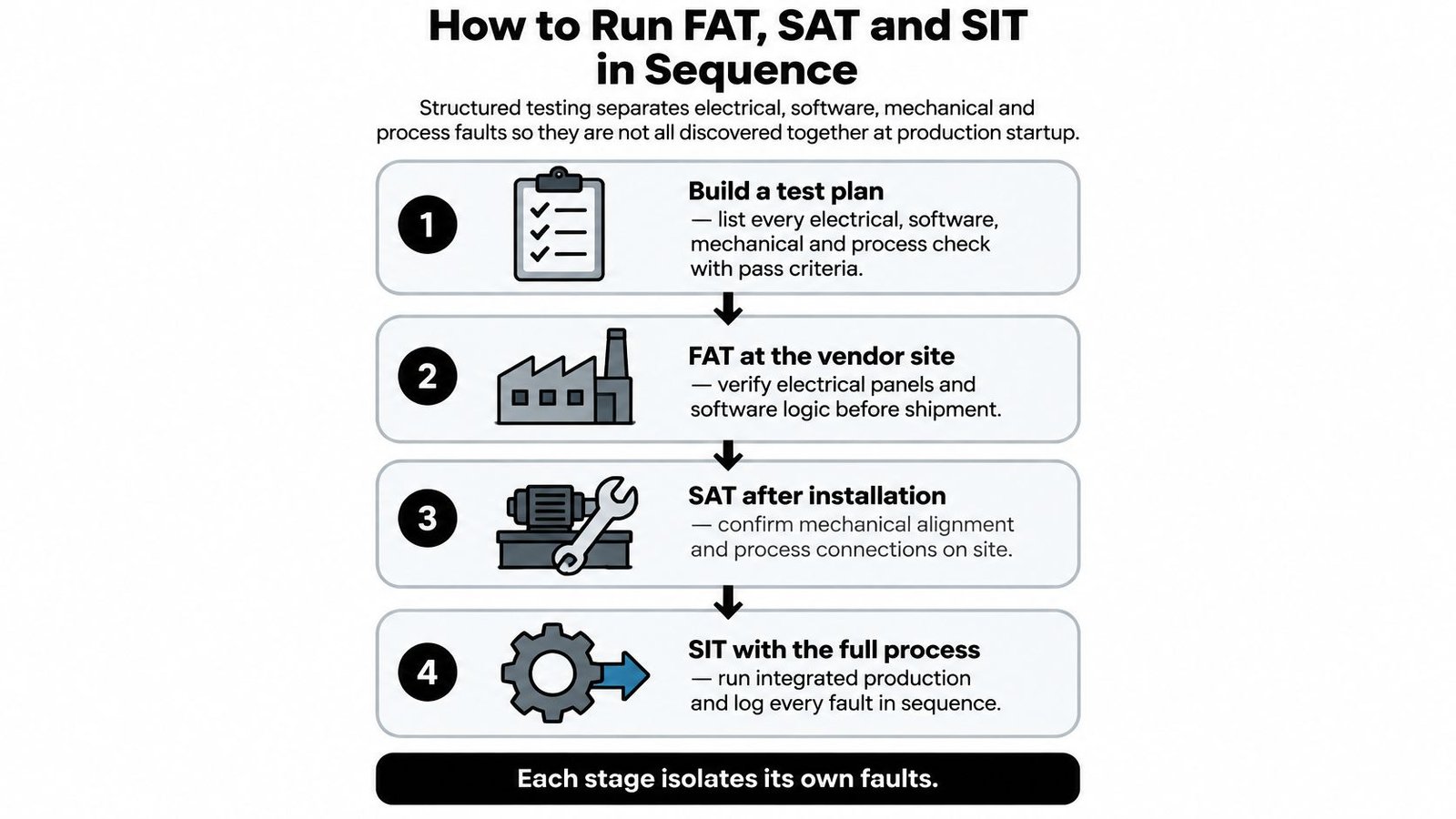
Build a traceability matrix. Start with the approved sequence-of-operations document and requirements, creating a row for each I/O point and each control sequence, with its acceptance criterion and evidence reference. The common slip is writing tests around available software screens rather than the behavior the plant specified.
Run loop checks on every I/O point. Record the device tag, wiring reference, signal range, simulated input and observed controller or output response, using a calibrated signal simulator or suitable test instrument. Don't stop at confirming a value on the HMI; prove that it belongs to the correct field device and engineering units.
Run the FAT at the supplier. Have the customer witness manual and automatic modes, normal and contingency operation, operator controls, interlocks, permissives and the defined failure state of every output using safe, approved simulations. Testing only the successful automatic cycle leaves recovery behavior unproven; establish the scope and witness expectations in the factory acceptance test plan.
Ship, install and perform the SAT. Repeat critical tests using real utilities, field wiring and the actual layout, recording anything that shipment or installation could have changed. Don't assume a supplier result proves a relocated sensor, reterminated cable or site air supply; our shipping and setup process includes shipping to the customer's location, on-site setup and installation, unpacking and full buy-off.
Run the SIT with connected equipment. Check upstream and downstream handshakes, alarms, timing, blocked conditions, starvation and restart behavior across the complete operating boundary. A common slip is proving that machines exchange signals without proving that they recover coherently when either machine stops.
Control failures through the punch list. Record the failed requirement, observed behavior, responsible owner, corrective action and retest evidence. Never close an item because someone downloaded a program change; close it when the specified response has been demonstrated.
Keep speed separate from skipped evidence
Prepare test materials, simulation methods and witness availability before the machine is ready. That saves time without weakening acceptance.
Where a FAT uses simulated equipment interfaces, label those results clearly and retain the corresponding site integration tests. Simulation is useful evidence about logic, but it isn't evidence about an unconnected field installation.
The release test is explicit: every matrix row closed, no open punch-list items, and FAT, SAT and SIT records signed. A cycle-time demonstration doesn't substitute for that decision.
Qualification Evidence for Regulated Production Lines
A machine that runs isn't necessarily a qualified production line. Qualification must show that the installation is correct, operation stays within approved limits and the process produces consistent results under intended conditions.
EU GMP Annex 15 distinguishes Installation Qualification, Operational Qualification and Performance Qualification, with protocols defining critical systems, parameters, test methods and acceptance criteria in advance. Deviations must be documented and scientifically justified rather than explained away after an unsuccessful run.
Qualification stages and what each one proves
| Stage | Question it answers | Typical evidence |
|---|---|---|
| Installation Qualification (IQ) | Is the system installed as the approved drawings and specifications say? | Verified drawings, component lists, software versions and calibration status |
| Operational Qualification (OQ) | Does the system operate within defined limits? | Tests of alarms, interlocks, recipe limits and operator access controls |
| Performance Qualification (PQ) | Does the system produce consistent output under production conditions? | Representative production runs with recorded acceptance results |
Assemble evidence around the process risk
For a semi-automated medical-device workstation, collect records that identify both the installed configuration and the process being qualified:
- Configuration baseline: Approved drawings, component identification and installed software versions.
- Measurement readiness: Calibration status for instruments used to control or verify critical parameters.
- Functional boundaries: Safety and interlock results, recipe limits, parameter limits and alarm verification.
- Controlled operation: Operator access permissions and representative production-run results.
Use the GMP equipment requirements as a planning reference, then have your quality team determine the applicable qualification scope. GMP-aware design practices help prepare evidence; they don't replace the manufacturer's quality-system decisions.
The FDA quality-system overview explains that process validation is required when results can't be fully verified through subsequent inspection or testing, and describes documentation of validation activities and results, including approval dates and signatures. The practical implication is to agree on the evidence before running qualification, not reconstruct it from production notes afterward.
Include personnel in the qualification boundary
Equipment evidence alone won't demonstrate that the plant can maintain the process. In CECIMO's skills-gap report, 63% of surveyed companies reported significant or very significant shortages in mechanical and industrial engineering skills.
Account for that constraint when scheduling qualification personnel and allocating technical review. Record who is authorized to execute a protocol, assess a deviation and approve the result, rather than assuming anyone available can substitute.
Don't automatically relabel FAT or SAT results as qualification evidence. Quality should assess whether their protocols, acceptance criteria, configuration controls and approvals support the intended use.
For every record in the qualification pack, name the protocol that covers it. If no protocol applies, resolve that gap before accepting the record as proof.
Safety and Cybersecurity Checks Before Startup
Safety and security aren't finishing tasks to complete after the machine achieves rate. OSHA's 2024 injury-and-illness summary identified 550 robot-related incidents in U.S. manufacturing, with cuts, fractures and musculoskeletal disorders among the reported injuries.
Plan the work boundary before anyone energizes equipment.

Separate pre-power checks from controlled functional tests
Before first power-up, approve the cell risk assessment, inspect safeguarding and establish isolation procedures for electrical, pneumatic, hydraulic, gravity and stored energy. Then, under an authorized test procedure with personnel protected, deliberately trip guards, light curtains and interlocked doors to verify the specified response and restart prevention.
Confirm reduced-speed and teach-mode behavior where applicable. Train operators on the actual machine, including safe recovery, rather than relying on a generic safety presentation.
Cybersecurity requires a similarly deliberate acceptance boundary. The industrial-automation threat report from Kaspersky ICS CERT identifies commissioning as a stage where cybersecurity is often an afterthought.
Make security testable
Include these checks in the industrial network security review:
- Asset inventory: Identify controllers, HMIs, engineering laptops, operating systems and installed software.
- Identity and access: Remove default passwords, assign accountable users and restrict privileges.
- Remote support: Approve vendor access paths, control when they're enabled and record who authorizes them.
- Segmentation: Separate office and control networks through the approved architecture.
- Recovery: Test backup restoration on a compatible spare machine or isolated test environment.
- Operator response: Teach personnel how to report unexpected prompts, connections or device behavior.
A small or mid-sized plant shouldn't accept an unmanaged commissioning laptop or unsupported operating system without an explicit disposition. Record the exposure, responsible owner and corrective plan instead of letting temporary equipment become permanent infrastructure.
Use the following video as a discussion aid, not a replacement for machine-specific procedures.
Before startup approval, require a tested safeguard for each hazard, a named approver for each remote path and a proven restore.
Handover Readiness and Operator Skills Transfer
Acceptance confirms that the contracted tests passed. Handover confirms that your people can operate, diagnose and maintain the system within their assigned authority.
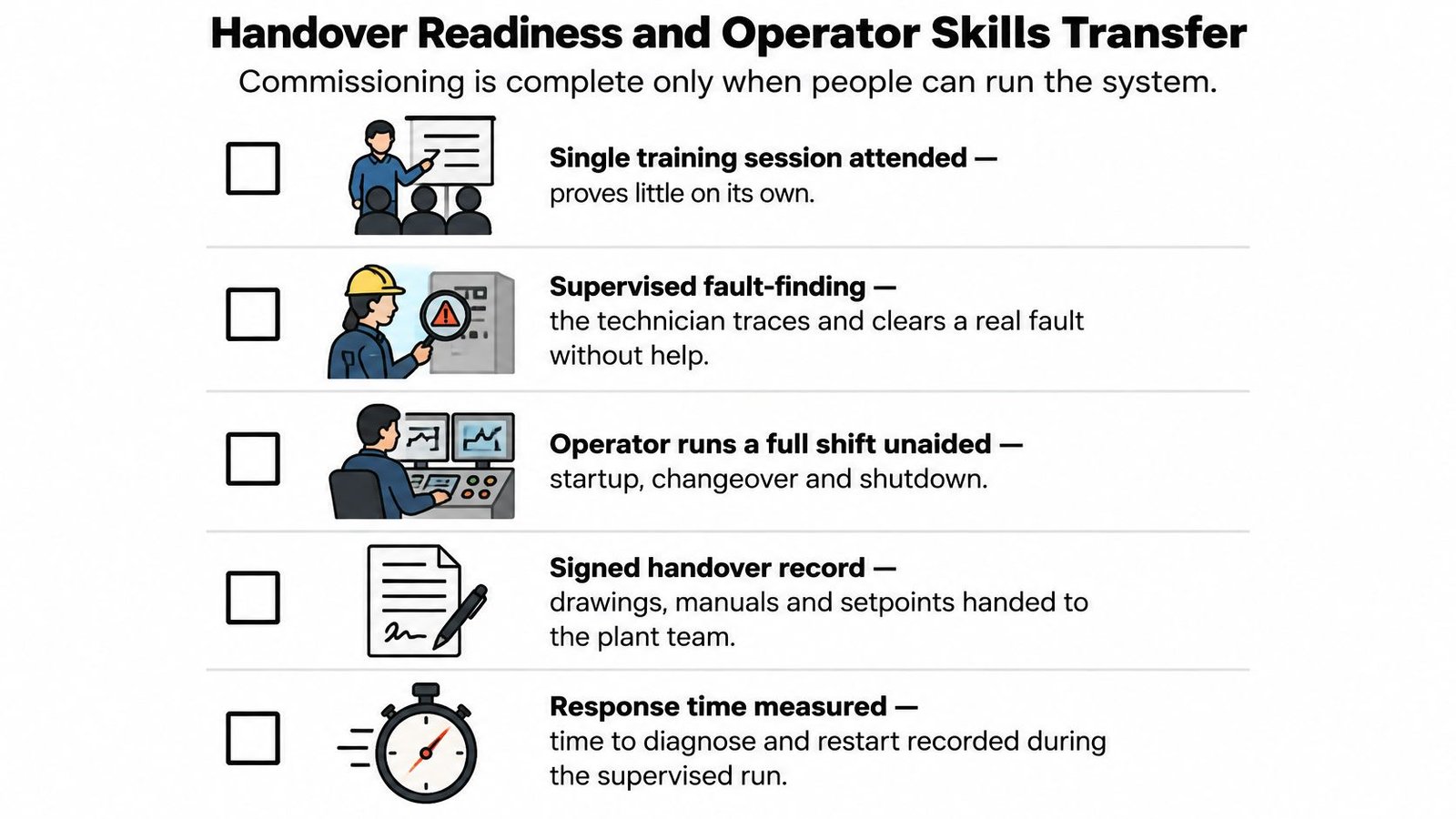
Attendance at a training session proves attendance. Readiness appears when a technician traces a safely introduced sensor fault, identifies the cause and restores operation without the trainer supplying the answer.
Train each role for its actual decisions
Operators need startup, changeover, shutdown, alarm response and escalation practice. Maintenance technicians need signal tracing, component replacement, isolation and controlled recovery. Engineers need configuration management, parameter control and the boundaries around authorized software changes.
Give each role a competency sign-off, not just a shared attendance sheet. Where a task exceeds someone's authority, successful performance means stopping and escalating correctly, not improvising a workaround.
Use this checklist to organize the people side of handover.
Test whether the plant can take ownership
Build the final handover around observable actions and accessible records:
- Fault-finding exercise: Each technician completes a supervised diagnostic task, with the fault, actions and outcome signed off.
- Recipe change: An operator performs an authorized change, checks the selected limits and verifies the resulting setup.
- Recoverable programs: Verified controller backups and required project files are stored off the machine in a plant-controlled location.
- Spare-parts ownership: The parts list identifies a responsible owner, stocking decision and reorder point.
- Escalation coverage: The contact matrix records responsibilities and agreed response times.
- Maintenance execution: The maintenance schedule is loaded into the plant system, with tasks assigned and supporting instructions accessible.
For medical-device production, connect training records to process-validation evidence so the plant can identify qualified personnel for each validated task. The FDA process-validation guidance connects validated operation with qualified individuals and documented monitoring and control.
Handover test: Remove the trainer from the conversation and observe whether the team can make the next authorized decision.
There's a trade-off between extended supervised practice and an earlier departure for the commissioning team. Resolve it by prioritizing high-consequence faults and routine production tasks, then documenting any remaining training restrictions before the equipment changes hands.
At SEA, we commit to long-term support and maintenance after equipment delivery. A long-term support and maintenance agreement can carry the records forward, but the plant should still retain its own controlled copies and internal ownership.
Confirm Your Commissioning Plan Before Production Release
Make the release decision go or hold, based on evidence rather than schedule pressure. The stage register needs a signed record in every evidence cell, the responsibility matrix needs named people, and each hazard, remote path and qualification record needs a traceable evidence file.
Hold production release until those gaps close, even if the machine has passed its cycle-time check. Passing rate proves only the conditions tested.
Bring the unresolved work to a decision
Prepare a review pack containing:
- Current stage table: Show completed gates and missing approvals.
- Responsibility matrix: Identify unresolved ownership.
- Open punch list: Include failed criteria and proposed retests.
- Missing-record register: Identify documents needed for acceptance.
System Engineering & Automation's consultations are free and come with no obligation. We use the manufacturing automation consultation to understand current bottlenecks, labor and production constraints, quality or consistency concerns, and budget and timeline expectations before agreeing on a plan.
Finish the review with a disposition for every open item: release, hold or re-test, supported by a date and named owner. Items marked hold return to the stage register until their evidence exists.
System Engineering & Automation provides engineering, installation and commissioning support to help manufacturers improve production without losing control of acceptance evidence. Visit System Engineering & Automation to arrange a free, no-obligation consultation, and bring your stage register, responsibility matrix and unresolved startup issues for a practical review.