
A fixture that holds a part steady during assembly costs a fraction of a filling line. So why do quality teams hand it the same qualification template?
That question sits at the center of GMP equipment requirements, and it's where projects lose the most time. The rules ask for control proportionate to risk. The paperwork on most shop floors doesn't work that way. It gets copied from the last big project, trimmed in a hurry, and signed by someone who never asked what the equipment does to the product. The distance between what a regulation demands and what a specific machine needs is where audits are won and lost.
Table of Contents
- GMP Equipment Requirements at a Glance
- Design Rules for Product-Contact Surfaces
- Qualification Stages From DQ to PQ
- Cleaning, Maintenance and Written Procedures
- Right-Sizing Qualification for Each Equipment Class
- Cleaning Validation for Fixtures and Medical Device Stations
- Document Every Equipment Change Before Startup
GMP Equipment Requirements at a Glance
GMP equipment requirements cover seven connected areas: how equipment is designed and located, which materials touch the product, how it's cleaned and maintained, what written procedures govern that work, how it's qualified, how cleaning effectiveness is proven, and how changes are assessed before they go live.
A kitchen counter is the easiest comparison. It has to be easy to wipe down, it must not leach into the food, and the routine behind it (the cloth, the sanitizer, the person who does it) matters as much as the surface itself. Inspectors judge equipment the same way. They look at how it's built, and they look at the procedure that keeps it that way.
| Requirement area | What the rule asks for | Where it appears |
|---|---|---|
| Equipment design and location | Appropriate design, adequate size and suitable location for intended use, cleaning and maintenance | 21 CFR 211.63 |
| Product-contact materials | Surfaces not reactive, additive or absorptive in ways that alter safety, identity, strength, quality or purity | 21 CFR 211.63 |
| Cleaning and sanitizing | Cleaned and maintained at suitable intervals, sanitized or sterilized where appropriate, to prevent contamination or malfunction | 21 CFR 211.67 |
| Written procedures | Six control areas: responsibility, schedules, methods and materials, disassembly, batch ID removal, protection before use | 21 CFR 211.67 |
| Qualification | Specification, then design, installation, operational and performance qualification | EU GMP Annex 15 |
| Cleaning validation | Demonstrated effectiveness of cleaning for product-contact equipment, not only documented cleaning | EU GMP cleaning guidance |
| Change control | Documented assessment when equipment, tooling or methods change in ways that could affect quality | EU GMP Annex 15 |
The reach of these rules surprises people. Design and cleaning obligations attach to equipment used to manufacture, process, pack or hold product, which pulls storage racks, transfer carts and inspection stations into scope alongside the reactor. The U.S. framework and the European framework use different vocabulary for the same logic. Washington writes design and cleaning expectations as regulation; Brussels writes qualification and change control as guidance that member states enforce. A machine built for one market usually satisfies the other, provided the documentation trail exists.
What separates a compliant build from a painful one is rarely the steel. It's whether someone wrote down what the equipment must do before the drawings were frozen, and whether the cleaning method was chosen alongside the geometry instead of after installation.
Where to start: identify the two or three areas that match your equipment, then work through the matching section in order. A manual fixture rarely needs all seven; a filling line usually does.
Design Rules for Product-Contact Surfaces
Design is a compliance decision, not an engineering preference. The U.S. pharmaceutical GMP rules for equipment make four demands of any machine that touches product: appropriate design, adequate size, a location that supports cleaning and maintenance, and product-contact surfaces that are not reactive, additive or absorptive in any way that could alter the product's safety, identity, strength, quality or purity. Read those four together and the message is blunt. A brilliant mechanism that can't be cleaned is a non-conforming mechanism.
Three failures that pass a drawing review and fail an audit
A blind pocket in a machined fixture is the classic. The part sits in a recess that a brush can reach but a spray can't, so residue accumulates in a place nobody inspects. A dead leg in a fluid line creates a stagnant branch where product sits and bioburden grows; a few centimetres of pipe can turn a validated cleaning cycle into a guess. A painted frame near the product zone is quieter and worse. The coating chips, the chips land where they shouldn't, and the investigation starts with a foreign-matter complaint.
None of these show up as defects on a mechanical drawing. All of them show up in a deviation report eighteen months later.
The five checks I apply to any drawing
Run these before fabrication, not after:
- Minimise retention points. Crevices, seams, lap joints, threaded holes that break into the product zone, and dead legs should be designed out or explicitly justified.
- Match materials to the actual cleaning agent. The detergent your cleaning procedure names is the one the surface must survive. A material that tolerates water can still pit under a caustic wash.
- Give the surface something to drain. Slopes, radiused corners and drain points let liquid leave. Pools are where residue concentrates.
- Enable tool-free or documented disassembly. If a fixture needs a hex key and a sequence, write the sequence down and train to it.
- Position for access. Operators and cleaning crews need to see and reach every product-contact face without climbing, twisting or removing a guard.
Custom equipment can carry sensors, data collection and verification steps that track performance metrics and flag quality trends, and that telemetry is useful. It doesn't substitute for a cleanable surface. Sensors tell you a process drifted; they don't tell you what's sitting in a blind pocket.
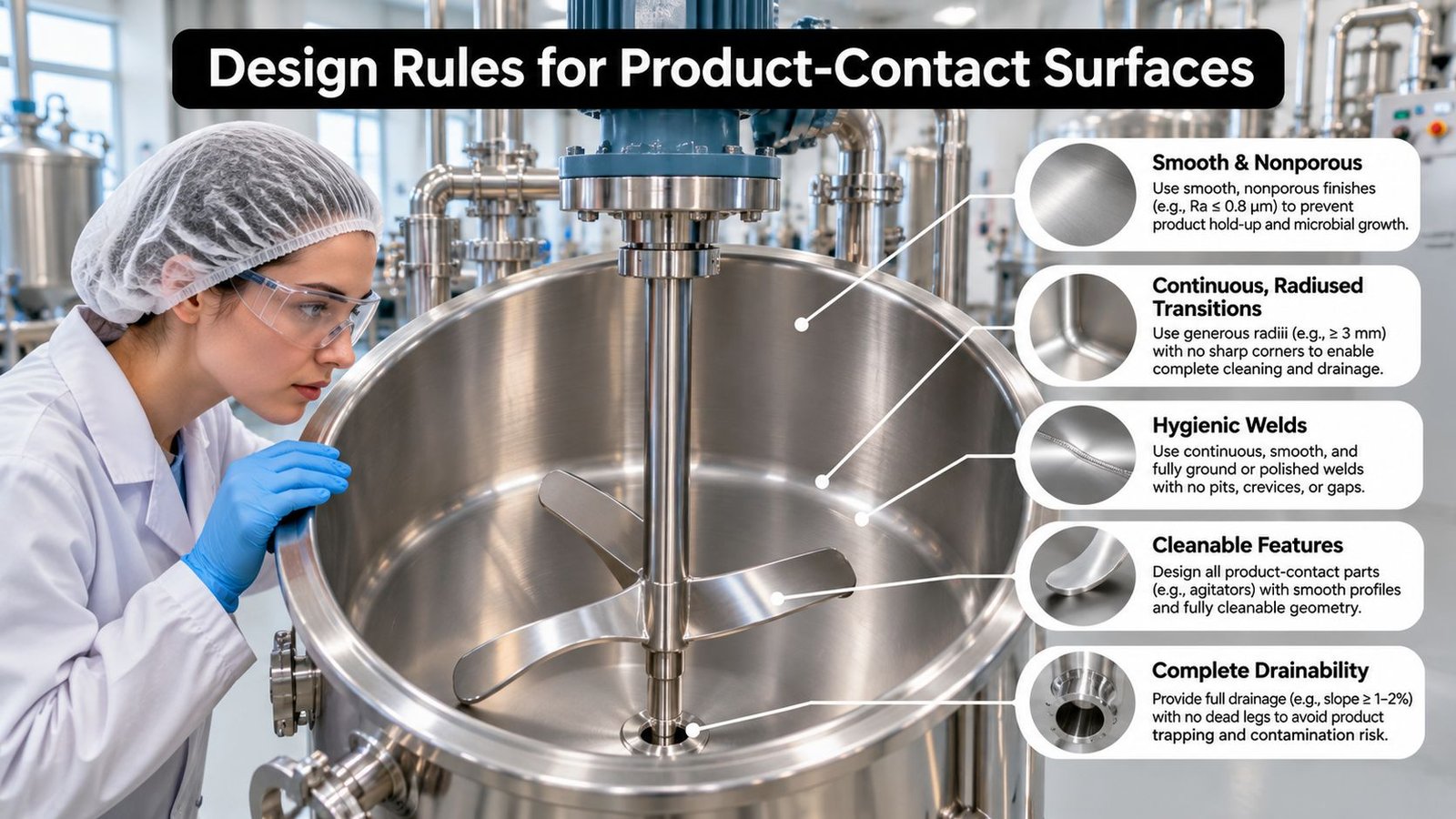
The question to put to the design team before the first chip is cut: can every product-contact surface be seen, reached and wiped? If the answer requires a caveat, the drawing isn't finished.
Qualification Stages From DQ to PQ
Qualification starts with a document, not a machine. EU GMP Annex 15 requires equipment, facilities, utilities and systems to be specified in a user-requirements or functional specification, with quality elements built into the design and GMP risks reduced to an acceptable level. Everything downstream traces back to that specification. Skip it and the rest of the file has no anchor.
The sequence runs requirements → DQ → IQ → OQ → PQ, then finalises procedures once the equipment has proven itself.
| Stage | Question it answers | Evidence to file |
|---|---|---|
| User requirements | What must the equipment do? | Approved user requirements or functional specification |
| DQ | Does the proposed design meet those requirements? | Design review record and risk assessment |
| IQ | Is it installed as drawn and documented? | Verified drawings, supplier manuals, calibration list |
| OQ | Does it operate correctly across its ranges? | Challenge test results at operating limits |
| PQ | Does it perform repeatably in production? | Results from multiple production runs |
What each stage should actually produce
Design qualification is a review, not a formality. The design either addresses each requirement or it doesn't, and the gap list belongs in the file with an owner against every item.
Installation qualification is where manufacturers verify the install against current engineering drawings and specifications, collect supplier operating and maintenance instructions, and identify calibration requirements. The word that matters here is "current". If the drawings on file don't match the machine on the floor, IQ becomes an exercise in photocopying old mistakes.
Operational qualification challenges the ranges: speed, pressure, temperature, torque, dwell time. A press that holds torque at the nominal setpoint but drifts at the upper limit isn't qualified, it's lucky.
Performance qualification runs the equipment across real production, multiple batches, real operators on real shifts. One clean run proves the machine can work. Three prove it usually does.
After OQ succeeds, the organisation finalises standard operating procedures, cleaning procedures, operator training and preventive-maintenance requirements. Annex 15 also expects records for calibration, cleaning, preventive maintenance, operating procedures and training, which is the boring half of the file and the half inspectors open first.
A worked example with torque
Picture a torque-controlled table-top press that must apply the same setting across three shifts and two operators. OQ puts the controller at the low and high limits of the setpoint and records the actual torque delivered at each. PQ then runs a full batch and shows the distribution holds across the shift change. If the third shift drifts, PQ caught it and the cause is usually a fixture that seats differently, not the controller.
This is also where commissioning of equipment earns its keep. Commissioning gets the machine running; qualification proves the running is documented. Teams that treat them as one activity save weeks, provided the acceptance criteria were written before the tests started.
The evidence file should let an inspector walk from the first requirement to the final performance result without asking your team a single question. If they have to ask, the chain has a break.
Cleaning, Maintenance and Written Procedures
Cleaning is a procedure before it's an act. FDA 21 CFR 211.67 requires equipment and utensils to be cleaned and maintained at appropriate intervals, sanitized or sterilized when the product demands it, to prevent contamination or malfunction affecting product safety, identity, strength, quality or purity. The EU GMP guidance on cleaning validation adds the harder standard: the cleaning process must be demonstrated effective, not merely described.
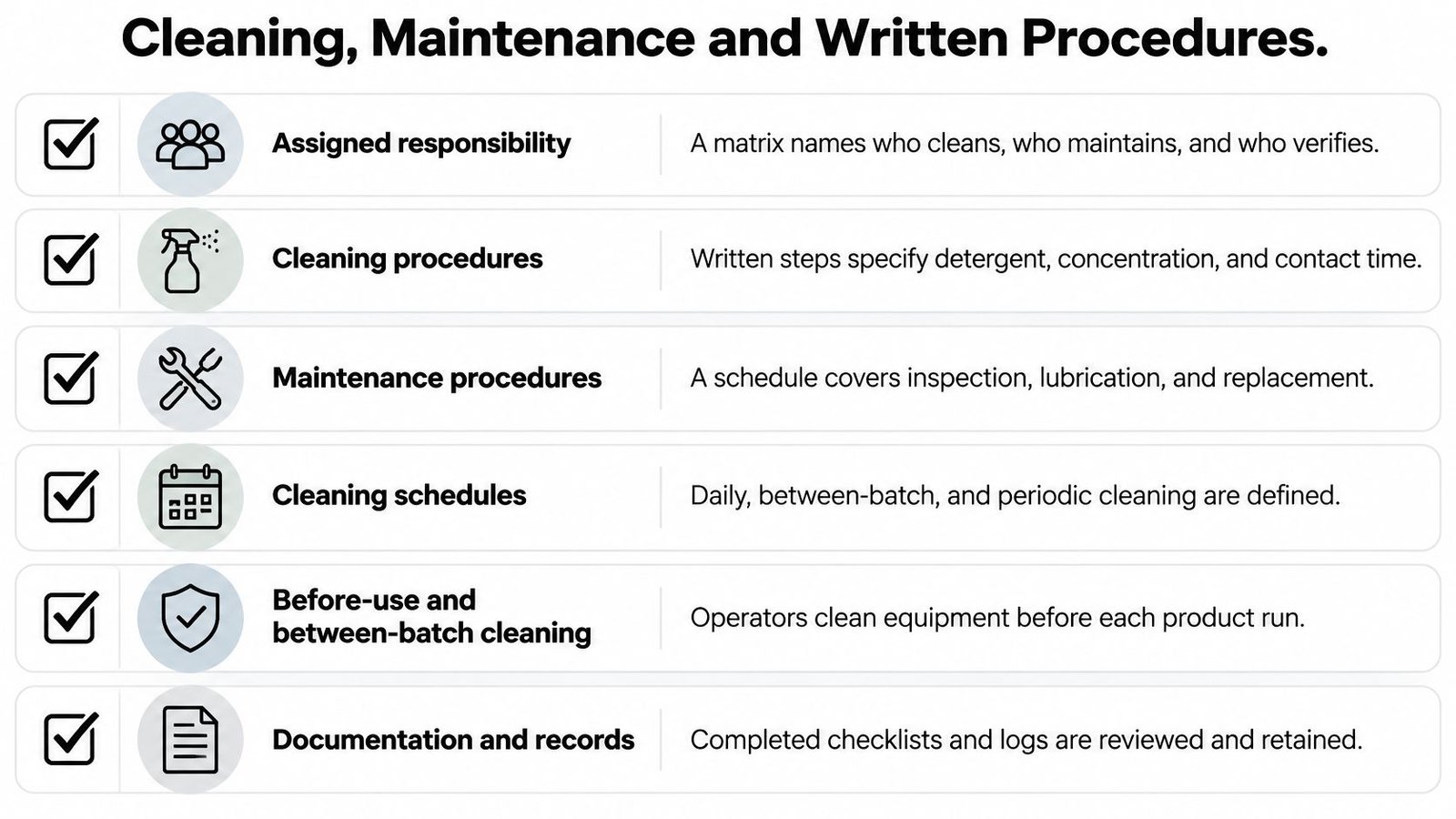
The written procedure must cover six control areas, and each one exists because a real batch went wrong without it.
- Assigned responsibility. A matrix names who cleans, who maintains and who signs off. No name means no owner.
- Cleaning and maintenance schedules. Tie intervals to batch count or elapsed time. "After every third batch, and every 72 hours, whichever comes first" survives a shift handover; "as needed" does not.
- Detailed methods and materials. Name the detergent, concentration, contact time, temperature and rinse step. "Clean thoroughly" isn't an instruction.
- Disassembly and reassembly. For a multi-part fixture, supply a drawing or numbered sequence so a new operator puts it back the same way it came apart.
- Removal of previous batch identification. A documented label-removal step at changeover is what stands between you and a mix-up.
- Protection and inspection before use. Cover clean equipment, then inspect it immediately before the next run. Where the product calls for it, add a swab check.
Then record all of it
Cleaning, maintenance and inspection activities must be recorded. That single clause reshapes equipment design: it forces a conversation about where the log lives, who signs it, and how the operator reaches the inspection point without dismantling a guard. A beautifully hygienic skid with no accessible inspection point still fails.
Preventive maintenance deserves the same discipline. The maintenance plan should cover the functions OQ tested, including calibration and sensor checks, so the qualified state survives month twelve. Ageing equipment that drifts out of calibration is one of the most common sources of deviations and out-of-specification results, and it's entirely preventable with a schedule someone follows.
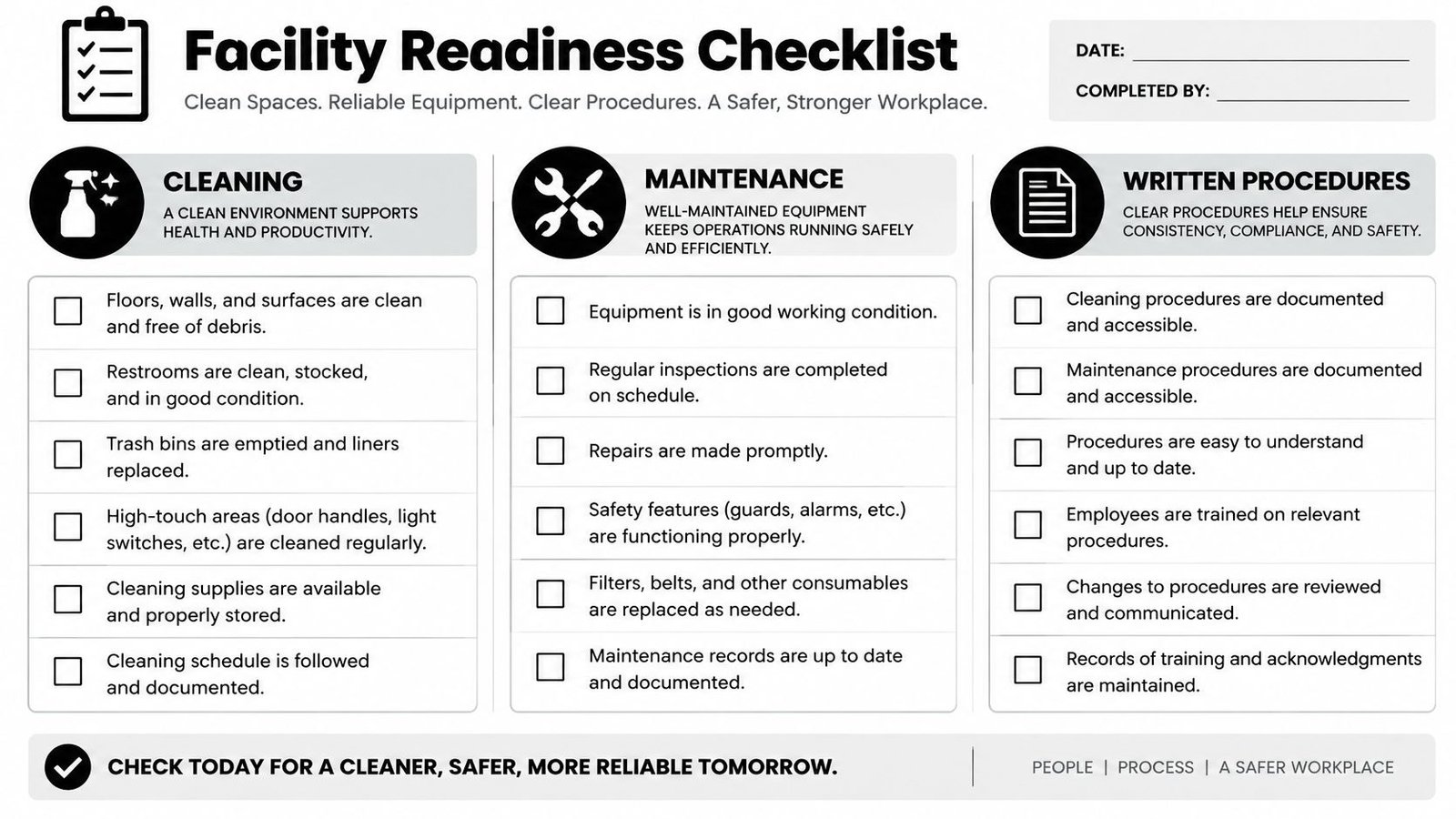
Practical rule: a schedule with no named owner and no record fails an inspection even when the cleaning itself is spotless. Paper is the deliverable.
The design consequences are measurable. Inaccessible crevices, dead legs, rough or incompatible materials, poor drainage and hard-to-remove tooling all increase cleaning variability and cross-contamination risk. Minimising retention points, enabling documented disassembly, keeping surfaces inspectable and choosing materials compatible with your cleaning agents costs far less at the drawing stage than at the remediation stage.
A maintenance relationship that continues after delivery matters more here than most buyers expect. We commit to long-term support and maintenance after delivering equipment, because the procedures above only hold up if someone keeps the machine in the condition it was qualified in. Review your equipment maintenance procedures against the six control areas and confirm every one has both a named owner and a record.
Right-Sizing Qualification for Each Equipment Class
Regulators expect a risk-based scope, not an identical validation package for every asset. FDA guidance on cleaning validation expects written protocols, defined responsibilities, acceptance criteria, sampling methods, analytical sensitivity, documented results and a final approved report. PIC/S directs that effort toward the equipment and process steps where contamination or carryover poses the greatest risk rather than treating every asset the same. The FDA inspection guidance on validation of cleaning processes is explicit about the protocol content, and silent on the idea that a holding fixture needs a line's worth of paperwork.
| Equipment class | Qualification scope | Documentation load |
|---|---|---|
| Manual equipment, fixtures and tooling | IQ, simple OQ on the holding function, documented cleaning procedure | Light: drawings, procedures, training records |
| Semi-automatic table-top station | IQ, OQ on critical functions, PQ on the process it performs | Moderate: adds control software and sensor calibration records |
| Fully automated processing line | DQ through PQ, software and sensor verification, full cleaning validation | Heavy: complete validation package with change control links |
Why more automation isn't automatically more control
The instinct that a more automated station is more compliant is wrong often enough to be worth stating plainly. Poorly specified software, unproven sensors and tangled change dependencies expand validation risk. A simple, well-designed station with clear human steps can be easier to qualify, easier to clean and easier to maintain. Automation buys repeatability. It doesn't buy control unless the requirements behind it were written properly.
That's the trade-off worth naming. Manual equipment is often the right call when production demands are low or when the goal is improving quality over a traditional manual operation. Table-top systems suit operations that need precision, repeatability and consistency, and companies planning a gradual scale into full automation, which is where we do most of our work. Neither choice is a compromise on compliance. Both can be qualified properly.
The video below walks through the kind of station-level thinking that keeps scope proportionate.
A four-step method for the rationale
- List the critical functions and process parameters. For a holding fixture that's location and clamping force. For a dispensing station it's volume, position and cure time.
- Rate each one for its effect on product quality. Ask what happens to the patient or the device if this function drifts.
- Set the scope from the rating. High effect earns DQ, challenge testing and PQ. Low effect earns IQ, a functional check and a cleaning procedure.
- Record the reasoning on one page per asset. Signed, dated, attached to the qualification plan.
That one-page rationale is the document that lets you defend a light package without apologising for it. It's also the document that catches an under-qualified asset before an inspector does.
The computerized-system note
Any station with a PLC, HMI or recipe software carries a parallel obligation. During DQ, specify user access levels, audit trails and electronic record controls. Verify them in OQ alongside the mechanical functions, and file the evidence in the same package. Software changes then route through the same change-control assessment as any hardware modification, which keeps the validated state intact instead of fragmenting into two separate files.
Cleaning Validation for Fixtures and Medical Device Stations
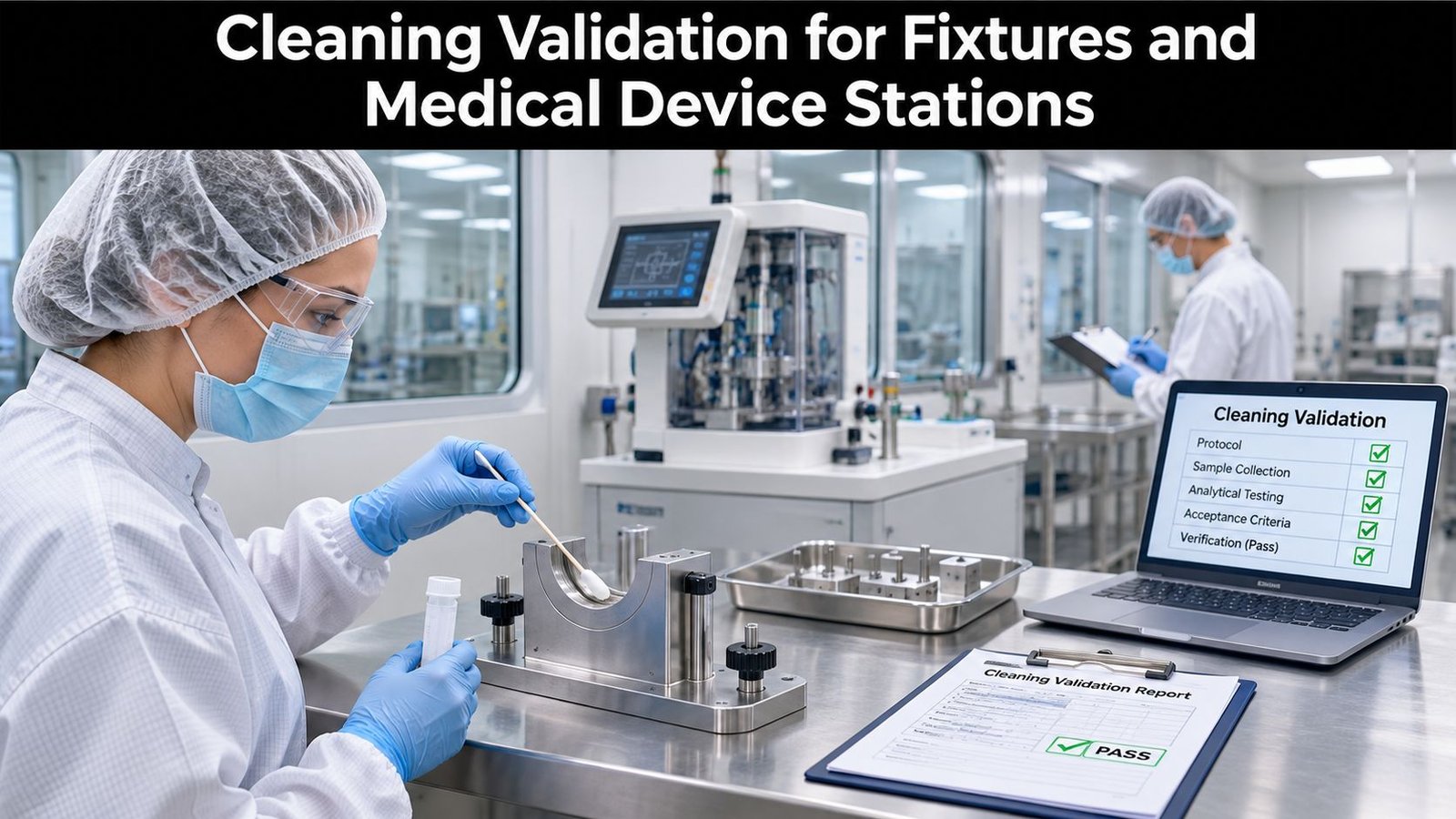
A clean-looking nest can still carry particulate, bioburden, lubricant or adhesive residue. Visual inspection is a useful first gate and a poor final limit. Health Canada's cleaning validation guidelines require a contamination-control strategy covering premises, equipment and associated processes, with product-contact cleaning validated on quality-risk-management principles. On assembly, inspection and handling equipment, the risk profile shifts. Particulate, bioburden, lubricant and adhesive residue usually matter more than drug carryover.
A protocol has to name the equipment, the cleaning materials, the acceptance limits, the monitored parameters, the analytical methods, the sampling type and the sample locations. PIC/S adds that sampling may use swabs, rinses or direct extraction depending on the residue, and that choice isn't interchangeable.
Matching the sampling method to the residue
- Swab sampling for defined surfaces, especially edges and corners. On a vision station with a glass fixture, the swab targets the nest edges where parts contact tooling, not the middle of the glass.
- Rinse sampling for distributed residue across a path. A conveyor is the standard case: rinse captures adhesive transfer along the belt line that a single swab would miss.
- Direct extraction for embedded or porous material where neither swab nor rinse reaches the residue.
When residue can't be reached or verified, disassembly isn't optional. That's the moment to decide whether the tooling gets a documented teardown step or a redesign. A question to settle at the drawing stage, and settling it there is what custom test fixtures designed around cleanability look like in practice: accessible surfaces, documented disassembly, no cavity a swab can't enter.
Lifecycle triggers, not a one-time exercise
Validation done once and filed forever is a common and expensive misreading. FDA expects documented procedures and defined triggers for revalidation. Write the triggers down: a change of cleaning agent, a new product or component family on the same station, a geometry change to tooling, or a trend of rising residue results.
Hygienic design and accessible tooling reduce the compliance burden for years. Sensors added after installation mostly document the burden you already have.
Document Every Equipment Change Before Startup
Most change-control failures aren't dramatic. They're a fixture swap, a fresh sensor, a moved station. EU GMP Annex 15, in the same qualification guidance, requires formal documentation and an assessment of the effect on the validated state or control strategy whenever a change to facilities, equipment, utilities or processes could affect product quality.
The triggers are predictable. Replacing a manual operation with automated controls. Adding custom tooling. Changing a fixture's geometry. Modifying a material-contact surface. Relocating equipment to a new room. Changing the production environment around it.
The four-step sequence
- Define acceptance criteria before installation. Write them into the purchase or work order, not into a memo afterwards.
- Preserve critical process parameters where possible. A cost-effective upgrade keeps the settings that were validated and changes only what needs changing.
- Decide what else moves. Requalification, updated procedures, extra operator training, revised preventive-maintenance records. Early engineering involvement makes this a thirty-minute conversation instead of a three-week debate.
- File the qualification evidence after the change. The same file structure as the original, with the new test results added and the change record cross-referenced.
An upgrade designed to future-proof existing equipment keeps a machine competitive without reopening the validation question from scratch. Replacing a worn fixture with a better-designed one of identical function is a far cheaper conversation than replacing it with one that changes three process parameters.
Use the consultation to fix scope, not just price
The right moment to settle documentation scope is before fabrication, during the no-obligation manufacturing automation consultation where we aim to understand current challenges and bottlenecks, labour and production constraints, quality or consistency concerns, and budget and timeline expectations. That conversation produces the requirement list, the risk rationale and the intended qualification scope together, which is the only way they stay consistent.
Do this this week: before authorising any fabrication, send the requirement list, the risk rationale and the intended qualification scope to your engineering team in one package. Ask for a documentation package matched to that scope, and ask them to flag every item they think you've under-specified.
System Engineering & Automation builds GMP-aware equipment at the level of complexity your process needs, from manual fixtures and custom tooling to semi-automatic table-top stations and fully automated lines, with the drawings, calibration records and qualification support to match. If you're planning a new station or changing an existing one, we can review your user requirements, cleanability constraints and intended qualification scope before anything is fabricated. Visit System Engineering & Automation to start that conversation and get the documentation package right the first time.