Your line has run the same way for three years. Then a changeover runs long, someone reaches past the light curtain to nudge a part into the fixture, and the curtain gets switched to bypass so the shift can finish on time. Nobody logs it. The machine still passes a walk-by, because nothing on it failed.
That gap, between how a machine was designed to be used and how it is used in practice, is where most serious injuries begin. A machine safety risk assessment is the tool that closes it, and it works best when you treat it as a control you maintain rather than a document you filed once at commissioning.
Definitions that hold up on the floor, a scoring method two people can apply the same way, a full walk-through on a table-top press cell, and rules for what to do when the machine changes after the paperwork is signed.
Table of Contents
- Why Every Machine Needs a Written Risk Assessment
- Scoring Severity, Exposure and Avoidance
- How to Run a Machine Safety Risk Assessment
- A Table-Top Press Cell Assessed Step by Step
- Hidden Exposures in Abnormal Tasks and Access Paths
- Reassessing Risk After Machines Change
- AI, Connectivity and Cybersecurity in Safety Reviews
- Your Next Step Before Changing the Line
Why Every Machine Needs a Written Risk Assessment
The jam happens at 2:15 on a Thursday. A part sticks in the fixture, the cycle stalls, and the operator does what she has done a hundred times. She reaches in with her left hand to flick it loose while her right hand is still on the start button. The press is energized. Nothing has malfunctioned.
That's the situation an assessment exists to prevent, and it's not a freak event. The Occupational Safety and Health Administration reports that workers who operate and maintain machinery suffer approximately 18,000 amputations, lacerations, crushing injuries, and abrasions each year, along with more than 800 deaths annually. Those injuries don't cluster in normal production cycles. They cluster in setup, cleaning, jam clearing, adjustment and maintenance, the moments when someone has to get close to a machine that isn't expecting them.
A machine safety risk assessment is a documented process that identifies the hazards on a machine, estimates how likely and how severe the harm is, and decides which safeguards are needed before the machine runs. Written is the operative word. An assessment that lives in one engineer's head can't be reviewed, can't be handed to a new maintenance tech, and can't be defended after an incident.
Hazard, harm and risk are not the same word
Think of a stove. The hazard is the hot burner. The harm is the burn on your palm. The risk is a judgment that combines how bad the burn would be with how often your hand ends up near the burner. Slide the pot to the back ring and you've changed the risk without touching the burner.
Machines work the same way. The pinch point between a clamp and a fixture is the hazard. A crushed finger is the harm. The risk depends on whether an operator reaches into that gap every forty seconds or once a week during scheduled maintenance.
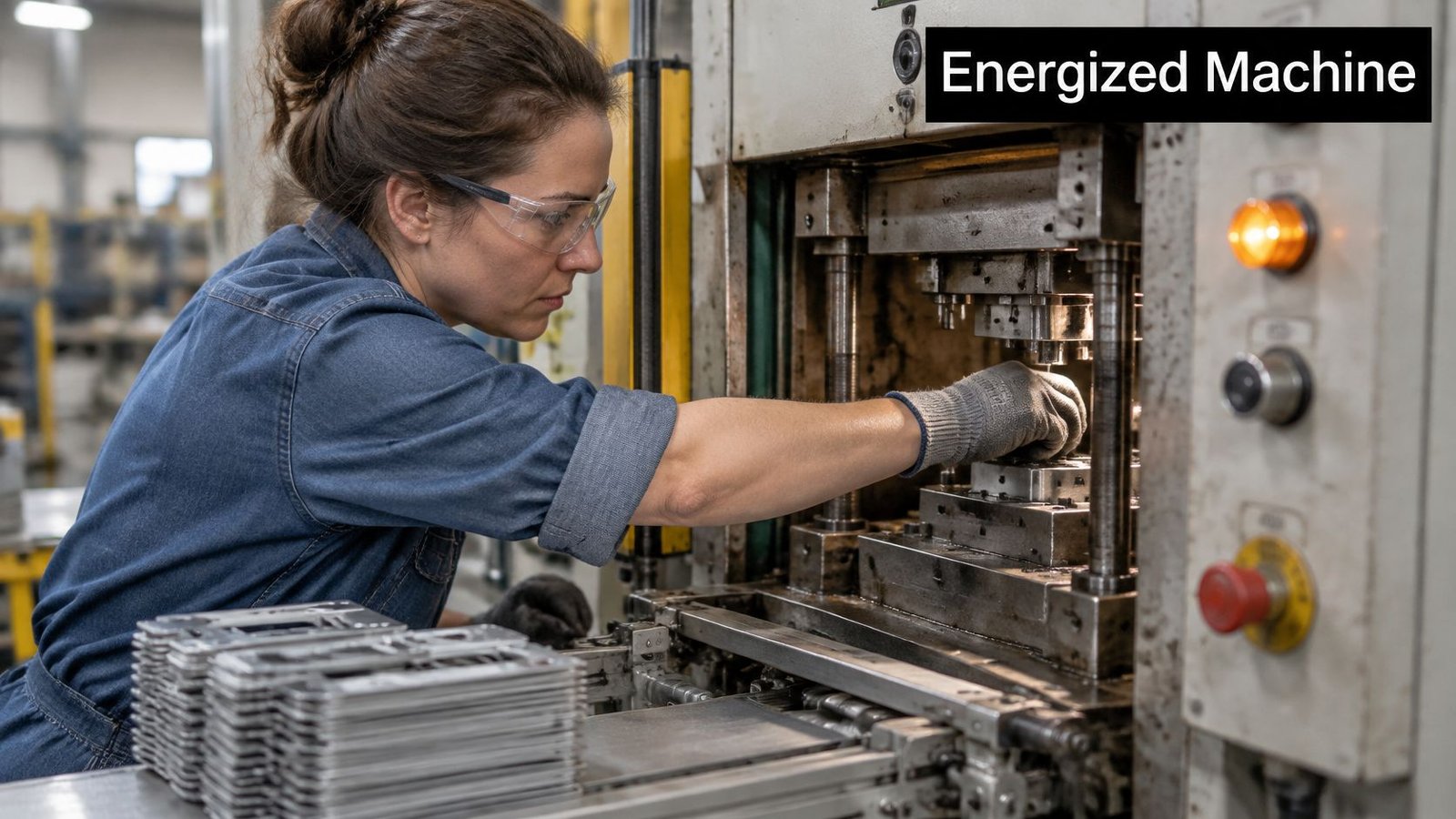
Teams that skip the distinction spend their budget on the wrong things. They buy a light curtain for a hazard nobody can reach and leave a bypassable guard on the one that gets opened twice a shift. Writing it down makes those choices visible before someone gets hurt, which is the same logic behind the machine safeguarding standards most plants are measured against.
You'll get four things from the rest of this guide: a repeatable procedure, a scoring method you can apply to your own equipment, a worked example on a semi-automatic press cell, and the triggers that tell you when the assessment has to be reopened.
Scoring Severity, Exposure and Avoidance
You need a scale that two people can apply to the same hazard and land on the same answer. The one below uses three parameters: severity of the harm, exposure frequency to the hazard, and the possibility of avoidance once the hazard presents itself. ISO 12100 frames risk exactly this way, treating probability as a function of how often people are exposed, how likely the hazardous event is, and whether a person can get out of the way, as IDEC's summary of the standard sets out.
| Parameter or combination | Level | Meaning | Typical example or required action |
|---|---|---|---|
| Severity | S1 | Slight, reversible injury | Bruise or minor laceration needing first aid |
| Severity | S2 | Serious or irreversible injury | Crushed finger, fracture, amputation |
| Exposure frequency | F1 | Rare or brief access | Clearing a jam about once a week |
| Exposure frequency | F2 | Frequent or long access | Reloading the fixture every 30 to 60 seconds |
| Avoidance | P1 | Hazard can be noticed and avoided | Slow motion with a visible warning |
| Avoidance | P2 | Hazard is hardly avoidable | Clamp closes faster than a hand can withdraw |
| S2 + F2 + P2 | High | Safeguard required before the machine runs | Press loading pinch point |
| S2 + F1 + P2 | Medium to high | Reduce by design or guarding | Press clamp during jam clearing |
| Other combinations | Low to medium | Judge against your written risk criteria | Agree the full matrix before scoring so two assessors rate the same hazard alike |
Read the top six rows as a dictionary and the last three as the sentences you build with them. S2 + F2 + P2 comes out high, and high means the safeguard goes in before the machine runs again. S2 + F1 + P2 lands at medium to high, which still needs reduction, usually by design change or guarding rather than procedure alone.
ISO 12100 doesn't prescribe one numeric scale. Many teams pair the qualitative result with a risk graph borrowed from ISO 13849-1 when they size the control system, because a high score needs an architecture that fails safely, not just a physical barrier.
Practical rule: Score the task, not the machine. "Jam clearing with the interlock held open" is a different task from "loading parts in automatic mode," and it usually scores worse.
Three habits keep the scoring honest:
- Score one hazard at a time. A single verdict for the whole machine hides the two tasks that hurt people.
- Raise avoidance to P2 when the operator can't see the hazard. If the clamp closes inside a fixture shroud, the operator has no warning to react to, regardless of how carefully she was trained.
- Never average scores. Averaging a high hazard with four low ones produces a comfortable number and an unprotected pinch point.
Before you read the procedure, do one small thing. Pick the machine on your floor that worries you most, list its top three hazards, and write one sentence justifying each rating. That sentence is what an auditor, an insurer or a grieving family will read later.
How to Run a Machine Safety Risk Assessment
The procedure below follows the sequence the European machinery directive has required since it was adopted on 17 May 2006 and published on 9 June 2006. Directive 2006/42/EC requires a manufacturer or authorized representative to conduct a risk assessment to determine which health and safety requirements apply to a machine, then design and construct it in light of that assessment. The order matters. The assessment shapes the machine; it doesn't describe it afterward.
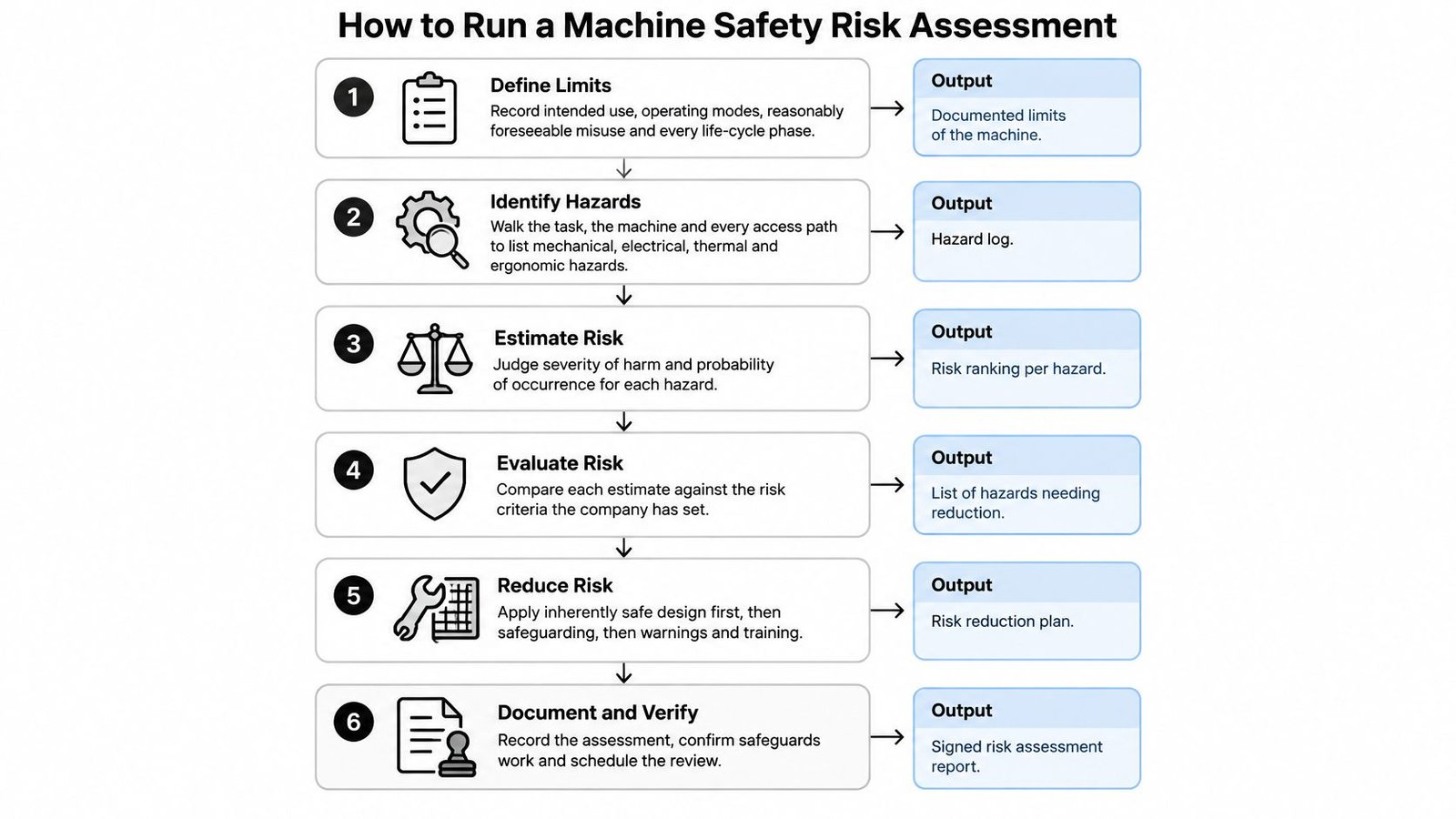
Six steps and the output each one produces
- Define the limits. Record the intended use, every operating mode, and the reasonably foreseeable misuse the machine invites. Cover the phases where people touch it, because ISO 12100:2010 sets the methodology across relevant life-cycle phases including design, use, foreseeable misuse, maintenance and decommissioning (ISO 12100:2010). Output: a documented statement of what the machine is for and where its boundaries sit.
- Identify hazards and hazardous situations. Walk the task, not just the machine. Mechanical hazards such as crushing, shearing and ingoing nip points come first, then electrical and pneumatic energy, stored energy in springs and gravity-loaded parts, heat, and unexpected startup. Output: a hazard log, which is the backbone of the hazard identification process you'll reuse on every machine.
- Estimate risk for each hazard. Apply severity, exposure frequency and avoidance to one hazard at a time, using the scale above. Output: a ranking that shows where the money and the engineering hours go first.
- Evaluate whether the risk is tolerable. Compare each estimate against criteria the company agreed in advance, not against a gut feeling formed in the meeting. Output: two lists, hazards needing reduction and hazards already adequately controlled.
- Reduce risk in a fixed order. Safe design first, which means removing a pinch point or limiting actuator force. Safeguards second, meaning fixed or interlocked guards, presence sensing and two-hand controls. Information last, meaning warnings and training. Output: a reduction plan tying each measure to a named hazard.
- Verify and document. Confirm each safeguard works in every operating mode, record the residual risk and the reason behind each decision, and set a review date. Output: a signed assessment a new technician can follow without translation.
The framework expects a chain, not a score. Each significant hazard should trace to a design measure, a validation activity, and an instruction about what risk remains. A single qualitative number for the entire machine satisfies none of those three.
If a diagram helps more than a list, this walkthrough covers the same territory at bench level.
Your first move is small. Draft a one-page hazard register for one machine, with a column for the hazard, the severity, the exposure, the avoidance, the safeguard, the residual risk and the reviewer's initials. Once the format exists, the second machine takes an afternoon instead of a month.
A Table-Top Press Cell Assessed Step by Step
The machine is a table-top semi-automatic press. The operator loads a part into a fixture, presses two buttons to start the cycle, and lifts the finished product out while the ram and a pneumatic clamp move on their own. Cycle time is 40 seconds. It's the kind of workstation that lifts output without a robot, and it's also the kind that hides two very different hazards behind one guard.
Hazard one, the clamp closing at loading
Severity is S2. A hand caught between clamp and fixture crushes fingers, which is irreversible harm, not a bruise. Exposure is F2 because the operator reloads every 40 seconds for a full shift. Avoidance is P2 because the clamp closes faster than a hand can withdraw from the fixture. The combination scores high, and high means the safeguard goes in before the machine runs again.
Hazard two, the same clamp during jam clearing
Severity stays at S2, but exposure drops to F1, roughly once a week. Avoidance is still P2, since a hand working a stuck part inside a fixture has nowhere to go. That produces medium to high. Teams often read the lower score as permission to leave the task as it is. A lower score changes the speed of the fix, not the need for one.
Where the safeguards land, and in what order
The hierarchy does the work. Safe design comes first: reshape the fixed clamp geometry so the pinch point no longer exists, or reduce clamp force where the part allows it. Safeguarding comes second: presence sensing that stops the clamp when a hand enters the loading zone, plus an interlocked guard that halts motion when the door opens for jam clearing. Lockout covers maintenance, when the guard is open and the energy has to be gone. Warnings and training come last, because a label doesn't stop a moving clamp.
Residual risk is the part the record has to say out loud. The operator still has to load parts, so her hands still enter the cell. Write down what remains: the reach path, the sensing zone boundary, and the rule that a jam gets cleared only after the interlock has stopped motion.
Now change one number. Drop the cycle from 40 seconds to 25 and watch what moves. The operator reaches into the cell more often, so exposure climbs. The ram and clamp travel the same distance in less time, so the stopping performance that once protected her reach path may no longer clear it. Nothing broke. The machine outgrew its assessment, which is the subject of the next problem.
Hidden Exposures in Abnormal Tasks and Access Paths
OSHA lists crushing, amputation, burns, blindness, ingoing nip points, rotating parts, and flying chips or sparks as the hazards guarding has to control, and Oregon OSHA recommends estimating risk from exposure frequency, injury probability and injury severity, then documenting whether existing safeguards are satisfactory, per OSHA's machine guarding guidance. Effective safeguards must prevent access to the danger zone, stay secure and tamper-resistant, avoid introducing new hazards, and still allow safe lubrication and maintenance. That last requirement is where designs usually fail first.
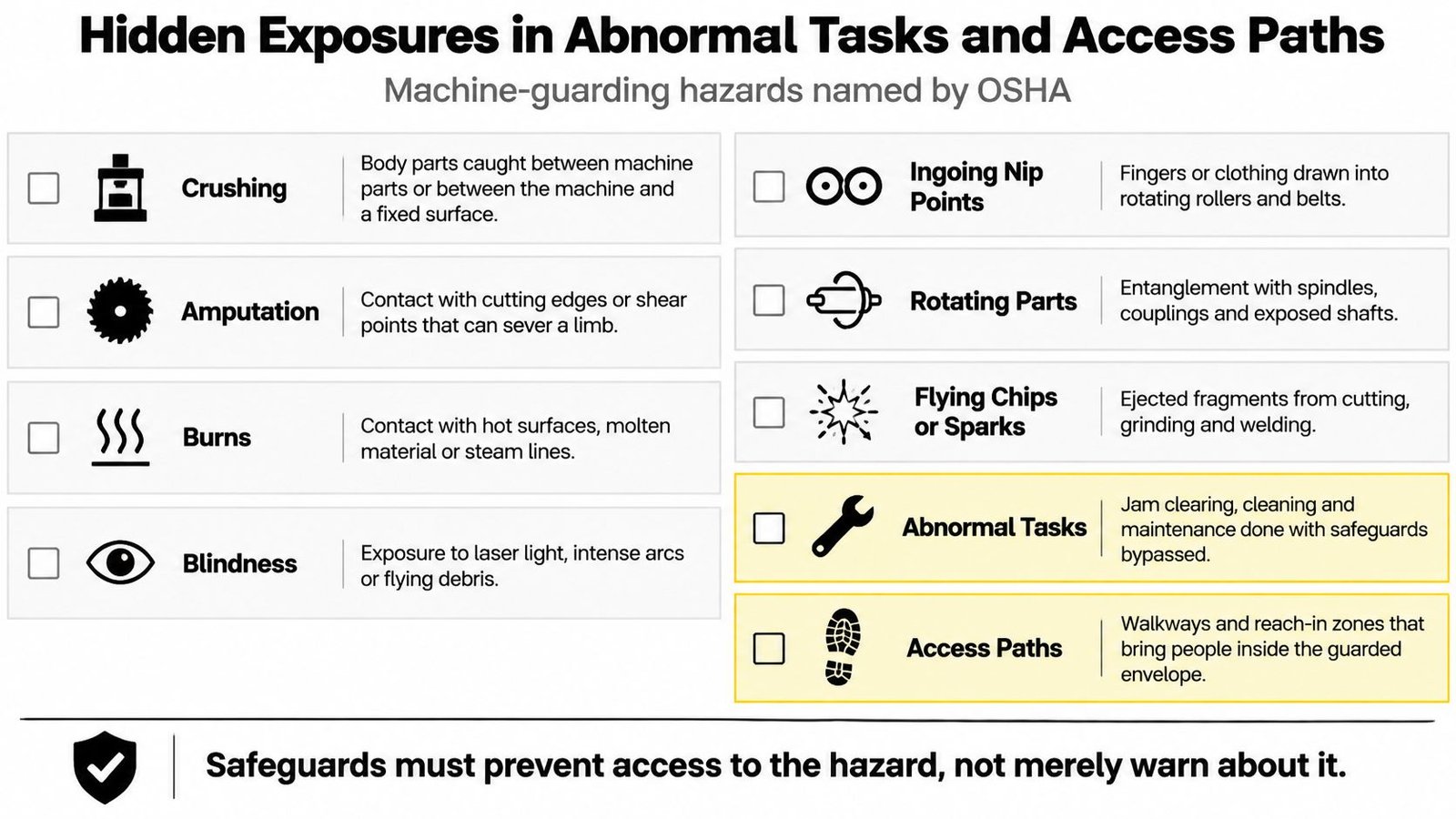
What the checklist has to cover
- Reach paths around the guard. Trace where a hand, forearm or shoulder can go, including over the top rail and around the side of a fence panel.
- Access doors and whether they open under power. If a door can swing while the ram is still moving, the interlock is decorative.
- Tooling interfaces. Bolts, clamps and quick-change fixtures create new pinch points the moment a different die goes in.
- The motion envelope of every actuator. Robot arms and pneumatic slides travel further than the drawing suggests under full pressure.
- Stored energy. Capacitors, accumulators, springs and a raised load that drops when the air is cut.
- Restart behaviour. What happens after a power loss, an emergency stop, or a fault clears mid-cycle, and whether the machine resumes on its own.
- Stop time against reach time. Measure how long motion takes to stop and compare it with how long a person needs to reach the hazard. If the first number is larger, the distance is wrong.
A safeguard you can bypass in ten seconds isn't a safeguard. It's a delay.
The most common failure isn't a missing guard. It's a guard that works perfectly in automatic mode and gets shimmed, taped or wired around during setup because the fixture change takes four hands and the shift ends in twenty minutes. Verify each safeguard during setup and fault recovery, not only during a production cycle. If the procedure requires a bypass, that bypass is a hazard the assessment hasn't addressed yet.
Reassessing Risk After Machines Change
A machine can become less safe without a component failing. A supervisor raises the cycle rate to clear a backlog. A technician fits a taller fixture. Someone trims a guard so the part clears. The assessment on the wall still describes a machine that no longer exists, like a recipe written before the kitchen changed its equipment.
OSHA's technical guidance says risk assessments should cover new, existing, modified, and rebuilt machines, and should identify hazards, exposure, likelihood and protective measures in OSHA's safety and health management chapter. Regulators also include guarding, blocking and lockout among compliance inspection topics. That matters because risk follows the work, not the drawing. A small productivity change can put a hand closer to motion, reduce reaction time, or make an abnormal clearing task routine.
| Change | How exposure can shift | Reassessment action |
|---|---|---|
| New or modified tooling | Changes pinch points and reach paths | Re-map the danger zone and retest guard fit |
| Guard removed or repositioned | Opens access to moving parts | Verify interlock and guard function by test |
| PLC or software logic change | Alters sequence, restart and fault states | Revalidate safety functions and restart behaviour |
| Higher cycle speed | Less reaction time, stopping distance may exceed reach time | Recalculate stopping time and safety distance |
| New material or part size | Changes jam and clearing frequency | Re-estimate exposure frequency |
| Maintenance or cleaning procedure change | Adds access while energy is present | Review lockout and access steps |
| Staffing or manual task redistribution | Operators take on new tasks near motion | Reassess human-machine interaction |
Treat the table as a change trigger list. If a line changes speed, tooling, access, sequence, material, task ownership or cleaning method, the old assessment has gone stale. Software changes deserve the same attention as mechanical changes. A revised sequence can alter restart behaviour or fault states even when every guard bolt stays in place. Productivity changes matter too, because a faster cycle can shorten the time an operator has to react.
Document review is not validation
Two different jobs get collapsed into one word. Document review means opening the drawings, the schematic and the PLC logic to confirm the design intent still matches the installed machine. Hands-on validation means standing at the cell with the air on and testing whether the guard stops motion before anyone can reach it, whether presence sensing resets only after a deliberate action, and whether the measured stop time still clears the reach path.
Do the first, skip the second, and you'll have immaculate paperwork attached to a machine that cycles with its door open.
Name one person who approves every change to the machine, the guard, the logic or the procedure. Without a named owner, reassessment becomes everyone's job, which is nobody's.
Keep the evidence with the change, not in a folder across the plant: updated drawings, dated test records, a signed line from the approver. That's how a risk assessment stays a lifecycle control instead of a one-time deliverable.
AI, Connectivity and Cybersecurity in Safety Reviews
A vision camera gets a routine software update on a Friday. On Monday it accepts a part orientation it used to reject, and the downstream pick head starts dropping product.
Nothing broke.
No guard moved, no interlock failed, the emergency stop still works. The exposure changed anyway, and the assessment on file has nothing to say about it.
That's the gap this review has to close. The classic checklist asks whether the guard is in place, the interlock works and the operator can reach the emergency stop. Those questions belong in every assessment. They go quiet on a vision model misclassifying a part at speed, a firmware update altering a sequence nobody retested, a laptop on the plant network reaching a controller, or a connected safety function acting on data it shouldn't trust.
The standards work is moving in this direction. ISO/TR 22100-5 covers how AI and machine-learning hazards should be considered inside the machinery risk-assessment process. A proposed 2025 revision of ISO 12100 identifies AI/ML and cybersecurity vulnerabilities that can affect safety and calls for generic measures. European Machinery Regulation implementation work treats AI-powered safety features and cyber-safety as standardization priorities, with high-risk treatment possible for certain machinery categories.
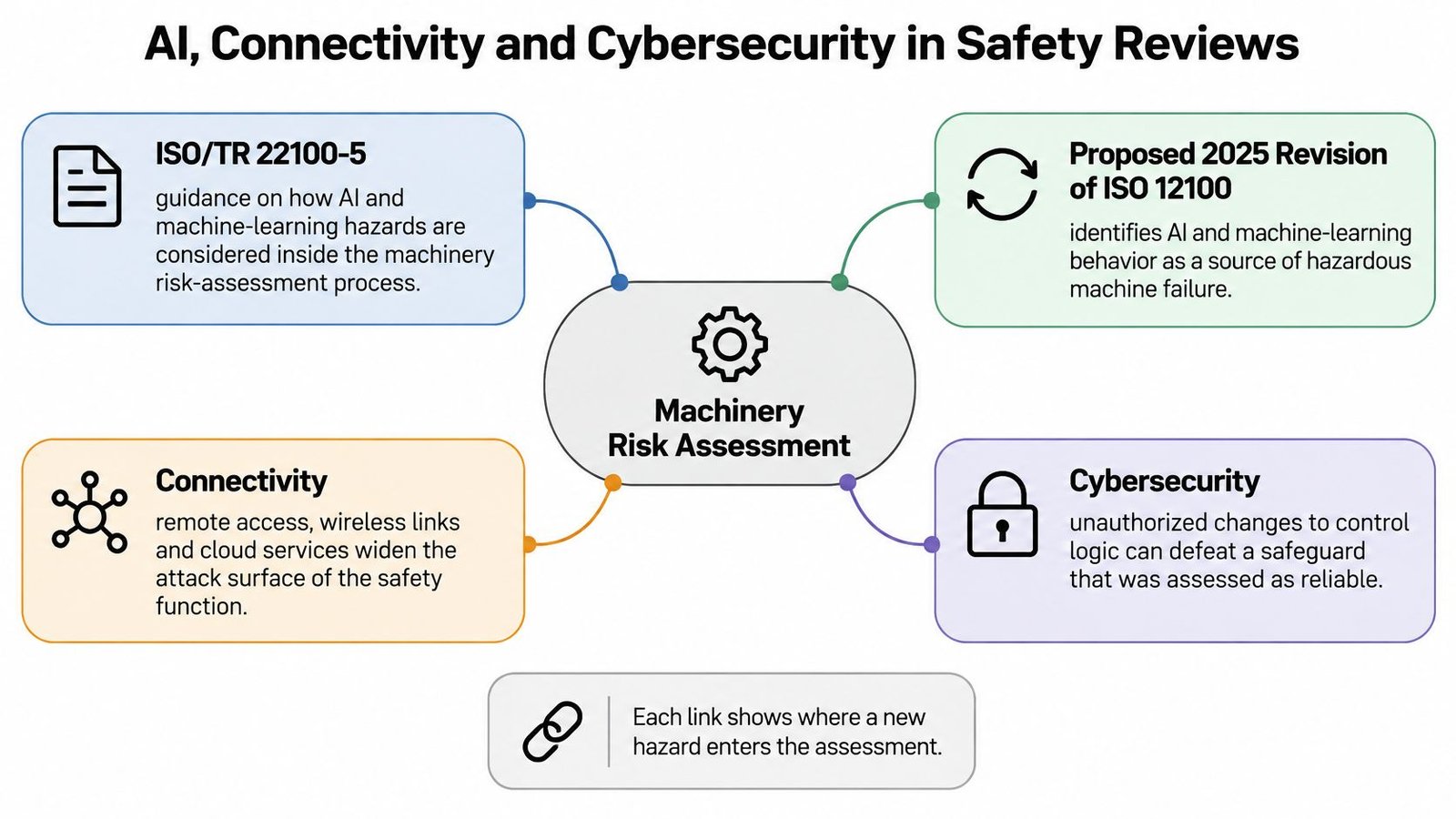
A light switch and an inspector
A conventional sensor is a light switch. It's on or off, and it behaves the same at the end of its life as at the start, which is why you can put a bounded reliability number on it. A learning system is closer to an inspector whose judgment drifts after retraining. It may get better at catching a defect and less predictable about what it ignores.
That drift is the new hazard, and it won't appear in a guard inspection. The network path hides the same way. Teams often hand connectivity to IT and file it under data security, yet a compromised controller or a spoofed sensor signal changes how the machine moves. Machine behavior is exactly what the risk assessment owns, so these exposures belong on its list:
- Operating limits for the model. Define what the camera may see, what lighting and part families it's validated for, and what it must refuse to classify.
- Fallback states. Decide what the cell does when the model returns nothing or returns two answers, and make stopping the default.
- Independent safety functions. Keep the protective stop on hardware that doesn't depend on the inference result.
- Change control for software and models. Version them, log them, and treat a retrained model as a design change.
- Cyber threat analysis. Include remote access, wireless links and cloud services in the hazard review, not just the IT risk register.
- Revalidation after every update. Retest the safety functions after any model or software change.
Responsibility sits with the machine builder, the integrator, the IT team and the end user at once, and an assessment that leaves any of them unnamed leaves the gap open. On the network side, the industrial network security review belongs inside the machine's risk file, alongside the guarding drawings. A line running on new software is a new machine for assessment purposes, even if no bolt was touched. When the model or firmware changes, the file reopens.
Your Next Step Before Changing the Line
Write a short scope before anyone touches the machine. Name the machine and its operating modes, list the hazards the procedure identified, and copy the reassessment triggers from the change table into whatever system your plant uses for engineering change. One page is enough to start.
Then gather what a reviewer will ask for: machine drawings, control schematics, measured cycle times, incident and near-miss logs, and a list of tasks that still require a hand inside the guarded envelope.
Where the internal team is stretched, a provider can fill the gap. SEA's Safety Enhancements service identifies risks and engineers solutions that protect the workforce. In a no-obligation consultation, we work through your current challenges and bottlenecks, labor and production constraints, quality or consistency concerns, and budget and timeline expectations, so safety scope grows alongside the productivity goal instead of competing with it.
Ask any provider for a written risk register and validation evidence before you accept installation. A risk assessment is only as useful as the reviews it triggers after every change.
System Engineering & Automation builds semi-automatic and automated equipment with the guarding, interlocks, and controls documentation a machine safety risk assessment depends on, and we scope that safety work alongside your throughput targets rather than after them. If a fixture, press cell, or packaging station is about to change, bring us the drawing and the task list and we'll tell you which hazards the design can eliminate outright. Visit System Engineering & Automation to start a no-obligation conversation about your next upgrade.