Most manufacturers ask the wrong first question. They jump straight to “Should we automate?” when the better question is “Which process is broken?” That mistake sends money to the wrong place, usually into equipment that looks advanced but doesn't fix the core constraint. In manufacturing process engineering, the job is to find the bottleneck, understand the loss mode, and then choose the simplest system that will hold quality, flow, and cost together.
For small and mid-sized plants, that mindset matters even more. Variable demand, short product lifecycles, and tight margins rarely reward a giant automation leap. More often, the fastest return comes from better workstation design, smarter fixtures, cleaner handoffs, and semi-automated equipment that fits the line you run, not the one you wish you had.
Table of Contents
- Why Most Manufacturers Start With the Wrong Question
- What Manufacturing Process Engineering Actually Is
- The Process Engineering Lifecycle From Concept to Optimization
- Core Methods and Tools That Drive Real Improvements
- Matching Automation Level to the Process You Actually Have
- Two Mini Cases That Show the Trade-Offs in Practice
- The Metrics That Actually Tell You Whether the Process Is Healthy
- Putting It All Together Into a 90-Day Action Plan
Why Most Manufacturers Start With the Wrong Question
Start with the constraint, not the purchase order
I've seen plants spend months debating robots while the core issue sat one station upstream. The line wasn't failing because it lacked automation, it was failing because the work was unstable, the changeover was messy, or the fixture didn't locate the part consistently. That's why manufacturing process engineering starts with the process, not the machine.
The historical lesson is clear. When Ford introduced the moving assembly line at Highland Park in 1913, the time to build a Model T chassis fell from more than 12 hours to about 1.5 hours (EBSCO on engineering statistics and manufacturing systems). The breakthrough wasn't just faster hardware, it was process design at scale. Throughput, labor use, and cost structure all changed because the workflow was engineered differently.
Practical rule: If you can't name the dominant loss mode, don't buy the equipment yet.
What SMB plants usually need first
Small and mid-sized manufacturers often get better returns by redesigning the way work moves. That can mean a new fixture, a clearer operator sequence, a safer reach zone, or a better station layout. None of that sounds flashy, but it often removes the friction that makes automation look necessary in the first place.
The important shift is to treat engineering as a question of fit. The right answer might be a semi-automatic cell, a poka-yoke fixture, or a better control loop rather than a fully automated line. For the audience that buys manufacturing solutions to optimize production and services, that's the starting point, matching the solution to the constraint instead of forcing the constraint to justify the solution.
What Manufacturing Process Engineering Actually Is
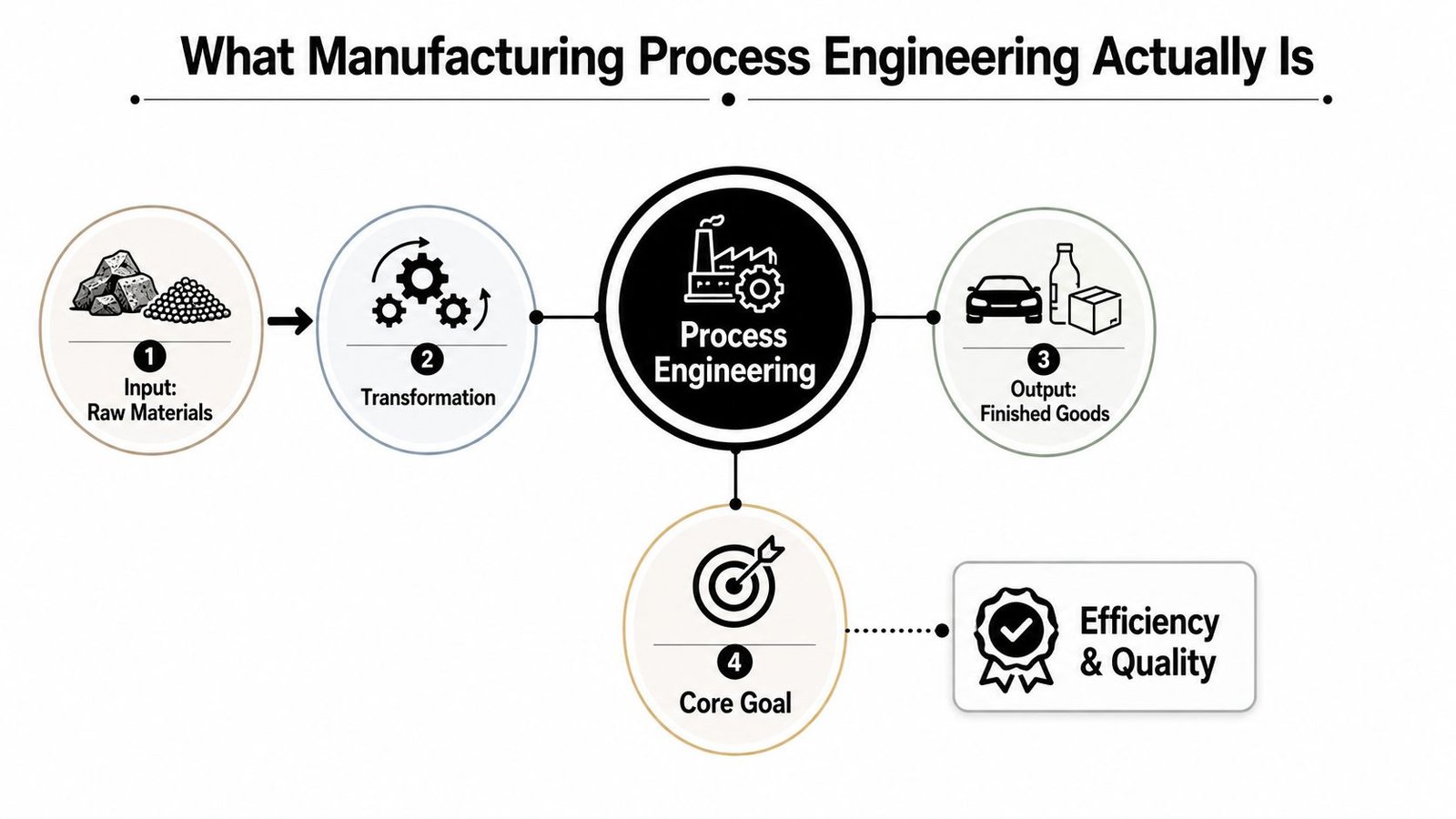
From raw material to repeatable output
Manufacturing process engineering is the discipline of converting raw materials into finished goods through defined unit processes. The National Academies names casting, machining, surface treatment, forging, powder compaction, and fusion arc welding as examples of unit manufacturing processes, and it identifies the enabling technologies that make them work: workpiece material behavior, process simulation and modeling, process sensors, process control, process precision and metrology, and equipment design (National Academies).
That matters because process engineering is not a back-office discipline. It decides how a product gets made, what tolerances are realistic, where quality can drift, and what the line will cost to run. Product design may define what the part should be, but process engineering defines whether the factory can build it consistently.
The bridge between design intent and shop-floor reality
A lot of production pain starts when engineering intent never becomes usable shop-floor work. Independent industry analysis says production instructions can remain inaccessible on the floor when companies fail to bridge engineering and operations, and a manufacturing engineering paper warns that smart manufacturing still struggles when product process design is not converted into standardized, lean, station-level work. That gap creates time-measurement errors, inefficient labor planning, and hidden capacity loss (Manufacturo).
Process engineering earns its keep. It turns product-level goals into station-level actions, control points, and acceptance criteria. If operators can't execute the process consistently, the design isn't finished yet.
Bottom line: Good process engineering makes work repeatable under real conditions, not just ideal ones.
The Process Engineering Lifecycle From Concept to Optimization
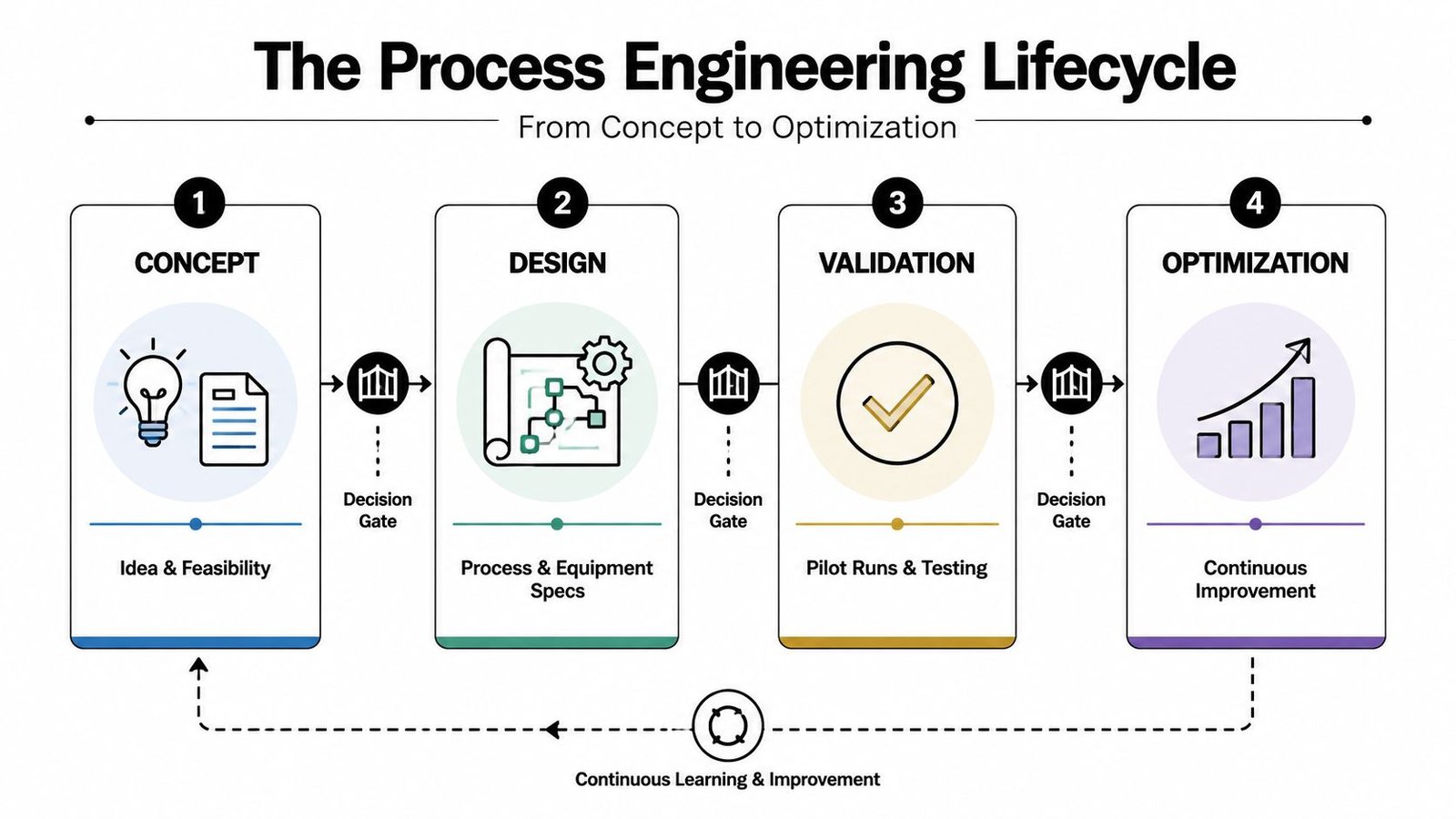
Concept and design set the limits
The concept stage is where you decide whether the product, process, and volume assumptions fit together. If the part needs tight cosmetic control, traceability, or a delicate material transition, that belongs in the process definition early, not after trial builds go wrong. Design then turns that intent into workstation layout, tooling, fixtures, controls, and operator flow.
I've seen too many teams lock in a product design and then ask production to “make it work.” That usually means the process gets forced around bad assumptions. The better path is to define the process window early, then choose the equipment and station design that can hold it.
Validation and optimization close the loop
Validation is where you prove the process can survive real variation. That's where FMEA, first-article inspection, and pilot runs belong, because you're testing whether the process can hold up at volume, not just whether it runs once. Optimization comes after that, when actual production data shows whether the main loss mode is availability, performance, or quality.
If you want a practical planning example, the process improvement and automation approach used by experienced integrators typically follows that same pattern, concept first, then proof, then refinement. The logic is simple. Don't tune a process you haven't stabilized.
Here's the cleanest way to think about the lifecycle:
- Concept. Define what the product needs from the process.
- Design. Build the station, tooling, and control logic around that need.
- Validation. Prove the process at pilot scale and during first article checks.
- Optimization. Remove the dominant losses after the line is running.
Video:
Core Methods and Tools That Drive Real Improvements
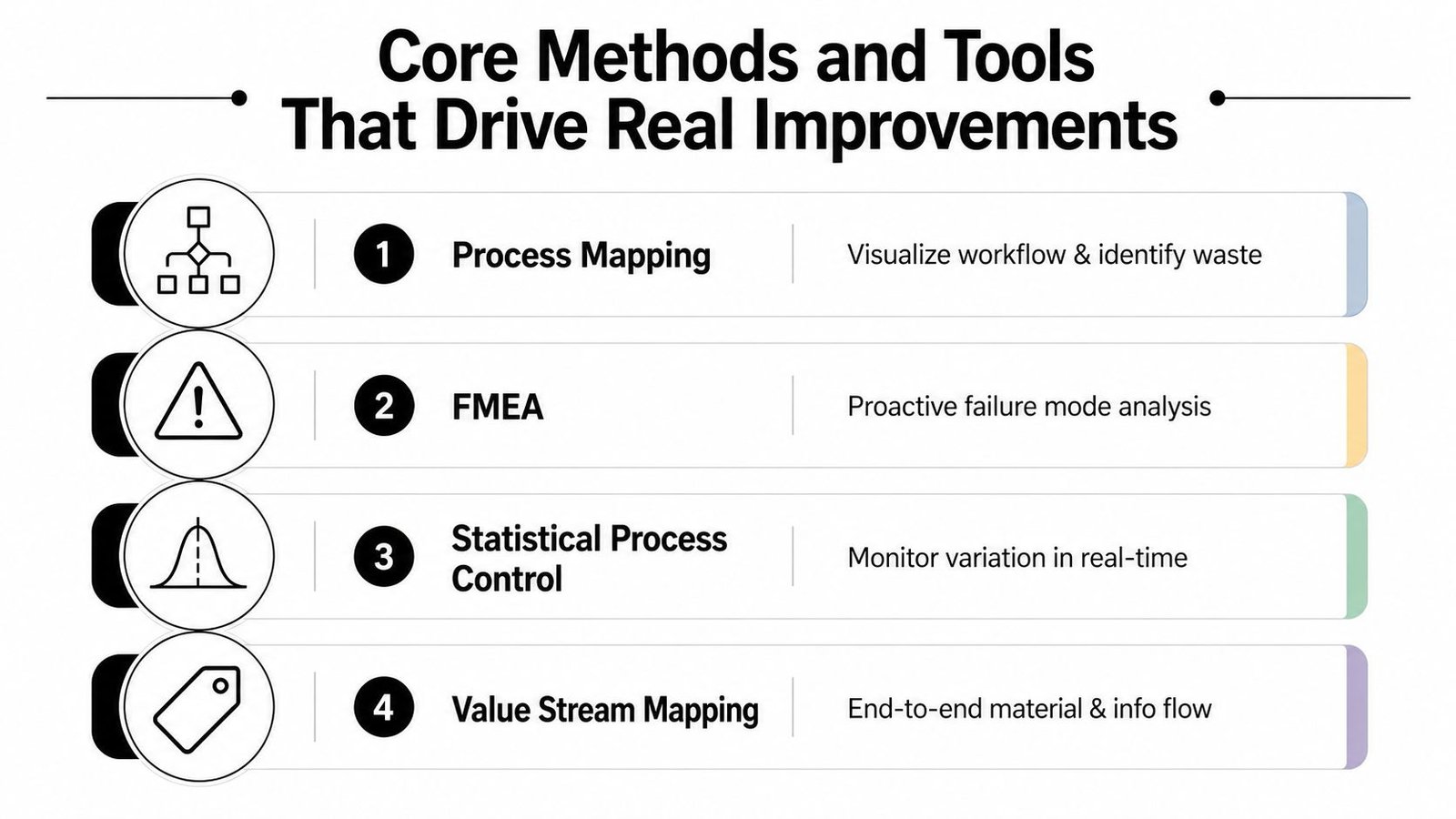
Use the right tool for the loss mode
Process mapping is the fastest way to expose hidden waits, rework loops, and handoff friction. If a line looks busy but output stays flat, mapping usually reveals that the work is bouncing between stations, approvals, or queues. Value stream mapping is especially useful when material and information flow are both part of the delay.
FMEA belongs where failures are expensive or hard to recover from. It forces the team to name the likely failure modes before they reach the customer or trigger a scrap run. That's useful in regulated manufacturing, but it's also useful anywhere a bad part can hide inside a larger assembly.
Control variation before it becomes waste
Statistical Process Control is the tool for drift. If quality is unstable, the issue may not be a single dramatic failure, it may be a process that wanders outside its normal operating band. A good SPC chart catches that early enough for the team to react before scrap or rework piles up.
DOE, or design of experiments, is the tool for finding the operating window that works. It helps answer which inputs matter, which ones don't, and where the process becomes sensitive. That's far better than adjusting one knob at a time and hoping the result holds.
For plants that want a leaner operating model, the lean manufacturing process improvement framework is often strongest when it combines these methods rather than using any single one in isolation. Ohio State's manufacturing process engineering group also points out that combining computational modeling with physical experiments helps identify critical process parameters and viable ranges, and can reduce cost, effluent, waste, tooling, and time when existing processes are improved (Ohio State University).
Engineering reality: The best method is the one that matches the loss you're trying to remove, not the one that looks most sophisticated.
Matching Automation Level to the Process You Actually Have
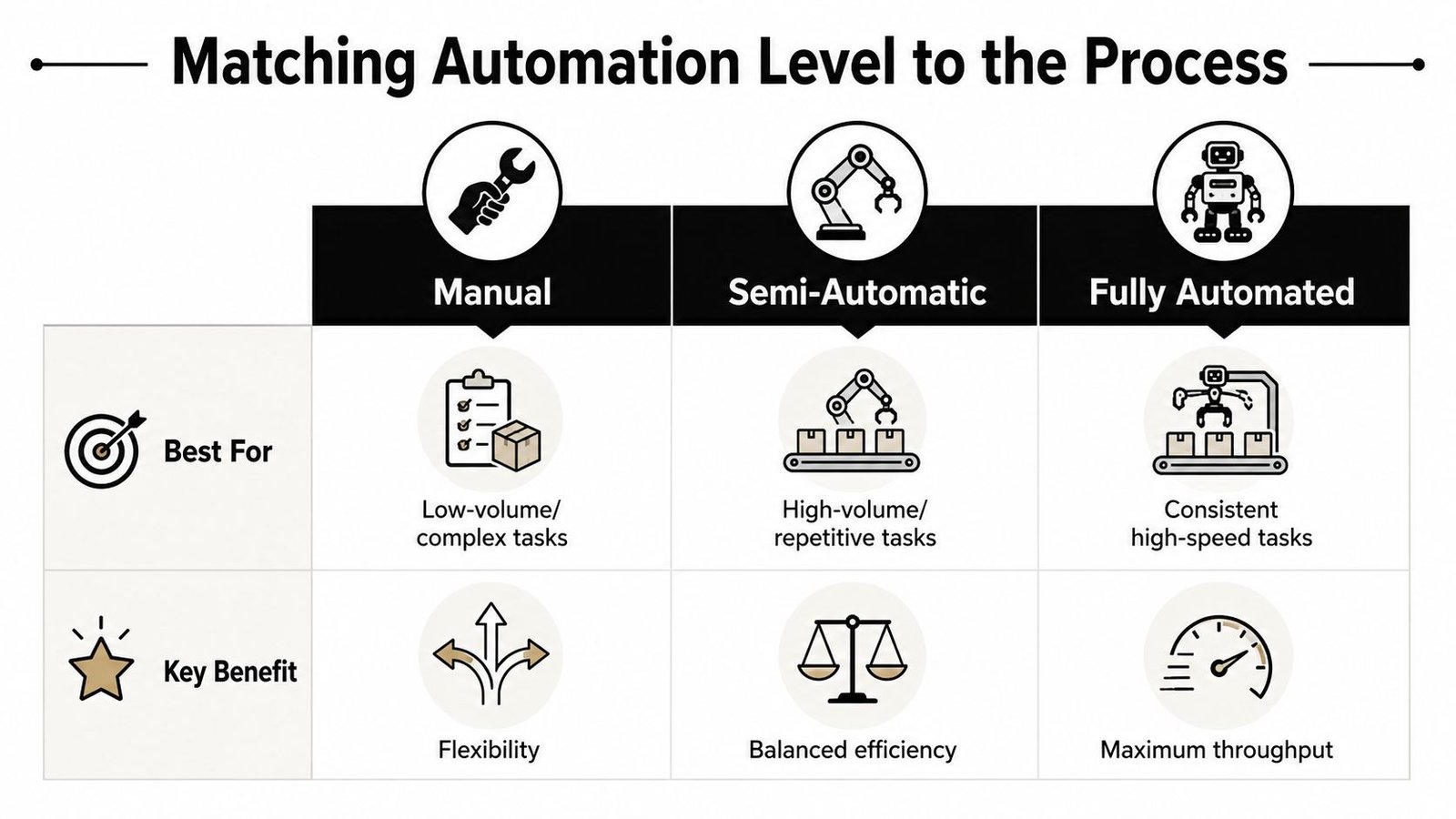
Manual, semi-automatic, and fully automated are different tools
The wrong way to talk about automation is as a ladder. Manual is not obsolete, semi-automatic is not a compromise, and full automation is not automatically superior. Each one fits a different production pattern, and the right answer depends on volume, variability, labor skill, changeover time, and quality risk.
A semi-automatic system often wins when the process needs human judgment at one or two points but can still benefit from controlled motion, fixed positioning, or integrated sensing. That's why custom tooling, fixtures, and integrated controls can outperform a more complex build. They're usually faster to commission, easier to validate, and more forgiving when product mix changes.
Why staged automation often beats a big leap
Fully automated lines make the most sense when the task is stable, repetitive, and high-speed. But many SMBs don't live in that world. They live in a world of short runs, frequent changeovers, and evolving customer specs, where over-automation can create a brittle line that's expensive to adjust.
That's where semi-automated systems fit well. They can reduce labor dependency without locking the plant into a rigid architecture. For GMP-aware production, they also support cleanability, validated work instructions, traceability, and auditable change control without forcing a lights-out investment that the business can't absorb.
SEA's mix of manual equipment, semi-automatic systems, fully automated options, custom tooling, fixtures, and integrated controls is a good example of how the market should be framed, as a range of engineering choices rather than a single automation answer. The key is not to maximize technology, but to match the level of automation to the process constraint.
Two Mini Cases That Show the Trade-Offs in Practice
A semi-automatic cell that solved the real problem
A medical device assembler was fighting inconsistent output at one bench. The temptation was to spec a robot, but the actual losses came from awkward part handling, variable placement, and operator fatigue. A custom fixture and semi-automatic assist cell changed the geometry of the work, stabilized the sequence, and reduced dependence on tribal knowledge.
The gain wasn't just speed. First pass quality improved because the part could only be loaded one way, and the operator no longer had to “feel” the correct alignment. That's the kind of improvement that matters in regulated work, because it supports repeatability without turning every motion into a validation headache.
A fully automated line that created a new bottleneck
Another plant chased full automation on a short-lifecycle product line. The line looked impressive during commissioning, but every design revision, material change, and product mix shift turned into a changeover problem. The process couldn't absorb the variety, so the bottleneck moved from labor to equipment flexibility.
That pattern is common. If the product life is short, the demand is uneven, and the process still needs adjustment from one run to the next, full automation can lock in the wrong assumptions. The better engineering choice is often a staged system that protects throughput while preserving changeover resilience.
The early warning signs are easy to miss if the team is focused on machine count instead of workflow. Watch for frequent manual overrides, long recovery after a changeover, and quality variation that only shows up when product mix changes. Those are usually signals that the process design needs work before more automation.
The Metrics That Actually Tell You Whether the Process Is Healthy
Read the metrics as a system, not a scorecard
The most useful benchmark metrics in manufacturing process engineering are OEE, First Pass Yield, scrap/rework rate, MTBF, and MTTR (LinkedIn on production and manufacturing systems evaluation). OEE breaks down availability, performance, and quality. MTBF and MTTR tell you whether the problem is frequent failure, slow recovery, or both.
First Pass Yield tells you whether the process makes good parts without correction. Scrap and rework rate show where cost is being pushed downstream. If throughput rises but FPY and MTTR don't improve, the plant may be moving the cost into rework and unplanned labor.
The metric table I'd use on a plant floor
| Metric | What It Measures | Primary Loss Mode Exposed | First Engineering Lever |
|---|---|---|---|
| OEE | Availability, performance, quality | Hidden production loss across the line | Find the dominant subcomponent, then attack that loss first |
| First Pass Yield | Good output without rework | Quality instability | Tighten process capability and station standardization |
| Scrap/Rework Rate | Defective or corrected output | Waste and downstream labor | Reduce variation, improve setup, and check incoming material |
| MTBF | Time between failures | Reliability weakness | Remove recurring failure causes and improve component robustness |
| MTTR | Time to restore operation | Slow recovery and maintainability gaps | Simplify access, diagnostics, and change procedures |
The reason layered data matters is that short-duration losses often disappear in end-of-shift summaries. Sensor and PLC signals can update at millisecond cadence, and MES data adds context like orders, materials, quality, personnel, and OEE. If you only look at ERP reports, you'll miss micro-stoppages, transient quality drift, and alarm cascades that happen below human reporting resolution (Symestic).
Putting It All Together Into a 90-Day Action Plan
Days 1 through 30
Start by mapping the process end to end, then identify the dominant loss mode. Don't try to fix everything. Isolate the constraint, whether it's changeover, scrap, downtime, or unstable station performance. That gives the team one target instead of a long wish list.
Days 31 through 60
Apply the right method to the right problem. Use FMEA on the highest-risk workstations, SPC on critical parameters, and DOE where process capability is unstable or poorly understood. If the process depends on tribal knowledge, convert that knowledge into work instructions, station standards, and measurable acceptance criteria.
Days 61 through 90
Implement the fix that matches the constraint. That may be a fixture, a tooling change, a control update, or a semi-automatic upgrade. Then measure the change in OEE, FPY, labor dependency, and rework burden, because those numbers tell you whether the line got healthier.
Good process engineering is not about making every line more automated. It's about designing work that operators can execute consistently as volume and product mix shift. That discipline protects margin, quality, and safety far better than a blind technology purchase ever will.
If your plant needs practical, budget-aware improvements in workflow, tooling, controls, or semi-automated equipment, System Engineering & Automation works on the same problem this guide focuses on, matching the engineering solution to the production constraint. Reach out if you want help choosing the right level of automation, tightening a process, or building equipment that operators can run consistently on a real shop floor.