A production manager gets the same call every week: output must rise, defects must fall, labor dependency is becoming harder to manage, and the budget won't support a blank-check automation project. One workstation is overloaded, another depends on an experienced operator, and a proposed fully automated line looks attractive until changeovers, maintenance, validation, and capital cost enter the discussion.
That is the pros and cons of automation decision. The question isn't whether automation works. It is which level of automation fits the process: manual, semi-automatic, or fully automated. A well-designed fixture may deliver more practical value than a robotic line when product mix changes frequently. In another plant, a fully automated system may be the only sensible route because demand, cycle time, and repeatability justify the fixed investment.
| Decision factor | Manual | Semi-automatic | Fully automated |
|---|---|---|---|
| Initial investment | Lowest | Moderate | Highest |
| Human involvement | High | Focused on setup, inspection, and exceptions | Low during normal operation |
| Flexibility | Very high | High when properly designed | More limited unless engineered for changeover |
| Throughput | Constrained by operator pace | Improved at targeted bottlenecks | Highest when volume and process stability support it |
| Quality consistency | Operator dependent | Repeatable critical steps with human oversight | Highly repeatable, dependent on system control |
| Maintenance burden | Relatively simple | Manageable with planned support | Specialized and potentially disruptive |
| Best strategic fit | Variable work and early-stage processes | Practical ROI with controlled risk | Stable, high-volume production |
Table of Contents
- Introduction Why Automation Decisions Matter Now
- Understanding Automation Levels in Manufacturing
- Key Benefits of Automation for Production Performance
- Hidden Drawbacks and Costs You Must Plan For
- Detailed Comparison of Automation Levels by Decision Criteria
- Real World Use Cases and When Each Level Fits Best
- How to Choose and Implement the Right Level of Automation
Introduction Why Automation Decisions Matter Now
A plant rarely reaches an automation decision because everything is running smoothly. More often, a quality complaint exposes variation in a hand operation, a customer increases order volume, or a skilled operator becomes the single point of failure for a critical process. The team then faces a familiar choice: add people, redesign the workstation, or automate the operation.
The wrong response is to treat automation as a binary purchase. Manual work can remain the right answer when products change often, volumes are uncertain, or the process still needs engineering development. Full automation can be justified when the sequence is stable, demand is predictable, and the financial return survives realistic assumptions about downtime and maintenance. Semi-automation often provides the middle path, controlling the repetitive or high-risk step while keeping people available for inspection, setup, replenishment, and exceptions.
That decision matters because automation changes more than labor content. It affects quality, safety, throughput, flexibility, maintenance, training, data capture, validation, and GMP documentation. A machine that runs quickly but makes changeovers painful may reduce the plant's ability to serve high-mix customers. A lower-speed fixture that prevents defects and records process conditions may create better total value.
Practical rule: Automate the constraint, not the entire factory by default.
The historical starting point for modern industrial automation is often placed in the early 1950s, when numerical control entered manufacturing. UNIDO describes numerical control as the starting point of modern industrial automation, after which automation expanded from machine-tool control into robotics and AI-enabled systems. The labor question has also become more nuanced. The OECD's earlier assessment found that automation risk was concentrated rather than universal, while its later work emphasized that job reorganization is often more common than outright displacement in adopting firms. The OECD's 2023 employment outlook is useful context for plant managers planning new roles around setup, maintenance, quality control, and process engineering.
This guide uses right-level automation as the practical lens. It weighs the upside and the hidden costs, then applies the comparison to medical devices, job shops, high-mix lines, and high-volume production.
Understanding Automation Levels in Manufacturing
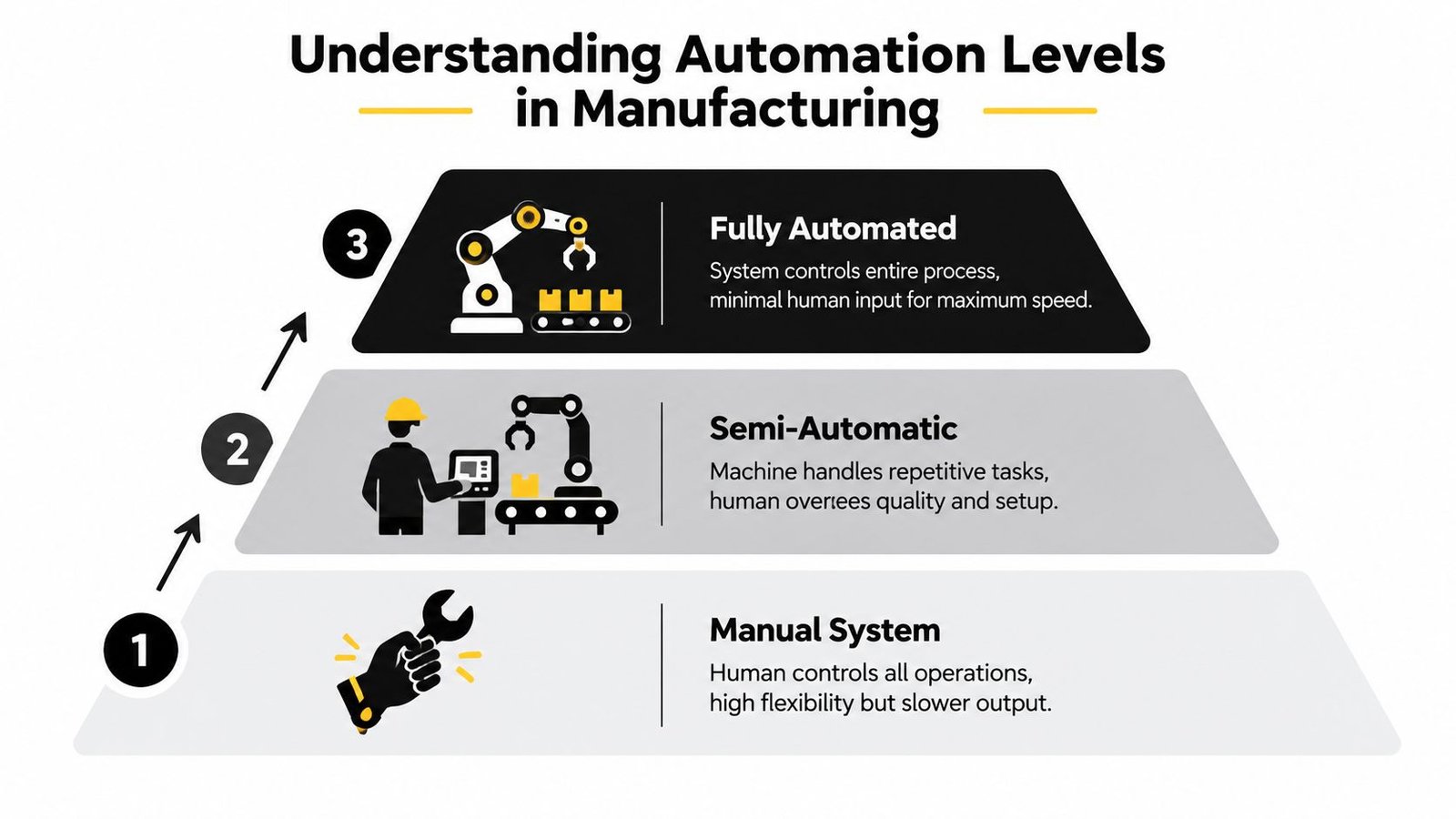
Start by describing what the operator and machine control. Don't label a process “automated” until you can identify the controlled steps, the remaining human decisions, and the recovery method when something goes wrong.
Manual systems
A manual system leaves the operator responsible for positioning, actuation, inspection, and often judgment about whether the work is acceptable. Hand tools, gauges, templates, and basic fixtures can still provide strong results when the product varies or the process is not yet stable.
Manual production offers maximum adaptability and the lowest equipment commitment. Its weakness appears when the operation depends on repeated force, alignment, timing, or motion. Operator fatigue and technique variation can then affect cycle time and quality. In a GMP-aware environment, the process also needs clear work instructions, traceability, inspection records, cleaning controls, and documented training.
Semi-automatic systems
A semi-automatic system assigns selected repetitive or precision-sensitive tasks to equipment while retaining a person for loading, unloading, setup, inspection, or exception handling. Examples include a pneumatic press with poka-yoke tooling, a table-top assembly station with controlled actuation, or a fixture that confirms part presence before a cycle starts.
This level is valuable because engineers can target one failure mode without locking the entire line into one product configuration. The operator remains part of the process, but the machine controls the steps where consistency matters most. For regulated production, semi-automatic equipment can also make critical motions easier to document, verify, and reproduce.
Fully automated systems
A fully automated system manages material handling, process execution, inspection, and transfer with minimal routine human input. Robotics, programmable logic controllers, vision systems, conveyors, sensors, and integrated controls may work together across the complete sequence.
The system can deliver high speed and repeatability when input parts, process conditions, and product specifications remain stable. It also creates the greatest dependence on integration quality. A failure in a sensor, gripper, software sequence, or upstream feeder can stop the line rather than only one workstation.
Use SEA's overview of manufacturing automation levels to map the current process before selecting equipment. The important question is not which category sounds most advanced. It is whether the chosen level matches volume, variation, risk, staffing, maintenance capability, and the evidence available for a credible return.
Key Benefits of Automation for Production Performance
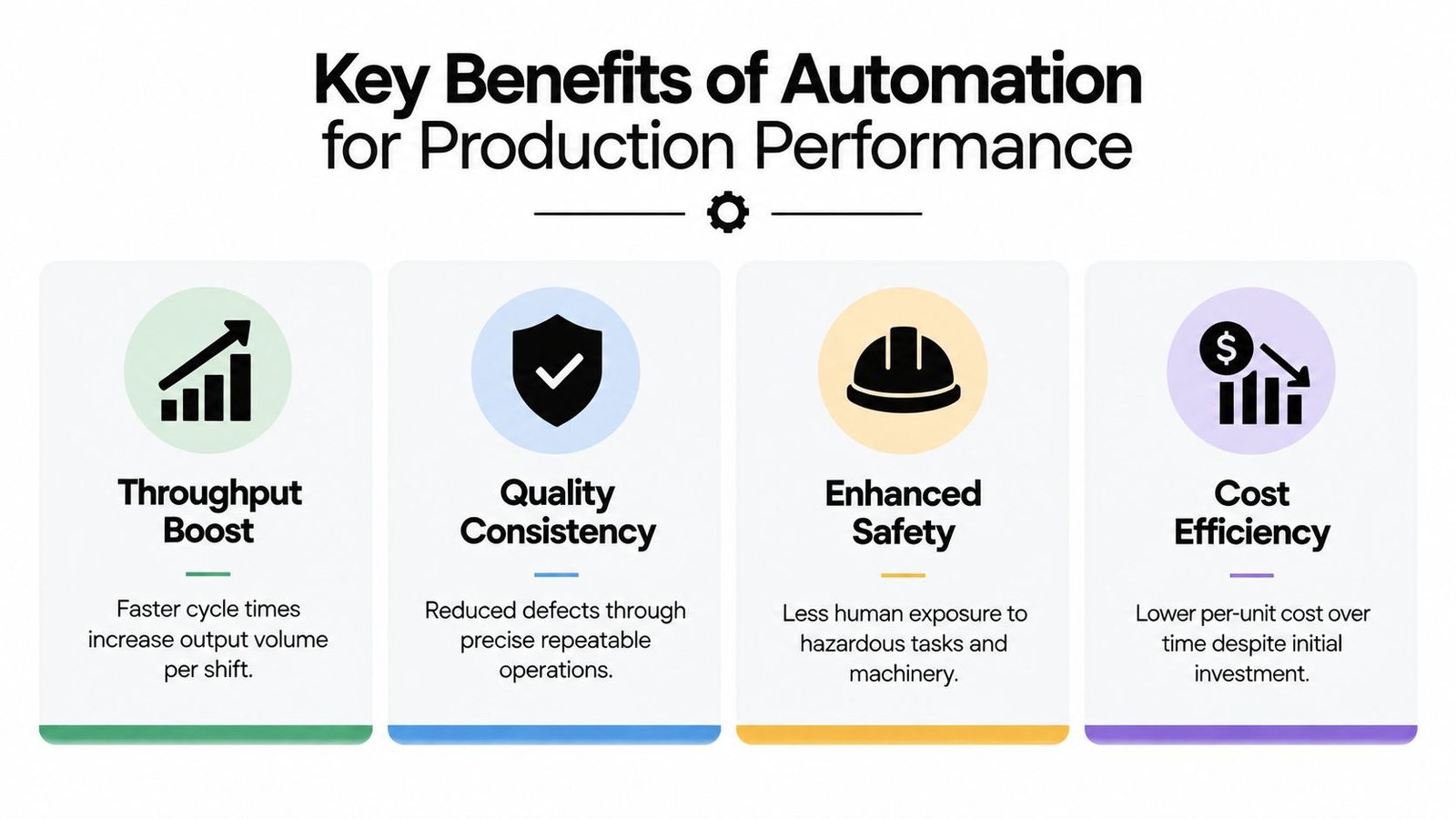
Automation creates value through specific operating mechanics. It shortens a repeated motion, controls a process variable, prevents an incorrect assembly, removes a worker from a hazardous exposure, or produces information that helps engineers correct a bottleneck. The strongest business cases connect the equipment to one or more of those mechanisms.
Throughput and cycle time
A robotic manufacturing case study recorded a cycle-time reduction from 218 seconds to 185 seconds per unit, while the defect rate fell from 2.30% to 0.30%. Staffing changed from 3 operators to 1 operator per shift in that example. The published case study details the cycle-time, defect, and staffing changes.
Those results matter because a faster cycle isn't useful if it creates rework or inspection queues. Automation earns its place when the complete flow improves, including loading, unloading, quality checks, material presentation, and recovery from faults. A semi-automatic station can capture much of the benefit when one repetitive operation creates the constraint, without requiring the plant to automate every adjacent task.
Consistency, safety, and process data
Repeatable tooling and controlled actuation reduce dependence on individual technique. That doesn't remove the need for quality engineering. It shifts attention toward validating the equipment, controlling inputs, maintaining calibration, and defining what happens when a result falls outside the acceptable range.
Automation can also reduce exposure to risky motions, sharp edges, heat, chemicals, or repetitive handling. A UK government review of advanced manufacturing identifies opportunities for improved speed, productivity, product quality, worker safety, and data collection that helps teams find inefficiencies.
The best automation business case includes quality and safety costs, not only direct labor.
At the firm level, the gains can extend beyond one machine. Research on Thai manufacturing found that automation adopters increased total factor productivity by an average of 23%, indicating that process control, repeatability, and utilization can improve the whole operation rather than merely substitute one manual task. The Productivity Institute's Thai manufacturing analysis supports targeting bottlenecks where variation, rework, or changeover losses dominate.
For a broader view of the operational argument, see why automation is more than a cost reduction exercise.
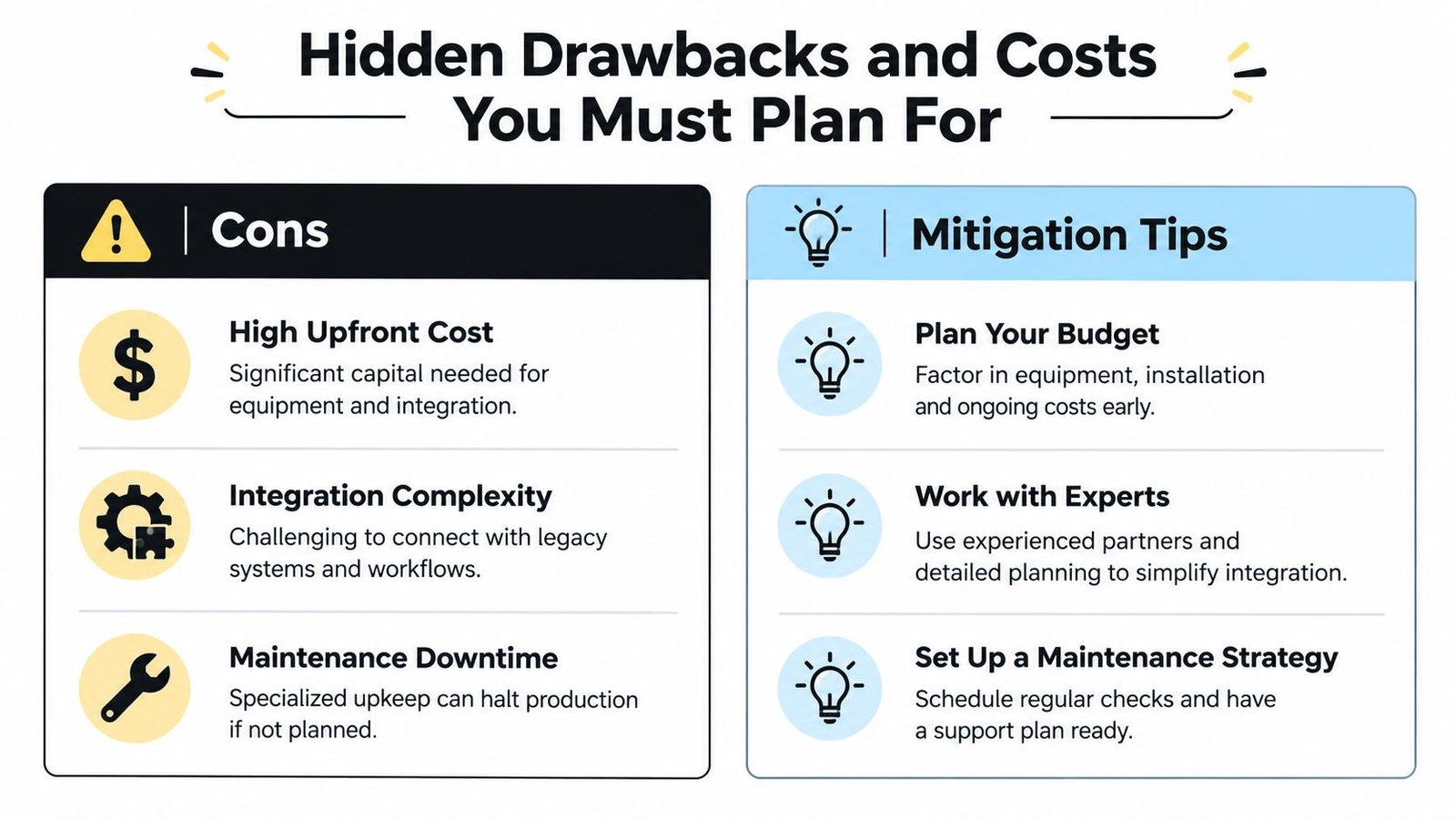
Hidden Drawbacks and Costs You Must Plan For
The most common automation failure isn't a lack of awareness. Plant managers already know that robotics, controls, vision, and smart tooling exist. The harder problem is execution. A 2025 smart manufacturing adoption study found that respondents most often identified high cost at 21%, capital requirements at 16%, lack of business cases at 14%, and workforce skill gaps at 14% as leading barriers. The 2025 ICAMS smart manufacturing report shows why a sound concept still needs disciplined implementation.
Capital and integration exposure
Equipment cost is only the visible portion of the investment. Engineering, tooling, controls integration, guarding, validation, operator training, spare parts, installation, and production disruption all belong in the business case. A line that depends on legacy equipment may need interfaces and communication work before the new station can deliver value.
This is why a staged project can be safer financially. A plant might begin with a custom fixture, controlled actuator, or inspection aid, then add data capture or robotic handling after the process proves stable. The approach keeps learning connected to actual production rather than assumptions made during a sales presentation.
Downtime and maintenance
Automated equipment doesn't remove maintenance. It changes the maintenance profile. Sensors, pneumatic components, servo drives, grippers, safety circuits, software, and vision systems require planned inspection and competent troubleshooting.
When a manual station fails, an operator may work around the problem. When an integrated automated line fails, the fault can stop several downstream operations. Total cost of ownership guidance from SEA is relevant because purchase price alone won't show the cost of spares, service response, change parts, downtime, and future modifications.
Flexibility and workforce transition
Fully automated equipment performs best within a defined operating envelope. Product variation, frequent changeovers, poor part presentation, or unstable upstream processes can turn speed into lost availability. Semi-automatic systems often preserve flexibility because people can manage controlled variation while the machine handles the repeatable core.
Labor effects also aren't uniform. OECD research associates robots with reduced employment in elementary occupations and increased employment in high-skill roles such as professionals and technicians, with negative effects in some mid-skill occupations and evidence of polarization in countries including the United States. The OECD analysis of automation's determinants and impacts makes reskilling and role design operational necessities, not public-relations details.
The distribution of gains deserves attention too. The World Bank's 2025 digital progress report warns that AI and automation can increase productivity and access while widening inequality between economies. UNCTAD similarly discusses pressure on labor's share of value added and greater capital concentration in its 2025 Technology and Innovation Report. A responsible plant plan measures who gains new skills, who loses routine tasks, and how the transition will be managed.
Detailed Comparison of Automation Levels by Decision Criteria
A decision table is useful only when the criteria reflect plant reality. Cost and throughput matter, but so do changeover time, maintenance response, documentation, training, and the ability to isolate a quality issue without shutting down the whole operation.
Automation Level Comparison by Manufacturing Criteria
| Decision Criteria | Manual | Semi-Automatic | Fully Automated |
|---|---|---|---|
| Cost | Lowest equipment cost, higher exposure to labor and variation | Moderate investment focused on defined operations | Highest capital and integration commitment |
| ROI timeline | Can be immediate when tooling solves a clear issue | Often practical when targeted at a bottleneck or defect mechanism | Depends heavily on volume, uptime, utilization, and stable demand |
| Quality consistency | Strongly dependent on training, technique, and inspection | Critical motions can be controlled while people handle judgment | High repeatability when inputs and controls remain stable |
| Safety | Operator remains exposed to process hazards and repetitive tasks | Equipment can isolate the riskiest motion | Highest potential reduction in routine exposure, with new safeguarding needs |
| Throughput | Limited by operator pace and manual handling | Improved where the machine removes a constraint | Highest potential for stable, high-volume flow |
| Flexibility | Excellent for product variation and frequent changes | Good when fixtures and recipes are designed for changeover | Lower unless the system is engineered for multiple products |
| Maintenance | Familiar tools and simpler recovery | Moderate controls, pneumatic, electrical, and mechanical support | Specialized maintenance, software support, and spare-part planning |
| GMP and regulatory fit | Depends on disciplined procedures and records | Supports controlled, repeatable critical steps with human oversight | Supports extensive control and traceability, but validation scope and integration complexity increase |
Manual production wins when flexibility and low commitment outweigh the cost of variation. It also gives engineers room to learn before freezing a process into equipment. The drawback is that quality and output can remain tied to operator technique.
Semi-automatic equipment is usually the most balanced option for small to mid-sized manufacturers. It can control force, position, timing, inspection, or part orientation while preserving human judgment and quick recovery. That balance is especially useful when the plant wants measurable improvement but can't justify a fixed, high-complexity line.
Fully automated production fits a different operating condition. The process should be repeatable, the input material controlled, demand credible, and the organization ready to support controls and maintenance. An OECD-linked study of industrial robots across 17 countries found gains in labor productivity and value added, with average country growth rates rising by about 0.37 percentage points. That evidence supports the potential of full automation, but it doesn't remove the need to match the system to utilization and product strategy.
Real World Use Cases and When Each Level Fits Best
The right choice becomes clearer when the process is described in operating terms rather than technology labels. Ask what the operator struggles to do repeatedly, what the customer pays for, and where a failure would create the greatest loss.
Medical device production
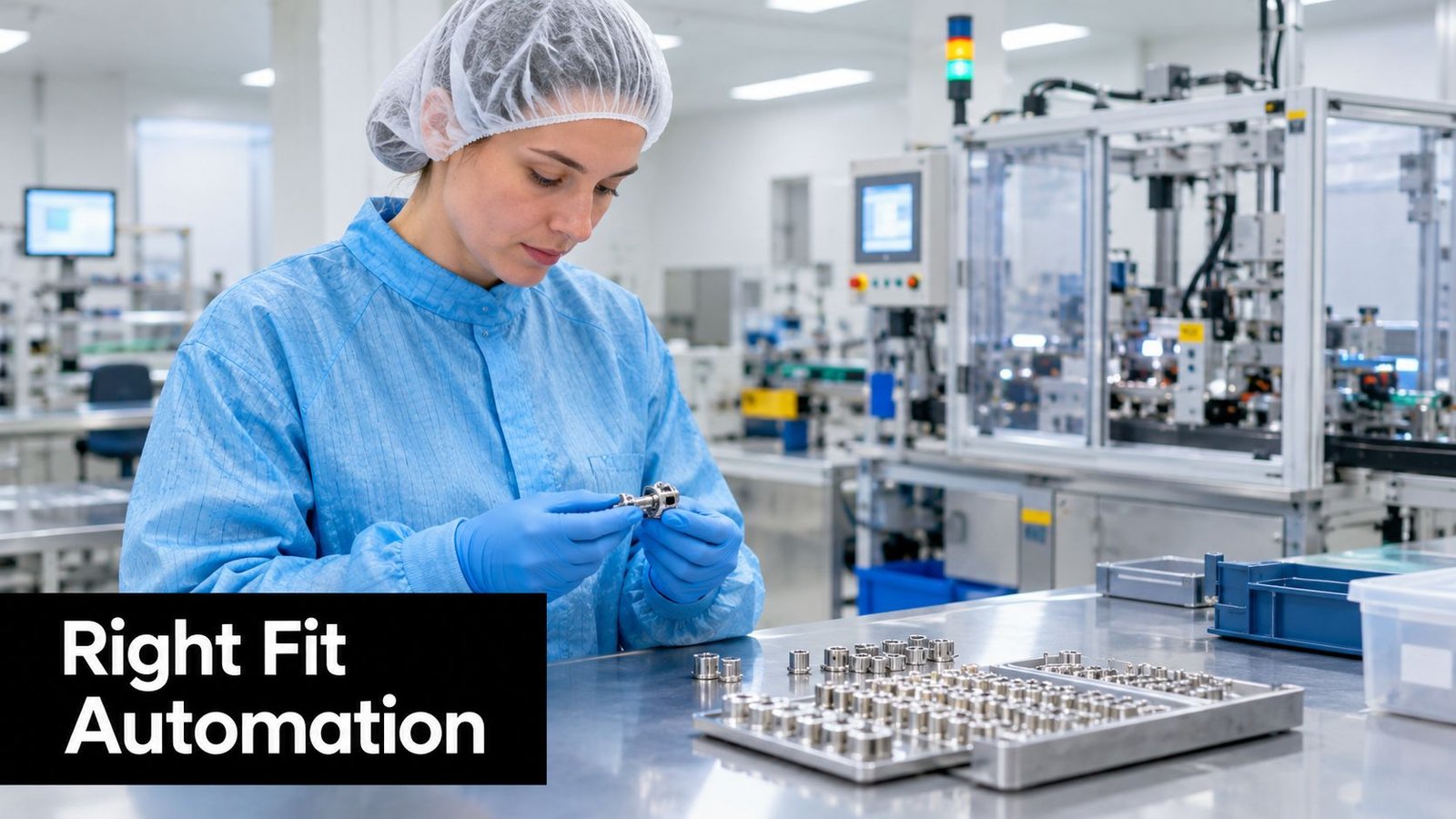
Medical device manufacturing often requires careful control of materials, cleaning, traceability, inspection, training, and documentation. A semi-automatic station can be appropriate when an operator must load a component and visually confirm a condition, while the equipment controls insertion force, alignment, torque, welding, dispensing, or another critical step.
The system should support documented setup, defined acceptance criteria, controlled recipes, and sensible segregation of nonconforming product. Full automation may fit a stable, high-volume device family, but validation and change control must be considered at the beginning rather than added after the design is complete.
Job shops and high-mix production
A small or mid-sized job shop usually needs flexibility before it needs maximum speed. Custom tooling, fixtures, guided work instructions, and controlled actuation can remove repeatability problems without creating a dedicated line for every product.
High-mix, low-volume work can benefit from semi-automatic equipment with quick-change nests, adjustable stops, recipe selection, and accessible inspection points. A fully automated cell may struggle if every order requires new fixturing or a different sequence.
Choose the level that lets the plant recover from variation without making every changeover an engineering project.
High-volume lines
High-volume production can justify integrated robotics, automatic feeding, vision inspection, and closed-loop controls when the demand is durable and the process has been proven. The key risk is building speed around an unstable upstream condition. A fast assembly cell will only produce faster if parts arrive correctly oriented, material replenishment is reliable, and defects can be contained without contaminating the flow.
System Engineering & Automation provides manual equipment, custom tooling and fixtures, semi-automatic systems, fully automated equipment, and integrated controls, with support spanning concept development, drawings, sourcing, installation, and commissioning. That end-to-end model is useful when a plant needs to test the process, select the right automation level, and maintain the equipment after launch.
How to Choose and Implement the Right Level of Automation
Begin with the bottleneck, not the machine catalog. Record where time is lost, where defects originate, which tasks create safety exposure, and how often products or tooling change. Separate labor savings from gains in quality, uptime, scrap reduction, capacity, safety, and customer service.
Use this implementation checklist:
- Baseline the process: Document cycle time, first-pass quality, rework, changeover effort, downtime, staffing, and manual decisions.
- Define the controlled task: Specify whether the equipment will position, press, dispense, inspect, test, handle, or record data.
- Compare levels: Price a manual improvement, a semi-automatic concept, and a fully automated alternative against the same production need.
- Test the ROI: Include integration, validation, training, maintenance, spare parts, downtime, and future product changes, not only labor reduction.
- Plan the people transition: Identify who will operate, set up, maintain, inspect, and improve the system, then build training around those roles.
- Verify performance: Run production-representative trials and compare actual output, quality, safety, and recovery behavior with the baseline.
For GMP-sensitive work, bring quality and validation personnel into the concept stage. Confirm that records, access, cleaning, traceability, alarms, and change control can be supported before the design becomes expensive to revise.
The safest automation project is usually staged. Prove the critical operation, measure the result, correct the weak points, and expand only when the data supports it. That approach protects flexibility while creating a defensible path to greater automation.
System Engineering & Automation can help manufacturers evaluate bottlenecks, develop custom tooling and fixtures, and design manual, semi-automatic, or fully automated equipment around real production constraints. Visit System Engineering & Automation to discuss a practical automation concept, ROI assumptions, GMP-aware requirements, installation, commissioning, and ongoing service support.