A customer complaint has landed, and the production lot appears clean. Quality can identify the batch, the manufacturing date, and the shipment, but not the exact units that passed through a particular test station or received a specific component. The team now faces an uncomfortable choice: quarantine more product than necessary, or accept uncertainty during an investigation.
That situation is where serial number tracking earns its place. It gives each unit a controlled identity and connects that identity to production, movement, shipment, repair, and final disposition. The strongest systems aren't built only for the clean scan at label creation. They're designed for the damaged label, missed scan, rework order, scrapped unit, and reissued number that will eventually test the process.
Table of Contents
- Why Serial Number Tracking Matters on the Shop Floor
- Define Objectives Data Model and Labeling Standards
- Choose Hardware Software and Integration Architecture
- Build the End to End Workflow From Serialization to Disposition
- Measure Performance Handle Exceptions and Avoid Common Pitfalls
- Roll Out Sustain and Scale Your Serial Tracking System
Why Serial Number Tracking Matters on the Shop Floor
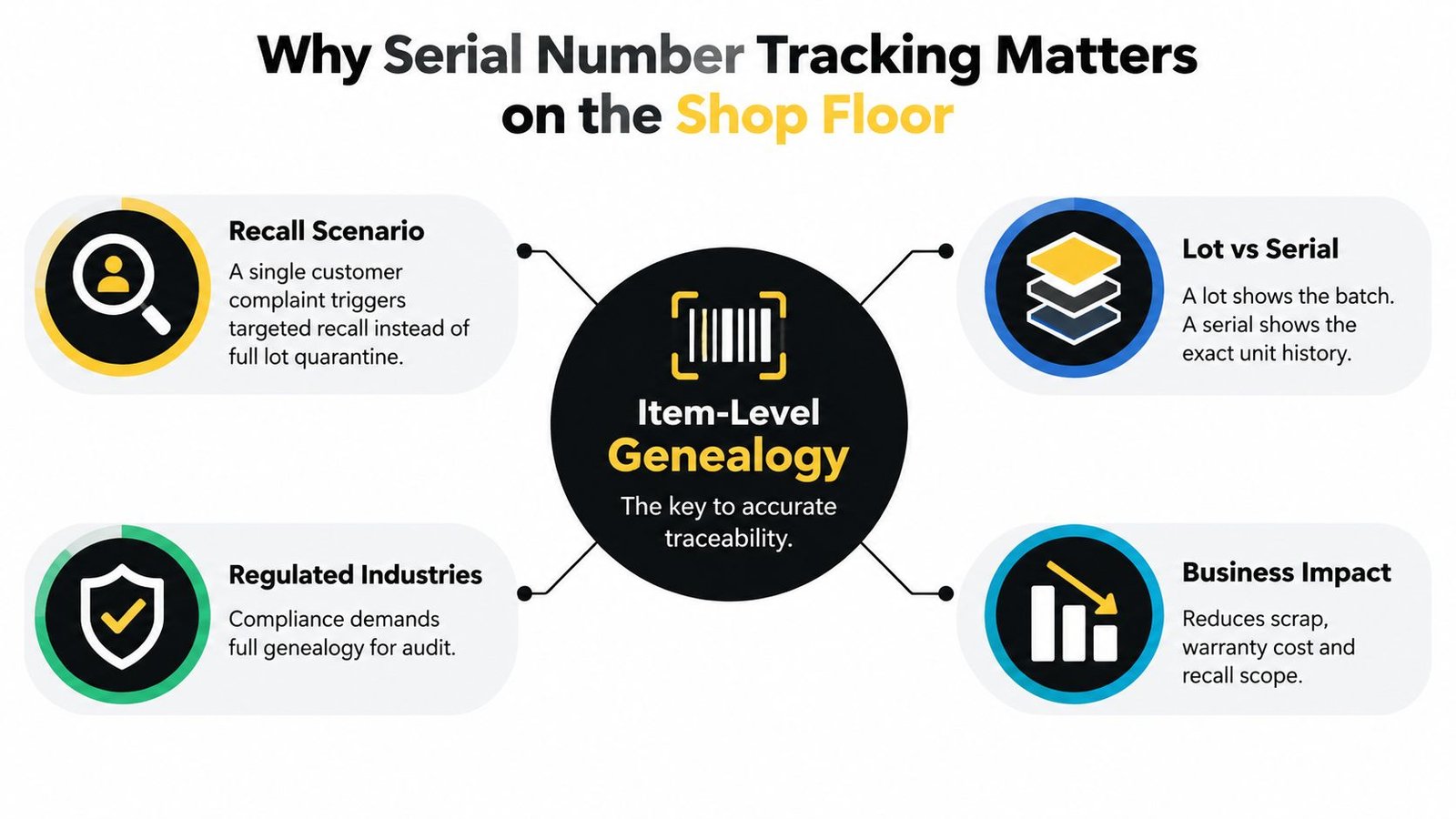
Lot tracking identifies the group a product belongs to. Serial number tracking identifies the individual unit, records what happened to it, and shows where it went next. That distinction matters when a complaint, audit, or recall demands evidence beyond a production run.
A service report may identify a failed shipped device, while the lot record covers every unit made in that run. Unit-level genealogy lets investigators trace the specific serial through receiving, assembly, testing, warehouse transfers, shipment, and service. The response can then focus on units connected to the condition instead of placing an entire population under suspicion.
From batch control to product genealogy
The difference is especially important in regulated and service-intensive manufacturing. In the European Union, the Unique Device Identifier is defined as a code for clear and unambiguous identification of medical devices on the market. The full UDI connects a model with its production run through details such as batch, lot, or manufacturing date, as described in serial tracking guidance for manufacturing.
The operational return is broader than compliance. Operations managers can locate inventory with greater confidence. Quality teams can connect a failure to a tighter evidence chain, while service teams can see what was built, tested, shipped, and repaired. Those records support warranty decisions and help distinguish a product defect from a handling or service issue.
Exception control determines whether that record remains trustworthy. A readable label and successful scan are the easy case. The system also needs a governed path for an unreadable mark, a missed scan, a reworked unit, a scrapped serial, or a number reissued in error. Operators should record the event at the point of work, while a central rule set controls status changes and prevents duplicate identities.
GMP-aware manufacturing relies on controlled records, repeatable procedures, and clear responsibility for critical events. Serial tracking does not replace the quality system. It supplies unit-level evidence inside it, and this guide to GMP in manufacturing explains the relationship between controlled production practices and manufacturing operations.
Practical rule: Invest in serialization when uncertainty, broad recalls, warranty disputes, service investigations, or audit preparation costs more than capturing each unit correctly.
The right system is not automatically a fully automated line. A semi-automatic station with a dependable scanner, clear prompts, and controlled exception handling may outperform a complex installation that operators bypass. Success means the plant can identify the unit, prove its history, and recover cleanly when the intended flow fails.
Define Objectives Data Model and Labeling Standards
Start with the business question, not the printer or scanner. A manufacturer that wants faster warranty decisions needs a different data emphasis than one preparing for device traceability, supplier investigations, or targeted recalls. Write the decisions the system must support, then define the records and events required to make those decisions defensible.
Establish the use cases first
Common objectives include:
- Recall scope: Identify affected units, their current locations, and their shipment destinations.
- Quality investigation: Connect a unit to test results, operators, equipment, components, and deviations.
- Warranty and service: Confirm the product identity and preserve repair history without relying on customer descriptions.
- Inventory control: Verify the exact unit received, moved, picked, or shipped.
- Process analysis: Compare outcomes across configurations, suppliers, workstations, or production conditions.
Not every product needs the same level of serialization. If a unit has no meaningful service history and the business only needs batch-level control, item-level capture may add work without enough return. If the product carries a warranty, contains safety-critical components, or may require a targeted recall, the case for serialization is much stronger.
Keep the identifier lean
Don't encode every business fact into the serial itself. Manufacturer-assigned serials aren't globally unique, and duplicates can appear across brands, acquisitions, or partner systems. The safer pattern is a lean serial identifier backed by a governed database record, as explained in why serial numbers aren't globally unique.
The database should hold context such as product family, configuration, lot or batch relationship, component serials, test records, status, location, shipment, customer, repair, and disposition. Parent-child relationships matter here. A finished assembly should connect to the serialized or lot-controlled components that went into it, while a replacement component added during service should create a new event rather than overwrite the original history.
Treat labeling as a process requirement
A label that scans in a clean office can fail beside a production line. Validate the material and marking method against the actual environment, including solvents, abrasion, moisture, temperature changes, and freezer storage where those conditions apply. A smeared or peeled label doesn't merely look untidy. It can sever the chain of custody.
For medical devices, UDI provides a formal framework. In the United States, Congress mandated unique identifiers in 2007, the FDA adopted the final rule in 2013, and lower-risk nonimplantable devices entered scope by September 2022. The identifier is intended to be human-readable and scannable, can contain up to 62 data elements, and is stored in the FDA's AccessGUDID database. By December 2019, more than 600,000 unique users had downloaded UDI data from AccessGUDID, according to the FDA's AccessGUDID resource.
Choose the applicable symbology and labeling standard only after confirming the data model, scanner capability, label space, and regulatory obligations. A short, durable, readable mark supported by authoritative records usually beats an overloaded label that operators struggle to scan.
Choose Hardware Software and Integration Architecture
A line can scan every unit correctly and still produce unreliable records if ERP, MES, WMS, and service systems each become an authority. Decide first where the authoritative serial event will live. Then assign ownership by event and synchronize only the data each application needs through a controlled integration layer.
ERP commonly owns item masters, orders, and financial disposition. MES may own routing, work instructions, process data, and electronic production records. WMS may control warehouse locations and shipment confirmation. Service software may govern returns, repairs, and replacement history. One platform does not need to perform every job, but every event needs one accountable owner.
Compare the practical options
| Option | Best Fit | Trade Off to Watch |
|---|---|---|
| Fixed barcode scanner and industrial printer | Repetitive stations with stable presentation and predictable takt | Less flexible when operators handle varied orientations or product sizes |
| Mobile scanner or tablet capture | Receiving, warehouse moves, service, and mixed manual work | Device handling, battery management, and ergonomics can affect adoption |
| MES-centered architecture | Process-heavy manufacturing with test, routing, and genealogy requirements | Requires careful ERP and WMS integration to avoid duplicate master data |
| ERP-centered architecture | Smaller operations with straightforward production and inventory events | May lack the station-level controls and immediate validation needed on a complex line |
| WMS-centered architecture | Distribution-led operations where location, picking, and shipment dominate | Production genealogy and rework may remain outside the system |
| PLC-connected validation | Automated equipment that can stop or release a cycle based on scan status | Integration effort rises, and poor exception design can create nuisance stops |
Design around exceptions before approving the happy path. The system should centrally govern unreadable marks, duplicate scans, rework, scrapped units, and serials that must be reissued. Each action needs an authorized reason, status change, and audit trail. Operators should not repair history by overwriting a serial or creating an untracked replacement.
EU and Australian UDI practices reinforce the need to connect identity with production context. A full identifier can associate a model with a production run through batch, lot, or manufacturing date, allowing a recall affecting one run to be isolated using the UDI-DI and UDI-PI. The architecture must therefore preserve both the identifier and the production events that give it meaning.
Match automation to the work
Use fixed scanners when presentation is controlled and every cycle follows the same pattern. Use mobile capture when products vary, work moves, or technicians record service events away from a station. Add PLC validation when a wrong serial could release an incorrect process state. Avoid connecting equipment merely because the connection is technically possible.
Network interruptions need an explicit recovery design. Stations should show transaction status, prevent silent acceptance, and route failed or pending transactions to a controlled queue. Define what can be held locally, who can release it, and how duplicate submissions are reconciled. Before selecting equipment, review hardware and software integration considerations against line layout, operator motion, validation rules, and maintenance capability.
Build the End to End Workflow From Serialization to Disposition
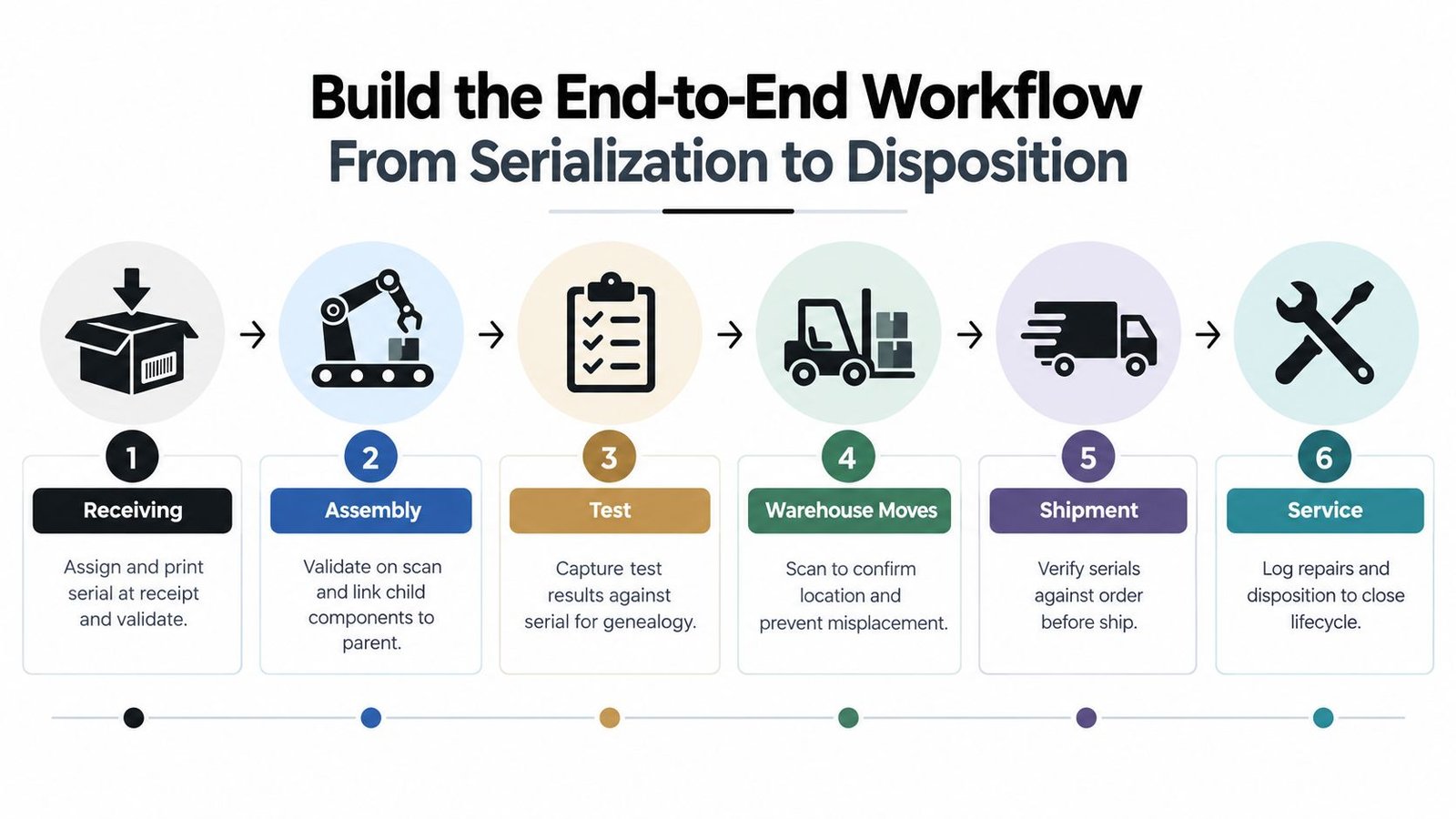
A serial record earns its value when it follows the unit through every event that affects identity, status, location, or release. Assigning a number at one station and checking it at shipment produces an inventory label, not usable genealogy. Build the workflow around controlled events, with each scan confirming that the unit is expected at that point in its lifecycle.
Map the governed event flow
Receiving: Capture or assign the serial when the unit or serialized component arrives. Validate it against the expected item, supplier, purchase order, and condition. An unreadable mark goes to an authorized exception process, not an unverified replacement record.
Assembly: Scan the parent and child components before the operation starts. The system should confirm that each component is available, matches the approved configuration, and has not already been consumed elsewhere. Record substitutions and removals as explicit events.
Test: Attach test results, equipment identity, method, operator, and outcome to the serial. A failed test must change the unit's controlled status and identify whether the next disposition is rework, quarantine, or scrap.
Warehouse moves: Require a scan whenever the unit changes location or status. Confirm both the serial and destination, so a physical move cannot become an unexplained digital discrepancy.
Shipment: Verify the serial against the order, customer, configuration, and release status before packing or shipment confirmation. Catch a wrong-unit shipment at the station rather than through later reconciliation.
Service: Record the complaint, inspection, repair, replacement components, retest, and final disposition against the same lifecycle record. A repaired unit keeps its original identity unless the governing procedure requires retirement and reissuance.
Validate at the point of scan instead of waiting for a nightly batch. Immediate checks catch duplicate, wrong-item, and wrong-status serials before they spread into ERP or MES records. The validation rules should sit in a controlled integration layer that governs which events are accepted, rejected, queued, or escalated.
A rejected scan is useful information. A silently accepted scan is a future investigation.
Design the exception transaction
Rework, scrap, unreadable marks, and reissued serials need formal states, not spreadsheet notes. When a unit enters rework, preserve the original serial, open a controlled rework event, record the reason, and define the disposition. If it is scrapped, retire the serial with an authorized reason and prevent its return to available inventory. If repair requires a new serial, link the old identity to the new one and preserve the chain of custody.
The FDA's UDI system supports identification from manufacturing through distribution to patient use, but it does not replace separate device tracking or tracing obligations. FDA tracking requirements under 21 CFR Part 821 apply to certain device classes and require manufacturers to maintain tracking records for covered products, as set out in the electronic Code of Federal Regulations requirements. Treat UDI and serial capture as parts of the compliance framework, not substitutes for it.
Permissions complete the control model. Operators should capture scans and respond to prompts. Authorized quality or engineering users should approve overrides, retirements, and reissues, with the reason and affected serial retained in the audit trail. That separation keeps the line workable while preventing a convenient workaround from erasing history. Practical serial number manufacturing guidance also supports validation during capture, where errors can still be contained.
Measure Performance Handle Exceptions and Avoid Common Pitfalls
A serial tracking system proves its value at the workstation, especially when a mark fails, a unit enters rework, or an operator must stop the normal flow. Measure whether people can capture identity without unsafe movement, avoidable waiting, or an unofficial workaround. Then check whether the recorded event supports a release, containment, rework, scrap, or service decision.
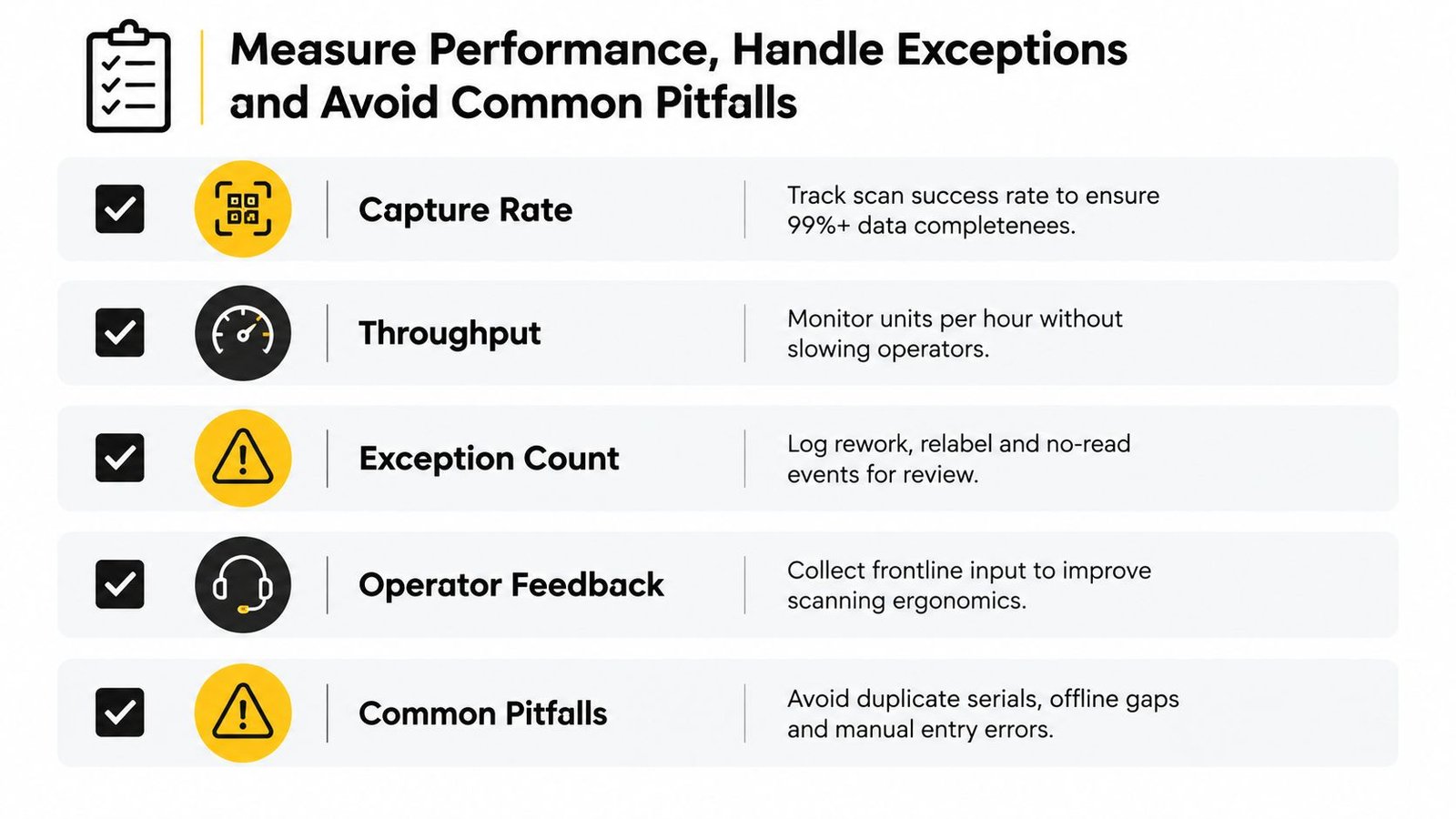
Use a 2 to 4 week pilot on one high-impact process. Compare baseline and pilot results for capture rate, throughput, exception count, and operator feedback. The purpose is to expose failure modes early, not to produce a polished dashboard.
Measure what the line experiences
Track the following measures without turning the pilot into a reporting exercise:
- Capture rate: Record successful scans and the reasons for no-reads, manual entries, and rejected transactions.
- Throughput: Compare unit flow before and during the pilot. If traceability blocks production, change the station design or transaction sequence.
- Exception count: Separate unreadable marks, missed scans, duplicate serials, wrong configurations, rework, scrap, and reissue events.
- Operator feedback: Check scanner position, label presentation, prompt clarity, and the points where work pauses.
- Data completeness: Verify required parent-child, test, location, shipment, and disposition relationships.
The infographic shows a 99%+ data completeness target. Treat it as a benchmark for examining the process, not as a universal result or promise. Define completeness around the events that affect release, recall, and service, then investigate each missing relationship.
Build recovery paths before launch
Design the exception process before commissioning the happy path. An unreadable mark needs a quarantine or relabel station. The operator should verify the unit through an approved secondary method, print a replacement label under controlled authorization, and retain the relationship between the original mark, replacement action, and current status.
A missed scan requires a documented correction event. Do not rely on a backdated spreadsheet entry without an explanation. Restrict manual entry to cases where scanning fails, and require a confirmation prompt plus reason code.
Reissued numbers after repair need a defined relationship to the retired or superseded identity. Keep these events in the audit trail so quality can distinguish an authorized correction from an unexplained data change.
Exception standard: Every recovery path should answer who changed the record, why the change was allowed, what happened to the physical unit, and whether the original identity remains valid.
Central event governance matters more than a perfect workflow diagram. Production, quality, warehouse, and service can use different screens, but they need the same authoritative issuance process and event definitions. Assign ownership for approving corrections, retiring identities, and releasing quarantined units.
Keep serials simple. A code that embeds plant, date, product, shift, and revision becomes difficult to govern as operations change. Store that context in the database, where authorized users can update master data without changing an identity already assigned to a manufactured unit.
Spreadsheets can support a temporary investigation. They should not become the permanent source of truth for serialized products.
Roll Out Sustain and Scale Your Serial Tracking System
The rollout should follow the risk and complexity of the process, not the ambition of the software demo. Start with a product family or workstation where a traceability gap has a clear operational cost. Confirm the identifier rules, label performance, event ownership, exception approvals, integration behavior, and operator ergonomics before expanding to additional lines or sites.
Training should use real failure conditions. Have operators practice a clean scan, an unreadable mark, a rejected component, a rework transfer, a scrap decision, and a service return. If training covers only the ideal path, the first real exception will become an improvised procedure.
Keep governance active after commissioning
Assign owners for master data, serial issuance, label templates, integration monitoring, and exception review. Use change control for new products, altered routings, replacement components, scanner changes, and label material changes. Revalidate labels when the environment or process changes, especially where solvents, abrasion, cold storage, or repeated handling can affect readability.
Review exception patterns as process signals. A growing number of no-reads may indicate poor label placement or inadequate marking. Repeated manual entries may indicate a scanner position problem. Frequent rework or reissue events may point to a design or test issue rather than a tracking issue.
Existing guidance often concentrates on the happy path, such as scanning at label creation, shipment, and warranty. The operational failures that matter most include unreadable marks, missed scans, rework, scrapped serials, and numbers reissued after repair, as discussed in exception-focused serial tracking guidance.
The durable approach is right-sized automation. Use automation to prevent predictable mistakes and capture evidence at the point of work, while keeping people responsible for judgment-based decisions. That balance protects GMP-aware processes, supports ROI, and gives manufacturers a system that can scale without forcing every station into unnecessary complexity.
System Engineering & Automation provides practical manufacturing solutions for serial number tracking, including semi-automatic equipment, custom tooling, fixtures, integrated controls, commissioning, and ongoing service support. Visit System Engineering & Automation to discuss a right-sized production or service solution built around your workflow, exception handling needs, and budget.