
If you're running a plant today, you already know where the pain sits. A manual station is slowing the line. Quality varies by operator. Changeovers eat more time than anyone wants to admit. And every automation quote that lands on your desk seems built for a budget and footprint you don't have.
That's why servo motors matter. Not as a flashy component, but as a practical way to put precise motion exactly where the bottleneck lives. In the right semi-automated setup, a servo system can tighten assembly, stabilize packaging, improve inspection repeatability, and reduce labor dependency without forcing you into a full robotic cell on day one. That's usually where the best ROI is found.
The broader market direction supports that decision. The global servo motor market was valued at USD 12.95 billion in 2023 and is projected to reach USD 19.06 billion by 2030, growing at a 5.7% CAGR from 2024 to 2030, according to Next Move Strategy Consulting's servo motor market report. That growth is tied to CNC machines, automated assembly lines, and precision robotics, which tells you where manufacturers are placing their money: on controlled motion that improves quality and throughput.
For manufacturers looking to optimize production and service performance, servo motor applications are one of the clearest paths from cost center to profit driver. The examples below stay grounded in real plant-floor use, especially for small to mid-sized operations that need targeted upgrades, not automation theater.
Table of Contents
- 1. Precision Assembly Line Automation for Medical Devices
- 2. Automated Packaging and Labeling Systems
- 3. CNC Machining and Precision Cutting Operations
- 4. Robotic Pick-and-Place and Material Handling
- 5. High-Speed Printing and Marking Systems
- 6. Test and Inspection Automation with Servo-Driven Positioning
- 7. Dispensing and Metering Automation for Fluids and Viscous Materials
- 8. Textile and Web Material Unwinding/Rewinding with Tension Control
- Comparison of 8 Servo Motor Applications
- Making the Right Move Your Next Steps in Automation
1. Precision Assembly Line Automation for Medical Devices
Medical device assembly is one of the clearest examples of where servo motor applications justify themselves fast. If you're aligning catheter components, placing small molded parts, or controlling insertion depth on a syringe or needle assembly station, operator consistency alone usually won't hold the same result all shift long.
Servo motors are a strong fit here because the motion can be programmed, verified, and repeated. In medical device manufacturing, they're used in surgical robots and imaging systems where precision must exceed 0.1 mm to support patient safety and GMP-driven production requirements, as described by STOBER's explanation of how servo motors work. That same discipline carries directly into semi-automated assembly stations.
Where servo control earns its keep
A good semi-automatic station doesn't try to automate everything. It automates the motion that creates risk.
For medical assembly, that usually means:
- Insertion depth control: A servo axis can stop at a programmed position instead of relying on a hard mechanical stop.
- Repeatable fastening motion: Torque and position can be monitored together for a better assembly signature.
- Vision-assisted placement: A camera can confirm orientation before the servo completes the final move.
Practical rule: In regulated assembly, automate the step that creates the deviation, not the entire line first.
Manufacturers also need to think about compliance, not just speed. If you're building equipment for this environment, GMP in manufacturing isn't a side topic. It shapes material choice, guarding, cleanability, documentation, and maintenance access.
How SEA would approach it
A company like SEA would usually start with one bottleneck station, not a full line replacement. Think of a semi-automatic fixture for tubing connector assembly: the operator loads parts, a vision check confirms orientation, and the servo completes the controlled press, hold, and return cycle. That keeps labor where human judgment still matters and removes variation from the critical motion.
What doesn't work is overspecifying the axis because the product is regulated. Many smaller manufacturers don't need robot-cell performance at every station. They need enough precision for the actual process. That distinction matters. Eiyu notes that small to mid-sized manufacturers often need around 0.1-degree precision for custom fixtures, while much of the industry conversation stays focused on much tighter robot-grade specs, even though those firms make up 90% of manufacturing companies globally, according to Eiyu's overview of servo functions and applications.
2. Automated Packaging and Labeling Systems
A line can hit target speed for filling or forming and still lose margin at the back end. Labels go on crooked after a changeover. Cartons arrive a fraction out of position. Operators start making hand corrections just to keep shipments moving. That labor cost hides in plain sight until volume climbs or SKU count increases.
Servo motors pay off in packaging because they solve a coordination problem. The label feed, conveyor index, sealing motion, and print trigger can all follow the actual product position instead of a fixed mechanical timing relationship. That matters more in mixed-product plants than raw top speed. If your team runs frequent changeovers, shorter batches, or customer-specific labeling, servo control usually returns value faster here than in a full machine replacement.
Why packaging is often the best first retrofit
Packaging equipment ages in uneven ways. The frame may still be sound while the clutch-driven labeler, cam-based sealer, or basic VFD conveyor creates most of the downtime. Replacing only the motion elements that cause drift is often the better capital decision.
A practical retrofit usually starts in one of three places:
- Label placement control: Replace a clutch or step-change drive with a servo axis for accurate label feed, registration, and stop position.
- Seal and index timing: Program the jaw stroke and conveyor index to match product pitch instead of living with one mechanical timing setup.
- Recipe-based changeover: Store format settings in the HMI so operators can switch products without repeated manual adjustments.
That approach fits plants that need output gains without the disruption of tearing out a working machine. It also gives maintenance a cleaner troubleshooting path because the axis behavior is visible in the controls instead of buried in springs, cams, and trial-and-error adjustments.
What a practical upgrade looks like
A blister packaging line is a good example, especially in operations with frequent SKU changes. The machine may run well enough on its primary product, then start missing label position, date-code registration, or carton timing as soon as the line switches formats. The root problem is often motion coordination, not the machine as a whole.
SEA would usually start with the indexing and label feed axes, then add a simple recipe structure the operators can effectively use. The goal is not to automate every hand motion. The goal is to remove the adjustments that create scrap and rework during changeovers. In some plants, that work also exposes a second opportunity upstream or downstream, especially where package geometry has to stay consistent before secondary processing such as 5-axis CNC milling for custom tooling and machine components.
There is also a reliability angle. PMD points out that servo systems are widely used in packaging because they support precise speed and position control in synchronized machine motion, which is exactly what labeling, sealing, and indexing demand on high-cycle equipment, according to PMD's overview of servo motor system applications.
The business case should be built on throughput stability, labor reduction during changeovers, and lower scrap. Energy savings may help, but they are rarely the main driver in a packaging retrofit. Plants get the better return by fixing the motions that force operators to babysit the machine.
A faster axis will not correct bad tooling, inconsistent infeed, or poor product presentation. It will expose those issues faster. That is why the best semi-automated packaging projects start with the station that creates the repeatable error, then scale only after the line proves out.
3. CNC Machining and Precision Cutting Operations
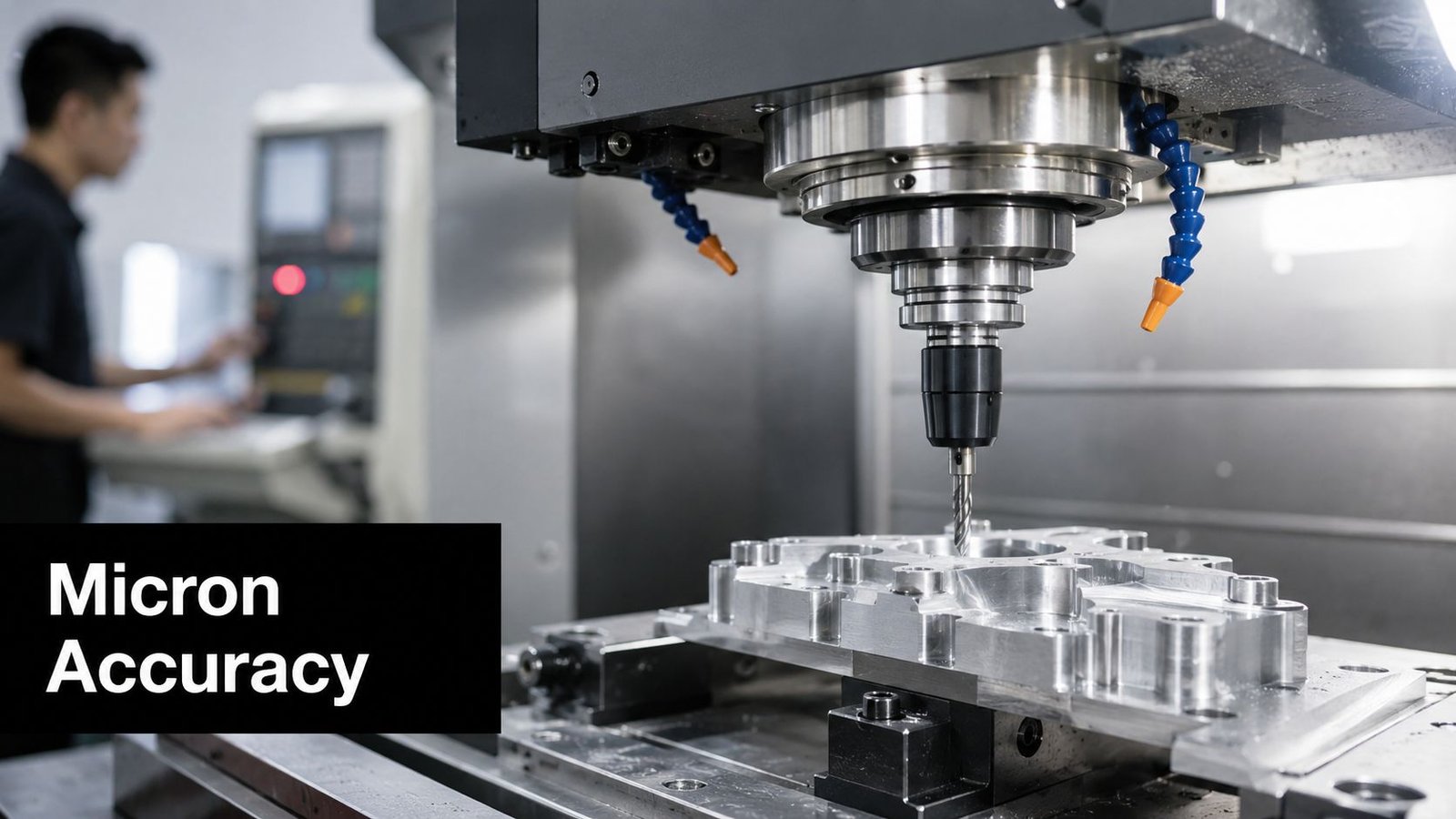
In CNC work, servo motors aren't optional extras. They're at the center of spindle control, feed movement, and axis positioning. If your shop depends on tight-tolerance parts, the difference between a stable servo-controlled move and a marginal one shows up in finish, scrap, and cycle consistency.
The real value is control under load
A lot of buyers focus on top-end machine specs. On the floor, what matters more is how the axis behaves under actual cutting conditions. Servo systems allow the machine to regulate speed, position, and torque with the consistency needed for precision milling, drilling, and contouring.
That matters in medical implant work, die fabrication, and aerospace parts where geometry can't drift because the cutter sees a harder section or the feed profile wasn't tuned properly. In semiconductor manufacturing equipment, servo motors are used for ultra-high-speed, ultra-precise motion across process steps where positioning accuracy must stay within a few tenths of a millimeter, according to Yaskawa's servomotor application page. Different industry, same lesson: precision under motion load is where servo control pays for itself.
Where SEA usually starts
For a small or mid-sized manufacturer, the smartest path is often a semi-automated CNC cell. The machine handles controlled motion. The operator handles setup, tool verification, and first-piece inspection. That keeps labor focused on judgment instead of repetitive machine babysitting.
A company evaluating more complex milling work should also look at whether the machine platform matches the part family. Shops moving into more angular or contoured work often benefit from understanding 5-axis CNC milling before they spend money upgrading fixtures around a machine that can't support the process window they need.
Most CNC issues blamed on the servo are really stack-up issues. Tooling, backlash, contamination, poor programs, and weak workholding all show up as motion problems.
What doesn't work is adding a better servo package to a machine with unresolved coolant intrusion, loose mechanics, or inconsistent tool-change procedures. The motor can't compensate for a weak platform.
4. Robotic Pick-and-Place and Material Handling
Material handling is often where manufacturers get their first win with servo-based automation. The tasks are repetitive, labor-intensive, and easy to define: load the CNC, unload the mold press, transfer parts to a tray, stack finished goods, repeat.
Why servos dominate robot motion
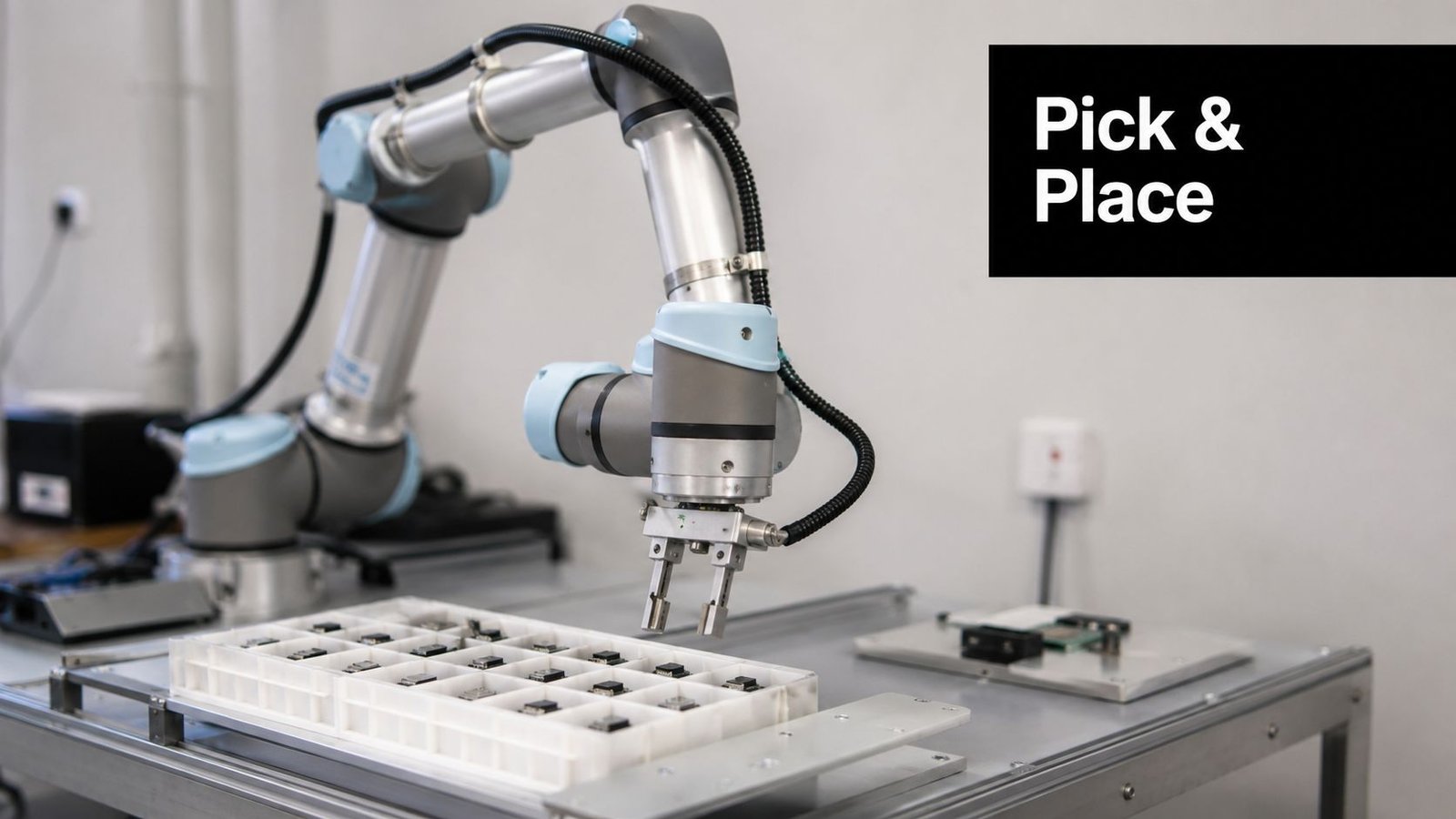
Nearly all industrial robot designs use servo motors because they offer the size efficiency, force density, and precision needed for complex movement sequences in welding, painting, and picking tasks, as noted by HEIDENHAIN's overview of servo motor applications. That same flexibility is why servo-driven robot arms work so well for machine tending and part transfer.
The appeal for smaller plants is simple. You don't need to redesign the whole facility to automate one repetitive movement. A collaborative robot with servo-driven joints can often be dropped next to an existing machine and put to work faster than a conveyor-heavy system.
A realistic first deployment
SEA would rarely recommend starting with the most complicated robot task in the building. A better first move is one station with stable part presentation and clear handoff logic. CNC load and unload is a classic example. The robot picks from a tray, presents the part to the chuck, waits on machine-ready status, and places the finished piece into a second location for inspection.
If you're evaluating broader material handling automation solutions, watch the support equipment just as closely as the robot. Feeder reliability, gripper design, and part orientation usually decide whether the cell performs.
A short demo helps show what smooth multi-axis motion should look like in practice:
A useful reference point comes from a delta robot demo using ECM 2Nm PCB Stator servo motors. The setup delivered ultra-precise motion control with reduced acoustic noise and a compact footprint in medical pick-and-place work, with faster cycle times and smoother end-effector trajectories, according to ECM's delta robot case study. The takeaway isn't that every plant needs that exact platform. It's that lower inertia and well-matched servo architecture can shorten cycles without making the cell mechanically bulky.
5. High-Speed Printing and Marking Systems
Printing and marking systems look simple until registration starts drifting. Then you find out quickly that the print head wasn't the underlying problem. The line speed changed, the web stretched, the product spacing wandered, or the label feed couldn't respond fast enough.
That's why servo motor applications are so valuable in coding, labeling, and traceability. They let you match motion to actual line conditions instead of forcing product through a fixed mechanical rhythm.
Registration problems are motion problems
In pharmaceutical packaging, food labeling, and electronics serialization, the mark has to land in the same place every time. If it doesn't, you create rework, scrap, and in some sectors a compliance headache.
A servo-driven marking system can coordinate print head timing, feed advance, and product index movement so the mark lands where it belongs even when format changes. The setup gets stronger when web tension feedback and encoder tracking are built into the control loop. That's what separates a stable system from one that only runs well on one SKU at one speed.
How SEA would frame the project
A practical project usually starts with the problem everyone sees: inconsistent print location or label registration. SEA would typically review actual product presentation first, then look at whether a servo upgrade on the feed axis, label unwind, or index conveyor would remove the root cause. There's no point buying a better coding unit if the carton isn't presented consistently.
For regulated production, especially in pharma and medical packaging, contamination and cleanability also matter. Robocraze notes an underserved question in the market around cleanroom-compatible servo integration, including features like sealed encoders and zero-lubrication drives, while also stating that 2024 to 2025 trends showed a 25% increase in FDA-cleared robotic surgical systems relying on servo precision, in its article on top servo motor applications in industry and daily life. Even when you're not building a surgical robot, that same selection discipline applies if the marking system sits in a controlled manufacturing environment.
What doesn't work is chasing high bandwidth on paper while ignoring substrate variability. If the film, carton, or label stock shifts unpredictably, the servo can only correct what the mechanics and sensing can detect.
6. Test and Inspection Automation with Servo-Driven Positioning
A test station can drift out of control without ever throwing a fault. The cycle still runs. The screen still shows pass and fail. But probe contact shifts, fixtures wear, and operators start compensating by feel. That is how plants end up debating the gage instead of fixing the process.
Servo-driven positioning reduces that problem because the machine presents the part and the sensor the same way every cycle. For dimensional checks, leak testing, functional verification, and seal inspection, that consistency usually has more value than shaving a second off cycle time.
Repeatability matters more than speed
This matters most in regulated production and mixed-SKU lines, where one station may need to test several variants without adding operator-dependent bias. A servo axis can position the stage, the test head, or both to stored coordinates, then hold position long enough for the measurement to stabilize. Operators load the part, start the cycle, and supervise the result instead of guiding probes by hand.
The design choice is practical. If test validity depends on exact contact force, angle, or location, servo motion gives the station a controlled method instead of a manual habit. That lowers false rejects, cuts retest time, and gives quality teams more confidence in the data they review.
How SEA would frame the project
SEA would usually start with one question: is the plant fighting a bad product, or a bad test setup? That distinction matters because many inspection problems are really fixture and presentation problems. Buying a higher-end sensor rarely fixes inconsistent part location.
A workable semi-automatic station often includes:
- Quick-change fixtures: Support multiple SKUs without rebuilding the base machine.
- Programmed reference moves: Check home position and known calibration points at set intervals.
- Separated motion axes: Use one axis for part staging and another for probe or camera placement, which simplifies calibration and troubleshooting.
- Digital result capture: Send test data into MES or quality records directly, so operators are not typing values by hand.
A medical device manufacturer is a good example. Suppose operators are manually positioning a catheter assembly under a leak-test head, and failure rates vary by shift. SEA would likely review fixture repeatability first, then add servo control to stage the part and lower the test head to a verified position. The business case is usually straightforward: fewer disputed failures, less operator influence, and faster changeovers when the line switches product variants.
If the measurement depends on position, fixturing, servo motion, and sensor strategy need to be engineered as one system.
Plants get into trouble when they install a high-accuracy servo stage on top of a loose nest or poor contact method. The axis can hit its commanded position every time and the measurement can still be wrong.
7. Dispensing and Metering Automation for Fluids and Viscous Materials
A filling line can run clean for the first hour, then start missing target weights after lunch. The pump did not suddenly fail. The material warmed up, viscosity shifted, air got into the line, or an operator changed speed to catch up on output. Dispensing systems live or die on how well motion, fluid behavior, and cleaning practice work together.
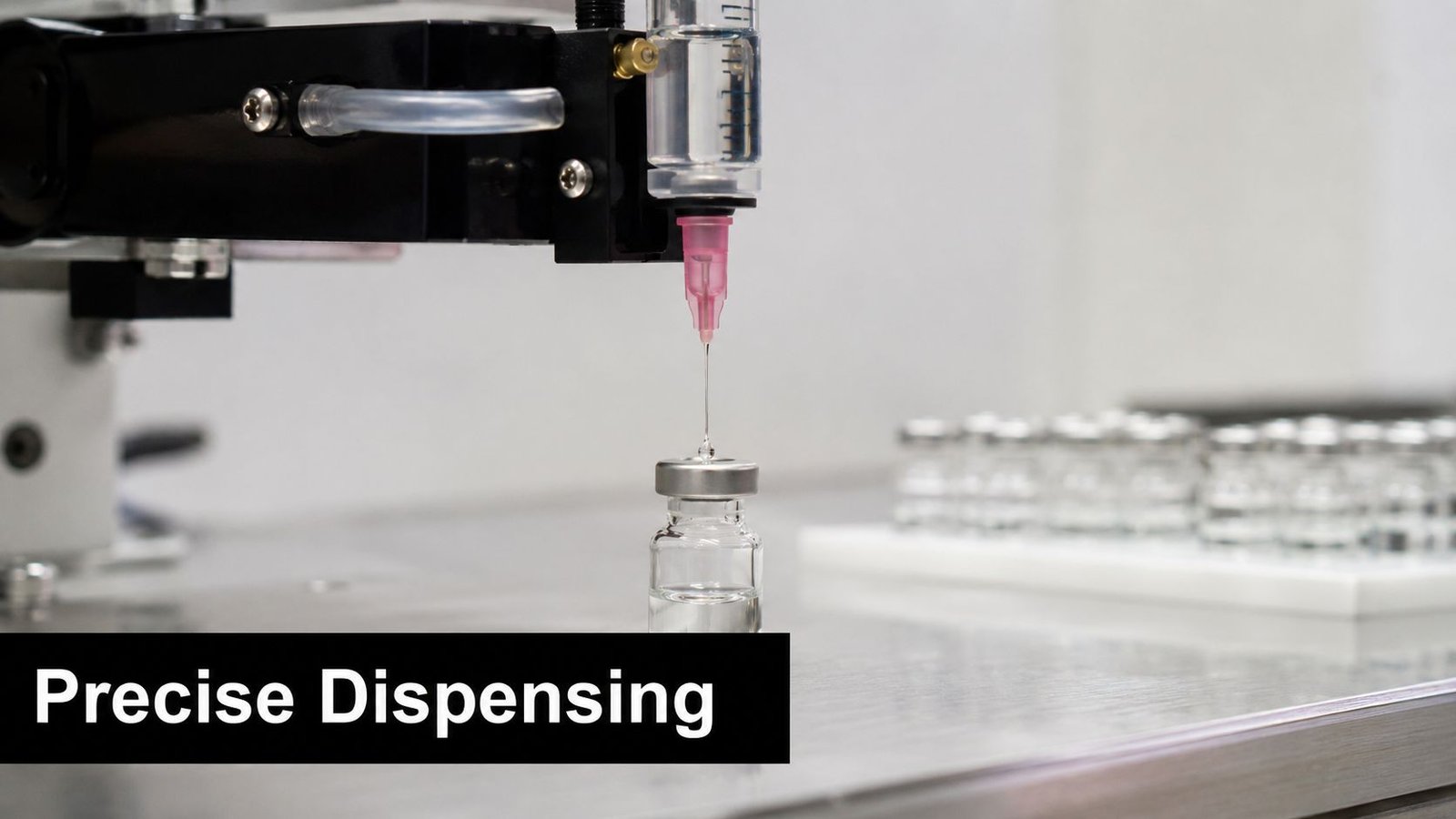
Servo control earns its keep here because it gives the machine a repeatable way to create each shot. That motion might drive a syringe plunger, a progressive cavity pump, or a rotary valve. In plants where product cost is high or rework is messy, that repeatability turns directly into less giveaway, fewer rejects, and faster recipe changeovers.
Where servo dispensing wins
Servo dispensing makes the most sense when fill accuracy matters and product mix changes often. Medical adhesives, cosmetic creams, sealants, gels, two-part materials, and portioned food products all fit that profile. A servo axis lets the team adjust stroke length, acceleration, suck-back, and dwell in software instead of changing cams, stops, or gear ratios.
That matters in semi-automated production. A plant may not need a fully automatic filler. It may need a bench or indexing station where an operator loads parts and the machine handles the shot consistently. That is often the better ROI path. Labor stays flexible, but the actual metering step becomes controlled and repeatable.
The wider automation industry uses positive displacement and servo-driven dosing where process control and repeatability matter. The PMMI overview of liquid filling technologies outlines how product characteristics and package requirements drive filler selection. The same rule applies on a smaller semi-automatic platform. Choose the dispensing method first, then match the servo and controls to it.
How SEA would approach the problem
Suppose a manufacturer is manually dispensing a two-part adhesive into an electronics housing. Operators are hitting the broad target, but bead size changes through the shift and scrap rises during product changeovers. SEA would not start by swapping in a bigger motor or a more expensive valve.
The first step would be to check the material path, shot size range, temperature sensitivity, and cleaning cycle. Then the team would decide whether the process needs syringe metering, gear pump control, auger dispensing, or another method suited to the product. Once that is clear, the servo gets sized around the required torque, speed profile, and resolution, with recipe control at the HMI so validated settings can be recalled by SKU.
That approach usually solves two business problems at once. It cuts waste from inconsistent fills, and it shortens setup because operators are no longer tuning the process by feel.
What works in practice
Useful design choices include:
- Pressure protection: Add relief or monitoring where a blockage could damage the pump, hose, or fixture.
- Recipe-based setup: Store validated profiles by product so operators select a job instead of adjusting hardware.
- Cleaning access: Design wetted parts and tubing runs for washdown, purge, or quick replacement.
- Shot verification: Confirm dispense completion with position feedback, flow confirmation, weight check, or vision, depending on the risk.
- Controlled suck-back or cutoff: Reduce stringing and nozzle drip, especially with sticky or high-value materials.
Common failures are rarely caused by the servo itself. Problems usually come from entrained air, poor temperature control, wandering inlet pressure, nozzle contamination, or a dispensing method that does not match the material. A servo can repeat the same bad shot all day if the upstream process is unstable.
That is the key lesson for dispensing applications. Servo motion improves the metering event, but the return comes from engineering the whole station so material behavior, maintenance, operator workflow, and motion control all support the same result.
8. Textile and Web Material Unwinding/Rewinding with Tension Control
A converting line can run well for hours, then lose money in one shift because a roll change, splice, or diameter change throws tension off just enough to wrinkle film, stretch a nonwoven, or misregister print. The problem usually shows up downstream, but the cause starts at unwind or rewind.
Servo control earns its keep here because web tension is never static. Roll diameter changes continuously. Material properties change by lot. Operators change line speed to keep production moving. A manual brake or clutch can be acceptable on forgiving materials, but it struggles on thin film, label stock, foil, medical textiles, and other webs where small tension errors show up as scrap.
The better approach is closed-loop control. A servo drive uses feedback from load cells or a dancer to adjust torque and speed as the roll builds or depletes. That keeps web tension inside a usable window instead of drifting through the run. The result is less wrinkling, better registration, cleaner winding, and fewer operator interventions. The Maxcess guide to web tension control fundamentals explains the same core point. Stable tension protects both web quality and line performance.
Where semi-automated upgrades usually pay back
A full multi-zone rebuild is not the first move I would recommend on most existing lines. The best ROI usually comes from fixing the section that creates the most instability, then proving the gain.
SEA would typically start with a case like this: an older rewinder handles three substrates, operators adjust brake pressure by feel, and quality swings between shifts. Scrap is highest at startup and near the end of the roll. In that situation, replacing the unwind or rewind with a servo-controlled axis, adding real tension feedback, and storing substrate-specific recipes often solves most of the loss without touching every roller stand on day one.
That matters because web projects can become expensive if the team tries to automate the whole machine before identifying the actual source of variation.
What works on the plant floor
A practical implementation usually includes:
- Load cells or dancer feedback in the right location: Measure actual web behavior, not inferred tension from motor current.
- Diameter compensation: Adjust torque as the roll builds or depletes so tension stays consistent.
- Stored material recipes: Let operators select validated settings by substrate, width, and line speed.
- Controlled startup and stop profiles: Prevent shock loading, telescoping, and loose winding at transitions.
- Mechanical correction first: Align rollers, inspect bearings, and fix damaged idlers before tuning the drive.
Startup, splice handling, and deceleration usually reveal weak tension control faster than steady-state running.
One caution from experience. Servo control will not rescue a bad web path. If rollers are misaligned, the core quality is poor, or the material arrives with inconsistent gauge, the servo will repeat those problems with great precision. The return comes from combining motion control with sound mechanics and a retrofit scope that matches the actual bottleneck.
Comparison of 8 Servo Motor Applications
| Application | Implementation Complexity 🔄 | Resource Requirements ⚡ | Expected Outcomes ⭐📊 | Ideal Use Cases 💡 | Key Advantages ⭐ |
|---|---|---|---|---|---|
| Precision Assembly Line Automation for Medical Devices | High 🔄, regulatory validation, safety integration, long setup | High ⚡, capital-intensive, servo + vision + qualified technicians | Consistent GMP-compliant quality; ~40–60% faster per unit; fewer defects | Micron-tolerance assemblies (needles, syringes, surgical instruments) | Precision positioning, traceability for audits, scalable automation |
| Automated Packaging and Labeling Systems | Medium 🔄, multi-axis synchronization and format change management | Moderate ⚡, tooling, barcode/RFID integration, maintenance expertise | 50–80% throughput increase; reduced labor; consistent package quality | High-speed packaging (blister packs, food wrapping, case sealing) | High throughput, format flexibility, easier retrofit integration |
| CNC Machining and Precision Cutting Operations | High 🔄, advanced CAM programming, calibration, environmental control | High ⚡, skilled programmers, sturdy machine platforms, regular calibration | Sub-micron accuracy; reduced material waste; enables unattended runs | Precision parts, medical implants, aerospace components | Unmatched accuracy, improved tool life, efficient material use |
| Robotic Pick-and-Place and Material Handling | Medium 🔄, programming, sensor integration, safety considerations | Moderate ⚡, robot arms, end-effectors, operator training | Consistent 24/7 throughput; reduced ergonomic injuries; rapid ROI | Machine tending, injection molding, palletizing, small–mid shops | Flexible redeployment, small footprint, improved worker safety |
| High-Speed Printing and Marking Systems | Medium 🔄, tight synchronization, encoder integration, legacy interfaces | Moderate ⚡, high-bandwidth controllers, sealed encoders, print-head maintenance | Maintains print quality at 100+ ppm; enables serialization and traceability | Inline date coding, barcodes, serialization on fast lines | High registration accuracy, reduced consumable waste, regulatory marking |
| Test and Inspection Automation with Servo-Driven Positioning | High 🔄, precise calibration, instrument and SPC integration | Moderate–High ⚡, measurement instruments, data logging, MES links | 3–5x test throughput; reduced operator variability; auditable records | Dimensional verification, electronic functional tests, vial integrity | Nanometer repeatability, traceable test data, SPC-enabled insights |
| Dispensing and Metering Automation for Fluids and Viscous Materials | Medium 🔄, precise volume calibration, CIP and viscosity handling | Moderate ⚡, pumps/syringes, pressure sensors, frequent nozzle maintenance | ±1–2% dosing accuracy; 10–20% reduced giveaway; lower contamination risk | Injectable filling, cosmetic dosing, food portioning | Accurate volumetrics, viscosity adaptability, improved hygiene |
| Textile and Web Material Unwinding/Rewinding with Tension Control | Medium 🔄, PID tuning, sensor placement, profile calibration | Moderate ⚡, load cells, PID-capable drives, multi-roll control | 15–30% scrap reduction; stable material integrity; higher line speeds | Film/foil unwinding, label rolls, medical textile processing | Consistent tension control, reduced defects, improved downstream quality |
Making the Right Move Your Next Steps in Automation
The biggest mistake I see with servo projects is starting from the technology instead of the production problem. A plant manager hears “servo” and gets pitched an expensive, fully automated future-state system. But most profitable upgrades don't start there. They start with one station where variation, labor burden, or lost throughput is already obvious.
That's the right lens for evaluating servo motor applications. In assembly, the value comes from repeatable positioning on a critical join or insertion step. In packaging, it's synchronized motion and easier format change. In CNC and cutting, it's stable control under load. In material handling, it's taking repetitive transfer work off operators without locking the plant into a rigid layout. In testing, dispensing, and web control, it's about making the process behave the same way every cycle.
For small to mid-sized manufacturers, that targeted approach matters even more. Full automation often looks attractive on paper and wrong in practice. It can be too expensive, too inflexible, or too disruptive to install. Semi-automated servo systems give you another path. You can automate the motion that drives scrap, delays, ergonomic risk, or inconsistent quality, while keeping operators in roles where setup judgment, product awareness, and exception handling still matter.
That's also where a good integration partner makes the difference. The right team won't push a robot because robots sell well. They'll ask where the line is losing time, where defects originate, how changeovers happen, and what maintenance can realistically support after commissioning. Then they'll design around your budget, floor space, compliance needs, and staffing reality.
SEA fits that approach well because the company focuses on practical manufacturing solutions that optimize production and service performance, especially through semi-automatic systems, tooling, fixtures, and integrated controls. That matters if you need a clean, cost-effective upgrade instead of a massive capital project. A well-designed servo station can improve quality, reduce labor dependency, support GMP-aware production, and still leave room to expand later.
If you're planning your next move, don't start by asking which servo motor is best. Start by asking which bottleneck is costing you the most every shift. That answer usually points to the right application. From there, the engineering becomes much clearer, and the ROI case usually does too.
System Engineering & Automation helps manufacturers turn manual bottlenecks into practical, scalable improvements. If you're evaluating servo-based assembly, packaging, CNC support, material handling, inspection, or dispensing equipment, System Engineering & Automation can help map the right level of automation for your process, budget, and compliance requirements.