You're probably dealing with one of two headaches right now. Parts aren't reaching the next station fast enough, or finished product is stacking up where it shouldn't. In both cases, people often blame staffing, operator pace, or scheduling first. More often, the underlying issue is flow.
That's where conveyor system design stops being a mechanical purchase and starts becoming a production decision. The right system doesn't just move product. It protects takt time, reduces manual touches, fits the building you already have, and supports the level of automation your team can maintain. For manufacturers looking for production solutions that optimize output and service, that distinction matters.
Plants that treat conveyors like commodity hardware usually end up paying twice. First for equipment, then again for workarounds, jams, awkward transfers, cleanup delays, and layout changes that should've been addressed before fabrication.
Table of Contents
- Beyond Moving Parts Strategic Conveyor System Design
- First Principles Defining Your Core Design Objectives
- Mapping the Flow Layout and Topology Choices
- The Anatomy of a Conveyor Selecting Key Components
- Engineering a Safe and Compliant Workspace
- Bringing Your System Online Integration and Commissioning
- Measuring Success ROI Maintenance and Common Pitfalls
Beyond Moving Parts Strategic Conveyor System Design
A conveyor becomes strategic the moment it sits between two processes that depend on each other. If upstream can't feed consistently, operators downstream wait. If downstream can't absorb output, upstream slows or stops. That's not a machine issue in isolation. It's a factory performance issue.
On most floors, the conveyor acts like the circulatory system for material. It decides where work-in-process accumulates, where operators interact with product, how much manual handling remains, and whether semi-automated cells behave like a line instead of disconnected islands. Good conveyor system design aligns motion, space, and labor. Bad design hides waste until production volume rises.
The business case is only getting stronger. The global conveyor system market is projected to grow from USD 10.27 billion in 2026 to USD 14.64 billion by 2033, at a 5.2% CAGR, driven by adoption of intelligent material handling across manufacturing, logistics, mining, and processing, according to MarketsandMarkets' conveyor systems market projection. That projection matters because it reflects what many plant leaders already see on the ground. Conveyors aren't peripheral anymore. They're part of how companies scale.
Flow decisions affect competitive position
When capacity is tight, every unnecessary touch matters. If operators walk parts between benches, if boxes rotate awkwardly at transfers, or if a machine waits on inconsistent presentation, the plant loses output without always seeing a single dramatic failure.
A strategic design approach asks harder questions early:
- Where is flow breaking down today: starved stations, blocked stations, unsafe handoffs, or unplanned accumulation.
- Which operations need consistency most: inspection, assembly, packaging, labeling, or palletizing.
- What level of automation fits reality: manual assist, semi-automated indexing, or a fully synchronized system.
Practical rule: If a conveyor changes labor balance, workstation timing, and floor traffic, it belongs in production planning, not just facilities purchasing.
Why generic layouts disappoint
A generic conveyor can still move product. It just won't necessarily move the right product, at the right speed, through the right path, with the right interfaces. That's why plants often outgrow “simple” systems faster than expected. The layout made sense on paper, but not with actual changeovers, real operator movement, or existing equipment footprints.
The strongest projects usually come from a different mindset. Start with production goals, service needs, and constraints. Then engineer the conveyor around them.
First Principles Defining Your Core Design Objectives
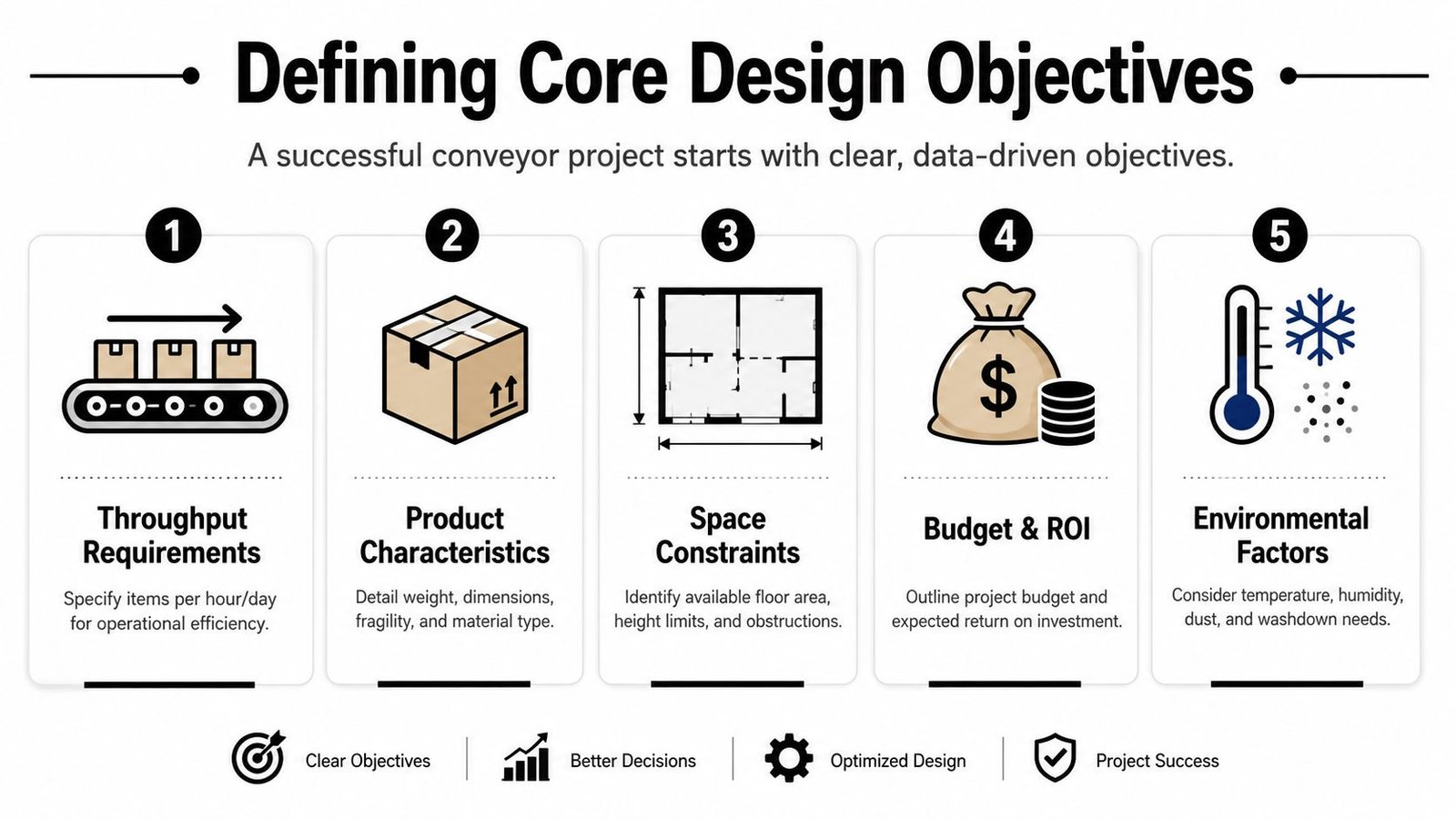
Most conveyor mistakes happen before anyone chooses a belt, roller, or motor. They happen when the project starts with a catalog instead of a production requirement. If the objective isn't precise, the hardware decision won't be either.
Start with throughput not hardware
Throughput is the first number that matters. Conveyor design should quantify output as units per minute or hour, because that determines belt speed, drive selection, and total system capacity, as explained in Wire Belt's guidance on conveyor efficiency optimization.
That sounds obvious, but plants still describe needs too loosely. “We need to move parts faster” is not a design input. “We need to feed two operators and keep a packaging station continuously supplied” is closer, but it still needs actual production data.
Use a short intake list before any layout work starts:
- Target output. Define what the line must produce in normal operation and what it must handle during short demand spikes.
- Process rhythm. Note whether flow is continuous, indexed, batched, or operator-triggered.
- Upstream and downstream behavior. A conveyor rarely runs at one steady condition all day.
A conveyor should be sized for the line you run, not the line you hope to have someday.
Define the product honestly
Many ROI problems arise from inadequate information. Engineers need the actual weight range, part dimensions, base stability, packaging condition, and fragility profile. If products vary by moisture, shape, or presentation, that variation belongs in the design brief too.
What matters in practice:
- Weight and load range affect support structure, belt selection, and drive demand.
- Dimensions affect side guides, transfers, lane width, and accumulation behavior.
- Fragility affects transfer geometry, product spacing, and handling strategy.
- Surface condition changes whether items slide, tip, scuff, or track poorly.
If you only provide the “typical” part, the system will struggle when the largest, lightest, least stable, or most delicate product shows up.
Capture the constraints that usually get missed
Many projects fail in the spaces between engineering disciplines. The conveyor fits the CAD model but interferes with maintenance access. It clears a machine body but blocks the operator aisle. It handles the product but ignores washdown, dust, or temperature.
Build the objective around real operating constraints:
- Space constraints including floor area, ceiling height, columns, doors, and service clearances.
- Budget and ROI expectations so the design team knows where custom work earns its keep.
- Environmental factors such as dust, humidity, temperature, and cleaning requirements.
- Integration needs with existing semi-automated stations, fixtures, sensors, or controls.
A good design brief gives everyone the same target. That's how you avoid a conveyor that technically runs but doesn't improve production.
Mapping the Flow Layout and Topology Choices
Layout is where design intent meets the building. A conveyor path has to support flow, fit around obstacles, leave room for operators, and justify its cost. This is usually where teams discover that the cheapest route to install isn't always the cheapest route to operate.
When straight lines win
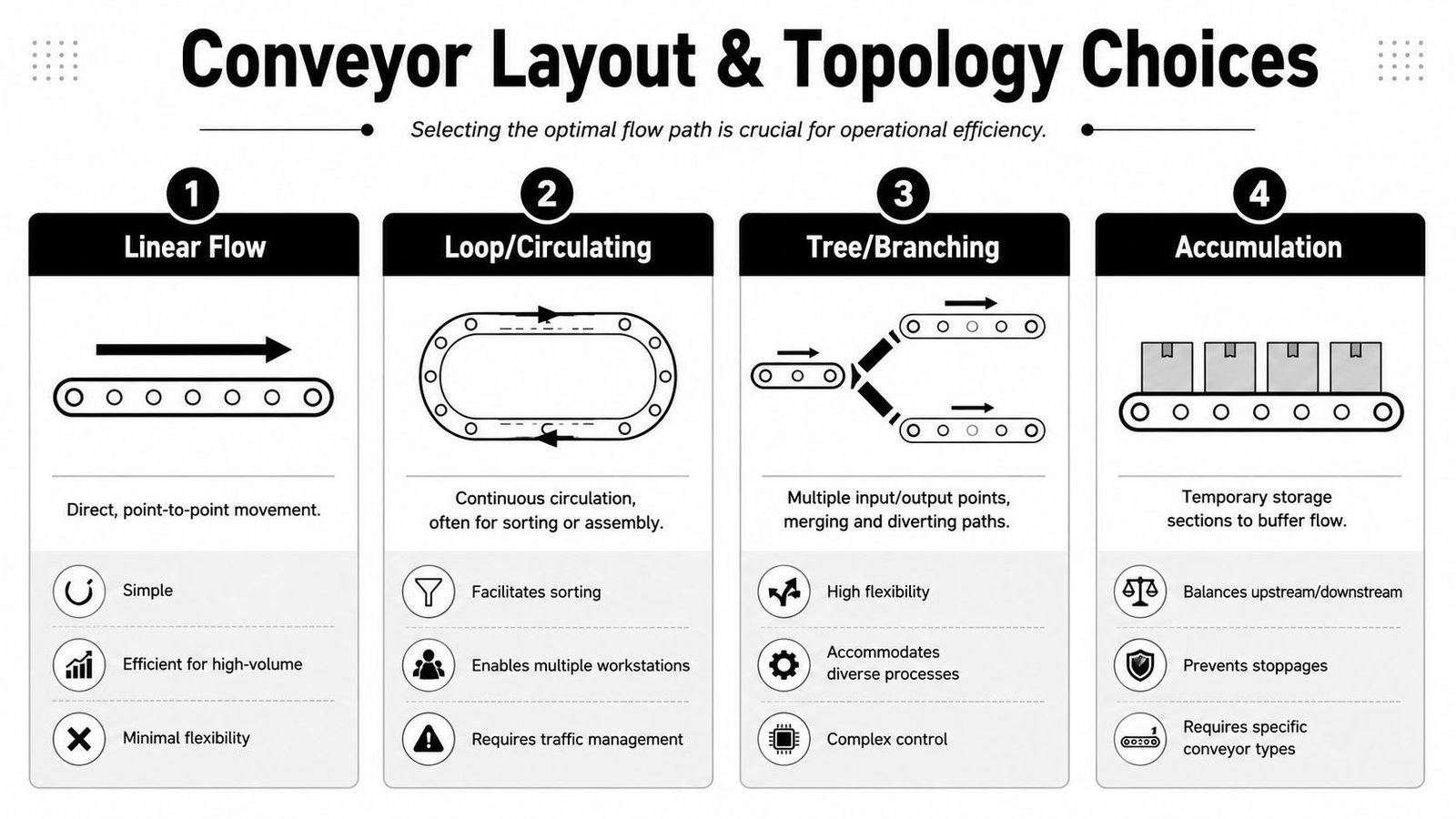
Straight runs are often the best value. They're simpler to support, easier to maintain, and easier to troubleshoot. If your process is mostly point-to-point with stable product presentation, a linear layout usually reduces both complexity and long-term risk.
That's especially true in plants upgrading from manual movement. A clean straight path can remove transport waste and improve visibility without introducing difficult transfers or control logic.
A few common patterns work well:
| Topology | Best fit | Main advantage | Main caution |
|---|---|---|---|
| Linear flow | Point-to-point transport | Simple and direct | Limited routing flexibility |
| Loop or circulating | Multi-station assembly or sorting | Supports repeated access | Traffic management matters |
| Tree or branching | Multiple destinations or merges | Flexible routing | Controls become more complex |
| Accumulation zones | Uneven upstream and downstream timing | Buffers the line | Requires the right conveyor type |
When topology earns its cost
Complex routing should pay for itself. Curves, merges, and transfers can solve real floor-space problems, but they're not free. A 90-degree Belt Curve AC system costs about $5,243 per linear foot, while a Roller Curve AC system costs about $2,686 per linear foot under the stated assumptions in Ocado Intelligent Automation's conveyor cost discussion. That's why conveyor system design is often an economic optimization problem before it's a mechanical one.
If floor space is tight, a curve may still be the right answer. But the question should be specific: does that curve provide better operator access, shorter travel, safer routing, or cleaner integration with existing equipment?
Plants also need to look at the whole line, not a single segment. If one area is overloaded while another sits idle, the issue may be flow distribution rather than conveyor speed. That's the same thinking behind production line balancing for manufacturing flow.
Pay for complexity only when it removes a bigger cost somewhere else.
Survey the site before you draw the line
A layout review should happen on the floor, not only on a screen. Columns, machine swing zones, utility drops, pallet traffic, sanitation access, and operator walking paths all change what's viable.
The best site surveys check for things drawings often miss:
- Maintenance reach around motors, sensors, and guarding.
- Forklift and cart traffic that crosses the proposed conveyor path.
- Height transitions that affect product stability and operator interaction.
- Existing controls locations that influence wiring and panel placement.
The physical path should make work easier. If the conveyor forces people to work around it, the layout needs another pass.
The Anatomy of a Conveyor Selecting Key Components
Component selection is where many projects drift into overdesign or false economy. The right conveyor isn't built from the most expensive parts. It's built from the parts that match your load, speed, product behavior, cleaning needs, and layout.
The key principle is simple. Motors, belts, rollers, and controls should match operational demands such as load capacity, speed requirements, and facility layout rather than being treated as plug-and-play selections, as noted in Lafayette Engineering's conveyor system design overview.
Belts rollers and frame choices
Start with the product-contact surface. Belt choice affects tracking, grip, sanitation, noise, and transfer performance. Roller choice affects cost, control, and where powered movement is needed.
Use the material decision as a production decision, not a vendor preference.
| Material | Best For | GMP Compliant? | Relative Cost |
|---|---|---|---|
| PVC | General material handling in dry environments | Can be specified for suitable applications, but depends on design requirements | Lower |
| Polyurethane | Clean handling and applications with stricter hygiene needs | Often selected for GMP-aware environments when properly specified | Higher |
| Modular plastic | Durable handling, washdown-friendly layouts, and applications needing replaceable sections | Can support compliant designs when properly engineered | Medium to higher |
Powered rollers make sense where you need controlled movement, zoning, or accumulation. Gravity rollers work well where product already has momentum, where operators manually push trays or totes, or where low-cost passive movement is enough. For passive turns and gravity concepts, some engineers still point to MA's Convey for Bulk in this engineering discussion about conveyor design resources as a solid starting point for fundamentals.
A practical selection checklist looks like this:
- Choose belt surfaces by product behavior. A stable carton has different needs than a medical device tray or a slippery pouch.
- Use gravity where gravity works. Not every section needs a motor.
- Keep frame construction aligned with cleaning reality. If the line requires frequent cleaning, avoid designs that make access difficult.
Drive sizing is where good projects go wrong
Motor selection gets oversimplified all the time. Teams either undersize and fight stalls, or oversize and pay for capacity they never use.
For belt conveyors, tension should be calculated with T = (W × L × f) + (H × W), where W is load per unit length, L is conveyor length, f is friction coefficient, and H is height lift, according to MKNorthAmerica's conveyor design considerations. That same source notes minimum safety factors of 10:1 for dynamic loads and 15:1 for static loads, and warns that loading beyond 85% of rated capacity typically causes motor torque saturation and a 20 to 30% increase in energy consumption.
That's the engineering side. The business side is just as important. Overloaded systems consume more energy and wear faster. Oversized systems cost more up front and can still perform poorly if transfers and product handling are wrong.
Motor power selection also needs to account for acceleration torque using T_acc = J × α, where J is total rotational inertia and α is angular acceleration. For variable-speed systems, NEMA MG-1 calls for motors with a 110% design capacity margin to handle transient loads without exceeding 97% power utilization, according to this IJMERR paper on belt conveyor design parameters.
Controls turn motion into production logic
The conveyor isn't smart because it has sensors. It's smart when the controls use those signals to support the process.
A strong control package usually includes:
- Photoeyes or presence sensors for release logic, backup detection, and handoff confirmation.
- PLCs and HMIs for speed coordination, mode changes, fault handling, and operator control.
- VFDs where speed adjustment helps synchronize flow or soften starts and stops.
- Condition monitoring where uptime matters enough to justify early warning on wear or failure.
The best conveyor controls don't impress visitors. They prevent small disruptions from becoming line stoppages.
Engineering a Safe and Compliant Workspace
A productive conveyor that creates injury risk, contamination risk, or hard-to-clean surfaces will cost more than it saves. Safety and compliance belong in the core design, not in the punch list after startup.
Safety has to be designed into the machine
Emergency stops need to be easy to reach. Guards need to protect real pinch points. Access doors need interlocks where exposure to moving components creates risk. Warning devices also matter, especially in shared work areas where operators may approach from multiple sides.
These choices affect daily operation more than people expect. If guarding blocks routine tasks, teams will work around it. If E-stops are poorly located, response time suffers. If restart behavior isn't clear, trust in the equipment drops.
A practical safety review should include:
- Emergency stop placement near likely intervention points.
- Guarding strategy around belts, rollers, chains, and transfer zones.
- Interlocked access where maintenance or clearing jams exposes hazards.
- Visual and audible warnings before motion begins.
GMP aware details affect uptime too
For medical device and other regulated environments, cleaning and inspection access are production issues as much as compliance issues. GMP-aware conveyor designs should prioritize accessibility for maintenance and cleaning, with easy-access inspection points and adjustable components that support regular inspections and help prevent breakdowns that could affect product quality, according to CS Conveyor's belt conveyor design guidance.
That principle changes how you look at the machine. Crevices, hard-to-reach supports, awkward fasteners, and buried inspection points don't just complicate cleaning. They increase downtime and make verification harder.
This walkthrough is worth watching because it shows how safety thinking translates into real equipment choices.
Ergonomics is a throughput issue
Conveyor height, operator reach, and product presentation affect fatigue and handling consistency. If people have to twist, stretch, or repeatedly reposition unstable parts, throughput drops and errors rise.
RW Conveyor's discussion of common design mistakes and ergonomic factors highlights workstation height, reach distance, and warning devices as important design elements. On the floor, that usually means checking whether the conveyor supports how operators work in practice, not how the layout looks in elevation drawings.
A safe conveyor is easier to run, easier to clean, and easier to keep in compliance. Those aren't separate wins.
Bringing Your System Online Integration and Commissioning
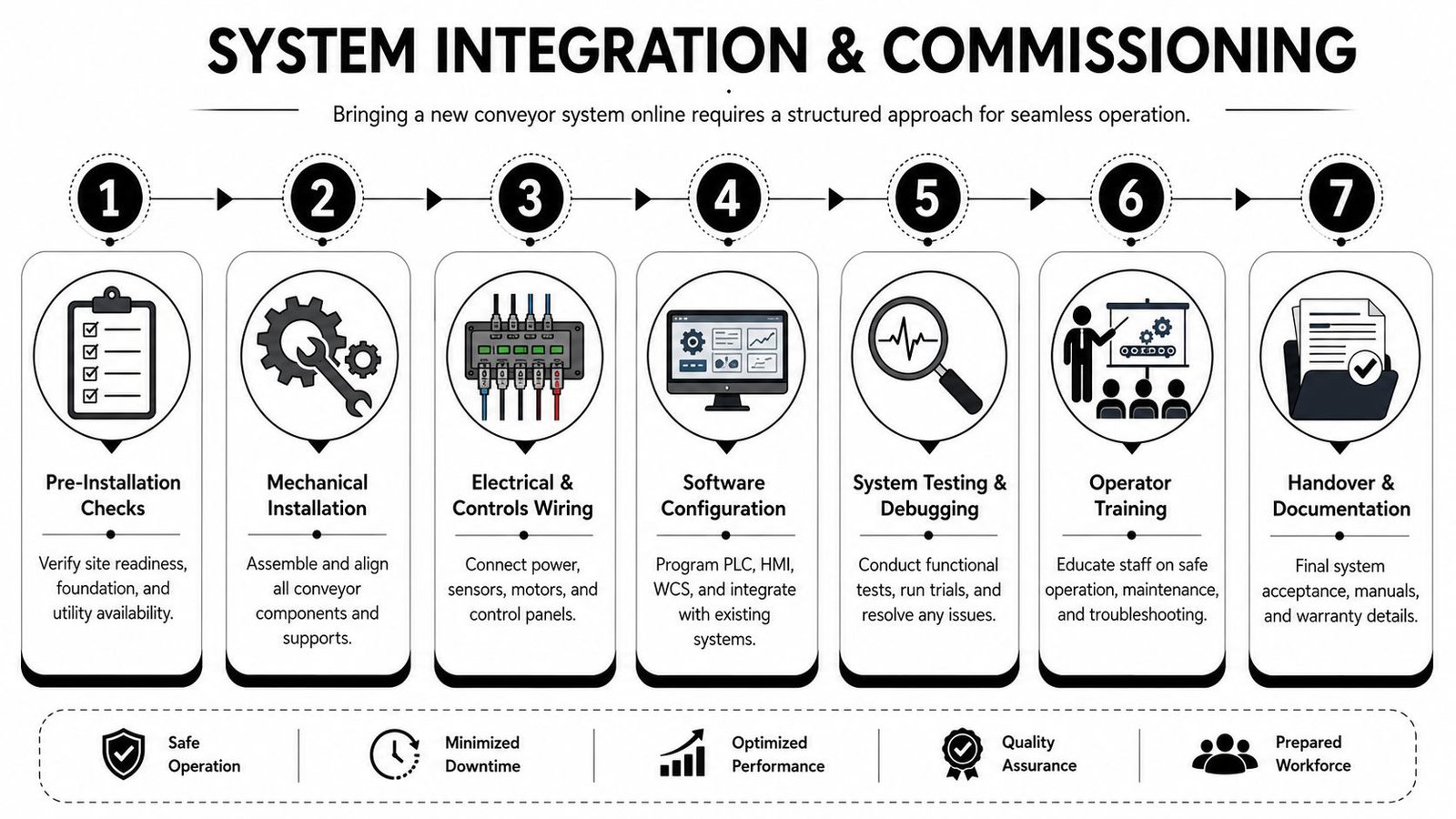
Installation isn't the finish line. A conveyor only starts creating value when it works with the rest of the line at production speed, under production conditions, with operators who understand it.
Integration starts before startup
Most conveyor projects interact with something else. Semi-automated workstations, vision checks, robotic picks, pack stations, labelers, and test fixtures all rely on timing and presentation.
That means integration planning should address more than wiring:
- Mechanical handoff. Product has to arrive in the right orientation and spacing.
- Signal exchange. The conveyor and connected equipment need clear permissives, faults, and ready states.
- Operator workflow. Manual interventions need to be safe and obvious.
- Recovery logic. Jam clearing, empty zones, and restart sequences should be defined before startup.
This is also where many teams benefit from a formal acceptance strategy. A structured factory acceptance test process for automation equipment catches interface problems earlier, when they're cheaper to fix.
Commissioning needs staged proof
Commissioning should happen in layers. First verify alignment, tracking, sensor operation, motor rotation, and basic controls with no product. Then run representative product. Then run the system the way production will use it, including stops, restarts, changeovers, and line interruptions.
Speed and throughput synchronization is critical because a conveyor that technically runs can still cause delays and disruptions if it doesn't match the line's required production pace, as discussed in this article on how conveyor system design affects factory efficiency.
A disciplined startup checklist usually includes:
- Dry run testing for motion, tracking, and fault response.
- Loaded trials with actual products, not stand-ins.
- Boundary testing at slow speeds, operating speeds, and restart conditions.
- Operator training for normal use, clearing issues, and calling for support.
Validation isn't paperwork for its own sake. It proves the system meets the mission it was designed for.
Measuring Success ROI Maintenance and Common Pitfalls
A conveyor project succeeds when the plant feels the improvement in daily operation. You see fewer workarounds, fewer waits between processes, easier handling, and more predictable flow. ROI comes from those repeated gains, not from the machine's presence alone on the floor.
What ROI looks like on the plant floor
The cleanest ROI review asks four questions:
- Did throughput improve where the bottleneck used to sit
- Did manual handling drop in a meaningful way
- Did the system reduce disruption instead of shifting it elsewhere
- Can maintenance keep it running without heroic effort
That last point matters more than many capital plans admit. A conveyor that needs constant adjustment will slowly give back the gains it created. Ongoing inspections, wear-part planning, cleaning access, and responsive support are part of the return. Many plants benefit from setting those expectations early through a structured maintenance and support services plan.
The mistakes that keep showing up
One of the most common errors is solving the wrong problem. Many conveyor design guides overlook the fragility-to-cost trade-off for sensitive products, even though 15 to 30% of product damage occurs at transfer points due to poor geometry rather than belt speed, according to Apex Warehouse Systems' discussion of conveyor design questions.
That's a useful warning because teams often react the wrong way. They add motor capacity, widen belts, or slow everything down when the actual issue is transfer geometry, product support, or orientation control.
Other repeat mistakes are less technical but just as expensive:
- Overbuilding for edge cases instead of designing intelligently for the true operating range.
- Ignoring existing infrastructure like columns, access aisles, sanitation routines, or utility locations.
- Treating commissioning as a quick startup task instead of a formal proof process.
- Accepting poor maintainability because the layout looked compact in CAD.
If a conveyor needs constant operator intervention to hit planned output, the design hasn't solved the production problem.
The strongest conveyor system design decisions usually look modest from the outside. Better transfers. Smarter layout. Correct motor sizing. Reachable safety devices. Cleaner interfaces with the rest of the line. Those choices don't always make the flashiest presentation, but they're the ones that hold up when production pressure rises.
Manufacturers that want practical automation, smarter semi-automated lines, and production solutions built around real budgets can work with System Engineering & Automation for engineering support that prioritizes throughput, safety, GMP-aware design, and long-term serviceability.