A line that used to meet its daily target is now missing it. The product mix has changed, a sensor fault has stopped the conveyor, and the people who know the control system best are already supporting another shift. The question isn't only whether automation can raise output. It's whether your plant can keep producing, or recover quickly, when the automated process stops.
A fully automatic production line can reduce repetitive work and make production more consistent, but it also shifts effort into controls, maintenance, validation, and change management. The right investment is the one your team can support through routine operation, product changes, and equipment failures, not just the one that looks fastest on a proposal.
Table of Contents
- What a Fully Automatic Production Line Includes
- Fully Automatic, Semi-Automatic and Manual Lines Compared
- Benefits and Trade-offs of Going Fully Automatic
- Design and Implementation Considerations for a Fully Automatic Line
- Total Cost of Ownership and ROI Beyond Labor Savings
- Designing a Fully Automatic Line for Regulated Medical Devices
- Use Cases Where Full Automation Fits Medical and Industrial Plants
- When to Choose Full Automation and Next Steps
What a Fully Automatic Production Line Includes
A fully automatic production line moves a product from raw input to packed output, with machines handling every step, including loading and unloading. An operator supervises the system, responds to exceptions, and changes recipes rather than touching each part. If someone still loads trays by hand for every cycle, that station is semi-automatic, even if a robot performs the work inside the machine.
Think of a modern car wash: the car enters, passes through each operation, and leaves without the driver operating individual controls. A semi-automatic station is closer to a manual gearbox, where a person still makes a choice at each step. The distinction matters because labor, line design, and recovery plans depend on who handles the product and when.
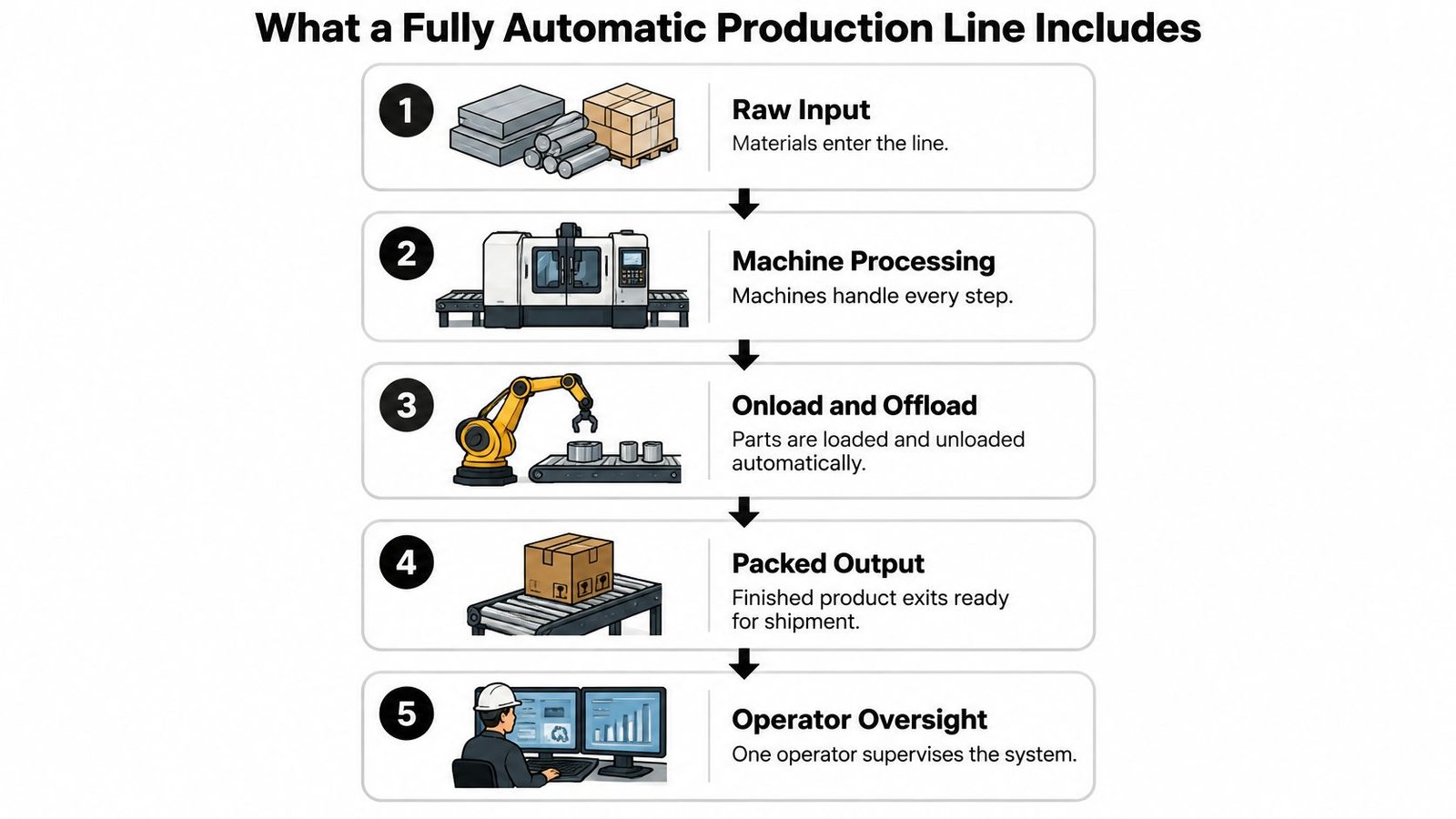
The line is a stack of connected functions, not a robot with equipment around it:
- Movement: Conveyors and cells bring parts to the right station and carry them onward.
- Handling: Robots and pick-and-place units load, orient, transfer, and unload components.
- Sensing and inspection: Sensors confirm presence and position; machine vision checks features that can be measured reliably.
- Control: Programmable logic controllers (PLCs) sequence the cycle, while human-machine interfaces (HMIs) let operators monitor and manage it.
- Production software: Recipe and production systems help capture process information and make approved settings available.
The International Federation of Robotics reported 542,076 industrial robots installed worldwide in 2024, the second-highest annual total recorded. Robot installations are only one measurable part of a larger automated system that also includes conveyors, sensors, controls, inspection, and material handling, as the International Federation of Robotics' 2025 industrial robot summary makes clear.
For an operations manager, the useful measure isn't how many robots a supplier proposes. Judge the whole stack: whether it can produce the required quality, handle the actual product mix, capture useful process information, and recover when a station fails.
Fully Automatic, Semi-Automatic and Manual Lines Compared
| Criterion | Manual | Semi-automatic | Fully automatic |
|---|---|---|---|
| Labor per unit | High, scales with volume | Reduced for repetitive steps | Lowest once running steadily |
| Upfront cost | Lowest | Moderate, tooling-led | Highest |
| Changeover to new product | Fast, operator-led | Tooling change | Reprogramming and requalification |
| Process data and consistency | Varies with operator | Consistent on automated steps | Full parameter capture |
| Fit for variable SKUs or low volume | Strong | Strong | Weak unless designed for it |
| Troubleshooting and maintenance | Simple | Moderate | Requires controls and software expertise |
| Validation burden in regulated plants | Lighter | Moderate | Heaviest |
| Best fit | Low volume, frequent change | Growing volume with mixed products | Stable, high volume, one product family |
Read across each row to see what the plant gives up as it moves toward more automation. Manual work needs little specialized equipment and can adapt quickly, but labor per unit rises with volume and results can depend on operator technique. Semi-automatic cells automate selected operations, such as pressing, dispensing, testing, or assembly, while a person loads parts or starts the cycle. That arrangement can improve repeatability without committing the whole process to fixed equipment.
Full automation shifts the loading, processing, and unloading work to the system. That can reduce labor per unit after the line settles into steady production, but it raises the need for controls expertise, planned maintenance, and documented changeovers. A new SKU may require more than changing a fixture: software, recipes, inspection logic, and validation may all need review.
Practical rule: Choose the level for the production constraint you need to solve, not for the highest automation level you can buy.
For one stable, high-volume product family, full automation often offers the lowest labor per unit once the line runs reliably. For mixed products or uncertain demand, semi-automatic stations built around adaptable tooling and fixtures often return more value. Shortlist the level that best fits your volume and variation before building a cost case.
Benefits and Trade-offs of Going Fully Automatic
Automation can make a repeatable process easier to control. A line can apply the same programmed sequence each cycle, record process data, and reduce handling at repetitive or hazardous stations. It can also lessen dependence on hard-to-fill production roles and support longer operating schedules, provided maintenance and production support are available.
Those gains come with a change in where the work happens. Operators may spend less time moving parts, but the plant still needs people to set up jobs, supervise the process, approve changes, program controls, and maintain equipment. If that expertise is missing, a line designed to reduce labor can become harder to operate than the manual process it replaced.
The sharpest trade-off is often recovery. Consider a line running two shifts when a robotic station stops. Without a planned manual fallback, that single fault may halt all downstream production. A semi-automatic cell with an operator may keep most of the output moving while maintenance repairs the failed equipment. The fully automatic line may have a better steady-state cycle, but a longer outage can erase the benefit.
Product changes add another pressure point. A new part geometry, inspection requirement, or process parameter can require mechanical adjustments, revised controls, new testing, and a deliberate approval process. The more tightly the line is integrated, the more one change can affect neighboring stations and production records.
Before accepting a projected gain, answer three questions:
- How many products will run each month? A frequent mix of low-volume jobs can make changeovers and requalification a large share of operating time.
- Who can repair a station at 2 a.m.? Name the person or support arrangement, and identify the skills and documentation they'll need.
- What output is lost when one station stops? Map the affected work, then decide whether a bypass, buffer, or controlled manual mode can protect production.
Design and Implementation Considerations for a Fully Automatic Line
Start with the physical and control architecture, not a machine list. Lay out conveyors, robots, operator access, guarding, and manual exits so a technician can reach a stopped station without forcing the entire line into an unsafe or unrecoverable state. The design should account for how parts move when a station is unavailable, not just how they move during a normal cycle.
Next, define the controls standard. Decide whether stations will share one PLC platform or use several, establish a common HMI approach, and document how production data and recipes interface with manufacturing execution systems (MES) or enterprise resource planning (ERP) software. Clear interfaces make it easier to identify which recipe ran, where a fault occurred, and what information is missing after a stop. A coordinated automation systems design approach helps connect equipment choices to the workflow they need to support.
Use a staged commissioning plan:
- Test cells before shipment. Confirm the sequence, guarding, interfaces, and fault responses at the integrator's site.
- Run alongside the existing process. Compare actual capacity and quality against the acceptance criteria before removing the established route.
- Ramp after checks pass. Increase production only when the line demonstrates the required capacity and quality.
Set stop-and-restart logic and manual fallback procedures during commissioning, not after go-live. Confirm who owns the control code, what spare parts the plant needs on site, and how software upgrades will be managed. Segment the controls network, restrict recipe access to named roles, and train the people expected to troubleshoot the line while commissioning support is still available.
Total Cost of Ownership and ROI Beyond Labor Savings
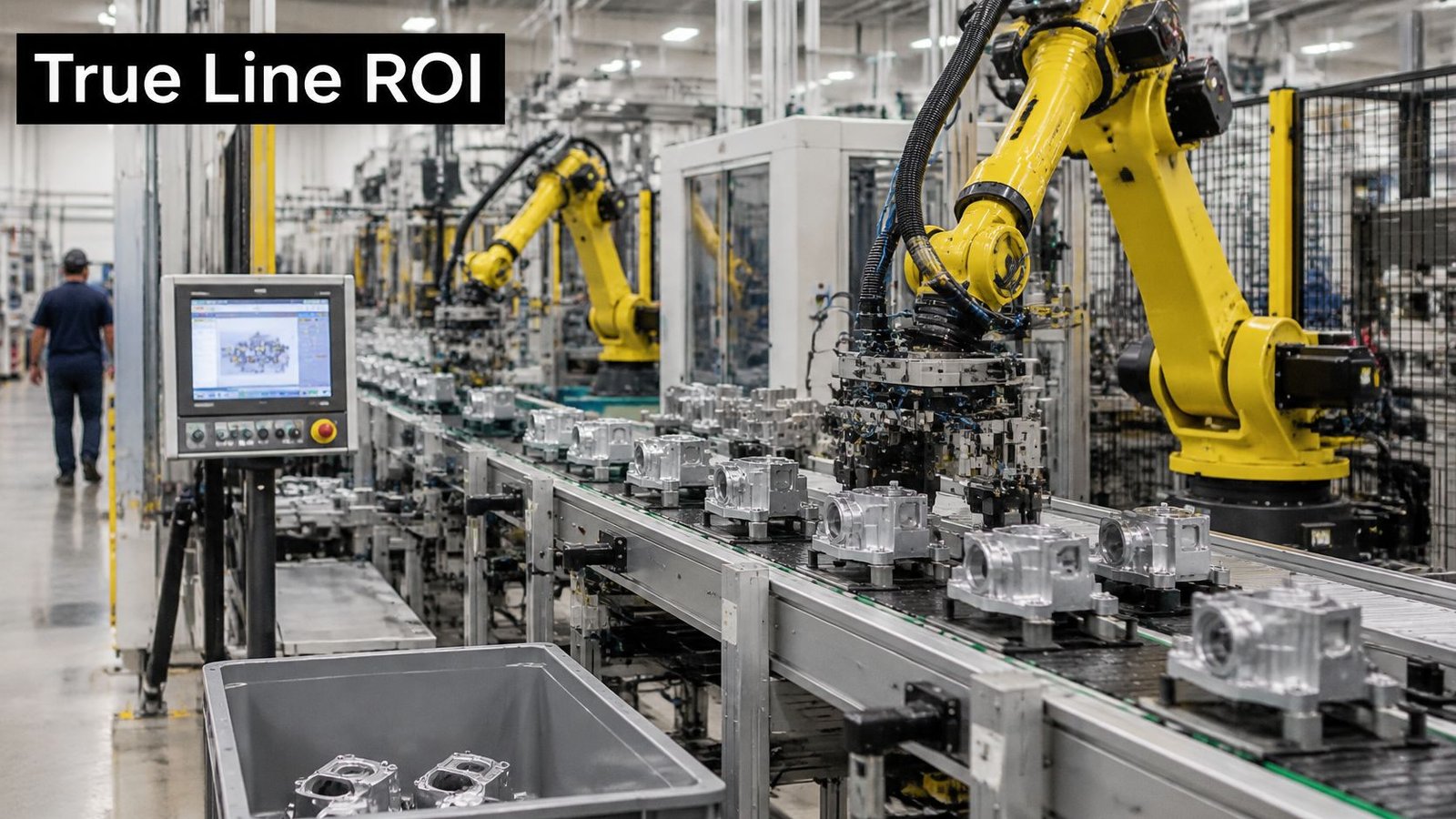
A basic payback calculation is familiar: compare labor removed, throughput gained, and scrap reduced against the capital cost of the line. It's a necessary start, but it leaves out expenses that arrive after installation. A realistic business case also counts design changes, software support, spare parts, planned maintenance, training, validation, cybersecurity, and downtime recovery.
| Cost category | What it includes | Often missed |
|---|---|---|
| Design and integration | Engineering, layout, controls architecture | Rework when product specifications change |
| Components and wiring | Robots, sensors, conveyors, cabinets | Spare parts kept on site |
| Programming and software | Controls code, HMI, recipe management | Vendor support fees and upgrades |
| Validation and change control | Test protocols and requalification after changes | Re-validation after every recipe change |
| Maintenance and downtime | Preventive service, repairs, planned stops | Cost of unplanned stops and recovery time |
| Training and retained expertise | Operator, maintenance and engineering skills | Staff who can troubleshoot the controls |
| Manual fallback | Procedures and tooling to keep running when automation fails | Left out of the business case entirely |
The 2025 Vention State of the Market report describes a gap between the perceived importance of automation and a company's ability to deploy and sustain it. 92% of surveyed manufacturing leaders considered automation critical for competitiveness, yet fewer than four in ten reported significant or full adoption. Nearly 40% cited insufficient expertise to design, deploy, or maintain systems, and almost one-third said automation projects didn't perform as expected.
That gap has a direct effect on ROI. A line that produces well when everything works can still underperform if a failed sensor, controller, or robot leaves production waiting for a specialist or a replacement part. Training, support arrangements, maintenance access, and the time needed to restore production are operating costs, even when they don't appear on the equipment quote. A semi-automatic design can have better lifetime economics if the plant can troubleshoot, reconfigure, and support it with existing staff.
For a full picture, the total cost of ownership approach looks beyond the purchase price to the costs of keeping a system useful throughout its operating life.
Here is a short visual overview of the kinds of recovery and maintenance questions to include in the evaluation.
The practical test is a recovery scenario. Estimate the cost of planned downtime, specify which critical spares will be held on site, and calculate how long it would take to restore a manual or semi-automatic process after an automation failure. Put those costs into the business case. If the line only pays back when it runs continuously and flawlessly, the calculation is missing the risk that operations will have to manage.
Designing a Fully Automatic Line for Regulated Medical Devices
When controls or production software automate manufacturing, testing, labeling, packaging, or another quality-system activity, the system needs documented validation for its intended use. That work goes beyond showing that a cycle runs. It includes written user requirements, risk-based protocols, test evidence, change control, and records that can be reviewed. The FDA guidance on software validation explains why a PLC, HMI, recipe system, vision inspection, data-acquisition function, or electronic record can create compliance risk if its role in production isn't validated.
For finished-device manufacturers in the United States, the FDA's Quality Management System Regulation took effect on February 2, 2026, incorporating ISO 13485:2016 into 21 CFR Part 820, according to the FDA's QMSR overview. The practical design requirement is a system that supports controlled, repeatable processes and preserves the evidence the manufacturer's quality system needs.
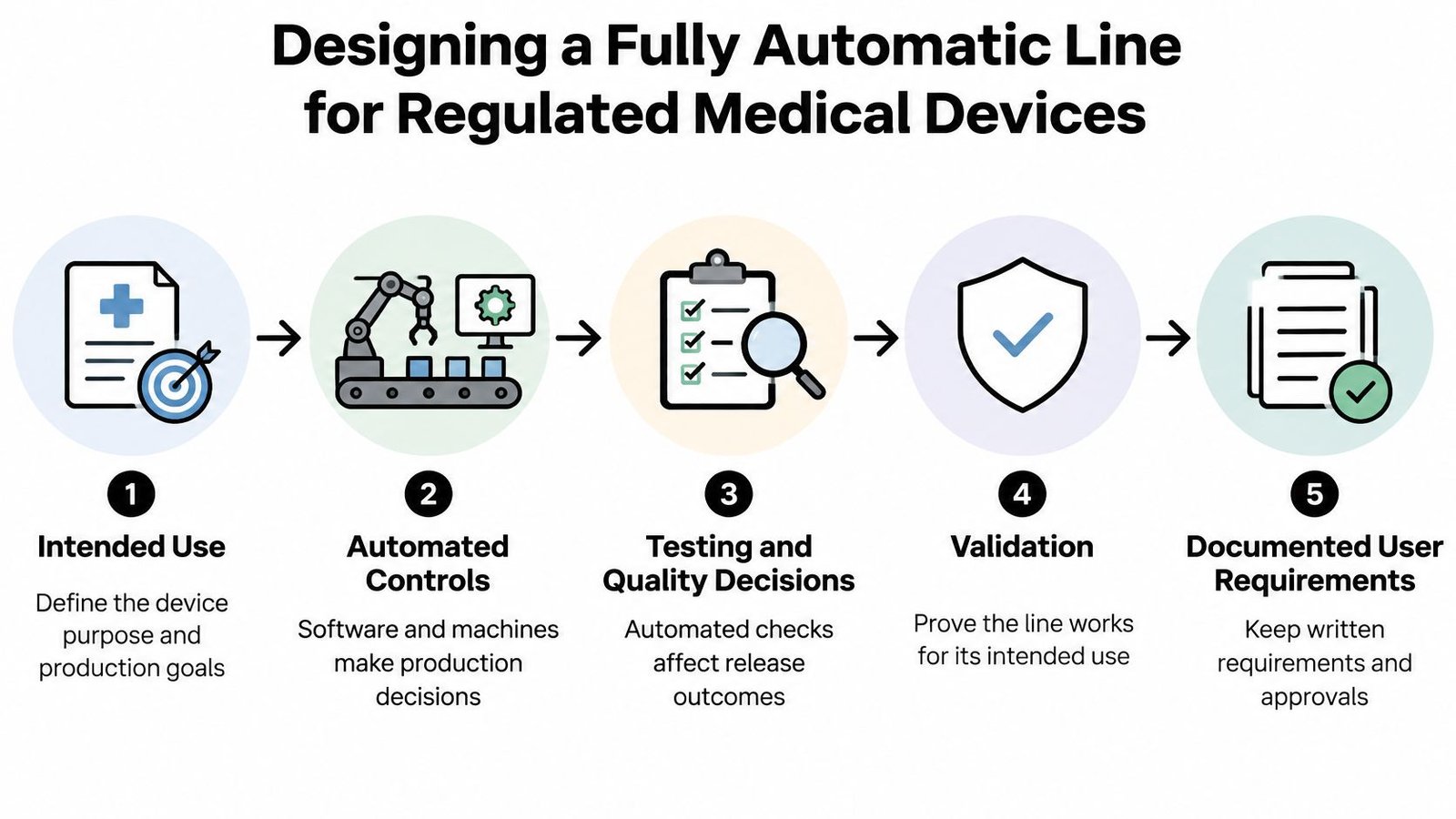
Plan the validation sequence in order:
- Define critical process parameters and critical quality attributes. Identify which settings and product characteristics determine whether a unit meets requirements.
- Validate control and software functions. Test PLC logic, HMI actions, recipe selection, inspection decisions, and data handling against written requirements.
- Qualify failure responses. Test what happens during sensor faults, rejected parts, power interruption, and communication loss.
- Release with synchronized records. Make sure equipment data can be associated with the relevant batch or device-history record.
- Maintain calibration and controlled changes. Keep equipment in a known state and document who changed recipes, parameters, or software.
| Regulatory need | Design response on the line | Evidence to keep |
|---|---|---|
| Software validated for intended use | Validate PLC, HMI, recipe and vision functions | Test protocols and change records |
| Critical process parameters controlled | Closed-loop control, interlocks and alarm limits | Parameter trend and limit logs |
| Failure response qualified | Defined actions for sensor fault, power loss and communication loss | Qualification reports |
| Traceable changes | Role-based access and controlled recipe selection | Audit trail of recipe and parameter changes |
| Calibration and maintenance | Scheduled calibration of automated equipment | Calibration status and intervention records |
The FDA's process-validation guidance also emphasizes objective evidence that a process consistently meets predetermined specifications, along with ongoing monitoring and control of validated process parameters. If an unmonitored setting drifts, the line can produce a run of nonconforming units before final inspection identifies the result. That makes parameter limits, alarm responses, equipment checks, and useful process records part of production design, not paperwork to add later. A GMP-oriented manufacturing approach can help teams align equipment and documentation with controlled production practices.
A line can run exactly as designed and still fail an audit if its recipes, HMI functions, or electronic records lack validation. Mechanical acceptance proves the equipment operates; it doesn't, by itself, prove that automated decisions support compliant product release.
Use Cases Where Full Automation Fits Medical and Industrial Plants
Full automation earns its place when the same operation repeats reliably and the cost of variation or manual handling is significant. A high-volume subassembly with one stable product design is a strong candidate: a robot can load components, perform a repeatable assembly, and pass each part to the next station. For a pressing or dispensing step, automated torque or dispense control can apply consistent parameters across units. For bonding or filling, recording relevant pressure, time, or temperature can help the plant identify process drift rather than relying only on a final visual check.
At the end of a line, electrical or leak testing can return an automatic pass or fail result and associate it with the production record. Machine tending and palletizing can also suit automation where repetitive handling keeps people tied to a station. System Engineering & Automation designs robotic machine-tending and material-handling systems for these kinds of recurring operations.
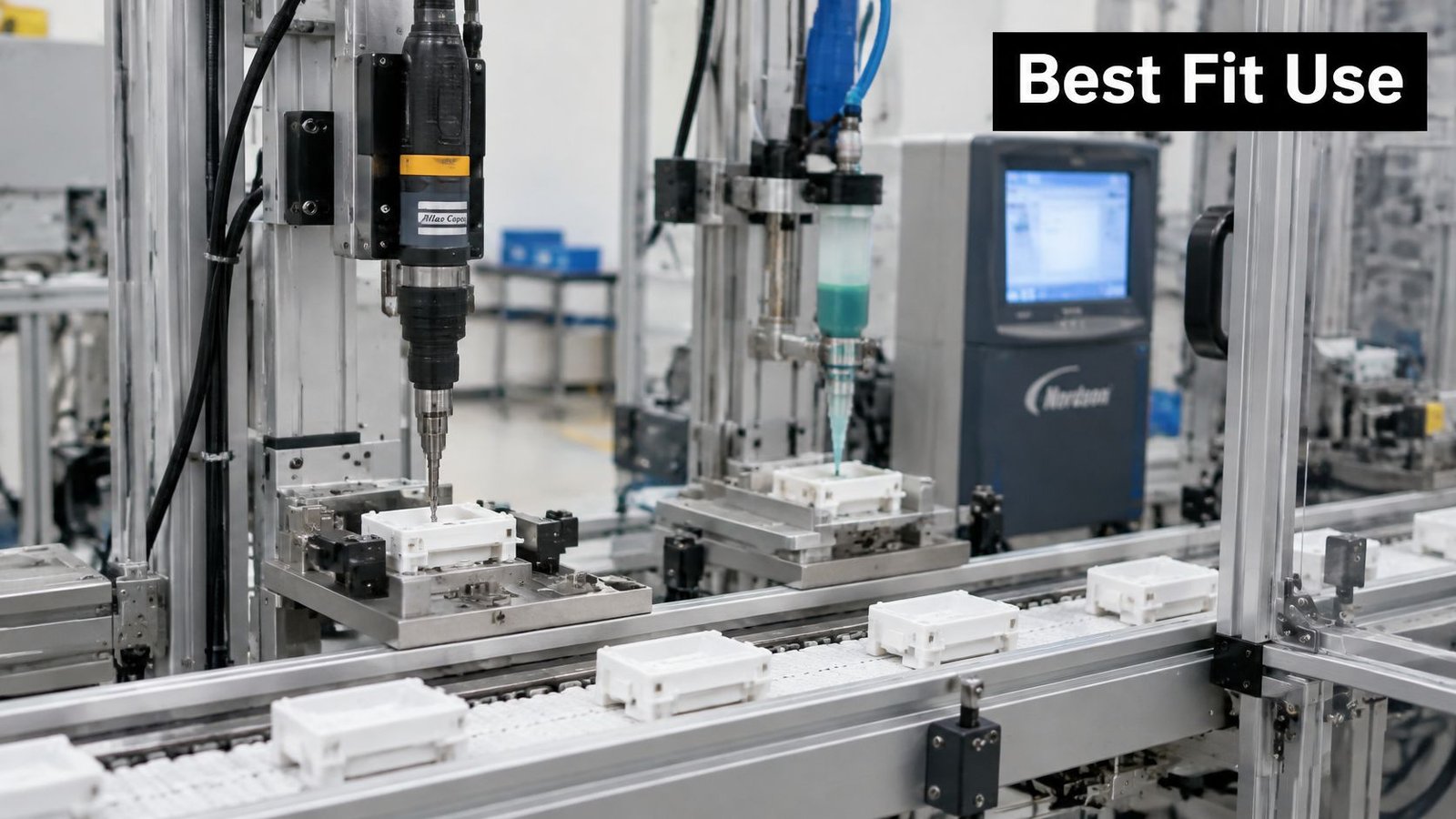
Labeling is a particularly clear medical-device application, but speed cannot be the only measure. FDA labeling requirements call for incoming labeling materials to be inspected and accepted, labels to be proofread by designated personnel, and issued labels to be checked against the device master record before use. The FDA's device labeling requirements also address mix-up prevention, legibility, and controlled changes. A line can support those controls with barcode or vision checks, product-to-label matching, automatic reject handling, and an auditable record of each check.
Full automation is less attractive for custom or low-volume devices, products with frequent design or label changes, and steps where quality depends on operator judgment that no sensor can reliably measure. For those operations, a well-designed semi-automatic workstation may make the process more repeatable while retaining human oversight and easier changeovers.
A quick screen is useful: if the same step repeats the same way thousands of times, it's a strong candidate for full automation. If the product or decision changes often, make flexibility part of the design before choosing equipment.
When to Choose Full Automation and Next Steps
Choose full automation when the volume is steady enough to justify the engineering, product mix and lifecycle are stable, process data matters to quality, and the plant has people who can support the controls. It can also make sense when the work is hazardous, physically demanding, or difficult to staff. A fully automatic system should automate both onload and offload, not leave an operator to feed every cycle while the rest of the line runs unattended.
Choose semi-automation when demand is uncertain, SKUs change often, or controls expertise is limited. A modular workstation can automate the repetitive task while leaving room for operator decisions. Table-top semi-automatic systems can also be connected, upgraded, or integrated into larger workflows as production demands grow. Keep manual processes for short runs and one-off builds where designing and validating a dedicated line would add more cost than value.
Regulation can shape the decision as well as volume. The European Commission's robotics and autonomous-systems standardisation plan describes how the EU Machinery Regulation addresses robotics and places certain AI-enabled machinery in high-risk categories, while the AI Act introduces obligations that interact with machinery-safety requirements. Review the EU robotics and autonomous systems planning page when AI-enabled functions are part of a project. A staged move to automation, with a validated manual or semi-automatic fallback, can be a more workable investment than committing to a full line immediately.
Use these steps to turn the decision into a production plan:
- Map the workflow. Identify the steps where automation could improve safety, quality, throughput, or labor use.
- Record the likely production mix. Document products, volumes, and changeover frequency for the next several years.
- Mark validation and fallback needs. Separate steps requiring process data from those where a manual route must remain available.
- Build the lifecycle cost. Include spares, software support, training, validation, and planned downtime.
- Choose an automation level for each cell. Set out how tooling or semi-automatic stations could be upgraded if demand grows.
Our team evaluates manufacturing workflows to identify where automation can have the greatest impact. System Engineering & Automation provides semi-automatic tooling that can connect to larger workflows as needs grow, as well as fully automated equipment that automates onload and offload and supports multitasking operations.
System Engineering & Automation provides manufacturing solutions, including semi-automatic and fully automated equipment, custom tooling, integrated controls, installation, and ongoing support. Bring your workflow map and production forecast to a consultation so we can help match an automation approach to your volume, product mix, and recovery requirements. Visit System Engineering & Automation to discuss your production goals.