
The production schedule looked reasonable at first. Then one order needed a different housing, another required a revised fixture, and a third called for a separate inspection routine. Operators stopped, searched for tooling, loaded new programs, checked instructions, and waited for material. By the end of the shift, the equipment's advertised cycle speed mattered far less than the time spent preparing the next variant.
That's the operating reality behind high mix low volume automation. A cell that produces one part extremely quickly may perform poorly when the work changes constantly. For operations managers, plant engineers, and medical device manufacturers, the better question isn't, “How fast can this machine run?” It's, “How economically and reliably can this process move from one variant to the next?”
This guide examines that decision from the shop-floor level. It covers HMLV fundamentals, changeover economics, fixtures, semi-automation, modular cells, quality control, implementation risk, and variant-level ROI. The aim is practical: help you choose an automation level that improves production without forcing a small or mid-sized operation into an expensive, rigid system.
Table of Contents
- Introduction to High Mix Low Volume Challenges
- What High Mix Low Volume Automation Really Means
- Why Flexibility Beats Speed in HMLV Environments
- Comparing Automation Approaches for High Mix Low Volume
- Practical Implementation Roadmap That Controls Risk
- Measuring ROI Quality and GMP Readiness by Variant
- Real World Examples and Your Next Move
Introduction to High Mix Low Volume Challenges
A medical device order may require a revised housing, a different fixture, a new inspection routine, and separate operator instructions. The run itself may be short, yet preparing for it can consume substantial time. In high mix low volume production, the handoff between variants often determines whether automation creates value.
A dedicated high-volume cell is designed around a stable sequence and predictable demand. An HMLV cell must earn its cost across many short runs, so processing speed is only part of the calculation. If technicians spend too long confirming revisions, changing tooling, loading programs, or checking the first piece, a fast machine can still produce a weak return.
Practical rule: Treat every changeover as a production process, not as an interruption between production processes.
HMLV therefore calls for a different design philosophy from conventional high-volume automation. Engineers need to prioritize rapid changeover, adaptable workholding, controlled variation, operator usability, and reliable product identification. These features act like a well-organized workshop: tools and instructions are ready for the next job, while the workholding can adjust without rebuilding the entire station.
The 2024 Auburn University Smart Manufacturing Adoption Study reports that 54% identified their order mix as low-volume/high-mix, while another 37% operated in both low-volume/high-mix and high-volume/low-mix modes, meaning 91% had at least some low-volume/high-mix exposure (Auburn University Smart Manufacturing Adoption Study). The figures show why HMLV should be treated as a normal operating condition for many manufacturers, including small and mid-sized firms, rather than as an unusual exception.
The hidden cost of variety
A short run can require revision confirmation, tooling retrieval, component staging, program selection, setting verification, first-piece inspection, and job release. Regulated production may also require documented approvals and traceability. Each activity is part of the changeover economics, even though it does not appear in the machine's cycle time.
For that reason, flexible, cost-effective automation can create more value than maximum speed. A semi-automatic workstation with a smart fixture may reduce handling and improve consistency while leaving operators enough control to manage variants. A modular cell can then add vision, sensing, or robotics when a specific product family provides enough recurring work to justify the investment.
The right question is variant-specific: which tasks should remain manual, which fixture features remove repeated setup work, and which variants can share a cell? This approach helps operations managers control payback, validation effort, and maintenance requirements instead of purchasing automation that performs well only on paper.
What High Mix Low Volume Automation Really Means
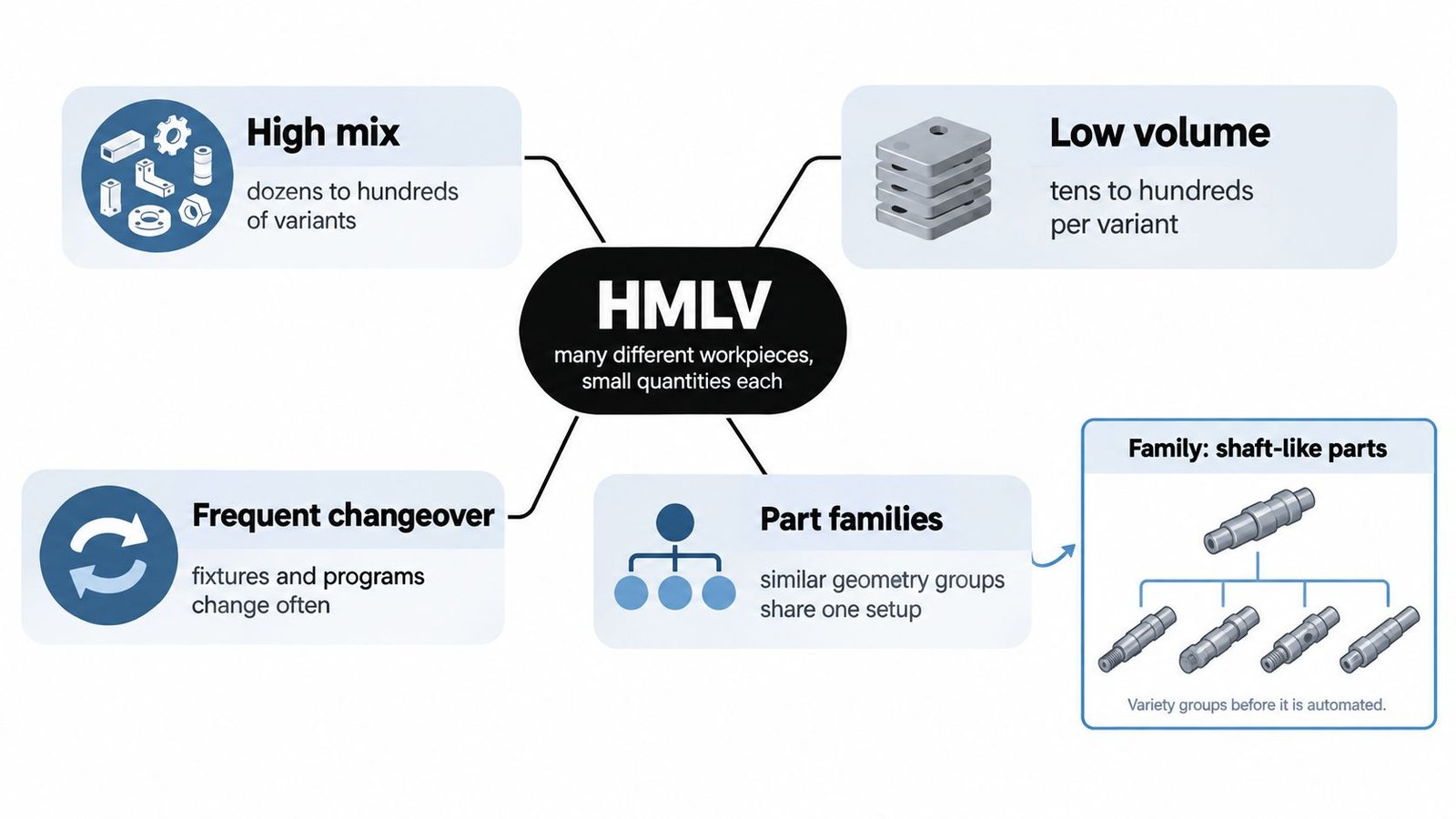
A job shop receives three urgent orders, each with different geometry, materials, revisions, and inspection needs. The machine may finish each part quickly, yet the work still loses money if every change requires new tooling, fixture adjustments, program checks, and first-piece approval. That operating pattern defines high-mix, low-volume production: many different workpieces made in relatively small quantities per workpiece. Annual demand can range from one unit to some thousands, and sometimes reach tens of thousands, as described in Fastems' overview of high-mix, low-volume automation.
Measure the variety before choosing equipment. Count distinct parts, configurations, revisions, and process routes. Then record how often the team changes jobs and which setup activities must be rebuilt, reprogrammed, or revalidated. These tasks shape the business case more directly than a machine's advertised cycle time.
A commercial kitchen offers a useful comparison. A high-volume, low-mix operation repeatedly prepares one dish, so it can dedicate a station, tools, ingredients, and staff to that recipe. An HMLV operation prepares many dishes in small batches. It benefits from shared tools, organized materials, adjustable work surfaces, and instructions that prevent guesswork. The same principle applies to a medical device cell or a small manufacturer serving several product families.
Build around part families
Part-family grouping is the practical starting point. Products with similar geometry, handling needs, machining requirements, or inspection characteristics can share a setup. Engineers can then create a flexible platform for related products instead of a separate automation system for every part.
Useful building blocks include:
- Universal machines: A broad process envelope lets fewer machines handle more jobs.
- Reconfigurable fixtures: Adjustable locators, clamps, nests, and datum features reduce rebuilds.
- Common programs: Parameterized recipes limit the code that operators and engineers must create and maintain.
- Shared inspection tools: Vision and measurement routines can change through validated product recipes.
- Standard interfaces: Common utilities, controls, safety devices, and tooling connections simplify later expansion.
Fastems' guidance describes grouping parts with similar machining needs, using fewer universal machines, and designing fixturing so one machine can cover multiple jobs. It also gives an example in which a single 4-axis milling machine can replace three 3-axis machines when the fixturing is designed appropriately (Fastems' HMLV automation guidance). The practical lesson is narrower than “buy a 4-axis machine.” Fixturing and process coverage can matter more than machine count, particularly when each variant contributes limited recurring work.
Define success differently
HMLV automation must measure more than units per hour, uptime, and labor per unit. Setup duration, first-piece approval, recipe accuracy, changeover errors, and support time for new variants also determine whether a cell pays back.
A sound HMLV cell should let the team switch products without excessive teardown, identify the approved recipe through clear controls, and trace results to the specific variant and work order. If those controls are missing, a faster robot may run an incorrect setup faster. For SMEs and medical device makers, a fixture, semi-automatic station, or modular cell can therefore deliver better variant-level ROI than full automation.
Why Flexibility Beats Speed in HMLV Environments
A robot completes a part cycle in seconds, yet the cell may sit idle while technicians change fixtures, verify programs, stage materials, or wait for inspection approval. In high-mix low-volume production, those intervals often determine whether automation earns a return. Cycle speed matters only after the process can change products economically.
Research on smart-manufacturing adoption in low-volume, high-mix plants points to workforce and operations, workforce and engineering, and operational efficiency as major investment priorities. The implication is practical: manufacturers are addressing labor constraints, engineering complexity, and variable work control, not pursuing a higher theoretical throughput.
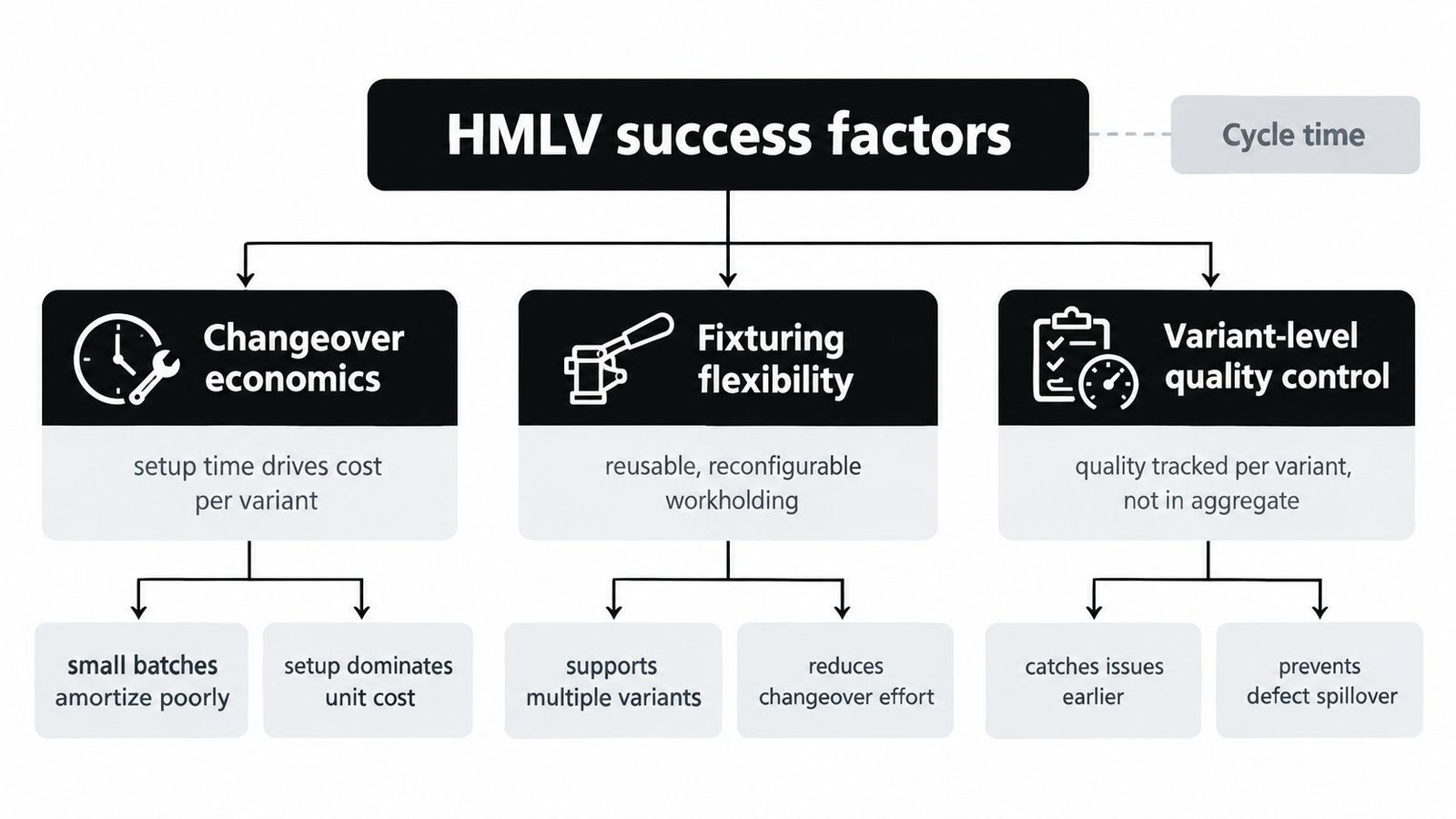
Three costs deserve attention
Changeover economics decides whether short runs can support automation. If setup consumes a substantial share of the production window, faster processing contributes little financial value. Apply SMED principles by separating internal work, which requires the machine to stop, from external work, which can occur while the current job runs. Prepare fixtures, tools, materials, and instructions before the cell becomes idle.
Fixturing flexibility determines how many variants one process can handle. A fixture that requires shimming, manual alignment, or repeated measurement turns each product change into a small engineering project. Quick-release features, poka-yoke elements, adjustable locators, and repeatable datums make a shared cell more practical. For an SME or medical device maker, that fixture investment may produce better variant-level ROI than a dedicated automated line.
Variant-level quality control keeps department-wide metrics from hiding weak product families. Overall output can look acceptable while one difficult variant generates recurring rework or inspection holds. Track first-pass yield, defects, setup errors, and downtime by variant, alongside department totals.
Design for the operator
A flexible cell depends on operator adaptability. Clear instructions, guided recipe selection, visual confirmation, and accessible tooling reduce the mental load created by frequent variation. Cross-training also reduces dependence on the few people who know how to prepare a particular job.
Scheduling software can help coordinate competing priorities, tooling limits, material availability, and due dates. It cannot repair poor process design, but it can expose conflicts earlier and reduce avoidable searching and waiting.
Independent HMLV literature identifies modularity, high changeover capability, multiple-attainability capability, rapid changeovers, minimal downtime, and operator adaptability as characteristics of effective lean cells (lean-cell design study). The same principle applies to automation selection: choose the level of control each variant can financially support. Semi-automation, adaptable fixtures, or a modular cell may outperform full automation when demand is fragmented and changeovers dominate the schedule.
Comparing Automation Approaches for High Mix Low Volume
A medical device maker may need approved recipes, traceability, and inspection records for each variant. A small machine shop may gain more from a universal fixture and guided tooling than from a fully automatic line. A contract manufacturer may need a modular cell that switches among product families without rebuilding the station.
The right question is how much automation each recurring variant can support financially. Compare the approaches below by changeover economics, not by maximum speed.
| Automation Approach | Best Fit | Flexibility and Changeover | Cost and ROI Profile |
|---|---|---|---|
| Semi-automation | Repetitive steps with variable loading, inspection, or assembly | Operators handle product variation while tooling and controls reduce repeatable effort | Lower entry cost, especially when full automation would wait between jobs |
| Custom fixtures | Part families with recurring location, clamping, alignment, or assembly problems | Very high when fixtures use common bases and interchangeable features | Targets a specific recurring loss, often producing a clearer variant-level return |
| Smart tooling with sensors and controls | Processes where force, position, presence, torque, or sequence affects quality | Recipes and sensor limits can change by approved variant | Adds controls and maintenance work, but can reduce errors and improve records |
| Modular cells with cobots and vision | Multiple variants sharing a broad process, especially repetitive handling or inspection | Strong adaptability when tooling, software, and vision recipes are modular | Higher capital and validation burden, with value tied to sustained use across variants |
Semi-automation often fits HMLV work because it divides the task at the point where variation begins. The operator loads the part and makes variant-specific decisions, while a press, torque system, dispenser, or vision check performs the repeatable portion. This arrangement avoids automating a judgment task that changes too often to justify dedicated equipment.
Custom fixtures can produce a strong return when unstable positioning causes the main loss. A well-designed nest reduces alignment time, prevents incorrect loading, and lets one machine serve a product family. If the recurring problem is part location rather than repetitive motion, the fixture may create more value than a robot.
Smart tooling adds process control without removing the operator from the cell. Force sensing, part-presence detection, torque monitoring, and recipe-controlled limits turn informal setup knowledge into repeatable checks. In medical device production, these functions can support GMP-aware documentation when the software, records, and validation approach match the process risk.
Modular robotic cells with vision provide wider capability, but they also bring more software, calibration, safety, validation, and maintenance work. Their value depends on stable interfaces between fixtures, programs, sensors, and product families. A modular cell should be designed around those repeatable interfaces, rather than treated as a general-purpose robot for every future job.
For operations managers comparing semi-automatic and fully automatic systems, the practical choice is the option that removes the dominant loss while preserving support for future variants. Full automation can make sense where demand and process conditions justify it. For fragmented demand, a fixture, semi-automatic station, or modular cell may reach payback sooner because it reduces changeover burden without sitting idle between jobs.
Practical Implementation Roadmap That Controls Risk
HMLV automation works best when the team earns the right to scale. Start with facts from the floor, isolate one painful process, and establish a decision gate before committing to broader deployment.
Assess the current mix
Map the variants, volumes, routings, setup activities, labor content, defects, and inspection requirements. Don't average away the difficult jobs. A family that creates repeated alignment problems or long first-piece approvals may be a stronger pilot candidate than the family with the highest volume.
Record the work in a simple process map:
- Variant profile: Identify product families, common features, and unique requirements.
- Changeover record: Capture fixture swaps, program loading, material staging, and approval activities.
- Quality record: Separate setup defects, process defects, handling defects, and inspection delays.
- Labor record: Identify tasks that are repetitive, ergonomic risks, and work that requires judgment.
- Layout record: Mark travel routes for people, material, tools, buffers, and finished parts.
Segment before automating
Separate standardized work from work that needs human judgment. Standardized tasks may include pressing, dispensing, screwdriving, part presence checks, barcode verification, or repeatable measurement. Manual work may remain appropriate for delicate loading, unusual variants, visual interpretation, or low-frequency operations.
Then group jobs into part families and common setups. A modular base, interchangeable fixture plate, and controlled recipe may provide more value than separate dedicated stations.
Build the pilot around the hardest family that shares a repeatable process, not the easiest part in the schedule.
Pilot one contained cell
Industry guidance recommends starting with one high-pain area, using a contained pilot, and measuring both throughput and consistency before expanding (HMLV manufacturing strategy guidance). Define acceptance criteria before the equipment is built. Include changeover performance, first-pass yield, operator training, recipe control, maintenance access, and documentation readiness.
A structured automation risk assessment can help identify hazards, integration dependencies, validation concerns, and failure modes before installation. This is especially important for medical device processes, where a seemingly small software or fixture change may affect process validation and documentation.
Plan material flow deliberately
Buffers and automated transport can support HMLV production, but layout decisions can also destroy the business case. A simulation-based optimization study found that a hybrid material-handling design combining parallel buffers and shared buffers tended by AGVs increased profit by around 10–30% compared with the other configurations tested. The same study identified AGV travel time as a critical bottleneck, showing why dispatch logic and floor layout must be evaluated together (simulation-based HMLV optimization study).
Before adding an AGV, verify that it reduces a real constraint. A shorter route, better dispatch rule, or point-of-use buffer may deliver more value than additional vehicles.
Scale only after the gate
Compare the pilot's results with the baseline by variant. If the cell improves consistency but struggles with one family, refine the fixture or recipe before expanding. If it reduces labor but creates unacceptable maintenance or validation work, reconsider the automation level.
Scale the architecture, not every detail. Reuse control standards, fixture interfaces, safety concepts, documentation templates, and training methods while keeping variant-specific tooling and recipes under control.
Measuring ROI Quality and GMP Readiness by Variant
Aggregate ROI can mislead HMLV decisions. A cell may look profitable across the whole department while producing poor economics on a low-frequency variant. Conversely, a specialized medical device family may justify a flexible fixture or inspection system because it reduces recurring quality risk, even if its volume is modest.
Build the business case at the variant or part-family level. Include setup labor, fixture preparation, programming, inspection, rework, scrap, waiting, maintenance, validation, and operator training. Then compare those costs with the portion of automation investment that the family uses.
Use the right measures
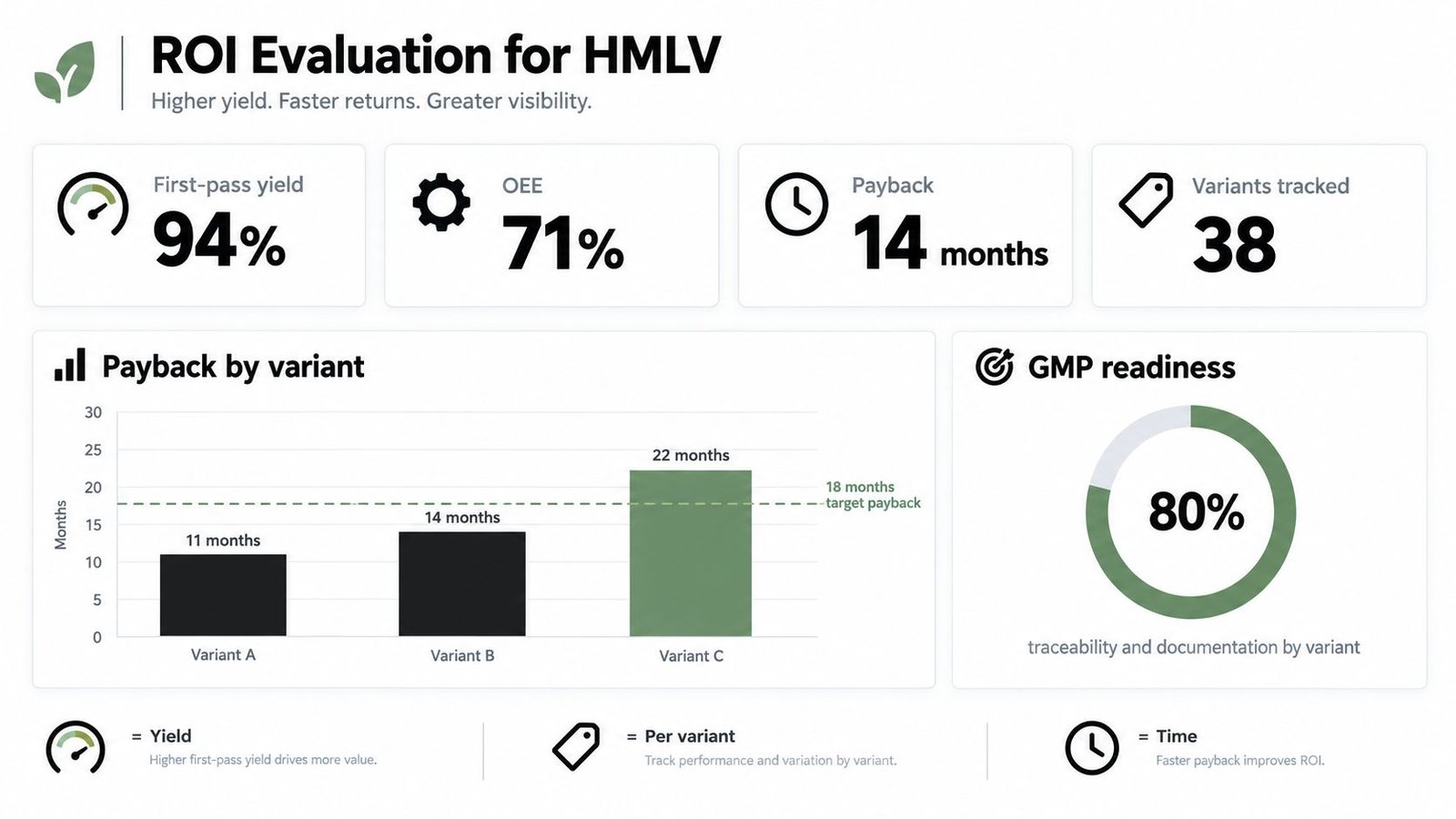
Track first-pass yield and OEE by variant, rather than relying only on plant-wide averages. The useful questions are specific:
- Does the fixture prevent wrong loading for this family?
- Does the vision recipe detect the relevant defect modes?
- Does the automated sequence reduce variation during this product's assembly?
- Does changeover time remain acceptable when the family enters production?
- Does the operator need fewer interventions, or merely different interventions?
- Can quality retrieve the required records for the exact variant and revision?
One industry guide recommends targeting 12–18 month payback windows and measuring FPY and OEE by variant (HMLV manufacturing guidance on changeover and ROI). Use that range as a practical screening target, not as a guarantee. The appropriate threshold depends on risk, product life, utilization, validation effort, and the cost of leaving the current process unchanged.
Connect ROI to GMP readiness
GMP-aware automation requires more than a robot that repeats a motion. The process needs controlled recipes, clear revision management, documented acceptance criteria, traceability, access control where appropriate, and a defined response to alarms or deviations.
AI-native vision, force sensing, and self-programming systems are changing which short-run applications can be considered. They may help an SME handle product variation without maintaining a large engineering team, but adaptability introduces its own burden. The team must assess software validation, false rejects, calibration, model control, cybersecurity, maintenance skill, and change-management requirements.
The right question is not whether the technology is advanced. Ask whether its adaptability removes enough recurring work to justify the added controls. A simple sensor with a clear limit and documented response may be more appropriate than an AI system when the defect mode is stable and easy to detect.
Use the automation ROI calculator to structure the financial discussion around actual variants, recurring losses, and realistic utilization. Keep the model transparent enough that production, engineering, quality, and finance can challenge the assumptions together.
Real World Examples and Your Next Move
A medical device workstation may not need a robot first. If operators repeatedly struggle to seat a component consistently, a custom nest with poka-yoke loading, controlled clamping, and presence sensing may address the main risk. The lesson is to automate the source of variation, not the entire workstation.
A small manufacturer with several related assemblies may choose a semi-automated cell. An operator loads the appropriate family fixture, while the system controls pressing, fastening, or dispensing and records the required checks. This approach preserves human flexibility while improving repeatability where the process benefits from it.
A higher-variation operation may justify a modular cell with interchangeable tooling, barcode-controlled recipes, and vision-guided verification. The cell can support multiple families, but only if the organization is ready to maintain its software, validate changes, and manage the inspection data.
Use this decision sequence:
- Identify the variant family with the highest recurring pain.
- Separate operator judgment from repeatable process steps.
- Improve the fixture and changeover method before selecting robotics.
- Pilot one contained workstation or cell.
- Measure quality, changeover, labor, and maintenance by variant.
- Scale only where the economics and compliance case remain clear.
System Engineering & Automation provides consultation, custom tooling and fixtures, integrated controls, table-top semi-automatic systems, robotics, and support from concept through installation and commissioning. Visit System Engineering & Automation to discuss a right-sized HMLV automation plan that protects flexibility while targeting measurable production and quality improvements.