Beyond the blueprint, the daily reality on a medical device floor looks a lot less polished than the product brochure. A design may pass review, the prototype may impress clinicians, and the business case may look solid, but production still has to survive line clearance, operator variation, component drift, documentation pressure, and the constant demand to ship on time without creating quality risk.
That tension is why operations managers rarely need another generic roundup of medical devices examples. The World Health Organization notes that the category is vast, with about 2 million device types across more than 7,000 generic device groups. In practice, that means the manufacturing playbook can't be one-size-fits-all. A syringe line, a catheter bonding cell, and an implant packaging station may all sit under the same quality system, but they fail in different ways and improve through different kinds of automation.
The commercial pressure is only getting higher. The global medical devices market was valued at USD 572.31 billion in 2025 and is projected to reach USD 1,032.66 billion by 2034, with North America holding 38.1% in 2025. That kind of scale pushes manufacturers to find capacity, quality, and margin at the same time.
The good news is that most production problems don't require a moonshot. They usually need the right mix of fixture design, poka-yoke, semi-automation, validation discipline, and operator-friendly controls. The following list focuses on 10 medical devices examples through that lens: where lines typically struggle, what fixes tend to work, and where targeted automation creates real operational advantage.
Table of Contents
- 1. Syringe Assembly Systems
- 2. Insulin Pen and Autoinjector Assembly
- 3. Catheter Manufacturing and Assembly
- 4. Surgical Instrument Finishing and Assembly
- 5. Implantable Device Packaging Systems
- 6. Diagnostic Test Kit Assembly and Packaging
- 7. Dental Implant Manufacturing and Finishing
- 8. Contact Lens Manufacturing and Packaging
- 9. Drug-Eluting Stent DES Coating Systems
- 10. Orthopedic Screw and Plate Assembly
- Top 10 Medical Device Manufacturing & Assembly Comparison
- From Challenge to Advantage Implementing Your Automation Strategy
1. Syringe Assembly Systems
High-volume syringe production looks simple until you try to hold repeatability across shifts. A standard disposable syringe still asks the line to manage molded variation, plunger insertion force, needle or tip alignment, safety feature placement, and contamination control without creating jams or cosmetic damage.
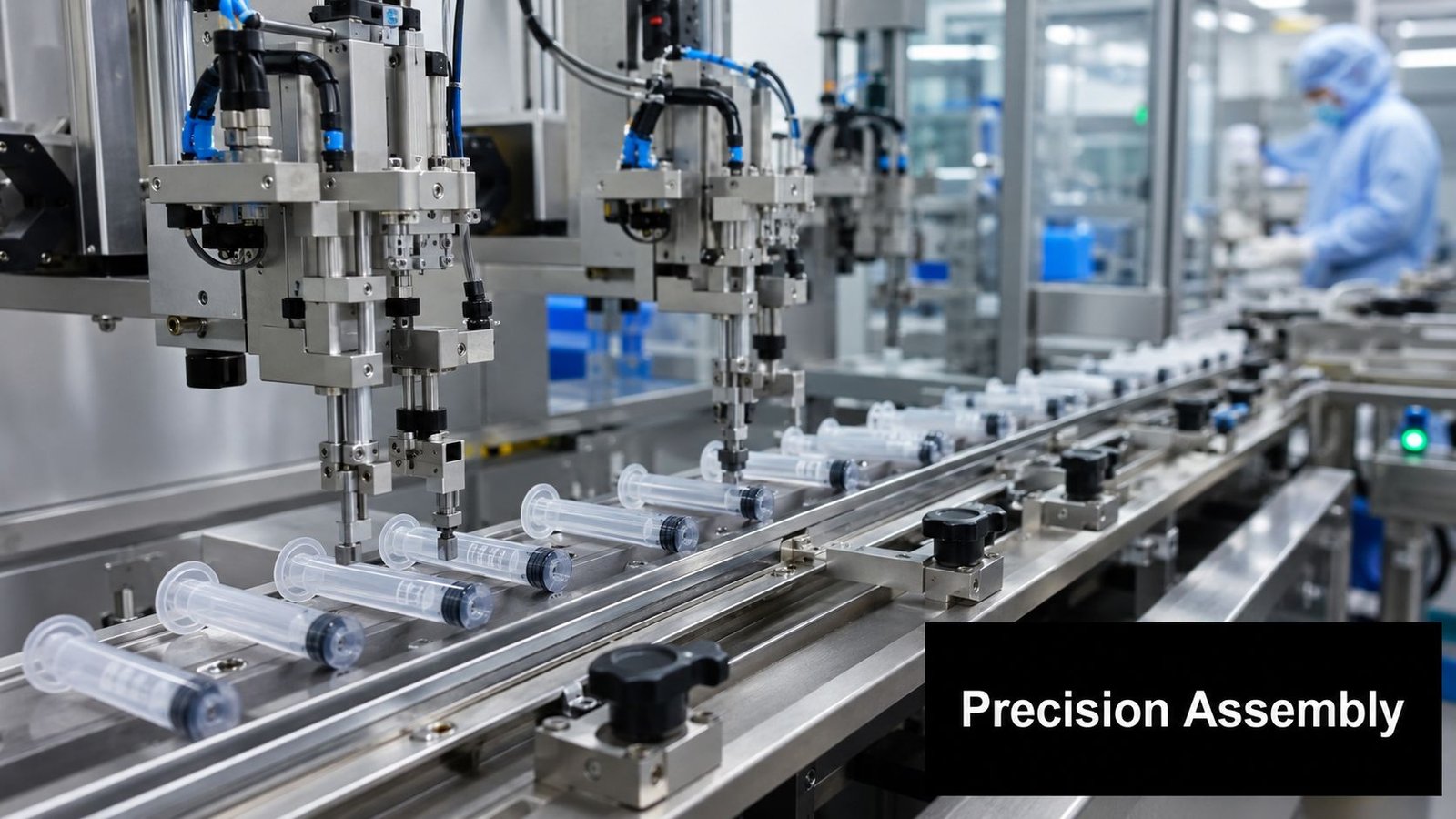
Most failures start small. An operator feels that a barrel “mostly fits” in a nest. A feeder occasionally flips plungers. A press station hides slight force variation until leak testing starts rejecting lots. By the time quality sees the pattern, the line has already produced scrap and consumed expensive cleanroom time.
Where syringe lines usually break down
Semi-automation works well here because syringe assembly often has a mix of highly repetitive motions and a few steps that still benefit from operator loading or inspection. The strongest setups use dedicated nests, controlled insertion tooling, presence verification, and force monitoring at the exact points where leaks or misassembly begin.
A practical upgrade path often includes:
- Custom nests: Hold the barrel consistently so operators and actuators interact with the part the same way every cycle.
- Guided insertion tooling: Reduce side load when plungers or needle subassemblies enter the part.
- Sensor confirmation: Verify component presence before the next operation locks in a defect.
- Recipe-based controls: Let one workstation handle product variants without relying on memory.
For teams trying to move beyond hand assembly without overcommitting to a rigid full-auto line, semi-automatic performance assembly solutions usually create the best balance of throughput, changeover flexibility, and validation control.
Practical rule: If a syringe line depends on operator feel to judge insertion quality, the process isn't stable enough yet.
A good syringe cell doesn't just run faster. It makes bad builds harder to produce in the first place.
2. Insulin Pen and Autoinjector Assembly
Insulin pens and autoinjectors are some of the most deceptive medical devices examples in manufacturing. They look compact and user-friendly on the outside, but inside they stack springs, dose mechanisms, carriers, caps, housings, and lockout features that all have to interact correctly under patient use conditions.
One weak station can ruin the entire device. If the drive mechanism is slightly misaligned, the final assembly may still pass basic handling but fail in dose delivery, reset behavior, or end-of-stroke response. That's why these products punish “good enough” assembly logic harder than many larger devices.
What makes these assemblies unforgiving
The biggest issue is tolerance stack-up across many molded and machined components. Operations teams often try to solve that with more training, but training alone won't fix a sequence that allows upside-down parts, partial spring seating, or incorrect torque transfer.
What usually works better is staged verification:
- Component orientation control: Bowl feeding, escapements, or presentation fixtures that only allow one valid loading condition.
- Intermediate checks: Confirm spring presence, mechanism travel, and dial engagement before the housing closes.
- Controlled torque or force application: Prevent overdriving delicate subassemblies.
- Functional simulation at end of line: Catch errors the eye won't see.
Real production pressure also shows up during scale-up. Teams often prototype these products with careful bench assembly and then discover that repeatability disappears when temporary fixtures are replaced by production labor. Semi-automated workstations close that gap by locking sequence, motion, and verification into the process.
The smart move isn't to automate every touch immediately. It's to automate the touches that create hidden risk, especially the ones tied to dose accuracy, trigger reliability, and irreversible closure.
3. Catheter Manufacturing and Assembly
Catheter production usually becomes difficult before final assembly starts. Extrusion consistency, lumen integrity, shaft straightness, tip geometry, hub bond quality, and coating behavior all affect whether the device performs properly in use. A line can appear busy and productive while imperceptibly drifting out of spec.
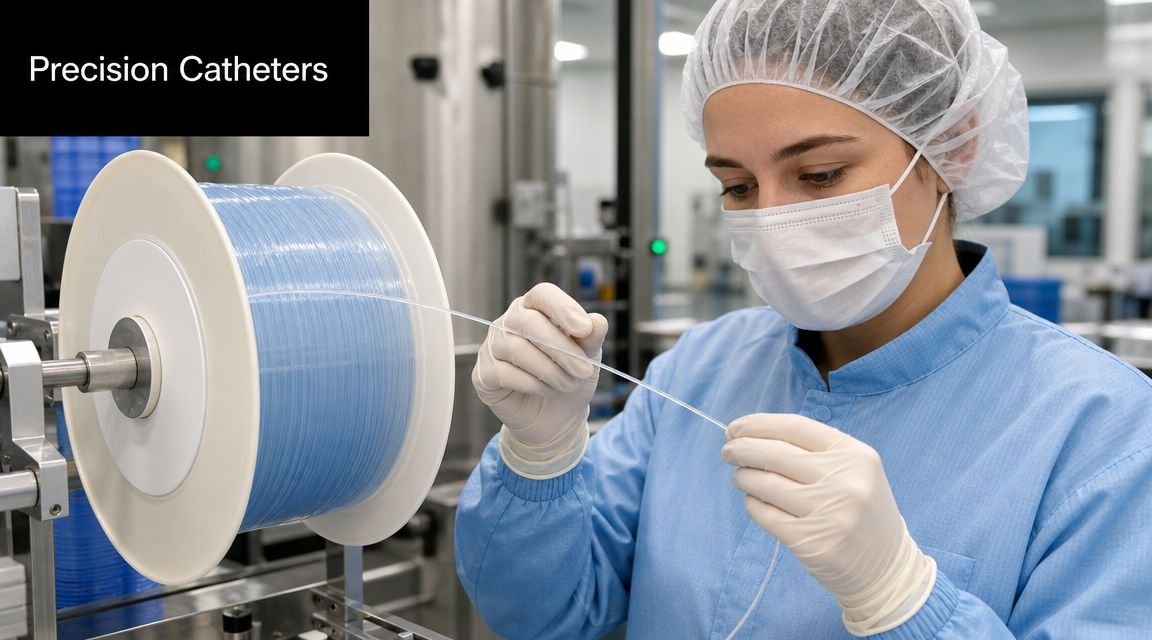
Many operations managers learn the hard way that manual handling introduces more variation than expected. Soft shafts kink. Adhesive placement varies by operator. Tip forming changes with dwell time and heat exposure. Those aren't cosmetic issues. They change functionality.
Precision problems show up early
The best catheter cells are usually built around process isolation. Instead of asking one long line to do everything, strong setups break the work into controlled modules for cutting, forming, bonding, curing, inspection, and packaging transfer. That makes problems easier to trace and validation easier to defend.
For custom products, off-the-shelf equipment often leaves too many workarounds in place. Therefore, custom-designed machinery for medical manufacturing pays off, especially when the product family includes multiple lengths, diameters, or hub configurations.
A few production lessons keep showing up:
- Bonding stations need repeatable part presentation: Adhesive and solvent processes hate inconsistency.
- Heat-forming needs controlled recipes: “Experienced operator timing” isn't enough for sustained output.
- Inline vision helps, but only after fixturing is stable: Cameras can't rescue a poorly presented part.
- Material handling deserves engineering attention: Soft polymer devices get damaged between value-added steps.
Catheter yield often improves less from faster equipment than from better part support during transfer, bonding, and curing.
That's the trade-off. A flexible process is useful, but too much manual freedom usually turns into rework, sorting, and unexplained complaints.
4. Surgical Instrument Finishing and Assembly
Forceps, clamps, needle holders, and similar reusable instruments often carry a surprising amount of labor. Grinding, polishing, deburring, passivation prep, hinge fitting, and final feel checks still rely heavily on skilled hands in many plants. That isn't automatically bad, but it creates two operational problems fast: variation and fatigue.
An instrument can meet dimensional expectations and still fail the user's hand test. The jaw closes with drag. The ratchet feels rough. The finish traps residue near a joint. When processes stay mostly manual, those defects get corrected late, which means the plant pays for value-added work before finding the problem.
Manual skill is valuable, but variation is expensive
The right response usually isn't full automation. It's selective mechanization of the most inconsistent or physically punishing steps. Polishing fixtures, torque-limited assembly tools, guided grinding supports, and poka-yoke workholding can stabilize output without removing the operator from the process.
That matters because reusable instruments occupy an awkward middle ground. They need craftsmanship, but production still has to scale. A bench built around loose hand tools and tribal knowledge may work for low volume, yet it usually struggles when staffing changes or demand climbs.
Three improvements often produce outsized gains:
- Consistent workholding: Keeps edge prep and polishing angle repeatable.
- Standardized clamp force: Reduces over-tightening in hinge or fastener operations.
- Defined inspection aids: Go/no-go gauges and visual references reduce subjective acceptance.
Reusable devices also sit inside a broader regulatory and commercialization reality. FDA educational material highlights how developers must determine classification and consider pathways such as De Novo, 513(g), and Humanitarian Device Exemption for certain products. On the floor, that translates into a blunt truth. The better product concept still loses if the process can't be repeated, documented, and supported at production scale.
5. Implantable Device Packaging Systems
Implant packaging is often treated as the final step. Operationally, it should be treated as a critical manufacturing process. Trays, lids, pouches, inserts, labels, and sterile barrier systems all have to work together to protect a high-value device through sealing, sterilization, shipping, storage, and clinical opening.
That's why implant packaging stations fail when teams think only about speed. If the tray doesn't hold the part securely, if a lead or implant edge shifts during handling, or if seal conditions vary by operator technique, the line creates risk long after the pack leaves the room.
Packaging is part of the product
A good implant packaging cell controls orientation, seal presentation, and documentation at every handoff. Operators should not be improvising tray placement or manually compensating for poor dunnage design. Packaging fixtures need to support the device, not merely contain it.
A practical packaging strategy often includes:
- Dedicated loading nests: Protect the implant from twist, abrasion, or contact with the seal area.
- Seal-area protection: Keep fibers, gloves, and part movement away from critical surfaces.
- Label and lot verification: Prevent a packaging error from becoming a field problem.
- Controlled transfer to sterilization prep: Avoid post-seal disturbance.
For medical manufacturers, this is also where GMP-aware production practices in manufacturing matter most. Clean documentation, line clearance discipline, and validated sealing behavior aren't paperwork burdens. They're what keep a sterile barrier credible.
The package isn't a shipping accessory. For an implant, it's the final protective subsystem.
Operations managers who treat packaging as a process engineering problem usually see fewer downstream surprises than teams that leave it to manual care and final inspection.
6. Diagnostic Test Kit Assembly and Packaging
Rapid diagnostic kits compress a lot of precision into a cheap-looking product. Reagent application, strip lamination, cutting, cassette loading, desiccant handling, pouching, and labeling all have to stay synchronized. If one step drifts, the device may still look fine while its performance changes in the field.
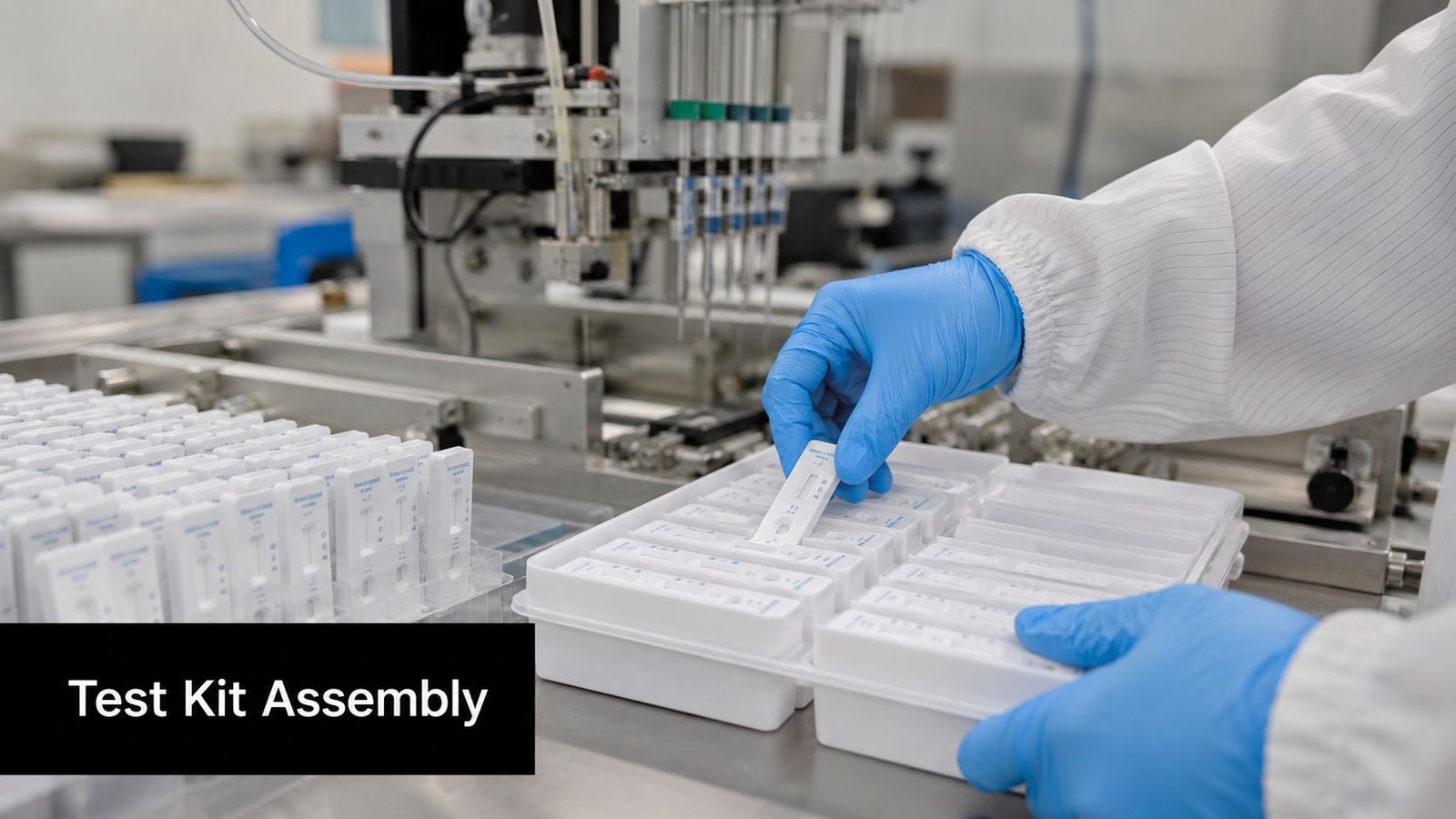
These products also expose a common operations mistake. Teams focus on machine speed before they stabilize material behavior. In diagnostic assembly, web handling, strip registration, adhesive response, and reagent sensitivity usually matter more than headline cycle rate.
Synchronization matters more than headline speed
Medical device data strategies increasingly rely on integrated longitudinal data streams, and one industry white paper reported 69 active studies using sensor data in clinical trials by August 2017. For diagnostic manufacturers, that points to a practical production lesson. Build systems that connect manufacturing parameters with downstream performance data whenever possible.
That doesn't require an enormous digital transformation project. It can start with logging dispense conditions, lamination settings, cut alignment, reject causes, and environmental conditions in a way engineers can use.
Useful upgrades often include:
- Vision on strip placement: Catch skew and misregistration before cassettes close.
- Controlled reagent dispensing: Reduce variation hidden by manual techniques.
- Part accumulation logic: Prevent line stoppages from turning into mixed lots or misplaced components.
- Traceable packaging confirmation: Link the right insert, pouch, and label to the right product run.
Later in the process, visual references help align the conversation between engineering and operations:
When test kit lines work well, they don't just move fast. They keep chemistry, mechanics, and packaging in step.
7. Dental Implant Manufacturing and Finishing
Dental implants are compact parts with very little room for process sloppiness. Thread form, concentricity, interface geometry, cleaning, and surface treatment all influence whether the part assembles correctly and supports clinical performance. Tiny deviations create big headaches because almost every downstream step assumes the machined base part is right.
Surface and geometry have to agree
This is one of the clearest medical devices examples where machining and finishing teams can't work in silos. A beautifully machined implant can still become problematic if blasting, etching, cleaning, or handling alters the intended surface or contaminates the part before packaging.
On the operations side, that means controlling transitions:
- Between machining and finishing
- Between finishing and cleaning
- Between cleaning and final handling
The highest-friction issues usually aren't dramatic machine failures. They're ordinary production details like mixed lots, fixture wear, edge damage during transfer, or an inspection setup that doesn't catch trends until late.
Keep the datum strategy consistent from machining through final inspection. If each station “finds its own zero,” the line will slowly teach itself bad habits.
Semi-automated support equipment often earns its keep here through loading fixtures, orientation control, thread protection, and guided handling rather than through fully automated machining alone. The more expensive the part and the narrower the tolerance window, the more valuable those “small” controls become.
A common mistake is overbuilding automation around one implant family and creating painful changeovers later. Flexible tooling with strong recipe control often beats maximum mechanical complexity, especially for manufacturers balancing premium precision with a broad SKU mix.
8. Contact Lens Manufacturing and Packaging
Contact lenses are delicate, transparent, hydrated products that punish rough handling immediately. That changes the manufacturing logic. On many other devices, a slightly aggressive transfer may mark the part or increase cosmetic fallout. On a soft lens, it can fold, tear, stick, or deform the product before anyone sees the issue.
These products also sit in a category that often gets underexplained in typical medical devices examples content. The attention goes to dramatic capital equipment, while the harder operational challenge is often reliable production of high-volume, lower-profile devices used directly by broad patient populations.
Delicate product, industrial discipline
An underserved lesson in device development is that design and data can fail to represent all users well. Review literature notes that poor-quality healthcare extends beyond low- and middle-income countries to underserved communities in wealthier countries, and it also highlights bias concerns such as pulse oximeter performance issues linked to worse outcomes for Black patients. For manufacturers, that's a reminder that high-volume devices need equity-by-design thinking, not just throughput.
On the floor, contact lens production rewards disciplined automation:
- Gentle transfer mechanics: Prevent lens distortion during movement.
- Reliable hydration handling: Keep the product state consistent before sealing.
- Vision tuned for transparent media: Standard vision setups often struggle here.
- Packaging alignment control: A misplaced lens in a blister pack becomes an immediate usability issue.
What doesn't work is forcing manual rescue steps into an otherwise automated process. Once operators are routinely “unsticking” lenses or correcting tray presentation by hand, consistency starts to collapse. Better cup design, fluid management, and presentation tooling usually solve more than adding another inspection person.
For operations teams, the key trade-off is clear. Delicate products need low-force handling, but they still need industrial-grade repeatability.
9. Drug-Eluting Stent DES Coating Systems
A drug-eluting stent combines micro-scale metal processing with highly controlled coating behavior. The scaffold may be laser cut and finished beautifully, but if the coating is nonuniform, poorly adhered, or damaged during handling, the product doesn't meet its intent.
That's why DES manufacturing often frustrates teams used to more forgiving assemblies. A tiny change in part presentation, spray path, drying conditions, or transfer handling can alter the result. The coating process becomes less like conventional painting and more like a tightly coupled quality system.
Coating consistency drives everything
Real-world data is already being used to support regulatory decisions across a broad set of device categories, including heart valves, stents, orthopedic implants, ablation catheters, diagnostic tests, durable medical equipment, and mobile health apps. For stent manufacturers, that reinforces the importance of post-market learning. Production teams should care about in-use performance signals, not just release testing.
Operationally, an effective DES coating system usually depends on:
- Stable part fixturing: The stent can't shift or distort during coating.
- Controlled motion paths: Relative movement between nozzle and part has to stay repeatable.
- Environmental control: Temperature and humidity can change coating behavior.
- Protected downstream handling: Good coating can be ruined by poor transfer.
The temptation is to automate coating first and figure out pre- and post-coating logistics later. That usually backfires. Loading, masking, curing, inspection, and handoff design matter just as much because they determine whether the process stays stable outside the spray zone.
For many teams, the most effective improvement is a semi-automated cell that locks down motion and handling while still giving engineering room to tune recipes during development and scale-up.
10. Orthopedic Screw and Plate Assembly
Orthopedic fixation systems often look operationally simple because many components arrive finished. Then the kitting problems start. Plates, screws, locking caps, drill guides, and related accessories have to be organized correctly, verified, and packed in a way that supports the surgeon and protects the sterile presentation.
The hidden cost here is manual sorting. When teams rely on visual identification and hand counting across similar-looking SKUs, they create exactly the kind of low-drama error stream that consumes quality time and undermines confidence in the line.
Kit accuracy beats line speed
These assemblies benefit from semi-automation more than many plants expect. Pick-to-light systems, guided loading fixtures, scan verification, compartment-specific sensors, and lockstep work instructions can turn a fragile manual process into a reliable one without building a fully automated pharmacy-style cell.
What works in practice:
- Part-family segregation before kitting: Don't ask operators to sort close variants at the point of pack.
- Guided kit presentation: Make the tray tell the operator what belongs where.
- Verification before seal: Catch omissions and swaps before the package closes.
- Controlled pre-assembly tools: For any attached subcomponents, use torque or force-limited tooling.
This category also benefits from a realistic commercialization mindset. The most impressive implant system on paper still needs a pathway to repeatable production, packaging, and reimbursement support. In day-to-day operations, that usually means simplifying kit architecture where possible and engineering the line around error prevention rather than final inspection.
The strongest orthopedic assembly cells are rarely flashy. They're clear, forgiving, and hard to misuse.
Top 10 Medical Device Manufacturing & Assembly Comparison
| Item | 🔄 Implementation Complexity | ⚡ Resource Requirements | ⭐📊 Expected Outcomes | 💡 Ideal Use Cases & Key Advantages |
|---|---|---|---|---|
| Syringe Assembly Systems | High, sterile, high-speed integration and 100% inspection | High capital, cleanroom, vision systems, smart tooling | ⭐ Very high throughput and low defect rates when validated | Ideal for high-volume syringe lines; retrofitting controls/QC improves yield without full replacement 💡 |
| Insulin Pen & Autoinjector Assembly | Medium‑High, multi-component motion and dose mechanisms | Modular semi-automation, torque sensors, vision inspection | ⭐ High accuracy and scalable production with modular stations | Best for mid→high volume drug‑device combos; Poka‑Yoke fixtures and torque logging reduce errors 💡 |
| Catheter Manufacturing & Assembly | High, extrusion tolerance, tipping, coating control | Extruders, tipping/bonding machines, leak testers, laser measurement | ⭐ Consistent dimensional accuracy and leak‑free bonds | Suited to medium→high volumes; inline laser feedback reduces scrap and process drift 💡 |
| Surgical Instrument Finishing & Assembly | Medium, manual finishing prone to variability | Moderate (CNC/robotic finishers, custom jigs), skilled labor | ⭐ Improved repeatability and reduced ergonomic risk | Low→medium volume reusable instruments; robotic finishers + fixtures standardize quality and cut RSI 💡 |
| Implantable Device Packaging Systems | Medium, validated sealing and traceability in cleanroom | Tray sealers with T/P/T control, barcode/UDI scanners, cleanroom | ⭐ Reliable sterile barrier integrity and documented traceability | Ideal for implant packaging (low→medium volumes); semi‑auto sealer + barcode scanning prevents mislabeling 💡 |
| Diagnostic Test Kit Assembly & Packaging | High, synchronized reagent dispensing and strip handling | High automation, multi‑camera vision, precision pumps, modular conveyors | ⭐📊 Very high throughput with low false rejects at scale | Perfect for surgeable IVD production; flexible nests + vision inspection enable rapid format changes 💡 |
| Dental Implant Manufacturing & Finishing | High, sub‑micron tolerances and surface texture control | CNC, automated blasting/etching, fixtured CMM/optical inspection | ⭐ Exceptional dimensional and surface consistency | Medium volume implant makers benefit from automated loading and fixtured inspection to ensure compliance 💡 |
| Contact Lens Manufacturing & Packaging | High, delicate hydrated part handling and 100% optical QC | Full automation, advanced vision, non‑contact handling systems | ⭐📊 Very high throughput with strict optical/sterility control | Mass contact lens production; retrofit vision and fluid handling reduces mechanical damage and increases yield 💡 |
| Drug‑Eluting Stent (DES) Coating Systems | Very High, micron‑scale coating on complex 3D geometry | Specialized ultrasonic sprayers, interferometry/microscopy, cleanroom fixtures | ⭐ Precise coating thickness/uniformity and controlled release profiles | Medium volume DES producers; in‑line interferometry and secure fixturing are critical for process control 💡 |
| Orthopedic Screw & Plate Assembly | Medium, many SKUs, torque control, kit accuracy | Guided workstations, smart electric screwdrivers, custom fixtures | ⭐ Correct kit contents with traceable torque and reduced assembly errors | Low→medium sterile kit assembly; Poka‑Yoke guided stations and torque logging maximize first‑pass accuracy 💡 |
From Challenge to Advantage Implementing Your Automation Strategy
Most medical device plants don't need automation everywhere. They need it where the process is unstable, labor-dependent, hard to validate, or expensive to inspect after the fact. That distinction matters because a poorly chosen automation project can lock in waste just as effectively as a manual process.
The first step is to identify where defects originate. In some lines, it's assembly force. In others, it's part orientation, adhesive placement, packaging presentation, or data capture. If you automate downstream of the problem, you'll move parts faster without improving quality. Operations managers get the best returns when they target the failure point directly.
That approach suits the device industry. The field is broad, and the World Health Organization describes medical devices as ranging from simple consumables to software, implants, and diagnostic platforms, all within a massive global category of products. Because the product mix is so wide, the right level of automation also varies. A syringe subassembly cell, an implant packaging station, and a catheter bonding workstation shouldn't be forced into the same capital template.
In practice, semi-automation is often the strongest move for small and mid-sized manufacturers. It gives you control over critical motions and checks without sacrificing flexibility. It also reduces dependence on operator memory, which is one of the least reliable “process controls” on any line. Custom fixtures, poka-yoke nests, force monitoring, guided loading, recipe control, and integrated vision can deliver meaningful gains without the cost and rigidity of a full lights-out system.
The strategic value isn't just labor reduction. It's quality, throughput, training speed, and documentation strength. When a workstation physically prevents the wrong part orientation, logs the right process step, and confirms completion before release, the line becomes easier to run and easier to defend during review. That matters even more as manufacturers face pressure from a growing market and tighter expectations around performance, traceability, and equitable design.
A practical automation roadmap usually looks like this:
- Start with one painful bottleneck: Choose the station driving scrap, rework, queue buildup, or operator fatigue.
- Define the control point clearly: Decide whether the fix is fixturing, sensing, motion control, vision, data capture, or a combination.
- Design for real operators: A cell that only works with your best technician isn't production-ready.
- Keep validation in scope from day one: Engineering shortcuts become quality problems later.
- Preserve upgrade paths: The best semi-automated station can often become the foundation for a larger line later.
A good system integrator helps you avoid two common mistakes. The first is over-automating a process that still isn't stable at its core. The second is under-engineering a process that operators can no longer carry through skill alone. The right partner will look at the product, takt pressure, quality requirements, floor space, staffing reality, and budget, then recommend the level of automation that fits.
That's how automation turns from a capital expense into a competitive advantage. It stops being a technology purchase and becomes a production strategy. For medical device manufacturers, that's usually the difference between reacting to quality issues and building a line that prevents them.
If you're evaluating where semi-automation, custom tooling, or a GMP-aware production upgrade can make the biggest impact, System Engineering & Automation can help you map the highest-ROI opportunities and build a practical solution around your product, process, and budget.