
Your team is pushing hard. Operators are busy, supervisors are firefighting, planners are revising schedules mid-shift, and yet delivery still slips. One machine waits on material, another sits idle after a changeover, and the line that looked fine on paper becomes the constraint by noon.
That's the point where many plants make an expensive mistake. They assume the answer is more equipment, more floor space, or a larger automation project. In practice, production capacity planning usually starts somewhere less dramatic and far more profitable. It starts with an honest look at what your current operation can really produce, where that capacity is being lost, and which improvement gives the best return without locking you into unnecessary capital spending.
For small and mid-sized manufacturers, especially in Southeast Asia where labor availability, product mix, and margin pressure can all shift quickly, the first win is often not replacement. It's recovery. Better line balance, tighter routing data, improved fixtures, smarter workstations, cleaner scheduling logic, and selective semi-automation can often release capacity that was already installed but never fully available.
Table of Contents
- The Real Reason Your Production Floor Feels Chaotic
- Assess Your True Production Capacity Not Just the Nameplate
- Calculating Required Capacity and Modeling Scenarios
- Unlocking Hidden Capacity with Smart Optimization Tactics
- Choosing Your Automation Pathway Semi vs Full
- From Planning to Performance A Resilient Production System
The Real Reason Your Production Floor Feels Chaotic
A common scene in growing plants looks like this. Sales commits to a date based on last month's output. Production starts the week believing capacity is available. By midweek, one process falls behind, WIP piles up in front of a single station, quality checks slow dispatch, and the team starts asking whether it's time to buy another machine.
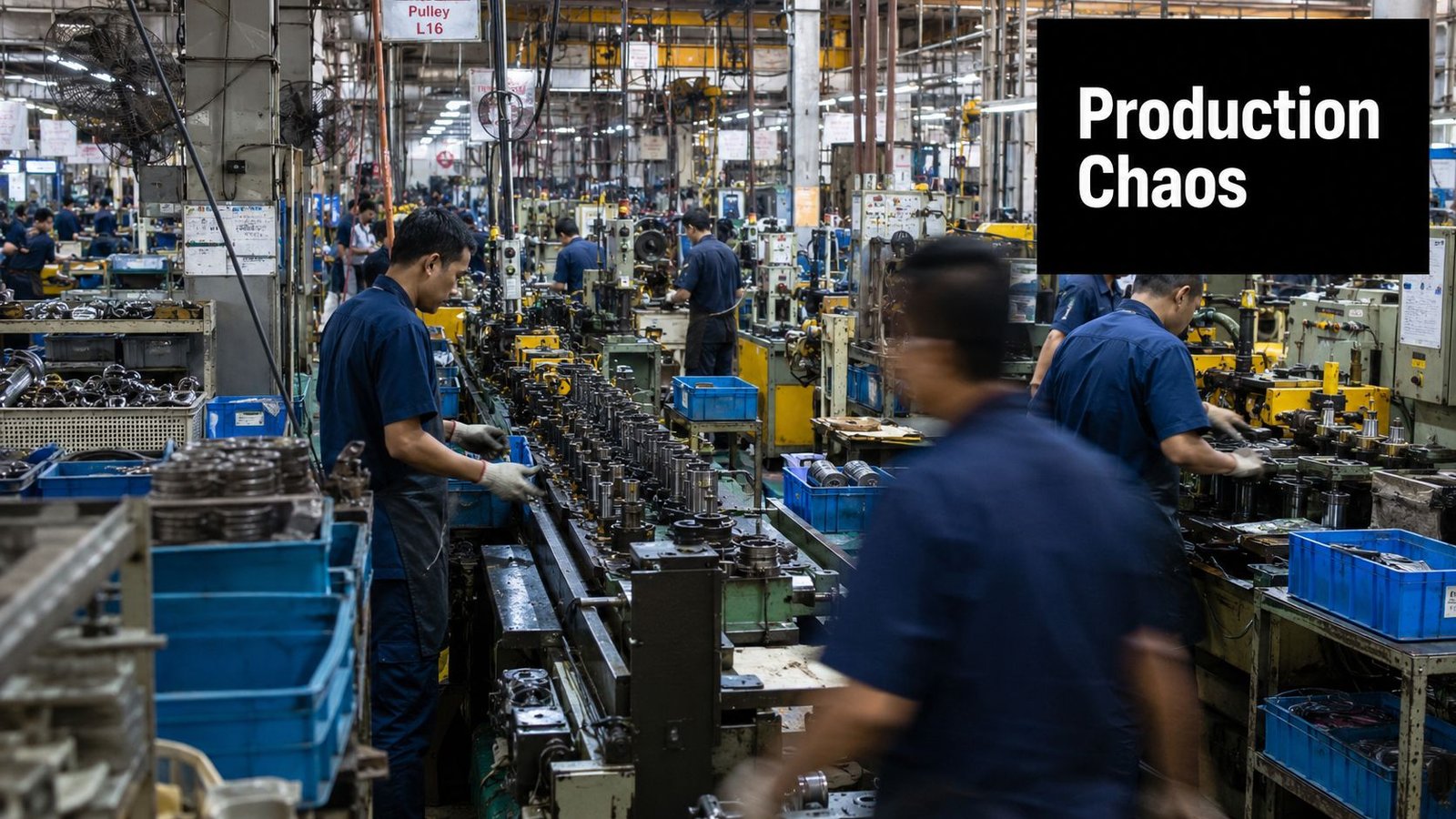
The problem usually isn't effort. It's that the plant is managing output from symptoms instead of from constraints. Capacity gets discussed only when orders are late, overtime is already spent, and every department has a different explanation. Purchasing blames supply delays. Production blames planning. Planning blames inaccurate cycle times. Maintenance blames old equipment. Sometimes all of them are partly right.
What cuts through that noise is disciplined production capacity planning. Not as a spreadsheet exercise. As an operating habit that connects forecast demand, demonstrated output, labor availability, bottlenecks, and real scheduling decisions.
Hidden losses look like lack of capacity
Many managers still compare demand against installed equipment as if the machine's theoretical output is the same as usable output. It isn't. Changeovers, waiting time, micro-stops, operator handoffs, missing tools, inspection delays, and poor sequence planning all consume capacity that never appears in a basic machine list.
Practical rule: Before approving new capital, prove that the current process is being used well enough to justify it.
That's why the most useful first move is often operational recovery. Data cited by Guidewheel's production capacity analysis notes a median equipment runtime of 32%, which suggests many factories have recoverable capacity before new capital is justified.
What good planning changes on the floor
When a plant starts planning capacity properly, the conversation changes. Instead of saying, “We need another machine,” the team asks sharper questions:
- Where is the actual pacing constraint: Which station limits total line output today?
- What loss is recurring: Changeover time, downtime, waiting for material, or labor mismatch?
- What can be recovered fast: Better scheduling, fixture upgrades, line balancing, or targeted semi-automation?
- What should wait: Big investments that won't help until the bottleneck is fixed
Often, smaller manufacturers find an advantage. You can move faster, test changes in one cell, and improve one bottleneck without rebuilding the whole factory. In many plants, a smarter fixture, poka-yoke check, guided assembly step, or rebalanced operator sequence solves the actual constraint faster than a full equipment replacement project.
Assess Your True Production Capacity Not Just the Nameplate
If your planning starts from brochure output, vendor cycle time, or an old commissioning target, your numbers will fail you. Real capacity comes from what the line can repeatedly deliver under normal operating conditions, with normal operators, normal stoppages, and the product mix you run.
Why nameplate output misleads managers
A machine supplier may give a theoretical maximum. Engineering may still have a design assumption from an earlier product mix. Finance may treat installed assets as available assets. None of those numbers tell you what the floor can sustain over a working week.
Modern manufacturing guidance has moved away from static nameplate thinking toward demonstrated capacity and utilization. Rockwell Automation's capacity planning guide describes this shift and cites benchmark data from more than 3,000 tracked machines showing a median runtime of 32.04%. That gap is why plants often feel constrained even when equipment appears available.
Capacity planning gets practical when you stop asking what the plant could make in theory and start measuring what it does make in routine operation.
Three measurements that matter on a real floor
For small and mid-sized manufacturers, you don't need a massive digital transformation to get a useful baseline. Start with three shop-floor views.
Throughput
Track actual completed units by shift, day, and product family. Don't count started units. Don't average away changeovers if the mix changes often. If one line builds several variants, track throughput by variant or by standard time bucket.
A simple approach works:
- Pick a stable period: Use recent runs that reflect current staffing and current product mix.
- Measure finished output: Count only good units that reach the defined completion point.
- Note context: Shift pattern, crew size, material interruptions, and changeovers.
This gives you a demonstrated output rate. It's imperfect, but it's real.
OEE
Use OEE as a loss-finding tool, not as a vanity score. Break it into availability, performance, and quality so supervisors can see what is hurting output. If availability is weak, maintenance and changeovers may be the issue. If performance is weak, minor stops or operator motion may be the issue. If quality is weak, rework is consuming hidden capacity.
If you want that visibility without relying on handwritten logs, a practical next step is machine monitoring software for production visibility. Even basic monitoring helps expose waiting time and stop patterns that operators already feel but haven't quantified.
Takt time and bottleneck pace
Takt time tells you the production pace required to meet demand. Your bottleneck tells you the pace you can sustain. When those two are out of sync, schedules become fiction.
Walk the line and identify the one step that routinely controls output. You'll usually see one of these patterns:
- Queue before a station: WIP builds up and stays there.
- Downstream waiting: The next operation stands idle waiting for parts.
- Frequent recoveries: A station falls behind and the team keeps “catching up.”
- Labor clustering: Supervisors keep assigning extra help to one area.
Once you find that point, treat it as the line's heartbeat. Every upstream and downstream decision should support it.
Calculating Required Capacity and Modeling Scenarios
A forecast is only useful when you can convert it into machine hours, labor hours, and material demand by work center. Otherwise planning stays abstract, and production teams receive targets that look clear in ERP but impossible on the floor.
Turn the forecast into hours not hope
A practical workflow is to start with demand, translate it through routings and BOMs, compare that load against demonstrated capacity, then keep monitoring variance. Deskera's manufacturing capacity planning guidance describes that sequence and also warns that poor master data makes the whole plan unreliable.
That warning matters more than is often acknowledged. If your routing says a press operation takes one time, but operators regularly need extra handling, cleaning, or inspection, your capacity model is already wrong. If the BOM is outdated, material availability gets overstated. If calendars don't reflect real downtime, planning creates load that the plant cannot absorb.
A clean way to work through the load is this:
Start with confirmed demand and expected mix
Use the demand view your plant is expected to serve, not a wish list.Apply routing times by operation
Convert each product into required machine and labor time at each work center.Check supporting materials and tools
A line may have machine time available but still be blocked by kit shortages, fixtures, or gauges.Compare against demonstrated capacity
Use what the process can sustain, not what the asset list suggests.Flag overload points early
Don't spread overload across the whole plant. Name the exact work center and shift where it occurs.
For manufacturers dealing with uneven cycle times across stations, production line balancing methods often become the bridge between planning and execution. A balanced line doesn't just look cleaner. It makes the required hours more believable.
Here's a useful walkthrough if your team needs a visual reset on the topic:
Model the problems before they hit the floor
The plants that handle volatility best don't assume a single future. They build a few realistic scenarios and ask what each one does to the bottleneck, labor plan, and inventory posture.
A strong scenario set usually includes:
- Demand upside: A major customer pulls orders forward.
- Mix change: A higher-complexity product takes a larger share of the schedule.
- Supply disruption: Material arrives late and sequence flexibility shrinks.
- Capacity loss: A key machine, fixture, or operator becomes unavailable.
If one scenario breaks your schedule immediately, the plan wasn't stable. It was only lucky.
Managers should separate short-term actions from structural decisions. Short-term smoothing might mean overtime, temporary staffing, resequencing, or subcontracting a limited operation. Structural action might mean new tooling, another fixture set, a semi-automated station, or a layout change.
The point isn't to predict everything. It's to stop being surprised by the few disruptions that happen repeatedly.
Unlocking Hidden Capacity with Smart Optimization Tactics
Most capacity gains don't start with buying larger equipment. They start by removing the reasons existing assets fail to convert available time into shipped product. That's where the highest-return work usually sits.
Find the constraint then organize around it
Near-term schedules become more realistic when planning respects actual constraints. Bizowie's explanation of finite and infinite capacity planning recommends using infinite planning to reveal constraints, then finite planning to build an achievable schedule around them. The same guidance highlights a core operational rule: subordinate non-bottleneck steps to the bottleneck, address the bottleneck, then repeat as the next constraint emerges.
That rule sounds simple. On the floor, it changes behavior.
If assembly is the bottleneck, don't keep overproducing upstream parts that pile into WIP. If a test station is the bottleneck, don't optimize packaging first. If changeovers are starving the bottleneck, production control should group jobs to protect flow instead of chasing local efficiency in every department.
Low capital improvements that usually move first
Plants often recover capacity with targeted actions like these:
- Rebalance manual work content: Shift small tasks away from the constrained station so the bottleneck operator only handles value-adding work that must stay there.
- Shorten setup exposure: Pre-stage tools, standardize setup kits, and move preparation outside machine time wherever possible.
- Reduce waiting between steps: Improve handoff points, part presentation, and in-process storage so operators don't hunt for material.
- Add smart fixtures or guided checks: A fixture that aligns parts consistently can reduce both cycle instability and defect-driven rework.
- Match labor to actual load: Move flexible operators to the pacing process during peaks instead of spreading labor evenly across the line.
The best optimization work is usually unglamorous. It removes friction that everyone on the floor has already learned to work around.
One mistake I see often is solving the wrong loss category. Teams invest in speed when the underlying issue is variability. They automate a motion that wasn't limiting output, while downtime, setup inconsistency, or queue management keeps throttling the line. That's why bottleneck discipline matters. It prevents expensive improvement theatre.
Another point for small and mid-sized manufacturers: flexibility has value. A semi-automated fixture, feeder, or guided workstation can increase repeatability and output without making the process so rigid that product change becomes painful. If your product mix changes often, preserving that flexibility is part of capacity strategy, not a compromise.
Choosing Your Automation Pathway Semi vs Full
Once the process is stable enough to measure and the main losses are visible, then automation choices become much clearer. At this point, many manufacturers either underinvest and stay stuck, or overinvest in a system that's too expensive, too rigid, or too slow to implement.
Structured forecasting is becoming more common. NetSuite's manufacturing capacity analysis article cites a 2026 survey reporting that 86% of organizations do capacity forecasting regularly or occasionally, up from 81% in 2025. As planning maturity grows, automation decisions need to be more disciplined, not more aggressive.
Decision Matrix Semi-Automation vs. Full Automation
| Criterion | Semi-Automation (e.g., Smart Fixtures, Guided Assembly) | Full Automation (e.g., Robotic Cells, Integrated Lines) |
|---|---|---|
| Capital cost | Lower entry cost and easier to phase | Higher upfront commitment |
| Implementation speed | Faster to deploy in an existing process | Longer integration and validation effort |
| Process flexibility | Better for mixed products and changing demand | Best when product and sequence are stable |
| Operator involvement | Still relies on trained operators | Reduces direct manual handling more aggressively |
| Change management | Easier for teams to adopt incrementally | Requires broader process and maintenance readiness |
| Scalability | Good for stepwise upgrades | Strong when long-term volume is stable and justified |
| Best fit | Plants upgrading manual work without losing flexibility | Plants with stable demand, stable design, and clear ROI logic |
A lot of manufacturers don't need a robotic cell first. They need a guided loading fixture, a poka-yoke station, an indexed workstation, a vision-assisted check, or a semi-automatic press with controlled sequence. Those solutions often solve the primary bottleneck with less disruption.
How to choose without overbuying
Ask these questions before committing:
- Is the process already stable enough to automate? If cycle time swings widely because material presentation is poor, automation may just lock in a bad process.
- Will product mix stay stable enough? Full automation rewards repetition. High mix often favors modular semi-automation.
- Does the constraint justify the spend? Automating a non-bottleneck process won't move plant output much.
- Can the team support it? Maintenance capability, spare strategy, operator training, and changeover discipline all matter.
- Are regulated requirements involved? In medical device environments, GMP-aware design, documentation, and validation planning must shape the automation level from the start.
For many SMEs, the sensible path is staged. Improve the line manually. Add fixtures and controls. Semi-automate the bottleneck. Standardize data collection. Then decide whether a fully automated cell is warranted. If you're evaluating that middle ground, semi-automated manufacturing systems that fit budget and production goals are often the most practical starting point.
From Planning to Performance A Resilient Production System
Good production capacity planning doesn't end with a schedule. It becomes a management routine. Demand gets reviewed against current constraints. Demonstrated capacity gets updated from real performance. Bottlenecks are treated as operating facts, not as surprises. Improvement projects are chosen because they release flow, not because they look impressive in a capital meeting.
A practical operating rhythm
The strongest plants keep a simple loop in place:
- Measure current output: Use actual throughput, loss patterns, and bottleneck behavior.
- Translate demand into required load: Machine time, labor time, and support resource needs.
- Check feasibility before release: Don't send impossible schedules to the floor.
- Recover lost capacity first: Remove downtime, waiting, imbalance, and setup waste.
- Invest selectively: Add tooling, semi-automation, or full automation only where the business case is tied to the constraint.
- Review again: Once one problem is fixed, the next limiting step becomes visible.
A resilient plant isn't the one with the most equipment. It's the one that knows where its real limits are and adjusts early.
A short checklist for plant managers
Use this as a working checklist on your next planning cycle:
- Validate routing and BOM data: If the master data is weak, planning accuracy won't improve.
- Baseline demonstrated capacity: Use routine operating conditions, not idealized output.
- Identify one active bottleneck: Name the station or process that paces the line.
- Protect the constraint: Sequence work, labor, and materials around that point.
- Prioritize low-capital recovery: Fixtures, balancing, changeover reduction, and monitoring often come first.
- Choose automation by fit: Match the solution to product mix, operator capability, budget, and compliance needs.
- Make planning continuous: Capacity planning works best as a weekly discipline, not a yearly exercise.
For manufacturers trying to improve output without overspending, that approach is usually the difference between a plant that keeps reacting and a plant that steadily improves.
If you're looking for a practical partner to improve throughput, reduce labor dependency, and choose the right level of automation, System Engineering & Automation helps manufacturers build cost-effective solutions that fit real production conditions. From custom tooling and fixtures to semi-automated systems, integrated controls, installation, and commissioning, SEA supports the full path from process assessment to implementation with an emphasis on smart, incremental gains rather than expensive overbuild.