You've probably seen this happen on a plant floor. The line is running, the vision cell starts flagging good parts, and everyone argues about the camera when the problem is the light above it. A control choice that looked harmless on paper, a fluorescent fixture, a bad dimming curve, a sloppy zoning layout, can decide whether inspection is stable, whether operators see what they need to see, and whether your automation team spends the next week chasing ghosts.
Integrated lighting controls belong in manufacturing conversations for that reason. They're not just a facilities upgrade and they're not just about reducing runtime. They shape inspection quality, safety exposure, operator comfort, and the consistency of machine-vision results, which is why they should be treated like a production input, not an afterthought.
Table of Contents
- Lighting on the Plant Floor and Why It Matters More Than You Think
- What Integrated Lighting Controls Do in Manufacturing
- Supporting Inspection, Safety, and Machine Vision
- Integrating With PLCs, SSRs, and Automation Controls
- Quantifying ROI, Energy Savings, and Lifecycle Value
- Implementing Integrated Lighting Controls in a GMP-Aware Facility
- Building the Business Case and Choosing the Right Partner
Lighting on the Plant Floor and Why It Matters More Than You Think
A vision-guided pick-and-place cell doesn't care that the fixture catalog says “high efficiency.” It cares about flicker, stability, and whether the light level stays predictable enough for a camera to see edges the same way every shift. I've walked into cells where the operator blamed the camera, maintenance blamed the robot, and the only thing unstable was the lighting above the part.
That's the trap with plant lighting. The same nominal lumen output can produce very different results in inspection, safety, and operator performance depending on how it's controlled. A fixed on/off circuit might be fine for storage space, but it's a weak answer in a high-mix cell where part reflectivity changes and the inspection task changes with it.
Lighting is part of the process, not the backdrop
In manufacturing, light affects the work the same way air pressure or cycle timing does. If the illumination shifts between shifts, the people on the floor adapt, but the quality system pays for that adaptation later in missed defects, false rejects, or inconsistent records. A stable control strategy helps create a stable visual environment, which matters just as much for human inspection as it does for machine vision.
Practical rule: if a defect is hard to see by eye, it's usually harder for a camera once you start dimming, switching, or spreading zones too aggressively.
The historical move from basic switching to networked control made this possible. The modern light switch dates to 1884, the dimmer switch to 1959, and DALI was codified in 1998, which marked the shift from simple on/off behavior to software-driven, interoperable lighting management, according to Casambi's lighting control history. That progression is what made today's sensing, tuning, and scheduling practical in industrial spaces.
For manufacturers, the question isn't whether lights can turn on. It's whether the control strategy supports inspection, safety, and uptime without creating another source of variability. That's where integrated lighting controls start acting like a manufacturing asset.
What Integrated Lighting Controls Do in Manufacturing
Define integrated lighting controls by the actions they perform in a plant zone. They sense occupancy, use available daylight, follow production schedules, adjust levels for specific tasks, and group luminaires by production cell. This approach matches the way a facility operates instead of treating the entire room as one circuit.
A packaging hall shows the difference. Receiving may need broad illumination for longer periods, assembly may require stable task light, inspection may need tighter level control, and shipping may reduce lighting after a shift change. A single control strategy across all four areas leaves some fixtures running without a production need while giving other workstations less control than the task requires.
The control functions that show up on the floor
Occupancy and vacancy sensing suit aisles, support benches, and stations used intermittently. Occupancy sensing can turn lights on as people enter. Vacancy sensing leaves activation to the operator and turns the zone off after use. That distinction matters in cells where an operator may need task light only for part of a setup or maintenance activity.
Daylight harvesting works near clerestory glazing and dock doors, where outdoor light changes the baseline throughout the day. Scheduling aligns lighting with shifts, planned downtime, and off-hours security needs. It is a straightforward way to reduce unnecessary runtime without changing the production sequence.
DALI, 0-10 V drivers, relay packs, and networked controllers suit different fixture types and control requirements. Room-level control may be adequate for a break area or warehouse bay. A manufacturing cell often benefits from fixture-level or zone-level control because one station can be producing while the adjacent station is in changeover. Networked control earns its keep when that separation improves operating control and troubleshooting.
| Common Lighting Control Functions in a Manufacturing Zone | |||
|---|---|---|---|
| Control Function | Typical Purpose | Sensor or Input | Manufacturing Use Case |
| Occupancy sensing | Turn lights on only when a zone is in use | PIR, ultrasonic, or combined occupancy sensor | Aisles, maintenance corridors, seldom-used support areas |
| Vacancy sensing | Require manual-on, automatic-off behavior | Wall switch or control input plus sensor | Work cells where operators should choose when task light is needed |
| Daylight harvesting | Reduce artificial light when daylight is present | Photocell or daylight sensor | Perimeter bays, dock areas, clerestory-adjacent zones |
| Scheduling | Align lighting with shifts and downtime | Time clock, BMS schedule, PLC timebase | Production halls, shipping, off-hours security lighting |
| Task tuning | Set a lower or higher light level for the job | Local dimming command or preset scene | Inspection benches, rework tables, quality labs |
Commissioning determines whether these functions help or create service calls. Sensor placement, timeout settings, grouping, and manual overrides must match how operators move through the area. A well-designed plant system groups luminaires by process need and exposes enough status for maintenance, while keeping the controls understandable during a fault or retrofit. Flashy features matter less than clear behavior, accessible wiring, and settings the facilities team can support.
Supporting Inspection, Safety, and Machine Vision
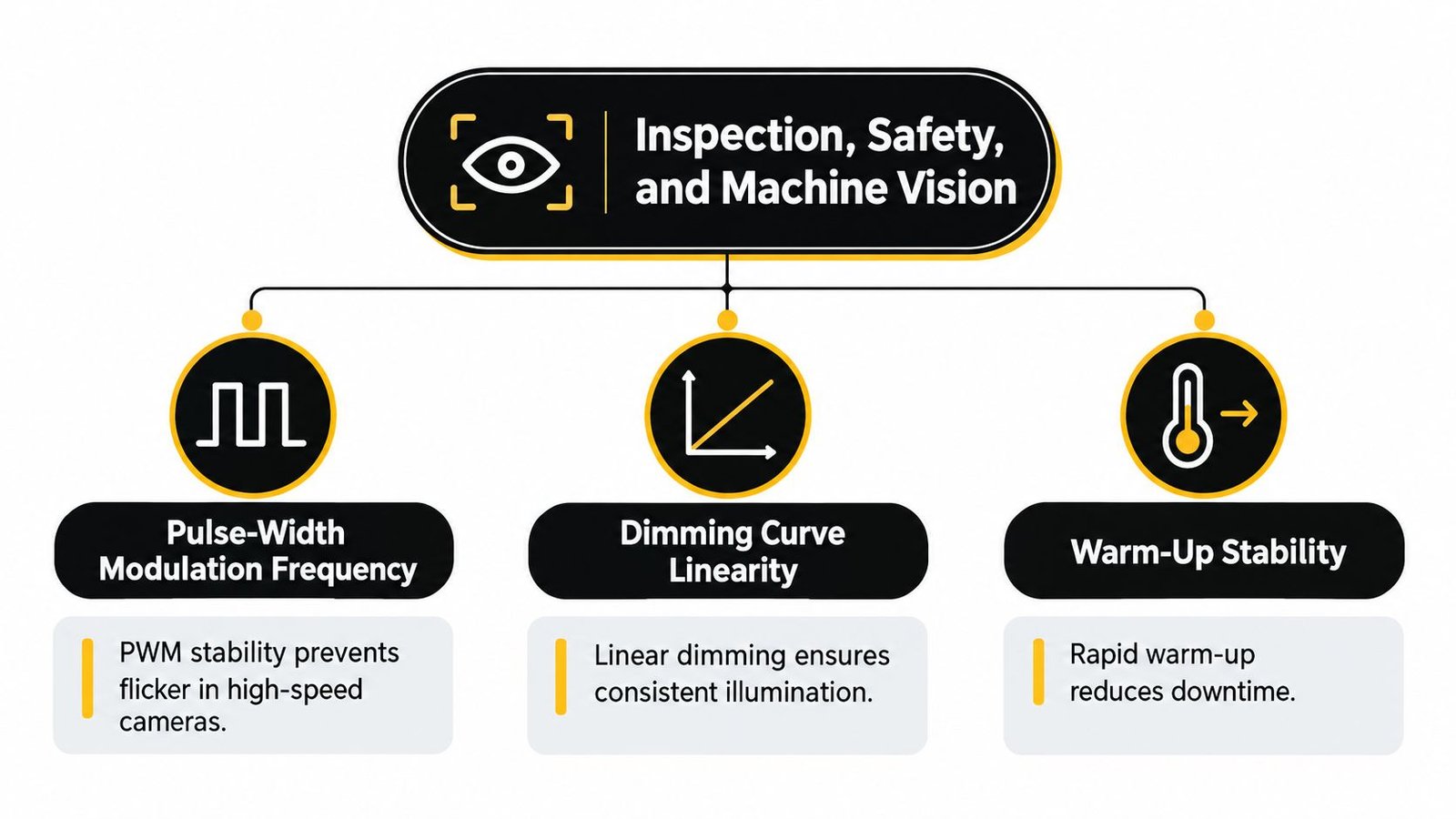
The most expensive lighting mistake on a plant floor is often the one people don't notice until quality drifts. Machine vision can be very sensitive to flicker, and pulse-width modulation choices, dimming curve behavior, and warm-up stability all affect how a camera sees contrast and color. If the control method creates strobing or uneven exposure, the system may never reach its real inspection potential.
Inspection quality depends on steady light
High-speed cameras are unforgiving. If a PWM dimming scheme creates visible strobing at the wrong frequency, edge detection can become unstable and color consistency can drift enough to affect pass or fail decisions. A simple on/off control may be perfectly fine for storage, but it leaves a lot of performance on the table in a vision-guided process.
That's why dimming behavior matters as much as nominal brightness. A smooth dimming curve helps preserve consistency when a station is tuned for different part geometries or reflectivity. Rapid warm-up also matters, because a light that reaches stable output quickly helps reduce downtime during changeovers and startup checks.
You can see why this matters in the earlier section on control functions. When aggressive daylight harvesting is used without enough local supervision, it can create dark zones or uneven illumination between shifts. That might be acceptable in a hallway. It's not acceptable over a camera-triggered inspection point.
Safety and operator conditions still have to hold
Integrated controls can't sacrifice egress or task lighting in the name of savings. If a zone serves as a path of travel or a critical work area, the control design has to fail in a safe state, not a dark one. That's a design issue, a wiring issue, and a maintenance issue all at once.
Operator comfort matters too. Glare, flicker, and unstable color temperature all contribute to fatigue and missed cues on the floor. In practice, the best lighting control strategy is the one that gives people a predictable visual environment while still allowing the system to reduce waste where the work isn't happening.
For teams that run vision inspection, the practical benchmark is simple. If lighting variation makes the camera setup harder to trust, the controls need to be rethought before the line does more damage.
Vision inspection systems are only as stable as the light feeding them, and that's why lighting strategy belongs in the same design conversation as optics, triggers, and PLC timing.
Integrating With PLCs, SSRs, and Automation Controls
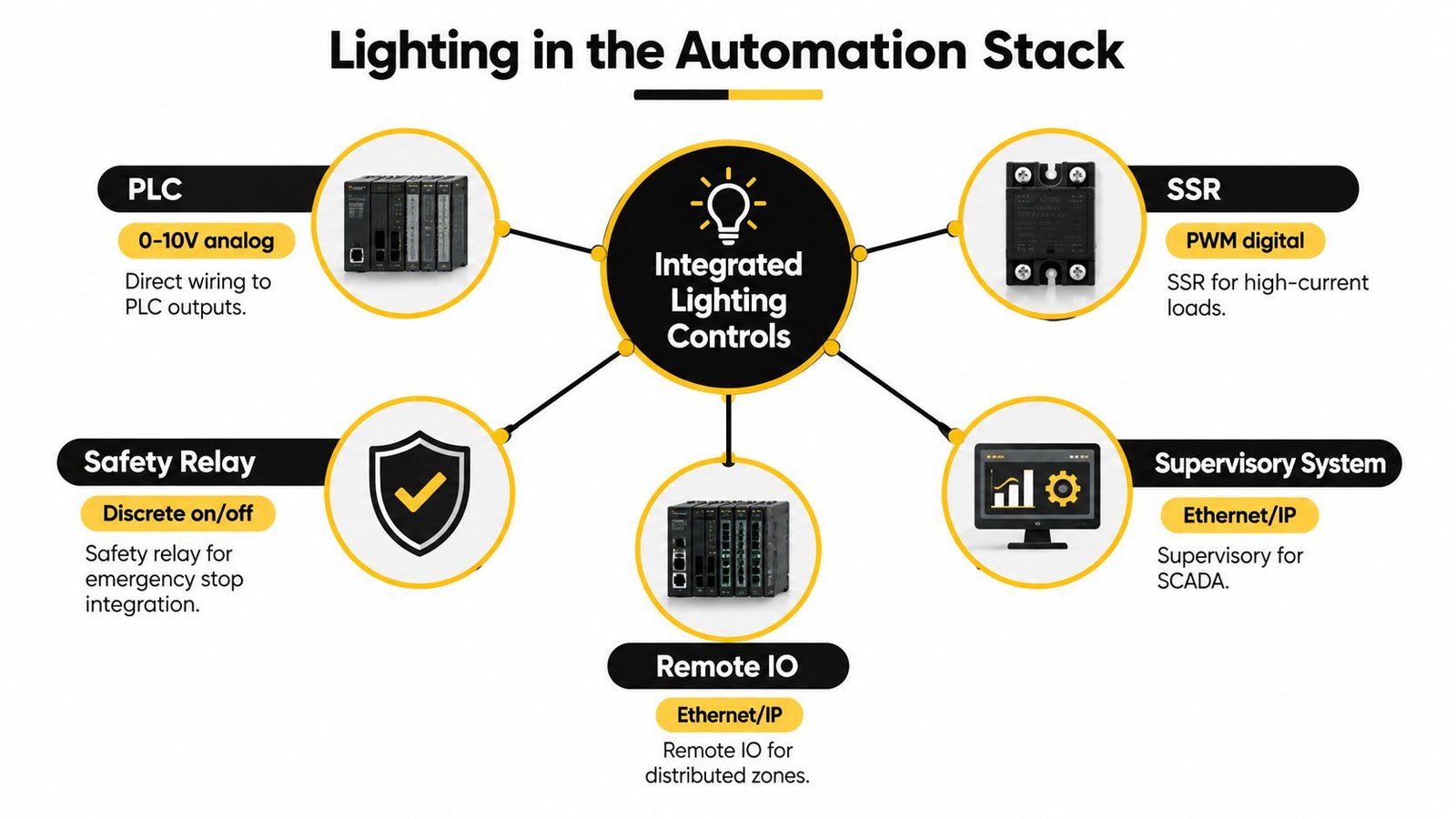
On a plant floor, lighting often operates as a controlled machine load. PLC tags, discrete outputs, analog dimming lines, gateways, and safety logic determine how fixtures respond to production, setup, maintenance, and E-stop states. Giving the controls team ownership of that sequence keeps lighting aligned with the work instead of leaving it as a separate facility system.
The signals that matter in real integration work
A common starting point is a 24 VDC discrete output from the PLC driving an SSR or relay input. This arrangement provides simple stage control for production, inspection, or night-security zones. For dimming, 0-10 V remains widely used and works predictably when the fixture and driver support it properly.
Teams responsible for tag structure and sequencing should establish naming conventions before wiring begins. A primer on PLC programming fundamentals can help align electricians, controls engineers, and lighting vendors around tags, outputs, permissives, and fault states.
Projects spanning several cabinets may use Ethernet/IP or PROFINET gateways to distribute control hardware. BACnet can connect the lighting system to building-level systems. Protocol selection matters less than documenting who owns each tag, zone, override, and fallback state.
Three architectures appear often:
- PLC-owned zones suit lighting that follows production state closely, including run, setup, and maintenance modes.
- Standalone lighting controllers reduce cabinet work and give facilities a simpler local maintenance path.
- Hybrid designs combine both approaches during retrofits. They work well when the handoff between systems is explicit and documented.
Retrofit friction is usually physical, not theoretical
The difficult work usually sits at terminations, addressing, and records. Legacy contactor panels rarely map neatly to newer logic. Mixing old switching with networked zones also forces the team to reconcile names, wiring, overrides, and commissioning documentation.
The cleanest retrofit is the one where the wiring map, PLC tag list, and as-built drawings all say the same thing.
Cabinet space is only one trade-off. Fault visibility matters more. A PLC that owns every circuit gives the automation team better status information, while also adding lighting faults to its troubleshooting workload. A standalone controller keeps local behavior with facilities, but limits sequence-level coordination with equipment.
Commissioning exposes these choices quickly. Test each operating state, confirm loss-of-communications behavior, verify safe lighting during an E-stop, and record who can override the zone. That work prevents a failed gateway or undocumented force from disrupting inspection or operator visibility.
The right architecture depends on how closely lighting must follow production. In a high-mix facility, deeper integration often pays off when the team budgets time for point checks, labeling, and as-built updates.
Quantifying ROI, Energy Savings, and Lifecycle Value
The strongest business case for integrated lighting controls starts with energy, but it shouldn't end there. The documented savings are real, and they're useful, yet the manufacturing value often shows up in cleaner inspections, fewer false rejects, faster fault isolation, and better audit readiness. That's a broader return than a simple utility line item.
A Lawrence Berkeley National Laboratory meta-analysis based on 240 savings estimates from 88 papers and case studies found average lighting energy savings of 24% for occupancy controls, 28% for daylighting, 31% for personal tuning, 36% for institutional tuning, and 38% for multiple combined approaches, according to LBNL's commercial lighting controls review. A separate DOE resource reported that in private offices, occupancy sensors cut lighting energy by 25% on weekdays, automatic daylight dimming saved an average of 27%, and combining sensors with dimming saved about 45%, which is a useful reminder that stacked strategies outperform single-function controls in real spaces, as shown in DOE's lighting controls guide.
What those numbers mean in a plant
The manufacturing takeaway is not just lower kWh. A vision station that sees stable illumination shift to shift can reject fewer good parts by mistake. A maintenance team that can isolate a lighting fault from the supervisory system doesn't spend as long hunting through a dark zone. A GMP-aware area that logs control activity has a cleaner audit trail when someone asks how the space was operated.
A DOE/field study summary also reported networked lighting control installations using occupancy, daylight harvesting, task tuning, and personal tuning achieved about a 40% reduction in lighting energy use, with a separate field study showing a portfolio-level average of 49% across 194 buildings. Those are meaningful numbers, but on a manufacturing floor the operational benefit is often the part finance notices after the first bad incident, not before it.
| ROI Inputs for Manufacturing Lighting Control Projects | ||
|---|---|---|
| Cost or Savings Category | Example Value | How to Capture It |
| Fixture and controls hardware | Project-specific | Quote by zone, not by building total |
| Integration labor | Project-specific | PLC, gateway, and commissioning hours |
| Reduced energy use | Documented through utility bills | Compare baseline and post-commissioning kWh |
| Inspection stability | Project-specific | Track false rejects, rechecks, or manual overrides |
| Maintenance time | Project-specific | Record fault isolation and replacement labor |
| Audit readiness | Project-specific | Capture logs, schedules, and as-builts |
If finance wants a simple answer, give them one: the payback story improves when lighting is treated as a production support system instead of a decorative utility. The savings are real, but the avoided friction is often what closes the case.
Implementing Integrated Lighting Controls in a GMP-Aware Facility
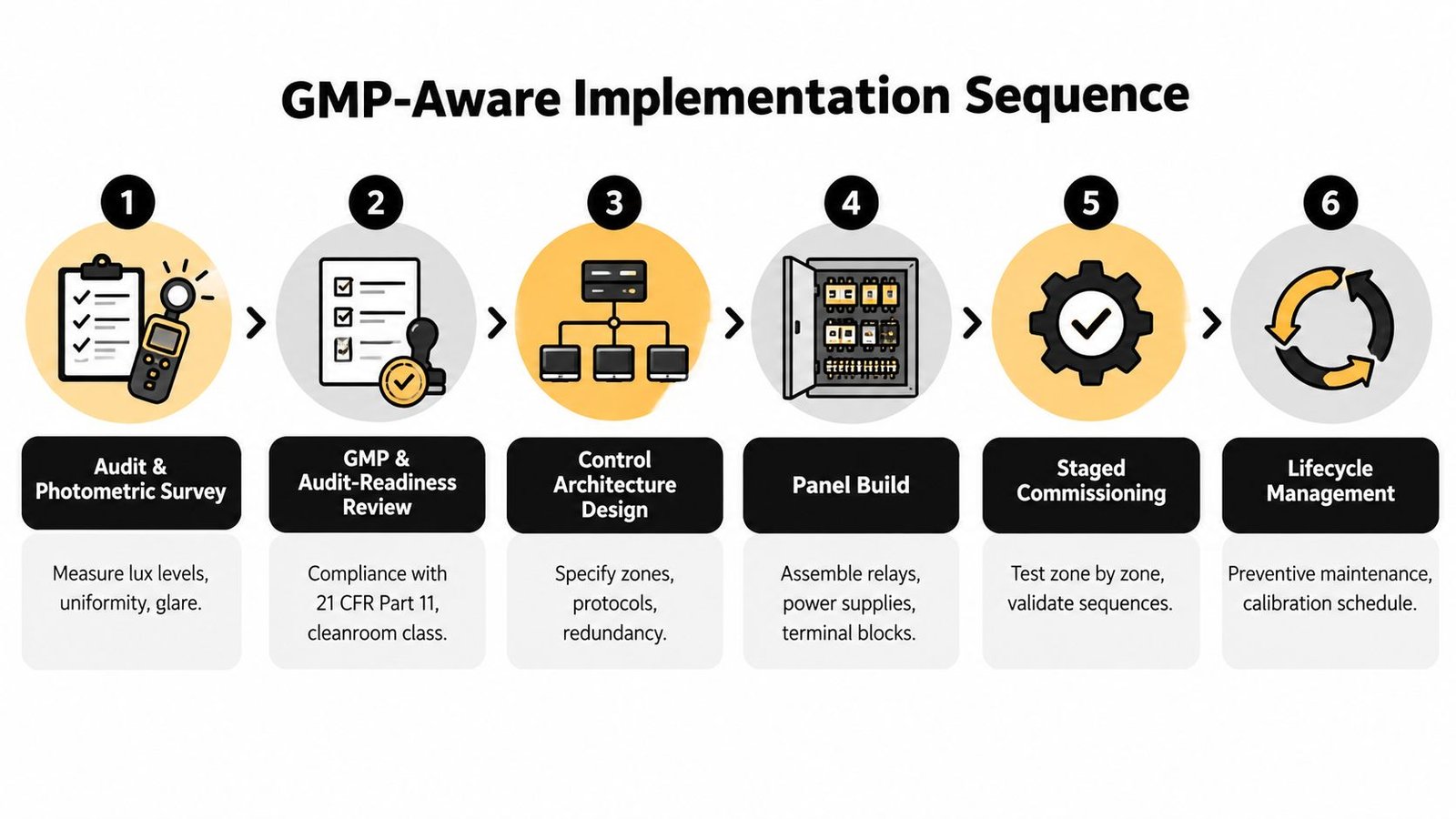
The cleanest implementations start before anyone orders hardware. An audit and photometric survey come first, because you can't design a control strategy without knowing where the light is needed and where it's being wasted. After that, the GMP and audit-readiness review has to happen early enough that fixture selection, control zoning, and documentation expectations all stay aligned.
The sequence that keeps projects from stalling
The most reliable path is straightforward: survey, review, design, build, commission, then support. The design phase should define zones, protocol choices, redundancy, and ownership before the panel is built. Staged commissioning matters because it lets the team validate one zone at a time instead of discovering conflicts after the whole plant is wired.
For regulated areas, the details matter. Cleaning-friendly fixtures, lumen maintenance behavior, and particulate considerations around ISO 7-8 zones can shape hardware selection before anyone starts talking about savings. The source of truth should also include event logs and dimming schedules, because auditors are increasingly interested in how the lighting system was operated, not just what was installed.
Where projects usually slip
The weak points are predictable. Utility coordination shows up late, change control drifts between facilities and automation, and the lighting drawings stop matching the PLC tag list. Pre-audit walkthroughs often expose validation gaps that should have been caught during commissioning, not after the punch list closed.
What GMP means in manufacturing is relevant here because lighting controls aren't exempt from documentation discipline just because they're not the process machine. If a project touches production space, QA and controls have to agree on ownership early.
Bring plant electricians, controls engineers, and QA into kickoff. If they only meet at the handover, the handover is already late.
The best plants treat lifecycle support as part of the project scope, not a separate favor. That means calibration schedules, replacement strategy, and maintenance access get designed in from the start.
Building the Business Case and Choosing the Right Partner
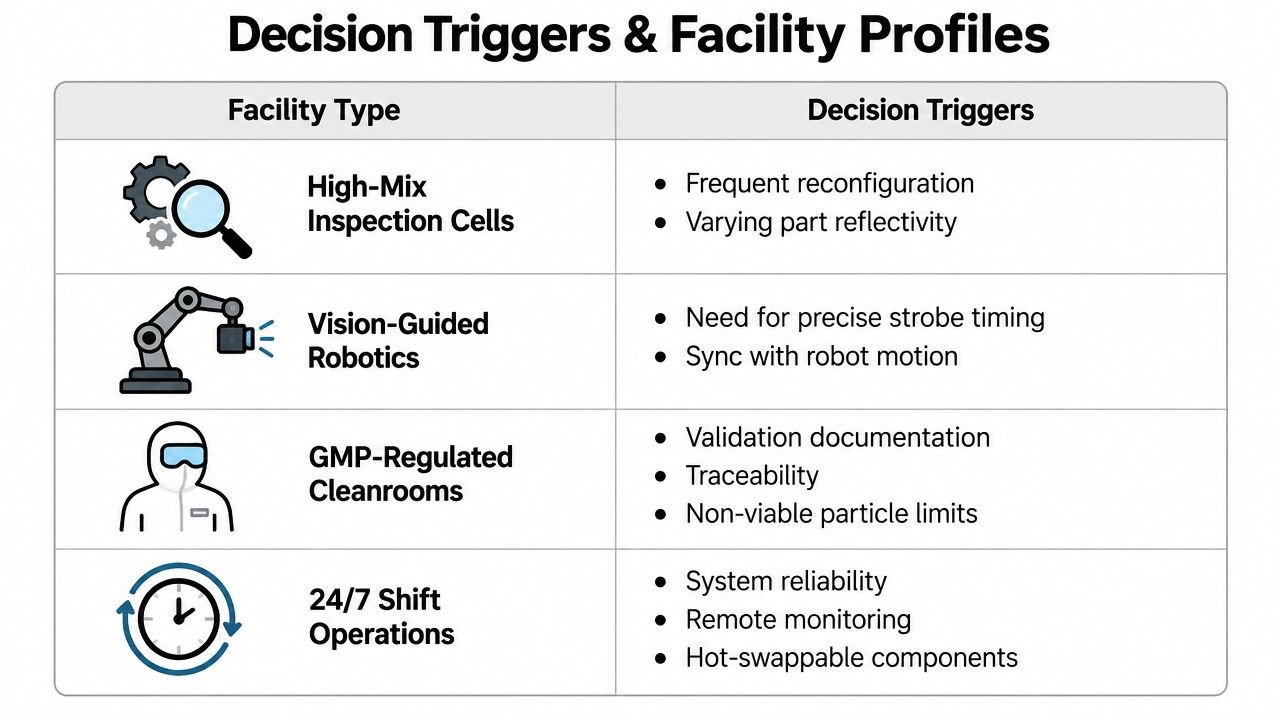
The right time to invest is when lighting affects margin in ways finance can't ignore. High-mix inspection cells, vision-guided robotics, GMP-regulated cleanrooms, and 24/7 shift operations all tend to reach that point sooner than a low-skill storage area. In those environments, the decision trigger is usually scrap, rework, false rejects, audit readiness, or uptime, not energy alone.
What to look for in a partner
The first filter is straightforward: does the vendor understand PLC integration, zoning logic, and fail-safe behavior, or do they only sell fixtures? If they can't explain how the system behaves during E-stop, maintenance mode, or a comms fault, they're not ready for a manufacturing project. If they avoid talking about SSRs, tag naming, or commissioning handoff, that's a red flag.
For GMP or audit-sensitive spaces, I'd want a partner who can work alongside your controls team and document the system with the same discipline used elsewhere in the plant. Lifecycle support matters too, because the control system doesn't stop being operationally relevant after startup. It has to stay maintainable when software, hardware, and staff change.
The real adoption threshold
- High-mix inspection cells need control stability because part reflectivity and task conditions shift often.
- Vision-guided robotics need timing discipline because lighting and motion have to stay synchronized.
- GMP-regulated cleanrooms need traceability because logs and commissioning records matter later.
- 24/7 operations need reliability because maintenance windows are narrow and downtime hurts.
When inspection yield, safety compliance, or vision uptime materially affects margin, integrated lighting controls stop being a facilities decision and become a manufacturing engineering decision. That's the right frame for evaluating both the project and the partner.
If you're ready to turn lighting into a controllable part of your production system, System Engineering & Automation can help you design, integrate, and commission a solution that fits your line instead of fighting it. Their team works on practical automation problems every day, so they can help you connect lighting controls to real manufacturing needs, not just fixture specs. Visit their site to discuss your plant's inspection, safety, and commissioning challenges.