You're trying to keep a line upgrade on schedule while mechanical, controls, quality, and validation teams all pull from different files, different revisions, and different assumptions. A fixture change looks small on paper, then it turns into a round of rework, a late test failure, and a scramble to explain why the commissioning plan no longer matches the build. That's the exact kind of mess model based systems engineering is meant to clean up.
Table of Contents
- The Challenge of Modern Manufacturing Complexity
- What Is Model Based Systems Engineering Really
- Traditional Engineering vs The MBSE Approach
- Key Benefits of MBSE for Automation and Manufacturing
- A Practical Roadmap for Adopting MBSE
- MBSE in Action Real World Manufacturing Use Cases
- Getting Started and Measuring Your ROI
The Challenge of Modern Manufacturing Complexity
A production line upgrade rarely fails because one machine is bad. It fails because the change touches requirements, controls, mechanical interfaces, operator workflows, safety rules, and verification evidence at the same time. When those pieces live in separate spreadsheets, drawings, and email threads, the team spends more time reconciling versions than solving the actual manufacturing problem.
That pressure is familiar in regulated environments too. A medical device line, for example, has to keep process intent, quality expectations, and evidence aligned while the design is still moving. If the team can't trace a requirement from concept to verification, every revision becomes a debate about what changed, who approved it, and whether the test still proves the right thing.
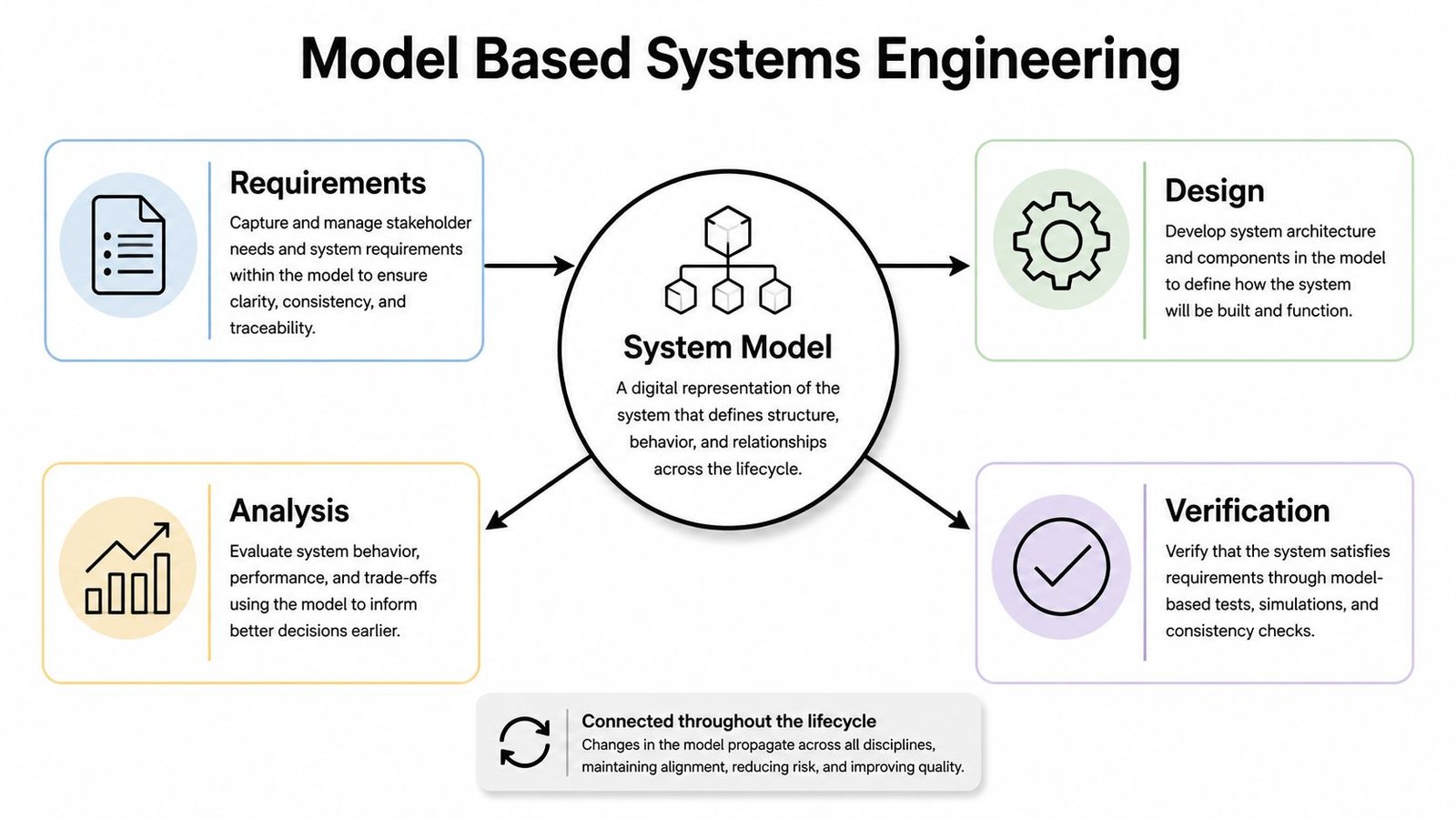
Model based systems engineering answers that coordination problem with a formal, connected working model. INCOSE defines MBSE as the application of modeling to support requirements, design, analysis, verification, and validation from conceptual design through later lifecycle phases, and SEBoK describes those models as a possible single source of truth for systems information (INCOSE MBSE definition, SEBoK discussion of the model as a single source of truth). For manufacturers, that means one connected picture of how the line is supposed to work, instead of many disconnected interpretations.
The practical shift is simple. Instead of asking every discipline to keep their own documents perfectly synchronized, MBSE makes the model the coordination point. That matters most when you're changing equipment, adding automation, or trying to improve throughput without creating a validation headache.
What Is Model Based Systems Engineering Really
Think of traditional engineering records like a stack of binders spread across a conference table. One binder holds requirements, another holds drawings, another holds test procedures, and each one can be technically correct while still disagreeing with the others. Model based systems engineering replaces that stack with a connected digital model that links the important pieces together.
The model is more than a drawing
The word model throws a lot of people off because they picture a diagramming tool. In practice, the model holds the logic of the system, the relationships between elements, and the trace links that tie requirements to design choices and verification artifacts. NIST describes model-based engineering as using models “as the data source for all engineering activities,” with data “created once and reused by all downstream data consumers” (NIST TN 1753).
That's the piece manufacturers should care about. When one requirement changes, the model can show which functions, interfaces, and test cases are affected. No one has to hunt through five documents to figure out whether the upstream decision reached the downstream station design.
Practical rule: if a change can't be traced from requirement to verification without a manual scavenger hunt, the organization is still working document-first, even if the files are stored in a digital platform.
For factory leaders, this is useful because production systems aren't just technical assemblies. They're combinations of tooling, controls, fixtures, operator steps, quality checks, and commissioning activities. A model gives those pieces a shared structure so the team can discuss the same system, not three different versions of it.
Why the “single source of truth” matters
A single source of truth sounds like a software slogan until a line change shows up. Then it becomes the difference between a team that knows which revision is current and a team that wastes hours reconciling outdated assumptions. In MBSE, the value is not that everyone sees a prettier diagram. The value is that everyone works from the same connected system definition.
That discipline pays off most when multiple stakeholders need to make decisions quickly. Operations can see what the change does to process flow. Engineering can see what the change does to interfaces. Quality can see what must be revalidated. The model doesn't remove the need for judgment, but it makes that judgment better informed.
Traditional Engineering vs The MBSE Approach
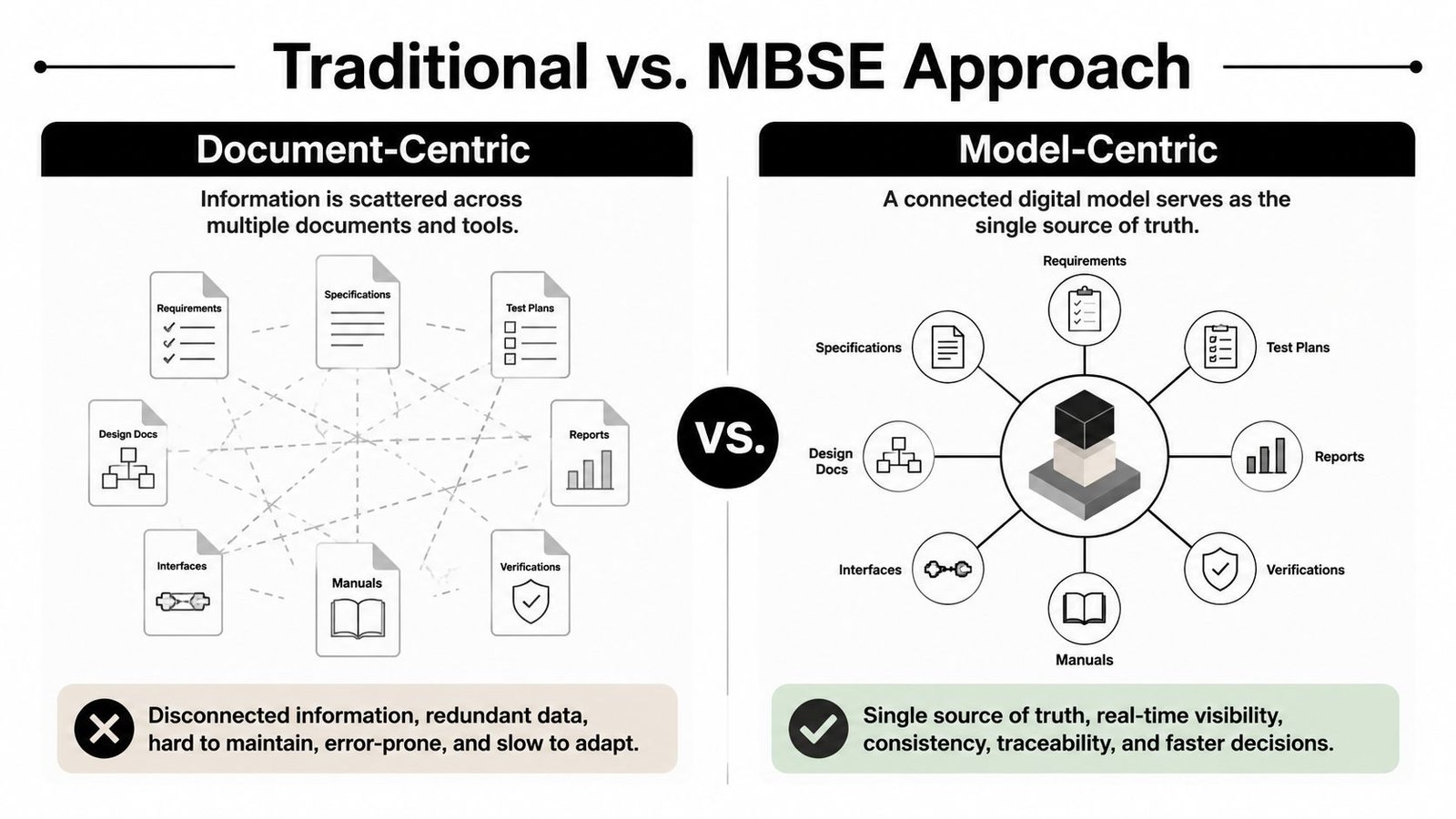
A line upgrade starts with a simple question, what changed, and who needs to know? In a document-first workflow, that answer is usually buried across requirements files, change notices, verification plans, and inbox threads. That can survive on a small job, but it breaks down fast when a manufacturing system combines controls, software, utilities, safety logic, and regulated records.
Document centric workflows break under change
Document-centric engineering depends on people catching every downstream effect by hand. That is a weak control method when one equipment change can affect layout, interface assumptions, acceptance criteria, and operator training. NIST's description of model-based engineering points to the opposite pattern, data is created once and reused by downstream consumers, which reduces duplicate updates and inconsistency risk (NIST TN 1753).
The factory-floor impact shows up quickly. If a controls update and a mechanical change are both in flight, the team still has to know whether a sensor move also changes the test procedure or the startup sequence. In a document-first setup, that answer often comes from manual comparison. In MBSE, the links already exist.
If the change cannot be traced from requirement to verification without a manual scavenger hunt, the organization is still working document-first, even if the files sit in a digital platform.
Model centric workflows make impact visible
MBSE uses explicit relationships. A requirement points to a design element. A design element points to an interface. The interface points to a verification case. That structure makes impact analysis easier to manage, especially in regulated manufacturing where hidden dependencies create real schedule and quality risk.
The systems engineering literature describes the model as a centralized repository and a single source of truth, with cross-referencing that supports earlier validation and assurance (Systems Engineering article on MBSE). A model-based approach also makes interface control more disciplined, which is why teams often pair it with interface control documentation when they are tightening handoffs between mechanical, electrical, and controls groups. For manufacturing teams, that means a design change shows its impact on quality evidence before the team commits to tooling, rework, or downtime.
That does not mean every organization should throw away its existing documents overnight. The practical move is to put the most important system logic into a connected model first, then generate or maintain documents from that core. Handled well, the model becomes the source of the system definition, and the documents become outputs that stay aligned instead of competing versions of the truth.
Key Benefits of MBSE for Automation and Manufacturing
A manufacturing team usually feels MBSE first in the places where projects slip. Interface mistakes show up earlier, verification stays tied to the design intent, and the engineering group spends less time reworking documents after a line change or automation update.
Better traceability for quality and validation
Quality work depends on being able to show how a change connects back to a requirement. MBSE is built around requirements, design, analysis, verification, and validation, which is why it fits regulated production work so well, as described by INCOSE MBSE definition.
That structure matters in plants where validation evidence has to survive audits and handoffs across disciplines. The model shows where a requirement came from, which design element satisfies it, and which test demonstrates it. For GMP-aware operations, that means the evidence trail sits inside the engineering work instead of being assembled at the end from scattered files.
Early issue detection lowers downstream rework
MBSE pays off before hardware is ordered. A virtual model can expose interface conflicts, allocation problems, and behavior mismatches while the change is still cheap to fix. Defense and industry material also describes MBSE as a way to use simulation and trade studies from early design through validation, which lines up with how manufacturing teams reduce late prototype surprises (DTIC source on MBSE with simulation and verification).
The practical result is easy to see on the floor. If a semi-automated station will not fit the workflow, or a control sequence does not match operator timing, the model can show that before anyone commits to fabrication, install, or commissioning. That keeps the fix in the engineering phase instead of turning it into rework, downtime, and schedule pressure.
Stronger change control on retrofit projects
Retrofits are often where MBSE earns attention fastest. These jobs usually involve a live production system, a tight outage window, and hidden dependencies that are hard to track by memory. A model helps the team see what a proposed change does to throughput, staffing, verification, and startup readiness before anyone touches the line.
Teams that already use interface control documentation usually find MBSE useful as the connected layer above those handoff documents. If interfaces are still being managed by email threads, spreadsheets, and local discipline notes, the gap becomes obvious quickly. A disciplined model gives those handoffs a common reference point, which matters when mechanical, electrical, and controls work all have to line up under a production deadline.
Real caution, not hype
MBSE helps when the model stays current and somebody owns it. Without clear governance, it turns into another artifact that people trust less over time. The evidence base is also mixed, and a review of MBSE value and benefits found that many claims were still supported mainly by perception, with only a small amount of measured evidence, so the business case should stay tied to operational metrics rather than broad promises (review of MBSE value and benefits evidence).
For small and mid-sized manufacturers, that reality is useful rather than discouraging. MBSE does not need to start as an enterprise overhaul. It can begin where the cost of a bad interface, a late change, or a weak validation trail is already visible, then expand only after the team can show that the model is saving time, reducing rework, or shortening review cycles.
A Practical Roadmap for Adopting MBSE
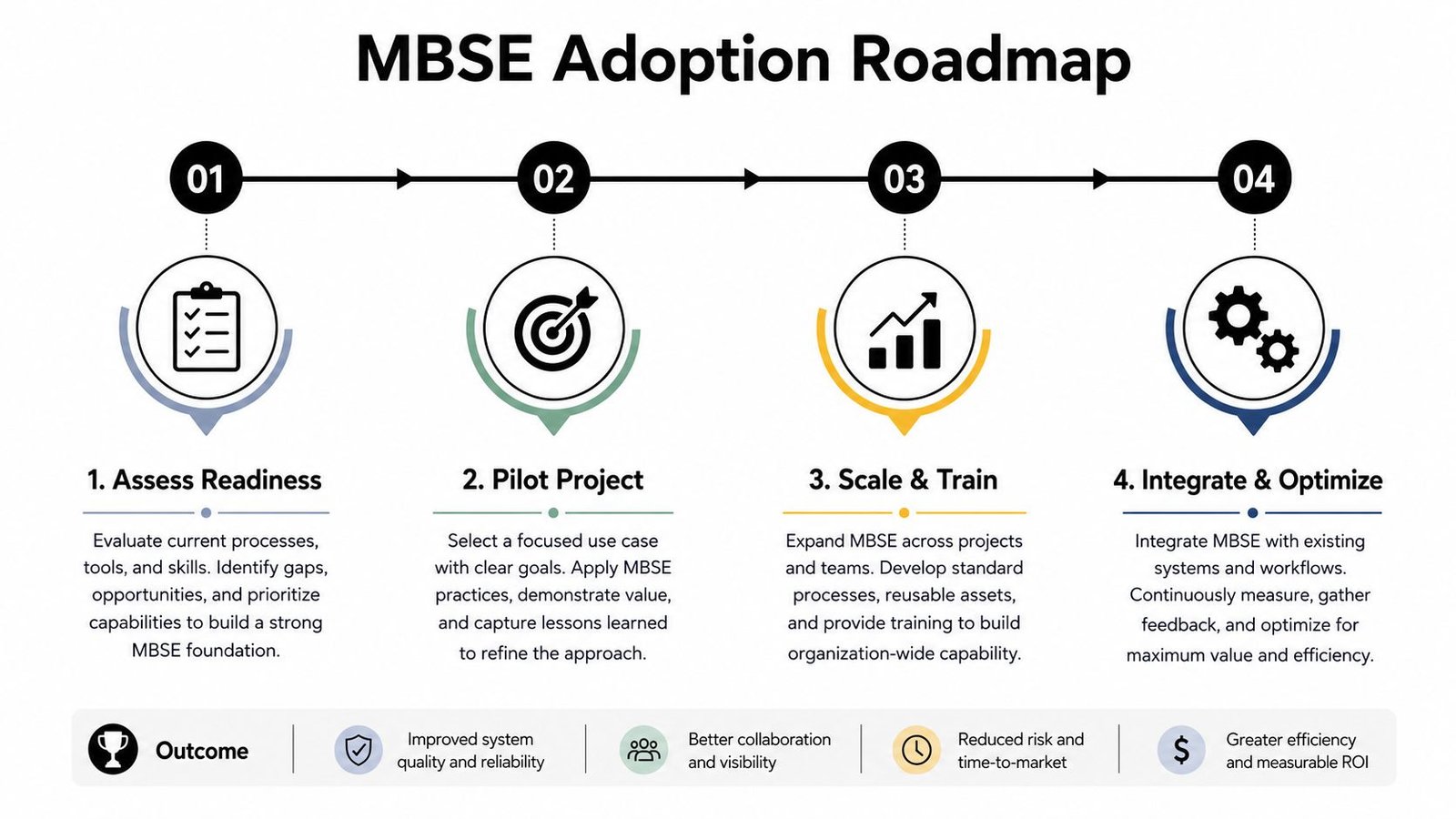
A workable MBSE rollout starts with a problem that hurts enough to justify change and small enough to manage without distracting the plant. A full enterprise rollout may look efficient in a presentation, but it usually burdens the people who have to build, review, and keep the model current. A phased rollout gives the organization time to learn while protecting production work.
Start with one pilot that matters
Pick one pilot project where the pain is already visible. A new semi-automated cell, a controls modernization, or a retrofit with a history of late changes are all good candidates. The pilot needs enough business value that the team cares, but it also has to stay contained so the model does not become a sprawling architecture exercise.
A strong pilot answers a narrow business question. Can the model trace a process requirement into a test case without forcing the team to rewrite every support document by hand? If it can, the pilot has already shown practical value.
Define the scope before you build
The biggest MBSE mistake is trying to model everything. That often produces a polished artifact that nobody wants to maintain, then confidence in the model drops fast. Scope should follow the decision the team needs to make, not technical enthusiasm.
A lean scope usually starts with the smallest useful system boundary, a few high-risk interfaces, and the verification points leadership wants to control. That approach fits the practical guidance in the brief, which notes that MBSE can be hard to adopt because of the upfront effort and the need to decide where it pays off first (SEI introduction to MBSE).
Choose tools for the workflow, not the other way around
Tool selection should start with the job the team needs to do. Some groups need a SysML-based architecture environment. Others need a lighter workflow tied to simulation, requirements management, commissioning support, or automation systems design. The commercial market has also grown into a real ecosystem, with estimates valuing the global MBSE market at about USD 4.49 billion in 2026 and projecting it to reach USD 17.77 billion by 2035, an estimated 16.5% CAGR over that period (MBSE market study).
The value lies in the fact that manufacturers now have more than one practical option, so they can choose based on fit instead of novelty.
- Fit the tool to the decision: Use the simplest platform that can handle the traceability and review needs of the pilot.
- Keep ownership clear: Someone has to maintain model quality, or the model will drift.
- Plan reuse early: If the model can support the next line upgrade, structure it that way from the start.
Integrate with existing processes carefully
MBSE works best when it fits into current engineering and quality workflows instead of competing with them. Connect it to requirements reviews, design gates, validation planning, and change control. Do not create a parallel process that nobody trusts. The model should become the place where decisions get checked, while the rest of the organization keeps using the formats it needs for approvals and execution.
Practical rule: if the team has to choose between doing the job and feeding the model, the adoption plan is too heavy.
Phased implementation also makes training more realistic. People learn the method by applying it to work that matters, not by sitting through a tool demo and hoping their habits change later.
MBSE in Action Real World Manufacturing Use Cases
A medical device manufacturer wants a new semi-automated assembly station. The engineering team needs to meet process requirements, define the operator interaction, and prepare verification evidence without turning the project into a documentation maze. MBSE gives them one connected place to link the GMP-sensitive requirements, the station architecture, and the tests that prove the design works.

New semi automated station for a medical device
The team starts by capturing the functional need, then allocates it to the station design and the control logic. Instead of writing a requirement in one file and hoping the test team finds it later, they trace the requirement to the fixture, the sensor logic, and the verification step. That structure helps quality teams review what changed and what still needs evidence.
MBSE fits well with digital twin thinking, especially when the model is used to test behavior before the equipment is built. INCOSE's Systems Engineering Vision 2035 points toward semantically rich, digitally linked model assets, and the latest review material in the brief notes that MBSE and digital twin integration looks promising but still raises open implementation questions (INCOSE vision material on digital twin based model assets). For a manufacturer, that means the model is most valuable when it informs design decisions before the first build, not after the machine is already on the floor.
Retrofit of an existing production line
A second manufacturer needs to retrofit an older line without missing delivery commitments. The proposed change affects a conveyor section, an inspection step, and a handoff point between stations. With a model in place, the team can review the interface changes, walk through the likely operational impact, and decide whether the retrofit should proceed as designed or be adjusted before hardware is ordered.
The advantage here is not abstract efficiency. It's the ability to expose conflict early, before the outage window gets consumed by debugging. The DTIC material on MBSE emphasizes simulation and system-level behavior as part of the method, which is why the same model can help a plant team discuss commissioning readiness, not just design intent (DTIC MBSE simulation source).
One more reason this matters for manufacturers is that line changes rarely stay inside one department. Operations wants uptime, quality wants evidence, engineering wants stable interfaces, and management wants a credible schedule. MBSE gives those groups a shared system view so the conversation stays about the change itself, not about which spreadsheet is right.
For teams exploring connected model strategies more broadly, the manufacturing use case aligns closely with digital twins for manufacturing, especially when the goal is to compare design intent with operational behavior before committing to physical changes.
Getting Started and Measuring Your ROI
The ROI question is the right question. MBSE has to earn its place beside other priorities, and that means tying the pilot to a measurable manufacturing outcome. The cleanest way to do that is to define one line problem, one model scope, and one or two operational metrics that leadership already cares about.
For many manufacturers, the first win is not dramatic transformation. It's fewer surprises in change control, a cleaner handoff into verification, or less friction during a controlled retrofit. Those are practical gains because they affect quality, schedule confidence, and engineering workload without asking the plant to reorganize around theory.
A solid business case starts with the pilot and ends with a review of what changed in the process, not just what changed in the drawing. If the model helped the team reach a decision faster, find a conflict earlier, or reduce rework in the build-up to commissioning, that's meaningful value. If it only created a prettier set of diagrams, the scope was too big or the governance wasn't strong enough.
The right partner matters here because MBSE only works when model discipline matches manufacturing reality. System Engineering & Automation helps manufacturers translate complex automation goals into practical, budget-aware solutions, from semi-automatic systems to integrated controls and commissioning support. If you're planning a production upgrade and want a grounded way to apply model based systems engineering to the work, visit System Engineering & Automation and start a conversation about the line you're trying to improve.